Passing your CDL test comes down to nailing two things: the written knowledge exam and the hands-on skills test. The secret isn't just cramming—it's having a solid game plan that tackles both so you're ready for any question or maneuver they throw at you.
Your Roadmap to a First-Time CDL Pass
Getting your Commercial Driver's License is your ticket into the trucking industry. It can feel like a huge mountain to climb, but when you break it down into smaller, manageable steps, it's absolutely doable. Think of this guide as your personal roadmap to passing the CDL test on the very first try.
The journey really boils down to two main challenges.
First, you've got the written knowledge exams. This is where you build the foundation, learning everything from traffic laws and safety rules to the nuts and bolts of complex vehicle systems. After that, you'll have to prove you can handle the rig in the real world during the hands-on skills test. This part covers the vehicle inspection, basic control maneuvers, and an on-road driving test.
Understanding the Core Components
Before you even crack open a book, you need to know exactly what you're up against. The first step is making sure you meet all the prerequisites. This means checking the age, medical, and residency rules in your area. You can get the full rundown by reviewing the specific CDL requirements for your state.
Once you know you're eligible, you can zero in on the test itself.
To give you a clearer picture, here’s a quick breakdown of what the CDL examination involves.
CDL Test Components at a Glance
| Test Component | What It Covers | Key Skills Required |
|---|---|---|
| Written Knowledge Exams | Multiple-choice questions on traffic laws, vehicle systems (like air brakes), and safety protocols. | Reading comprehension, memorization of regulations, and understanding mechanical concepts. |
| Hands-On Skills Test | A three-part practical exam: Pre-Trip Inspection, Basic Control Skills, and a Public Road Test. | Attention to detail, vehicle maneuvering (backing, turning), and safe driving in real traffic. |
As you can see, the two parts are designed to work together, testing both what you know and what you can do.
The secret to a first-time pass isn't just about logging hours; it's about having a deliberate plan for both the written and practical portions of the exam. A structured approach removes guesswork and builds confidence.
Ultimately, a strong performance in one area makes the other much easier. Truly understanding the "why" behind the air brake system from your studies makes the pre-trip inspection feel like second nature. Likewise, practicing your backing maneuvers over and over again reinforces the safety principles you read about.
If you approach your training with this dual focus, you'll be ready for anything the examiners have in store.
Cracking the CDL Written Knowledge Exams
First things first: the written exams are your gateway to getting behind the wheel. It's easy to think you can just cram the night before, but trust me, that's a recipe for frustration. The real key isn't just what you study, but how you study. A smart approach is what separates the drivers who walk in confident and walk out with a pass from those who end up back at square one.
Your state's official CDL manual is your bible. Seriously. Every single question on the test comes directly from that book. But just reading it like a novel won't cut it. You have to get active with the material.
Instead of just running a highlighter over a page, try this: after reading a section, close the book and try to explain the concept out loud or write a quick summary. Make flashcards for the nitty-gritty details, especially for the tricky stuff like the air brake system. This forces your brain to actually process the info, not just recognize it.
From Manual to Mastery
The written portion isn't just one big test. For a Class A license, you're guaranteed to face three core exams, on top of any special endorsements you might want later.
- General Knowledge: This is the big one. It covers a massive range of topics, from basic safety and traffic laws all the way to vehicle control principles.
- Air Brakes: You can't fake your way through this. You need a solid, in-depth understanding of how air brake systems work—the components, how to use them properly, and how to inspect them.
- Combination Vehicles: This exam zones in on the unique physics of driving a tractor-trailer. Think coupling and uncoupling, and managing dynamic forces like the "crack-the-whip" effect.
Passing these takes more than a quick skim of the manual; you need a game plan. For a really detailed breakdown of the biggest test, you should check out our guide on the General Knowledge test. Getting specific with your prep here pays off big time.
Using Practice Tests the Smart Way
Online practice tests are gold, but only if you use them correctly. Their real value isn't just seeing if you can pass—it's pinpointing exactly where you're weak.
After you take a practice test, don't just glance at the score. Go back and review every single question you missed. Figure out why you missed it. Did you just forget a number, or do you fundamentally not understand the concept? If you keep getting tripped up by questions on air brake lag time, that's a huge red flag telling you to go back to that chapter in the manual and hit it again until it makes sense.
Treat practice tests like a conversation with the material. They aren't just for checking your score; they're for revealing exactly where you need to focus your energy for the biggest improvement.
This turns studying from a random guessing game into a targeted mission. It also gets you used to the way the questions are worded on the real exam, which can be half the battle.
How to Tackle the Tough Stuff
Let's be honest, some parts of the CDL manual are dense. When you hit a section that feels like a wall of text, your job is to break it down into smaller, bite-sized pieces.
Take the pre-trip inspection, for example. Don't try to memorize all 100+ items in one go. You'll drive yourself crazy. Instead, compartmentalize it.
- Engine Compartment: First, just focus on everything under the hood—fluids, belts, hoses.
- In-Cab & Engine Start: Next, master the routine inside the cab. Learn the sequence for checking gauges, lights, and running your air brake tests.
- The Walk-Around: Finally, learn the flow for the exterior inspection, moving logically from the front of the truck, to the coupling system, and all the way around the trailer.
By tackling it in chunks, you're building a mental map that's much easier to follow when you're feeling the pressure of test day. This strategy works for any heavy topic, whether it's hazmat rules or the physics of stopping distance.
Ultimately, the quality of your training program is a huge factor. The first-time pass rate is a strong signal of how effective a school’s instruction is. While official national numbers are elusive, most solid CDL schools aim for pass rates north of 70%, with the really top-tier programs seeing over 90% of their students pass on the first attempt.
Dominating the Hands-On Skills Test
Once you’ve conquered the written exams, it’s time to prove your skills where it really counts: behind the wheel. The hands-on skills test is the final gatekeeper, and it's not just one test but three distinct challenges rolled into one. Each part is designed to see if you have the competence and safety awareness to handle real-world situations.
This isn’t just about driving. It’s about showing an examiner you have complete command of your vehicle. You'll be evaluated on your pre-trip inspection, your basic control skills in a closed yard, and finally, your performance on a public road. Think of it as a performance where consistency and precision are everything.
Mastering the Pre-Trip Inspection
Believe it or not, the pre-trip inspection is where many students lose the most points. It’s easy to miss a step or rush when you’re nervous. The examiner wants to see a systematic, repeatable method for checking every critical component. Trying to memorize a list of over 100 items is a recipe for disaster; you need a flow.
The best strategy I've seen is to break the inspection down into manageable zones.
- Engine Compartment: Pop the hood and start there. Check your fluid levels (oil, coolant, power steering), hunt for any leaks, and give the belts and hoses a good look for cracks or wear.
- In-Cab and Engine Start: Next, get in the cab. Run through your gauges, check your safety equipment, and then perform the full air brake test sequence—static, applied, and low-pressure warning. The order here is critical.
- The Full Walk-Around: Start at the driver's side front wheel and work your way around the entire rig in a consistent pattern. At each stop, check tires, brakes, suspension, lights, and reflectors. When you hit the coupling system, make sure everything is locked down and secure before moving to the trailer.
This zone-based approach turns a massive task into a simple, repeatable routine. You can dig deeper into building a foolproof method with our in-depth guide on the pre-trip inspection. Having a solid system builds the muscle memory you need to perform perfectly, even with an examiner's clipboard tracking your every move.
An examiner isn't just looking for you to name parts; they are verifying that you understand why each component is critical to safety. Explaining the function of what you're checking shows true mastery.
Perfecting Your Basic Control Skills
After the inspection comes what most people call "yard work." This is a raw test of your ability to maneuver a huge vehicle in tight spaces. You'll be asked to perform several backing maneuvers, which could include straight-line backing, offset backing, or the dreaded parallel park.
The secret here is simple but not easy: practice. These maneuvers are about inches, not feet. Bumping a cone or crossing a boundary line is often an automatic fail, so precision is non-negotiable.
Here’s where most people struggle and how to fix it:
- Over-Steering: Small, slow adjustments are your best friend. A tiny turn of the steering wheel has a massive effect on the back of the trailer. Make a small correction, straighten out, and see what the trailer does before you correct again.
- Losing Sight of the Trailer: Use your mirrors constantly. Before you even start, make sure they’re set up perfectly so you can see your trailer wheels and the boundary lines. Don't be afraid to Get Out And Look (G.O.A.L.). It’s much better to take a moment to re-evaluate than to fail the maneuver.
- Rushing the Process: Nerves make you want to go faster, which is the worst thing you can do. Go slow. The slower you move, the more time you have to react and make those tiny corrections.
Building a consistent study habit is one of the biggest predictors of success, for both the written tests and these hands-on skills. This visual flow shows a simple but powerful way to structure your practice.
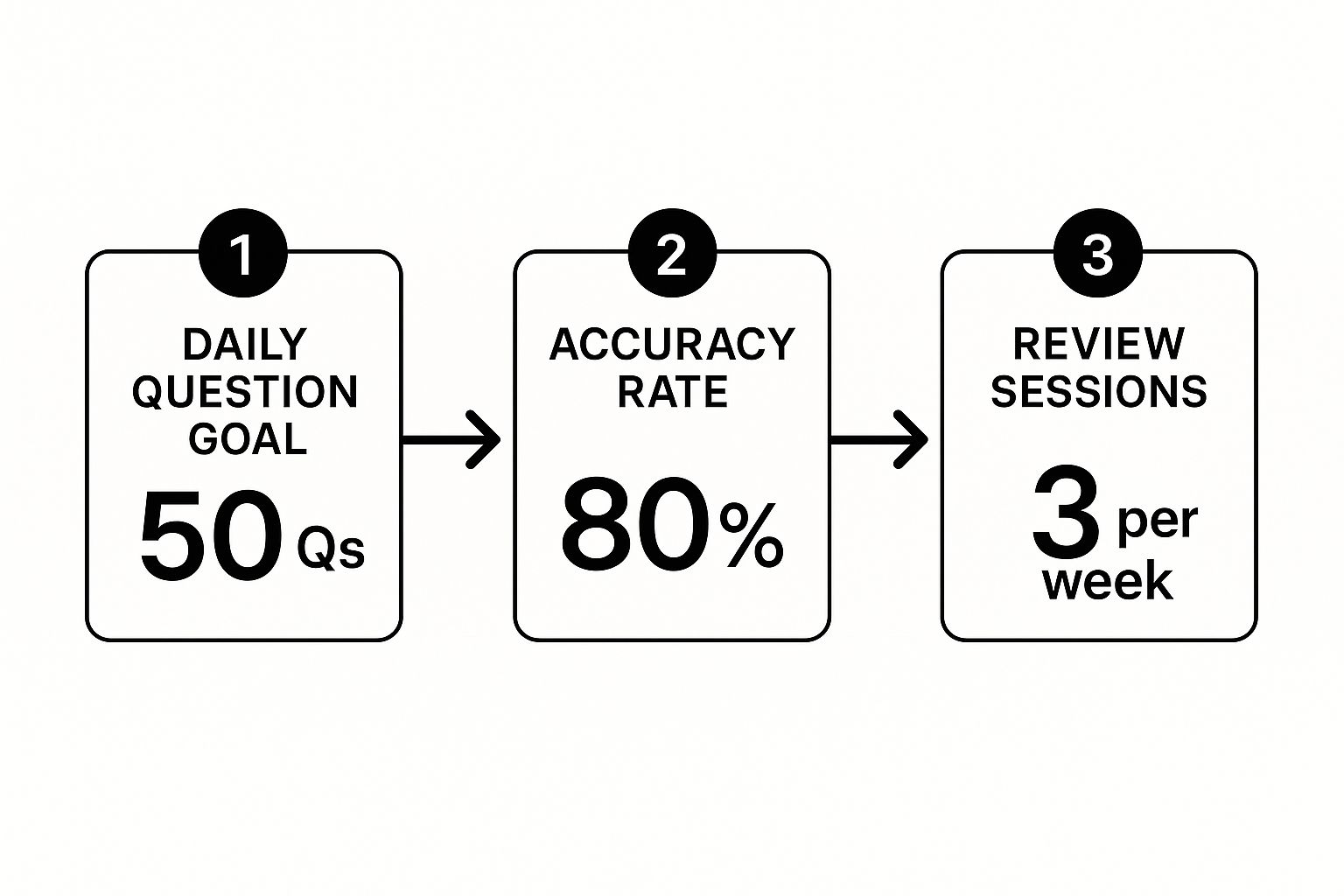
The image breaks it down perfectly: set daily goals, track your accuracy, and schedule regular reviews. This creates a feedback loop that helps you improve way faster.
Acing the Public Road Test
The final piece of the puzzle is the road test. Out in real traffic, the examiner is watching to see if you can operate the vehicle safely and legally. They're looking for more than just your ability to stay in your lane; they’re sizing up your overall awareness and decision-making skills.
Examiners pay extremely close attention to how you manage your space, speed, and especially your turns. A classic mistake is the "right turn squeeze," where a driver cuts the corner too tight and the trailer tire climbs the curb. To nail your turns, you have to pull far enough into the intersection to give your trailer the room it needs to clear the corner without issue.
They will also be watching for:
- Constant Mirror Checks: Your head needs to be on a swivel. A good rule of thumb is to check your mirrors every 5-8 seconds to stay aware of what’s happening all around your rig.
- Proper Lane Management: Keep your truck centered. It shows you have control and a true understanding of your vehicle's footprint on the road.
- Smooth Acceleration and Braking: Jerky starts and stops are a huge red flag. They tell the examiner you aren't anticipating traffic conditions far enough ahead.
- Correct Gear Selection: You need to show that you can choose the right gear for the situation, especially when navigating hills or slowing down for an intersection.
While regulations vary, the need for extensive training is universal. The difficulty and pass rates for commercial driving tests differ widely from country to country, but one thing holds true. In the United States, data shows that the most successful students log between 100 and 150 hours of behind-the-wheel instruction before taking their CDL test—way more than the minimum federal requirement. This focus on practical, hands-on training is what makes the difference when it comes time to pass the on-road exam.
Choosing the Right CDL Training Program
The single biggest factor in passing your CDL test on the first try is the quality of your training. Let me be blunt: not all schools are created equal. The right program does more than just drill you on test answers; it builds the real-world confidence and muscle memory you need to perform when an examiner is sitting in the passenger seat.
Making a smart choice here is the first real investment you'll make in your trucking career. You're looking for a school that prepares you for the realities of the road, not just the exam. This means you have to look past the price tag and dig into what they actually offer.

Comparing Different Training Models
When you start your search, you'll quickly see there are a few different ways to get your training. Each one has its pros and cons, and the best fit really depends on your budget, timeline, and how much flexibility you want in your first job.
- Private CDL Schools: These are the specialists. They live and breathe commercial driver training, often offering fast-track programs and lots of scheduling options. They can also be the most expensive choice upfront.
- Community College Programs: Many local community colleges run excellent CDL courses. They’re often more affordable and sometimes covered by financial aid. The trade-off? They usually move at a slower pace, sometimes lasting a full semester.
- Company-Sponsored Training: This is the "earn while you learn" model. A large trucking company pays for your training, and in return, you commit to driving for them for a set period—usually about a year. It's a low-cost way to get started, but you're locked in with that first employer.
You really have to weigh the upfront cost against the long-term reality. Spending more on a top-notch private school might mean a higher first-time pass rate and better job offers right out of the gate.
Key Questions to Ask Any CDL School
Before you even think about signing on the dotted line, you need to put on your investigator hat. Think of it like a job interview, but you're the one asking the tough questions. A good, reputable school will have no problem giving you straight answers.
Don't be afraid to get on the phone with their admissions team with a list of questions ready to go. Here are the absolute must-asks:
- What's your instructor-to-student ratio for the behind-the-wheel portion? You want to hear 1:1. You're paying for seat time, not to be one of four students crammed in a cab, watching someone else drive.
- How many actual hours will I spend driving the truck on the road? Get a specific number of clock hours. Vague answers like "miles driven" don't cut it. A solid program should provide 40-50 hours or more of real on-road training.
- Can you give me your verifiable first-time pass rate for the state CDL exam? Good schools are proud of their pass rates and track them carefully. If they get dodgy or won't provide a number, that's a huge red flag.
- Is your school listed on the FMCSA's Training Provider Registry? This is non-negotiable. As of 2022, federal law requires all new drivers to train at a registered school to even be eligible for the CDL test. You can get the full rundown on these rules by learning about the Entry-Level Driver Training (ELDT) requirements.
Choosing a school is your first major decision as a professional driver. The right program provides not only the skills to pass the test but also the foundational safety habits that will protect you throughout your career.
Getting clear answers to these questions will tell you everything you need to know. It helps you cut through the glossy brochures and make a decision based on facts, not marketing hype. The program you choose truly sets the stage for your entire career in this industry.
Essential Tips for Test Day Success
All that time you spent buried in the CDL manual and perfecting your backing maneuvers—it all comes down to test day. How you handle these final hours is just as crucial as the weeks you spent studying. Getting your head in the right space can easily be the thing that separates a pass from a frustrating retake.
First things first: the night before your test is absolutely not the time to cram. Your brain needs a break to process and store everything you’ve learned. Seriously, aim for a solid 7-8 hours of sleep. It’s probably the single best thing you can do to walk into that testing center feeling sharp, not stressed and exhausted.
Your Test Day Morning Routine
When you wake up, the mission is to keep things calm and organized. Start with a real breakfast—think protein and complex carbs like eggs and whole-wheat toast. That’ll give you steady energy, helping you avoid the jittery crash that a sugary cereal or, even worse, an empty stomach will bring on.
Before you even think about leaving, lay out every single document you need. Go through the checklist from your state's DMV one last time.
- Your valid driver's license
- Your Commercial Learner's Permit (CLP)
- Proof of residency (utility bill, etc.)
- Your DOT Medical Card
There is no worse feeling than that jolt of panic when you realize a critical piece of paper is sitting on your kitchen counter. Getting this squared away early eliminates a huge, totally avoidable stressor. If you're unsure about what's needed, you can review our guide on the CDL permit process.
Managing Nerves and Staying Focused
Look, a few butterflies are normal. The trick is not letting them fly the truck. When you feel that anxiety building, just stop for a second. Take a slow, deep breath in for four counts, hold it, and then let it out slowly for six counts. A few of those can work wonders to slow your heart rate and clear your head.
During the actual test, especially the skills portion, force yourself to stay in the moment. Don't worry about the maneuver you just botched or the one that's coming up next. Just focus on the task right in front of you.
A positive mindset makes a real difference. Instead of letting your brain say, "Don't screw this up," actively tell yourself, "I've done this a hundred times. I know what to do." That inner voice can be your best co-pilot.
This kind of mental prep is especially vital for drivers from outside North America. The Federal Motor Carrier Safety Administration (FMCSA) only recognizes commercial licenses from Canada and Mexico. If you're from any other country, you have to get a U.S. CDL from scratch by passing both the knowledge and skills tests—your international experience won't get you a pass. This policy really highlights how important it is to master the U.S. testing format.
Ultimately, walking in calm, prepared, and confident gives you the best shot at showing the examiner the skilled driver you've worked so hard to become.
Got Questions About Passing the CDL Test?
Even with the best preparation, you're going to have questions as you work through your CDL training. It’s completely normal. Getting answers to the most common ones can help you know what to expect and keep your eyes on the prize.
Let's cut through the noise and tackle the questions I hear most often from new drivers.
How Much Time Should I Really Spend Studying?
There’s no one-size-fits-all answer here. It really boils down to how you learn and what kind of training you're in. If you're in a full-time school, you're looking at an intense 3 to 7 weeks, cramming in everything you need to know. Part-time programs, on the other hand, can stretch out over a few months, which is great if you're juggling a job.
Now, if you're studying on your own for the written permit test, focus on consistency. A solid 4 to 8 weeks of dedicated, daily effort is usually enough to get you ready. But let's be honest—the real hurdle is the skills test. Nothing replaces actual time behind the wheel. You need to practice until the maneuvers feel like breathing. That’s where real confidence comes from.
Where Do People Go Wrong on the Skills Test?
You’d be surprised how many people fail the test before they even start the engine. The pre-trip inspection is a massive hurdle. It’s so easy to get nervous and forget to check a critical component like the air brakes, a tire, or your coupling system. That’s a quick way to rack up points against you right out of the gate.
When it comes to the backing maneuvers, the rules are black and white. Hitting a cone or crossing a boundary line? That's an instant fail for that maneuver. They don't give you any wiggle room.
Once you’re out on the road, the examiner is watching for a few common mistakes that scream "rookie":
- Cutting Corners: Not pulling far enough forward into the intersection on a right turn. Next thing you know, your trailer tires are hopping the curb.
- Forgetting Your Mirrors: If you aren't constantly scanning your mirrors, you're not situationally aware. It’s a huge red flag for examiners.
- Sloppy Lane Changes: Failing to signal properly or not checking your blind spots thoroughly before moving over is a critical error.
Nerves are the root cause of almost all these mistakes. The best way to beat them? Practice. Practice until your pre-trip inspection is a script you know by heart and your backing is pure muscle memory.
When you can execute without having to think through every single step, anxiety doesn't stand a chance. That’s what showing true competence looks like.
What if I Fail the CDL Test?
First things first: don't panic. Failing the CDL test is a setback, not a career-ender. Plenty of great drivers didn't pass on their first try.
What happens next depends entirely on your state's rules. You'll almost certainly have a mandatory waiting period before you can retest. For a written exam, it might just be a day. For the skills test, expect to wait a week or more, giving you some time to get back in the truck and practice. You'll also have to pay the testing fees again for each attempt.
Your first move should be to check your state's DMV website for their specific policies. Then, use that waiting period like a pro. Don't just drive around aimlessly. If the examiner failed you on the offset back, that’s what you practice. Drill that single maneuver over and over until you can do it in your sleep.
Ready to stop worrying about the test and start your career? Patriot CDL provides the expert, hands-on training you need to pass with confidence and get on the road fast. Learn more about our CDL programs.