For any commercial driver, getting the right certifications is a big deal, and the tanker endorsement is a prime example. This critical add-on to your CDL, officially known as the 'N' endorsement, is your ticket to hauling large volumes of liquid or gaseous materials. But it's not just for the classic, shiny fuel tankers you see on the highway.
Let's break down who really needs this endorsement and why it’s so important for opening up new career paths.
What Is a Tanker Endorsement and Who Needs One?
Simply put, a tanker endorsement is a certification on your Commercial Driver's License (CDL) that shows you have the specific knowledge to safely handle a commercial vehicle loaded with bulk liquids or gasses. And we're talking about a huge range of cargo here—everything from milk and juice to industrial chemicals and, of course, gasoline.
The real reason for all this special training boils down to one powerful and potentially dangerous force: liquid surge.
Think about carrying a shallow pan of water across a room. If you stop or turn suddenly, the water sloshes violently, and you have to fight to keep it from spilling. Now, imagine that force multiplied by thousands of gallons inside a massive trailer. That surge can shove your truck around, making it difficult to brake, turn, and maintain stability. It's a game-changer, and that’s why getting the right training isn't just a suggestion—it's a critical safety requirement.
So, What Counts as a Tank Vehicle?
The federal government is very specific about what defines a "tank vehicle." You'll need to get that 'N' endorsement on your license if the vehicle you're driving meets either of these criteria:
- It has a single tank permanently or temporarily attached with a capacity of more than 119 gallons.
- It has multiple tanks that, when added together, have a total capacity of 1,000 gallons or more.
This definition catches a lot of drivers by surprise. It's not just about traditional tanker trucks. If you’re a dry van or flatbed driver hauling large liquid totes or intermediate bulk containers (IBCs), you could easily cross these thresholds and legally need a tanker endorsement.
The table below provides a quick cheat sheet for when the N endorsement becomes a legal necessity.
When a Tanker Endorsement Is Required
| Requirement Category | Description |
|---|---|
| Single Tank | Any tank, permanently or temporarily attached, with a rated capacity of more than 119 gallons. |
| Aggregate Capacity | Multiple tanks on a vehicle with a combined capacity of 1,000 gallons or more. |
| Material Type | Applies to both liquid and gaseous materials transported in bulk. |
Understanding these rules is key, whether you're driving a dedicated tanker or just occasionally hauling liquid totes.
You might be wondering where these rules came from. The Federal Motor Carrier Safety Administration (FMCSA) actually clarified the definition of a "tanker" vehicle between 2011 and 2015. This update effectively widened the net, bringing more drivers under the requirement for the endorsement.
After a bit of confusion and some delays at the state level, the FMCSA put its foot down and set a final deadline, making the N endorsement mandatory nationwide by July 2015. The goal was simple: improve highway safety by making sure any driver dealing with the unique challenges of liquid surge has been properly trained and tested.
Checking Your Eligibility and CDL Prerequisites
Before you can even think about adding a tanker endorsement, you’ve got to make sure your foundation is solid. Think of it this way: you can't build a second story onto a house that doesn't have a first floor. The tanker "N" endorsement isn't a license on its own; it’s an add-on that proves you have specialized skills beyond basic truck driving.
First thing's first: you absolutely must have a valid Class A or Class B CDL. This is the mandatory starting point, no exceptions. Your CDL is the baseline, proving you already know how to handle a large commercial vehicle safely on the road.
Foundational Driver Qualifications
Holding the right class of CDL is just the beginning. You also have to meet a handful of personal and professional standards that show you’re fit for the job and ready for the responsibility.
Here's a quick rundown of what you'll need:
- Age Requirements: You have to be at least 21 years old to drive a commercial vehicle across state lines (interstate commerce).
- Medical Fitness: A current Department of Transportation (DOT) medical card is a must. This is your proof that you're physically healthy enough for the demands of the job.
- Clean Driving Record: A spotty driving history with serious violations can stop you in your tracks.
That last point about your driving record is a big one. Things like DUIs, hit-and-runs, or a pattern of reckless speeding can get you disqualified right away. States are strict about this because public safety is on the line. To see the full checklist, it’s a good idea to review the complete list of general CDL requirements and make sure you have all your ducks in a row.
Think of the tanker endorsement as a specialization. It takes the skills you proved by earning your CDL and adds a new layer of expertise for handling the unique challenges that come with hauling liquid cargo.
Background Checks and Security Clearances
A standard background check is already part of getting your CDL. For the tanker endorsement alone, you might not need another one. But let's be realistic—most tanker jobs involve hauling something that's considered hazardous material.
If you plan to get your Hazardous Materials (H) endorsement, which is often paired with the N endorsement to create the highly valuable "X" endorsement, you'll need to pass a TSA Security Threat Assessment. This isn't your average background check. It's a comprehensive federal screening that involves fingerprinting and a deep dive into your criminal and immigration history. It's a crucial step for anyone who will be trusted with hauling potentially dangerous loads like gasoline, industrial chemicals, or other sensitive materials.
Getting all of this sorted out before you start the process will save you a world of headaches and make sure you don't hit any unexpected roadblocks down the line.
Passing the Tanker Endorsement Knowledge Test
Getting through the written knowledge test is the main hurdle you'll face when adding a tanker endorsement to your CDL. This isn't just about rote memorization; it's about getting a real feel for the physics involved in hauling thousands of gallons of liquid. Once you truly understand these concepts, you'll walk into the DMV feeling ready to ace it on your first try.
The exam is designed to test your grasp of the "why" behind every rule. You have to understand how the immense forces sloshing around inside a tank can seriously impact your truck's stability, how it brakes, and the way it handles on the road.

Core Concepts You Must Master
Success on the tanker knowledge test really boils down to a handful of critical topics. These ideas are the foundation of safe tanker driving, and you can bet you'll see them on your exam. If you get a solid handle on these, you'll be in great shape.
- Liquid Surge and Dynamics: This is the big one. You absolutely have to understand how that liquid slams forward when you brake and sloshes back when you accelerate. That movement can push your truck around in ways you wouldn't expect.
- High Center of Gravity: Tankers are notoriously top-heavy compared to a standard dry van. This makes them much more likely to roll over, especially when you're navigating curves or taking an off-ramp.
- Baffles and Bulkheads: Get the difference straight between these two. Baffles have holes in them to slow down the liquid surge, while solid bulkheads are walls that create completely separate compartments in the tank.
- Outage and Ullage: These terms refer to the empty space you have to leave at the top of a tank. You'll need to know why leaving this room for liquid to expand (outage) is so important for preventing a tank rupture when temperatures change.
- Special Driving Procedures: The test will hit on specific techniques for managing your speed on curves, what to do on slick roads, and why you need a much bigger following distance than you might think.
The whole point of the testing process is to make sure you're prepared for the unique dangers that come with hauling liquids and gases. You're dealing with serious risks, from the massive push of liquid surge to that high center of gravity just waiting to tip you over.
Real-World Scenarios and Study Tips
The best way to make these concepts stick is to visualize them. Picture yourself driving a half-full tanker—one with no baffles—down a steep hill. As you tap the brakes for a curve, thousands of pounds of liquid crash toward the front of the tank. That surge pushes your whole rig forward, making you go faster than you want and fighting your steering. That's the kind of practical, on-the-ground understanding the test is looking for.
Your state's official CDL manual is your bible for this test. Stick to the tanker section like glue, because every single question on the exam comes directly from that material. Don't get sidetracked by unofficial study guides alone.
As you prepare, use practice tests to find your weak spots. A lot of drivers get tripped up by the questions on outage calculations or the specific dangers of smoothbore (unbaffled) tanks. Hammer those topics until you know them inside and out. For some great foundational tips on test-taking, you can find guides on tackling the general CDL knowledge test.
Understanding the Test Format
The tanker endorsement knowledge test is usually made up of 20-30 multiple-choice questions. The magic number to pass is typically 80%. While the exact number of questions and the passing score can shift a little from state to state, that 80% mark is the industry standard.
Make sure you read every question slowly and carefully. They love to throw in tricky questions with small details that change the whole meaning. Take a breath, rule out the answers that are obviously wrong, and then pick the one that represents the safest way to operate, according to your CDL manual. Passing this test shows you’ve got the knowledge to handle the complex and demanding job of hauling liquid freight.
Navigating State Rules and Application Paperwork
While the federal government (specifically the FMCSA) sets the big-picture rules for tanker endorsements, your state’s DMV is where the rubber really meets the road. Think of it this way: the feds create the blueprint, but your local DMV is the crew on the ground pouring the concrete and putting up the walls. This means you’ll find small but critical differences in the process from one state to the next.
These variations usually pop up in the administrative details. The cost to add the endorsement, for instance, can be all over the map. One state might only charge a $15 processing fee, while another could have a higher price tag that includes the cost of printing a whole new CDL. Even renewal schedules can differ, so it's a smart move to know your state's specific timeline.

Your Universal Paperwork Checklist
Nobody wants to make a second trip to the DMV. To make sure your first visit is the only one, you need to walk in with every single piece of required paperwork. Always give your local DMV's website a final look before you go, but this checklist covers the essentials you'll need almost anywhere.
- Your Current Commercial Driver's License (CDL): This is your starting point. You can't add an endorsement without a valid Class A or Class B CDL.
- Proof of Identity and Residency: Be ready with documents like your Social Security card, birth certificate, or passport, plus a utility bill or lease to prove you live where you say you do.
- Valid DOT Medical Card: Your medical examiner's certificate needs to be up-to-date and properly filed with your state licensing agency.
- Proof of Passing the Knowledge Test: The DMV will either hand you a certificate or update your file on the spot once you ace the tanker knowledge test.
These state-level rules are exactly why a little bit of prep work goes a long way. For example, you can see how the process is applied by looking into the specific CDL requirements in different states.
Demystifying the TSA Security Threat Assessment
If you plan on hauling hazardous materials—which many tanker drivers do—you’ll have to clear a TSA Security Threat Assessment (STA). This is a non-negotiable step for getting a HAZMAT (H) endorsement, which often goes hand-in-hand with the tanker endorsement.
The STA is a deep-dive background check run by the Transportation Security Administration. The goal is simple: to make sure that anyone with access to potentially dangerous cargo doesn't pose a threat to national security.
This isn't your average background check; it's a more rigorous process with a few distinct steps.
- Submit an Online Application: First, you’ll head to the TSA's Universal Enrollment Services (UES) website to fill out the initial application.
- Schedule an In-Person Appointment: Once the application is in, you'll book a time at an approved enrollment center to get your fingerprints taken.
- Provide Biometric and Biographic Information: At the appointment, they’ll scan your fingerprints and verify your identity with official documents.
- Await Approval: The TSA then does its thing. The full assessment can take anywhere from a few days to a few weeks, so it’s smart to get this process started early.
Once you get the all-clear from the TSA, you can move forward with the HAZMAT endorsement. Getting through your state's paperwork and the federal security check is the last major hurdle before you can officially add that valuable "N" to your CDL.
Unlocking Opportunities With The Combined X Endorsement
For drivers who really want to maximize their earning potential, the "X" endorsement is the gold standard. This isn't a separate, standalone endorsement. Think of it as a powerful two-for-one deal: it combines the Tanker (N) and Hazardous Materials (H) endorsements into a single, top-tier credential.
When you have that "X" on your license, it tells companies you’re a highly skilled, versatile, and trusted professional. It opens up a whole new world of freight, and frankly, that’s where the better-paying jobs are. We're talking about specialized loads like gasoline, industrial chemicals, and other sensitive materials that are off-limits to drivers without the right qualifications.
What the X Endorsement Adds
Getting the X endorsement means you have to tackle everything required for the tanker endorsement and then add the much stricter criteria for the HAZMAT side. This definitely involves a few more hoops to jump through than just getting the N endorsement alone.
The biggest hurdle is the mandatory TSA Security Threat Assessment (STA). This isn't your average background check; it’s a deep dive required by the federal government for anyone hauling hazardous materials. On top of that, you’ll have to pass a completely separate HAZMAT knowledge test.
The HAZMAT exam gets into critical safety details that the tanker test never touches. You’ll be tested on complex topics like proper placarding, understanding hazard classes, creating security plans, and knowing the right emergency procedures for a spill or leak.
Here’s a simple way to think about it: the N endorsement is all about the physics of hauling sloshing liquids, while the H endorsement is about the chemistry and security of the cargo itself. The X endorsement makes you an expert in both.
The image below breaks down what you'll face on the standard tanker exam, which is the first piece of the X endorsement puzzle.
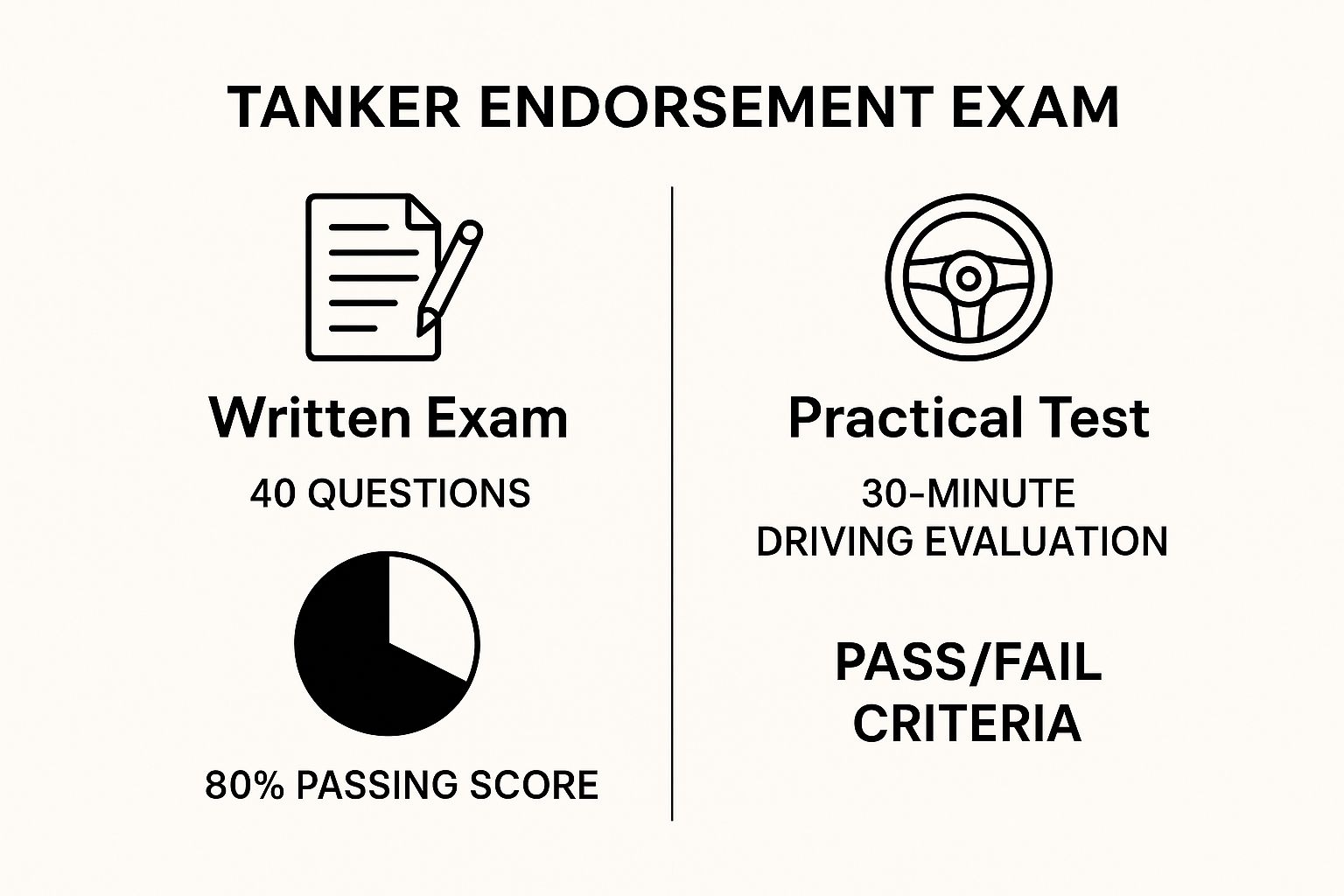
As you can see, the tanker portion itself requires a solid grasp of the material for the written exam and a practical skills evaluation—these are the building blocks for getting your combined endorsement.
Comparing N, H, and X Endorsement Requirements
So, which path is right for you? It really comes down to your career goals. Do you see yourself hauling non-hazardous liquids like milk or water? Or are you aiming for the more lucrative world of fuel and chemical transport? To help you decide, let's break down exactly what each endorsement involves.
The following table gives you a side-by-side look at the requirements, tests, and career benefits you can expect from the N, H, and X endorsements.
| Feature | N Endorsement (Tanker) | H Endorsement (HAZMAT) | X Endorsement (Combined) |
|---|---|---|---|
| Primary Focus | Safe handling of liquid surge and vehicle dynamics | Safe transport, placarding, and security of hazardous materials | Both liquid dynamics and HAZMAT protocols |
| Knowledge Test | Tanker-specific written exam (20-30 questions) | HAZMAT-specific written exam (30+ questions) | Must pass both the Tanker and HAZMAT exams |
| TSA Background Check | Not required | Required (Security Threat Assessment) | Required (Security Threat Assessment) |
| Typical Freight | Milk, water, non-hazardous industrial liquids | Packaged chemicals, explosives, compressed gases | Gasoline, propane, liquid chemicals, hazardous waste |
| Career Advantage | Access to tanker jobs for non-hazardous freight | Access to dry van, flatbed, or LTL HAZMAT freight | Maximum versatility and access to the highest-paying jobs |
As you can see, the requirements build on each other, with the X endorsement representing the peak of qualification and opportunity.
Ultimately, going for the X endorsement is a smart investment in your driving career. It takes more work upfront, there's no doubt about it. But the payoff is huge: more job security, higher paychecks, and the freedom to haul almost any liquid or hazardous load out there. For drivers who want to be at the top of their game, the combined X endorsement is the clear winner.
And if you’re getting ready for these exams, brushing up on the fundamentals with a combination vehicles practice test can give you a strong foundation for understanding how these complex rigs behave on the road.
Common Questions About Tanker Endorsements
When you're wading through the rules and regulations, it's natural to have a few questions pop up. Let's tackle some of the most common things drivers ask about getting their tanker endorsement so you can move forward with confidence.
How Long Is a Tanker Endorsement Valid?
This is one of the simpler parts of the process. Your tanker (N) endorsement is tied directly to your Commercial Driver's License—it doesn't have its own expiration date.
When it's time to renew your CDL, the tanker endorsement renews right along with it. Just meet your state's standard renewal requirements, and you're good to go. This is a nice contrast to the HAZMAT (H) endorsement, which has a separate TSA Security Threat Assessment renewal every five years. The N endorsement just follows your CDL's lead.
What Are the Typical Costs Involved?
Getting your tanker endorsement is usually pretty affordable, but the exact costs can shift a bit from one state to another. Generally, you can expect to run into a few small fees.
- Test Fee: Most states charge a small fee to take the written knowledge test, usually somewhere between $10 to $25.
- Endorsement Fee: This is the one-time fee for officially adding the endorsement to your license, often ranging from $15 to $50.
- License Reprint Fee: Some DMVs might also charge you for the physical cost of printing a new CDL with the "N" on it.
Your best bet is to check your local DMV's website for an up-to-date fee schedule. That way, there are no surprises when you show up.
What Happens If I Fail the Knowledge Test?
Don't sweat it—failing the knowledge test isn't the end of the line. Every state allows you to retake the exam, though you'll likely have to wait a bit, often just one business day, before your next shot. You'll probably have to pay the test fee again for each attempt.
Think of a failed test as a valuable learning experience. Find out what your score was and really zero in on the areas where you struggled. The test is all about safety and understanding the unique physics of hauling liquids, so mastering that material is what truly matters.
It’s a lot like how maritime authorities handle sea captains hauling dangerous cargo. Agencies like the Australian Maritime Safety Authority (AMSA) demand extensive sea time, specialized training, and competency certificates to guarantee safety on the water. The CDL system mirrors that same focus on proven skill, making sure drivers have the right knowledge before they ever hit the road.
Key Takeaway: The whole point of the endorsement process is to make sure you're ready for the unique challenges of driving a tanker. From understanding liquid surge to knowing your vehicle inside and out, every step is designed to build the skills for a safe and successful career.
Speaking of vehicle checks, getting your routine down cold is a game-changer for any commercial driver, but it's especially critical when you're hauling a dynamic liquid load. A perfect inspection confirms your rig is ready for anything, and a good guide on the pre-trip inspection gives you a detailed checklist to nail it every single time.
Ready to launch your trucking career or add a valuable endorsement to your license? Expert, hands-on training can get you on the road quickly. Learn more about accelerated programs from a certified CDL school.