Think of this CDL general knowledge study guide as the first tool you'll pick up on your way to a long and successful career as a commercial driver. Passing this test is your first big hurdle, and it’s a crucial one. It covers the absolute essentials of safety, vehicle handling, and the rules of the road—the bedrock on which all your other professional skills will be built.
Your Roadmap to a Commercial Driving Career
The path to getting your Commercial Driver's License (CDL) can seem intimidating, but every journey starts with a single step. For you, that step is acing the General Knowledge test. This guide is here to be your co-pilot, showing you exactly what’s on the test and how to prepare without getting bogged down. Earning that license is more than just a piece of plastic; it's your ticket into a secure, in-demand field.
Right now, the demand for qualified truck drivers is through the roof. The U.S. is facing a massive driver shortage, thanks to a wave of retirements and the non-stop growth of online shopping. What does that mean for you? It means real job security and a solid paycheck. Many drivers starting out can expect to earn between $50,000 and $65,000 in their first year.
Why This Test Matters
The General Knowledge exam isn't just a trivia quiz. It’s about deeply understanding the principles that will keep you, your truck, and everyone on the road around you safe. When you pass, you’re not just showing you can remember facts; you’re proving you have the fundamental knowledge to handle a large, complex vehicle with professionalism and care.
Passing this test is the mandatory first step. You can't even think about getting behind the wheel for training until you've proven you understand these core concepts. A great place to start is by checking the specific CDL requirements in your state, since there can be small differences from one state to the next.
The General Knowledge test is the gatekeeper to your commercial driving career. It ensures every new driver has the essential safety and operational knowledge before getting behind the wheel of an 80,000-pound vehicle.
What to Expect in This Guide
We've broken down the entire exam into simple, easy-to-digest sections. We'll start with the basics and work our way up to the more complex topics, so you can build your knowledge on a solid foundation. Our whole mission here is to give you a clear, step-by-step plan that lets you walk into that testing center feeling ready and confident.
Here’s a quick look at what we'll tackle together:
- Core Vehicle Control and Safety: Get the hang of managing your space, controlling your speed, and making turns like a seasoned pro.
- Pre-Trip Vehicle Inspections: Learn the step-by-step checks that spot problems before they happen on the road.
- Federal Rules and Regulations: Get a firm grip on the laws of the industry, from hours of service to securing your cargo.
- Proven Study Strategies: We’ll share smart study tips and practice questions to make sure you’re truly prepared.
By the time you're done with this guide, you'll have a complete roadmap to pass the test and officially start your new career.
Mastering Your Rig: Core Control and Safety
Driving a commercial truck isn't like driving a car. It's more like captaining a ship—it demands foresight, precision, and a deep respect for the machine you're handling. This section is all about those foundational skills that make the difference between an amateur and a pro. It boils down to mastering your space, controlling your speed, and nailing your turns.
The Art of Space Management
Imagine an invisible safety bubble around your truck. Your number one job, day in and day out, is to protect that bubble. This is the heart of space management, and it's the key to staying out of trouble on the road. You have to be constantly aware of what's happening in front, behind, and on both sides of your vehicle.
A solid rule of thumb for your following distance is one second for every 10 feet of vehicle length when you're driving under 40 mph. If you're behind the wheel of a 60-foot rig, that’s a six-second gap, minimum. If the rain starts coming down or traffic gets heavy, you need to double that. No excuses. It’s the buffer that gives you time to react.
Taming Your Speed
Managing your speed is about more than just staying under the speed limit. It’s about adapting to the road, the weather, and the sheer weight of your vehicle. A fully loaded truck takes a lot longer to stop than a car, a fact that becomes critically important when you're dealing with hills.
When you're heading down a steep grade, riding the brakes is a recipe for disaster. They can overheat and lose their stopping power, a terrifying situation called brake fade. The professional way to handle a downgrade is to let your engine and a smart braking technique do the work for you.
- Pick the Right Gear: Before you even start downhill, shift down. A good starting point is to use the same gear you'd need to climb that same hill.
- Apply Brakes Firmly: Press the brake just enough to feel the truck slow down decisively.
- Ease Off to Cool: Once your speed drops about 5 mph below your safe speed, get off the brakes. This gives them a chance to cool.
- Rinse and Repeat: Keep up this cycle of gentle braking and releasing all the way down the hill.
This method keeps your brakes from overheating, ensuring you have full stopping power if you suddenly need it. Proper braking is a massive part of the CDL exam, and you absolutely must know your air brake system inside and out. To really test your knowledge, work through our practice air brakes test until you've got it down cold.
Nailing Turns and Watching Your Blind Spots
Turning a tractor-trailer is a planned maneuver, not a last-second decision. Because of your vehicle's length, you need a ton of room. If you try to turn like you're in a sedan, you'll eat a curb, take out a sign, or worse. This is due to "off-tracking," where your trailer's wheels cut a much shorter path than your tractor's wheels.
The secret to a clean turn is the setup. You often have to swing wide into the next lane before you even begin the turn. This gives your trailer the space it needs to follow you around the corner without hitting anything. Always, always use your turn signals well in advance to let everyone know what you're about to do.
Another constant challenge is managing the huge blind spots around your truck, what we call the "No-Zones." These are the areas where a car can completely vanish from your mirrors.
The Four Main No-Zones:
- Right in Front: The area directly ahead of your hood is a blind spot.
- Straight Back: You can't see anything for a good distance right behind your trailer.
- Along Both Sides: Huge blind spots exist along the length of your rig, particularly next to the cab.
- The Big One (Right Side): The blind spot on your right side is the largest and most dangerous. It can extend across multiple lanes and stretch far back.
The only safe strategy is to drive as if there's always someone in your blind spot. Check your mirrors constantly. When you change lanes, do it slowly and deliberately, and only after you’ve checked, double-checked, and triple-checked that the coast is clear. Getting these core skills dialed in is your first major step toward passing the exam and becoming the safe, confident professional you want to be.
The Essential Pre-Trip Vehicle Inspection
Long before you even turn the key, the most important job of a professional driver has already started. The pre-trip vehicle inspection isn't just some checklist you have to memorize for the CDL exam—it's your single best line of defense against a mechanical breakdown on the highway. A proper, thorough check is what keeps you, and everyone else on the road, safe.
Think of it like having a quick conversation with your rig before you head out. You’re systematically going through each major system and asking, "Are you in good shape to do your job today?" To make that conversation effective (and to pass your test), it helps to break it down into three key zones: the engine compartment, the in-cab check, and the full walk-around.
This is the exact structured approach that examiners want to see. Following this process shows them you can perform a detailed, repeatable safety check no matter the circumstances.
The Engine Compartment Check
The very first stop is under the hood. This is where you get a look at the heart of the vehicle, checking its vital fluids and critical components. You don't need to be a master mechanic, but you absolutely need to know how to spot obvious problems like leaks, worn-out belts, or loose parts.
When you're doing this for the examiner, you’ll need to point to each part and explain what you’re looking for. For instance, when you get to the alternator, you'd say you're making sure it's mounted securely and that its wires aren't frayed or damaged.
- Fluid Levels: Check your oil, coolant, and power steering fluid. Are they at the proper levels? If not, it could mean you've got a leak somewhere.
- Belts and Hoses: Give all the belts a good look. You're searching for any cracks, frays, or if they feel too loose. Hoses should be free of bulges, cracks, or leaks.
- General Condition: Scan the engine and the ground underneath for any fluid drips. Also, keep an eye out for any parts that look loose, cracked, or are missing altogether.
In-Cab Inspection and Air Brake Tests
After you've cleared the engine compartment, it's time to hop in the driver's seat. The in-cab inspection is all about making sure your controls, gauges, and safety gear are ready to go. This is also where you’ll run through the crucial air brake system checks.
The air brake test is a make-or-break part of the CDL skills test and a non-negotiable part of your daily routine. It's a very specific, multi-step sequence designed to prove your brakes are working exactly as they should.
The air brake system check is one of the most common reasons people fail the CDL skills test. It demands precise steps and clear verbal explanations. Mastering this is not just for the test; it's for your safety on every single trip.
You'll need to demonstrate you know how to test the parking brake, the service brake, and check the low-pressure warning alarm. Every step has to be done in the right order to show that the system can build, hold, and use air pressure correctly.
The Full Vehicle Walk-Around
The last piece of the puzzle is the big one: the full walk-around. You'll start on the driver's side and work your way systematically around the entire rig, inspecting every key component. We're talking tires, wheels, suspension, lights, and—if you're in a combination vehicle—the coupling system.
For a really detailed breakdown of everything to look for, checking out a comprehensive pre-trip inspection guide is a huge help for studying.
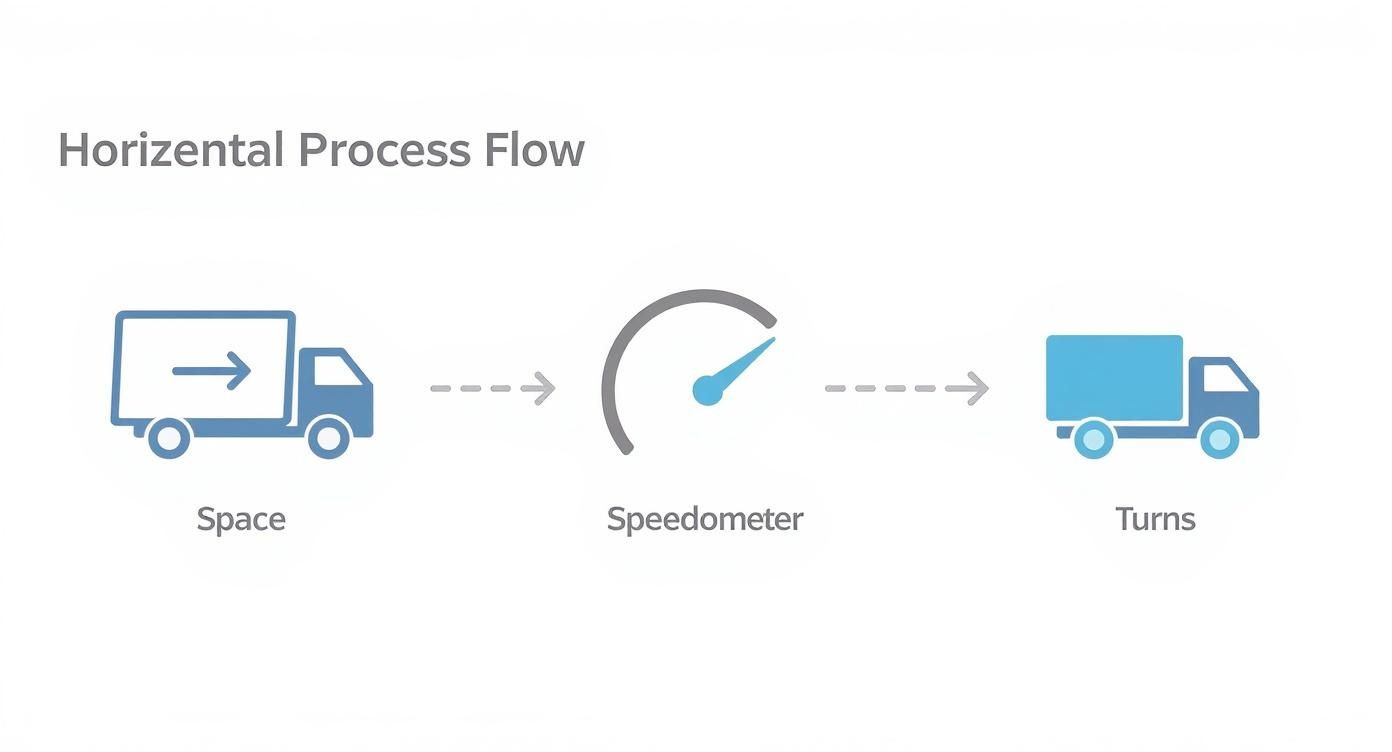
This process really drives home the point that safe driving maneuvers—managing your space, speed, and turns—are only possible if the truck's core systems are in perfect working order. And the only way to know that for sure is to inspect them yourself.
During the walk-around, you have to be hands-on and vocal. Point to or touch each part as you inspect it and say what you're checking for. A quiet inspection is a failed inspection.
To help you focus your efforts, here is a breakdown of the key areas and what to look for during your walk-around.
Table: Key Pre-Trip Inspection Areas and Focus Points
| Inspection Area | Key Components to Check | Common Issues to Identify |
|---|---|---|
| Tires & Wheels | Tread depth, inflation, sidewalls, rims, lug nuts | Uneven wear, cuts/bulges, cracks in rims, rust trails from loose nuts |
| Brakes | Chambers, pushrods, slack adjusters, drums/rotors, hoses | Leaks, bent or broken parts, excessive slack (over 1 inch of play) |
| Suspension | Leaf springs, shocks, torque arms, mounts | Cracked/broken springs, leaking shocks, loose or missing hardware |
| Lights & Reflectors | Headlights, turn signals, brake lights, clearance lights | Cracked lenses, burned-out bulbs, missing reflective tape |
| Coupling System | Fifth wheel, kingpin, locking jaws, airlines, electrical cord | Damaged parts, poor lubrication, cracked welds, worn-out connections |
This table isn't exhaustive, but it covers the high-priority items that can put a stop to your trip before it even starts.
When you master the pre-trip inspection, it stops feeling like a test and becomes a professional habit. It’s the one skill that lets you start every single trip with the confidence of knowing your vehicle is as safe as you can possibly make it.
Getting a Handle on Federal Rules and Regulations
When you get behind the wheel of a commercial truck, you’re more than just a driver—you're a professional operating under a serious set of federal laws. This section of your cdl general knowledge study guide is all about breaking down those rules. Getting these right isn't just about acing the test; it's about protecting your career, your safety, and the safety of every single person on the road with you.
The big name to know is the Federal Motor Carrier Safety Administration (FMCSA). Think of them as the rule-makers for highway safety when it comes to commercial vehicles. Their regulations cover everything from how long you can legally drive in a day to the proper way to tie down your cargo, all with one goal in mind: preventing accidents and keeping our highways safe.
Understanding Hours of Service Rules
One of the first things you absolutely must get down cold is the Hours of Service (HOS) rules. Driver fatigue is one of the biggest dangers in this industry, and HOS rules are the front line of defense against it. These regulations spell out exactly how long you can drive and be on-duty before you are required by law to take a rest break.
The logic behind it is simple: keep exhausted drivers off the road by mandating rest. For drivers hauling property, these are the key numbers to burn into your memory:
- 11-Hour Driving Limit: You can drive for a maximum of 11 hours but only after you've had 10 consecutive hours off duty.
- 14-Hour On-Duty Limit: Once your day starts, the clock is ticking. You cannot drive past the 14th consecutive hour after coming on duty.
- 60/70-Hour Limit: This one looks at your whole week. You cannot drive after being on duty for 60 hours in 7 consecutive days, or 70 hours in 8 consecutive days. You can hit the reset button on this clock by taking at least 34 consecutive hours off duty.
These numbers might seem a little random at first, but they are all backed by years of research into driver fatigue. If you understand why they exist, you'll have a much easier time remembering them for the exam.
Cargo Securement and Weight Limits
Beyond managing your own time, you are legally on the hook for every pound of cargo you're hauling. Cargo securement is a skill you cannot afford to get wrong. The entire point is to make sure your load doesn’t shift, spill, or worse, fall off your trailer. The rules are very specific, requiring cargo to be completely immobilized or tied down with straps, chains, or bracing that's strong enough for the job.
Just as critical are the vehicle weight limits. On the interstate, the federal maximum gross vehicle weight is a firm 80,000 pounds. Running overweight isn't just illegal—it's incredibly dangerous. An overloaded truck takes much longer to stop and handles poorly, turning a routine situation into a potential disaster.
Mastering the rules for cargo and weight isn't just about staying legal. It’s about physics. An improperly secured or overweight load can completely change how your truck brakes and turns, creating a massive safety hazard for you and everyone else.
Keeping Up with the Times
The trucking industry is always changing, and the regulations change right along with it. The FMCSA updates rules to address new safety data and technology. A true professional makes it their business to stay on top of these updates. For example, the FMCSA recently tightened the rules for issuing CDLs to non-domiciled drivers after finding some states had high error rates, ensuring everyone on U.S. roads meets the same strict standards.
A huge change for new drivers was the Entry-Level Driver Training (ELDT) mandate. This federal rule now requires all new CDL applicants to complete a standardized training program from a registered provider before they can even take their skills test. You can get the full rundown on what this means for you in our guide on ELDT. These kinds of updates show why learning doesn't stop once you have your license; it’s a career-long commitment.
Preparing for the Future of Commercial Driving
The world of commercial driving is changing, and it's changing fast. What it takes to be a top-tier professional is evolving right along with it. Your main goal right now is to pass that CDL General Knowledge test, but a truly smart driver is also looking down the road at where the industry is headed.
Trucks today are more than just engines and wheels; they're packed with technology that makes them safer and more efficient. This means being a skilled driver is about more than just manhandling a rig. It’s also about working with the sophisticated systems inside the cab. Getting a handle on these concepts now doesn't just prepare you for the test—it prepares you for your entire career.
The Rise of Smart Truck Technology
The next generation of commercial trucks comes loaded with an impressive array of technology, all designed to make your job safer. The big one you need to know about is Advanced Driver-Assistance Systems (ADAS). Think of ADAS as your digital co-pilot, one that never gets tired or distracted.
These systems use a network of cameras and sensors to keep a constant watch on the truck's surroundings. They'll give you a heads-up about potential dangers and can even step in automatically to prevent an accident. It’s important to remember they're not there to replace you, but to give you an extra layer of awareness and reaction time.
Here are a few common ADAS features you'll see on the road:
- Collision Mitigation Braking: If the system senses you're about to hit something head-on, it can slam on the brakes for you. This can turn a devastating crash into a minor one, or even avoid it completely.
- Lane Departure Warnings: Start drifting over the line without signaling? The system will jolt you back to attention with a loud beep or a vibration in the steering wheel.
- Adaptive Cruise Control: This is cruise control with a brain. It automatically adjusts your speed to keep a safe buffer between you and the vehicle in front of you. No more constantly tapping the brakes in traffic.
Getting comfortable with how these systems work is quickly becoming a non-negotiable skill for professional drivers.
Electric Trucks and Sustainable Driving
The trucking industry is getting a major facelift, driven by new tech and a push for cleaner air. The U.S. electric truck market is expected to explode by 2032, and the global market for AI-powered fleet management software is set to hit $14.4 billion by 2030. What does that mean for you? It means knowing about electric vehicle (EV) operation and other digital tools is no longer optional—it's becoming a core part of the job.
Electric big rigs are officially here. Major manufacturers are rolling them out for all sorts of routes. While the fundamentals of driving are the same, operating an electric truck introduces a few new things to think about.
The shift to electric and AI-assisted fleets isn’t some far-off dream. It's happening now. A good CDL study guide will prepare you for the equipment you’ll be driving in the next few years, not just the trucks that are common today.
For instance, you’ll need to get familiar with regenerative braking. This is a cool feature where the motor actually helps slow the truck down, and in the process, it sends a little bit of charge back to the battery. Trip planning will also change, as you’ll need to factor in battery range and where you're going to stop for a charge.
Beyond just electric, there’s a huge focus on sustainable driving practices for every truck on the road. Things like keeping a steady speed, avoiding jack-rabbit starts, and cutting down on idle time don't just help the planet—they save your company a ton of money on fuel. You can bet you'll start seeing more questions about fuel economy and eco-driving on the CDL test.
Proven Study Strategies and Practice Questions
It's one thing to know the material, but it's another thing entirely to prove it under pressure on test day. This is where we shift from just reading the rules to actually learning them in a way that sticks. The goal is to get all this critical information out of your short-term memory and lock it into your long-term knowledge, so you can pull it up instantly when it counts.
If your study plan is just re-reading the CDL manual over and over, you're not going to have a good time. That's one of the least effective ways to prepare. Instead, we need to focus on techniques that force your brain to engage with the material. This hands-on approach builds much stronger mental connections, making sure the information is there when you need it.
Get Your Brain in the Game with Active Study Techniques
To really get a handle on this stuff, you have to interact with it. Two of the absolute best ways to do that are active recall and spaced repetition. They might sound complex, but the ideas are simple and incredibly effective.
Active recall is just what it sounds like: actively trying to pull information out of your brain without looking at the answer. Instead of just reading the section on air brakes, close the book and try to explain the whole system out loud to yourself. This act of remembering strengthens the neural pathways, making that information easier to find the next time you look for it.
Think of it like this: your brain is a muscle. Just reading the manual is like watching someone else lift weights. Active recall is you actually doing the reps. The struggle to remember is what builds the strength.
Spaced repetition is all about being smart with your study schedule. Don't cram for eight hours straight the night before. Instead, review topics at increasingly longer intervals. Maybe you study pre-trip inspections today, glance over them again tomorrow, then review them in three days, and then a week later. This simple trick works against our brain's natural tendency to forget and signals that this information is important and needs to be saved.
Put Your Knowledge to the Test with Practice Questions
Honestly, there is no better way to get ready for the real deal than by grinding through realistic practice questions. This is where the rubber meets the road—it shows you what you really know versus what you think you know. It’s the perfect tool for finding your weak spots and getting comfortable with how the exam words its questions.
Let’s look at a couple of examples. When you do these, don't just focus on the right answer. Dig into why it's the right answer.
Practice Question 1
When driving a commercial vehicle with a manual transmission, when should you downshift?
A. Just as you start going down a hill.
B. Before you start going down a hill.
C. When you are halfway down the hill.
D. When you feel the brakes getting hot.
Answer: B. Before you start going down a hill. Explanation: You need to get into the right low gear before the descent even starts. This lets you use the engine's natural braking power to control your speed. Trying to downshift on a steep grade is a recipe for losing control.
Practice Question 2
What is the legal minimum tread depth for front tires on a commercial motor vehicle?
A. 1/32 inch
B. 2/32 inch
C. 4/32 inch
D. 6/32 inch
Answer: C. 4/32 inch. Explanation: Federal regulations are very clear on this. Your front steering tires must have at least 4/32 of an inch of tread. All other tires on your rig need a minimum of 2/32 of an inch.
To get truly confident, you need to expose yourself to a wide range of questions. For more in-depth prep, take a full-length general knowledge test to see what the entire exam feels like. Consistent practice is what separates the people who are ready from those who are just guessing.
Your Top CDL Test Questions, Answered
As you start digging into your CDL prep, you're bound to have some questions about how the test actually works. Getting those uncertainties cleared up early on helps you focus on what really matters: learning the material.
Let's tackle some of the most common questions we hear from new drivers.
How Many Questions Are on the General Knowledge Test?
The General Knowledge test is your first big step. You can expect 50 multiple-choice questions, though this can differ slightly depending on your state.
To pass, you need to score an 80% or better, which means getting at least 40 questions right. This test covers all the essential stuff—vehicle inspections, basic vehicle control, federal rules, and more—to make sure you have a solid safety foundation before you start your hands-on training.
What's the Hardest Part of the General Knowledge Test?
Everyone learns differently, but a few topics consistently trip people up. The sections on Air Brakes and Combination Vehicles are famous for being tough. They're dense with technical details, specific air pressure numbers, and complex procedures that you have to know inside and out.
The air brake system, for instance, is a complicated piece of machinery, and the in-cab inspection has a very specific sequence you have to follow. Likewise, getting your head around the physics of a big rig, like how much a trailer "off-tracks" in a turn, can be a real challenge. The best way to nail these sections is to run through practice tests over and over until the concepts click.
How Long Should I Study for the General Knowledge Test?
There isn't a one-size-fits-all answer, but most people who pass spend somewhere between 20 and 40 hours studying over a few weeks. Don't try to cram it all in at the last minute; that's a surefire way to get overwhelmed.
The key is consistency. A couple of focused hours each day will do you far more good than a frantic, all-night cram session. It’s about retaining the information for the long haul, not just for test day.
Remember, the goal is to genuinely understand the why behind the rules, not just memorize answers. That deep understanding is what will keep you safe on the road and help you build a long, successful career as a professional driver.
Ready to stop studying and start training? Patriot CDL offers accelerated, hands-on programs to get you on the road to a rewarding new career in as little as three weeks. Our expert instructors will guide you every step of the way. Find out how to get started at https://patriotcdl.com.