Thinking about a career in trucking is a big move, but the path to getting your first job is more straightforward than you might imagine. Landing one of the many truck driving jobs for beginners really boils down to three distinct phases: getting the right CDL training, acing your permit and skills tests, and then knowing how to sell yourself to companies that are ready to hire new drivers.
Your First Year On The Road: A Realistic Roadmap
Jumping into a new career as a professional truck driver is an exciting prospect, full of opportunity. But going from a regular driver's license to a commercial one involves hitting several key milestones. Let's break down that process into real, manageable stages to give you a clear picture of what your first year will look like.
We'll kick things off with the most critical decision you'll make right out of the gate: choosing how you'll get your Commercial Driver's License (CDL) training. After that, we’ll cut through the confusion around getting your Commercial Learner’s Permit (CLP) and cover what it really takes to pass that final, hands-on skills test.
What To Expect On Your Journey
Getting your first driving job isn't complicated, but it does require focus and dedication. You’ll need to put in the hours, both in the classroom and behind the wheel. The good news? You can complete the whole process in just a few months, which puts you on the fast track to a stable, in-demand career.
Here are the big hurdles you'll clear:
- CDL Training: You have to complete an Entry-Level Driver Training (ELDT) program. This is where you’ll build the foundation of knowledge and driving skills you'll use every day.
- Permit and Licensing: This phase starts with passing written exams to get your CLP. Then, you'll have to prove you have what it takes in a three-part skills test to finally earn that CDL.
- The Job Hunt: With your new license in hand, you can start applying to trucking companies that have training programs specifically for new drivers.
This simple diagram maps out the core steps, from day one of training to your first day on the job.
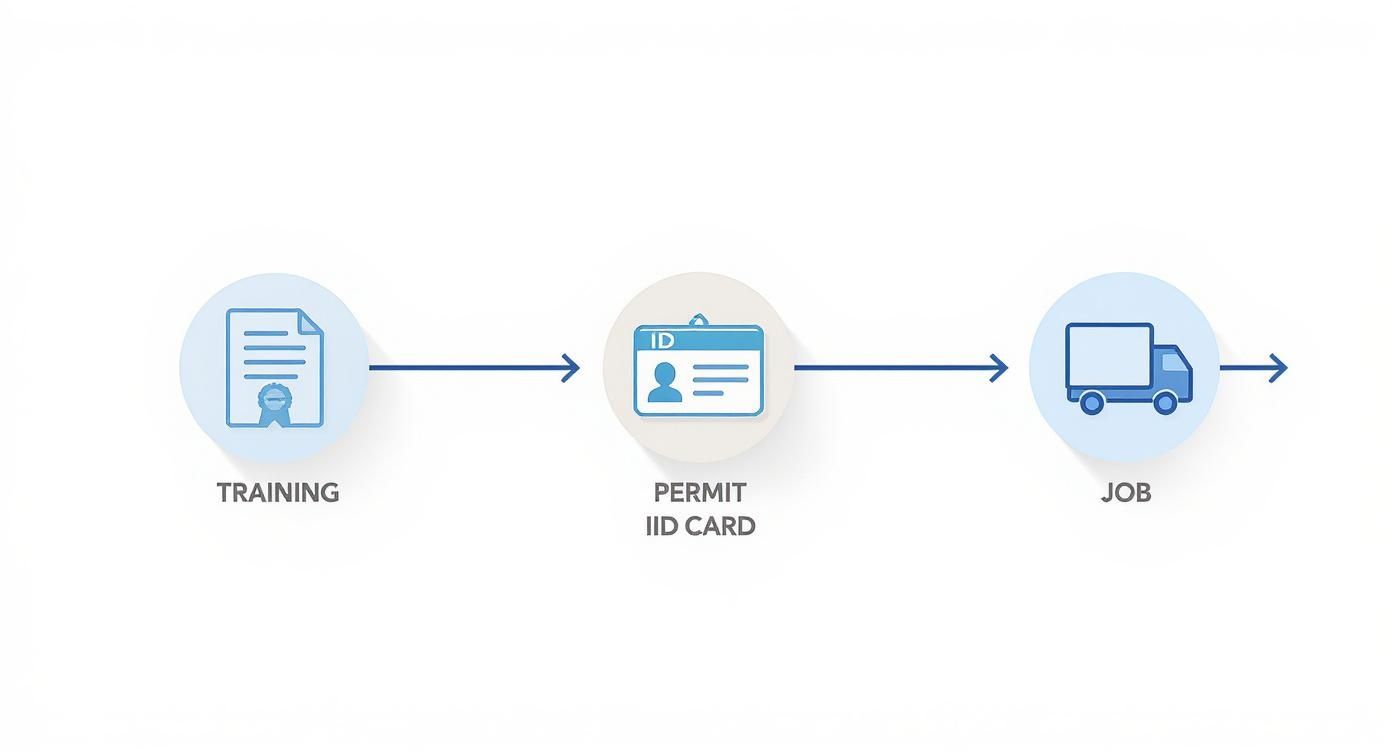
As you can see, it all starts with quality training. That’s the non-negotiable first step before you can even think about permits, tests, or job offers.
To give you a clearer bird's-eye view, here's a breakdown of the typical timeline and costs involved in launching your trucking career.
First-Year Trucking Career Milestones
| Milestone | Estimated Timeline | Average Cost | Key Outcome |
|---|---|---|---|
| DOT Physical & Drug Screen | 1-2 days | $75 – $150 | Medical Examiner's Certificate |
| CDL Training Program | 3-7 weeks | $3,000 – $8,000 | ELDT Certificate of Completion |
| Commercial Learner’s Permit (CLP) | 1-2 weeks | $50 – $100 | CLP allowing supervised driving |
| CDL Skills Test | 1 day | $100 – $300 | Full Commercial Driver’s License (CDL) |
| Job Search & Onboarding | 2-4 weeks | $0 | First professional driving job |
Keep in mind, these costs and timelines can vary a bit depending on your state and the training route you choose, but this gives you a solid idea of what to plan for.
One of the most important habits you'll build during training is mastering the vehicle inspection. It becomes second nature. For a deep dive into what's involved, you can learn more about the crucial steps of a proper pre-trip inspection and see why it's so critical for success and safety on the road.
Where Should You Get Your CDL Training?
Right out of the gate, you’ve got a major decision to make: how are you going to get your CDL? This isn't a small choice—it's the first real fork in the road that will shape your finances, your timeline, and where you'll be working for at least your first year.
You’ve basically got two main options. You can either go to a private CDL school or get trained directly by a trucking company. Neither one is universally "better"; they just serve different needs. Let's dig into what each path really looks like so you can figure out which one makes sense for you.
The Independent Route: Private CDL Schools
Think of a private CDL school as a trade school for truckers. You pay your tuition, they teach you everything you need to know to pass the test, and once you have that license in hand, you're a free agent. You can walk into any carrier's office with your CDL and apply for a job.
This path has some serious perks:
- Total Freedom: Once you graduate, you're not tied down. You can shop around for the best pay, the routes you want, and the benefits that fit your family. You’re in the driver’s seat of your career from day one.
- Better Instruction: Class sizes tend to be smaller, which usually means more one-on-one time with the instructor. That extra time behind the wheel is gold when you're just starting out and building confidence.
- Laser-Focused Training: The school has one job: get you to pass your CDL exam. The curriculum is tight and efficient, often getting you licensed and ready to work in just three to seven weeks.
The biggest hang-up, of course, is the cost. You're looking at an upfront investment of anywhere from $3,000 to $8,000. That's a lot of cash, so you'll need to have it saved up, look into financing, or see if you qualify for any grants.
No matter which school you choose, make sure it’s a legitimate program that follows federal guidelines. We cover exactly what that entails in our guide to Entry-Level Driver Training (ELDT), a mandatory curriculum for all new drivers.
The Contractual Path: Company-Sponsored Training
This is the option that catches a lot of people's eyes, and for good reason. Often called "paid CDL training," it's exactly what it sounds like. A big trucking company foots the bill for your training, and in return, you agree to work for them for a set amount of time—usually a year.
It's a tempting offer. You don't have to come up with thousands of dollars, and you’ve got a job lined up the second you pass the test. It's a straight shot into the industry, which takes a ton of the stress out of the process.
But here’s the catch: you're on their hook. The training can sometimes feel like a boot camp, with big classes and maybe not as much wheel time as you'd like. The most important thing to understand is that you're signing a contract. If you quit or get fired before your year is up, you’ll owe them the full cost of the training, and sometimes they bill you at an inflated rate.
You also give up the power to choose your first boss. The job is guaranteed, sure, but the pay, the routes, and how often you get home might not be the best out there for a new driver.
So, Which Path is Right for You?
So how do you decide? It really comes down to your finances and your personality.
If you can swing the tuition and you value your independence, a private school is almost always the better long-term play. You start your career with way more options.
On the other hand, if you don't have the cash and your top priority is just getting to work as fast as possible, company-sponsored training is a perfectly good way to get your foot in the door. Just do yourself a favor and read every single word of that contract before you sign.
The good news is, the industry is desperate for drivers. The American Trucking Associations figure we'll need 1.2 million new truckers over the next ten years just to keep up. That means no matter which path you take, if you get that CDL, the jobs will be there waiting for you.
Getting Your License: From the Classroom to the Open Road
Alright, you've figured out your training route. Now comes the real work: getting that license in your hand. This process is broken down into two major hurdles. First, you've got to pass the written tests to get your Commercial Learner's Permit (CLP). After that, it’s all about proving your skills behind the wheel in the final CDL exam. Let's walk through how to tackle both.
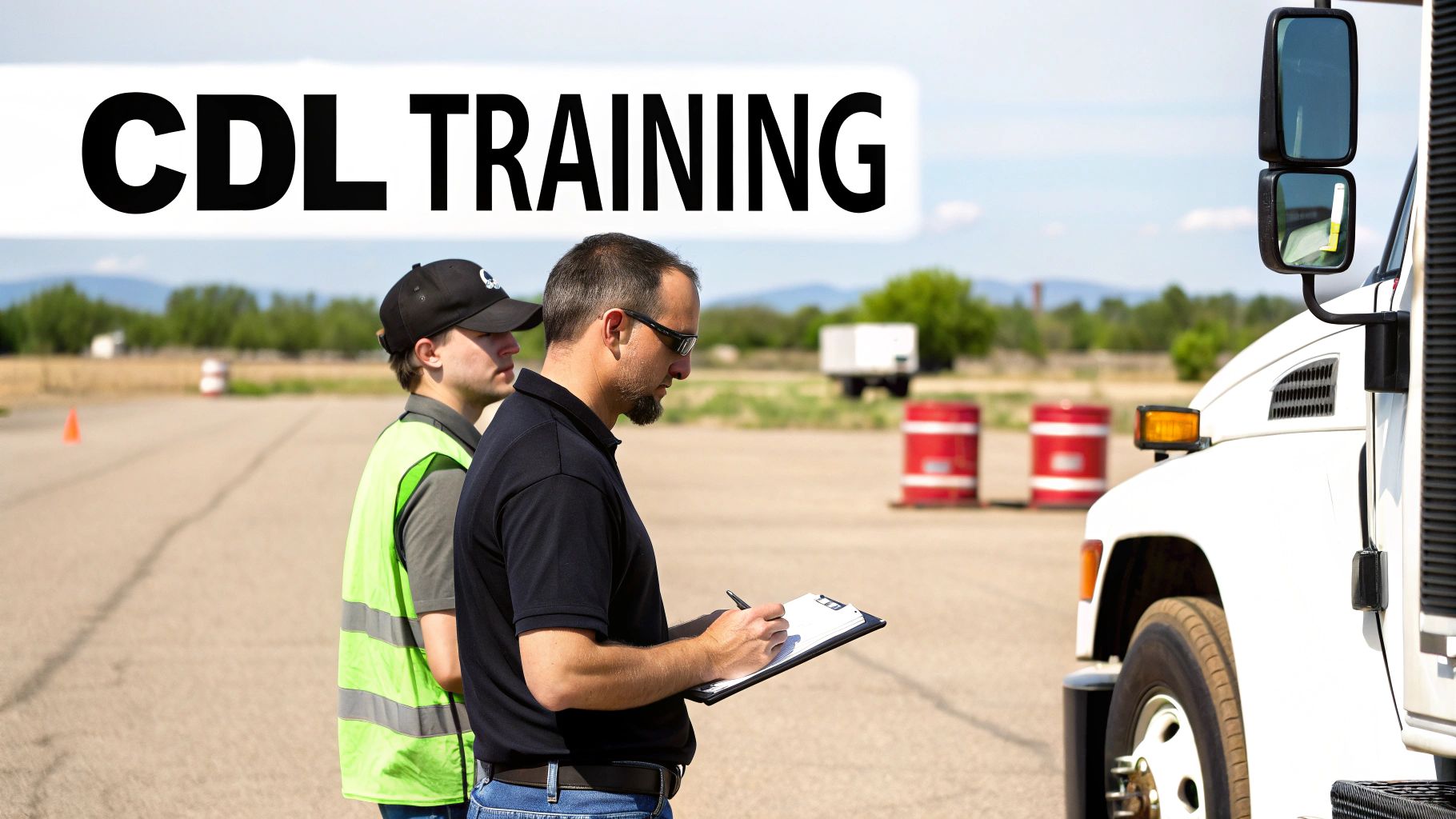
Your journey to a CDL always starts with hitting the books. You need to build a solid foundation of knowledge before you can even think about turning the key. This classroom time is crucial—it’s where you learn the principles that will keep you safe for your entire career.
First Up: Nailing the CLP Written Exam
Think of the CLP as your pass to get in the driver's seat with an instructor. To earn it, you have to prove you know your stuff by passing a few written knowledge tests at the DMV. It can feel like a lot to absorb, but if you focus on the big three, you'll be in great shape.
These are the core tests you absolutely must pass:
- General Knowledge: This is the heavyweight champion of the written tests. It covers a massive range of topics, from vehicle control and hazard perception to speed management and communication. Everything else is built on this foundation.
- Air Brakes: If you're driving a Class A or B truck, you can't avoid this one. You have to demonstrate a thorough understanding of how air brake systems function, how to properly inspect them, and how to use them safely on the road.
- Combination Vehicles: This one's specifically for anyone going for a Class A license. It dives into the unique physics of driving a tractor-trailer, covering critical skills like proper coupling/uncoupling and how to handle the dangerous "crack-the-whip" effect.
The General Knowledge section is where most of your study time should go. To really get a handle on it, check out our in-depth guide to the general knowledge test. A word of advice: don't just passively read the manual. Take as many practice tests as you can. It’s the best way to find out what you don't know before the real test does.
The Big Day: The 3-Part CDL Skills Test
Once you have your CLP, the training gets real. You'll spend the next few weeks out on the lot and on the road, preparing for the practical skills test. This is the final exam, and it’s divided into three distinct parts. You have to pass all three to walk away with your CDL.
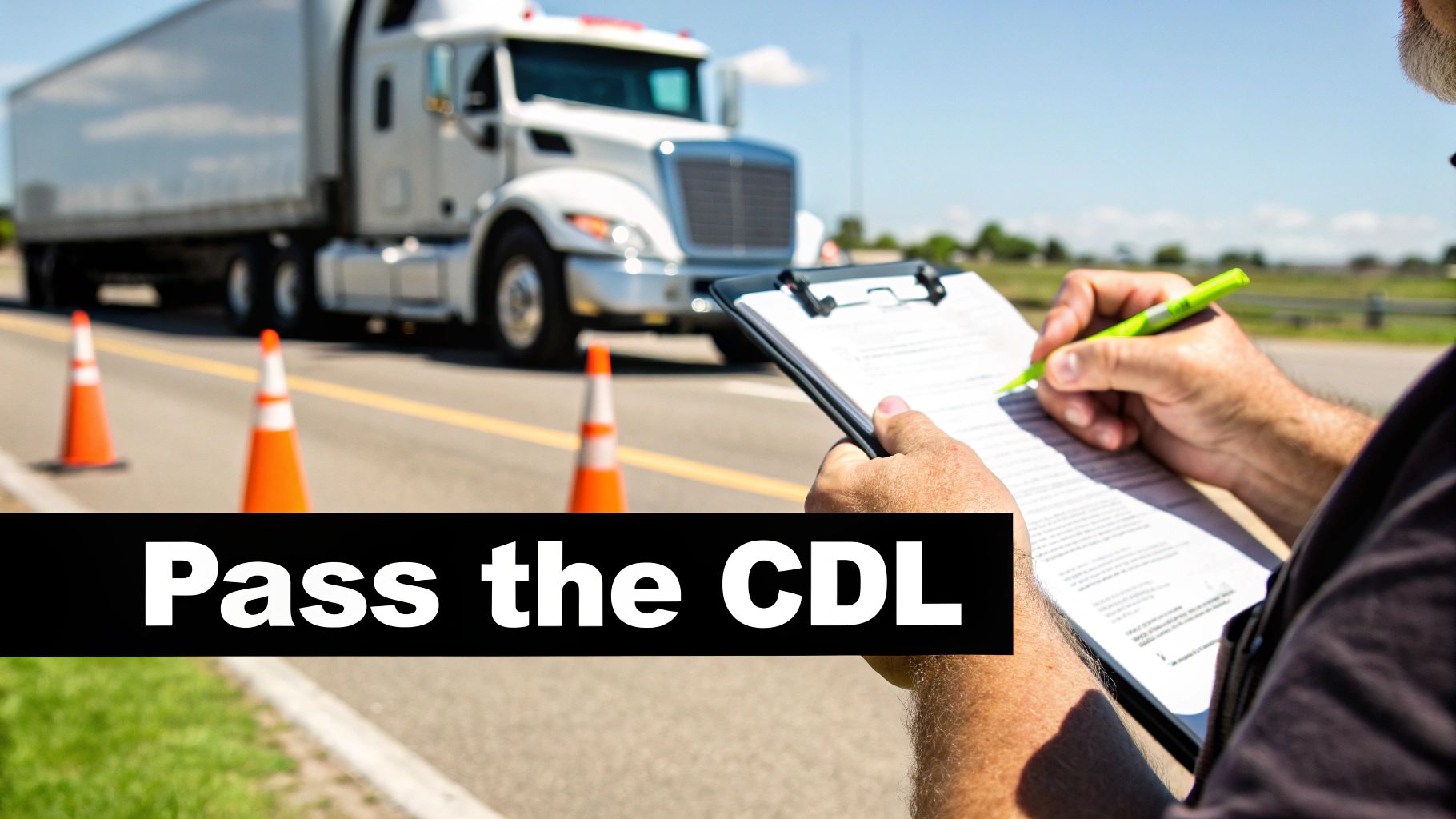
First is the vehicle pre-trip inspection. You’ll literally walk an examiner around the truck and trailer, pointing to different components and explaining what you're checking for. They don't just want to hear you name parts; they want to see that you can identify a safety problem before you hit the highway.
Next comes the part that gives most new drivers nightmares: basic control skills, or what everyone calls the backing maneuvers. This is where you prove you can control that 53-foot trailer. You’ll be tested on a few specific moves, like a straight-line back, an offset back, and the infamous alley dock. The secret here is to slow down. Take your time, get out and look if you need to, and remember that a "pull-up" to straighten out is almost always allowed.
Finally, you’ll head out for the on-road driving test. The examiner will ride along with you on a route that includes everything from tight city streets to busy highways. They're watching everything: how you merge, make turns, change lanes, and handle intersections. It’s all about showing them you are in complete, safe control of the vehicle at all times.
"Examiners aren't looking for perfection; they're looking for safety. A smooth, controlled stop is better than a sudden, jerky one. A safe lane change with proper signaling is more important than rushing to get ahead of another vehicle. Your mindset should be 'safety first' on every single action you take."
Why You Should Get Endorsements Now
While you're already in study mode, it's the perfect time to add a few endorsements to your new license. Think of these as special qualifications that open up more job opportunities. Getting them from the very beginning makes you a much more appealing candidate for truck driving jobs for beginners.
Two of the most valuable endorsements to consider are:
- Tanker (N): This allows you to haul liquids in bulk. It unlocks a ton of great-paying local and regional jobs that other new drivers can't apply for.
- Hazardous Materials (H): This one requires a background check but allows you to transport hazardous materials. It’s often combined with the Tanker endorsement (creating the "X" endorsement) and almost always comes with a significant pay increase.
By tackling these endorsements during your initial training, you're sending a clear message to employers: you're serious, you're motivated, and you're ready to take on more responsibility from day one.
How to Land Your First Truck Driving Job
Alright, you’ve got that shiny new CDL in your hand. Congratulations. Now the real work begins: finding a company willing to give you a shot. This part is all about strategy. You need to know what kinds of entry-level jobs are out there and, more importantly, how to sell yourself as a safe, reliable driver, even with a blank professional driving record.
First things first, you have to decide what kind of life you want on the road. The job you pick will dictate everything from your paycheck to how often you see your own bed. It’s crucial to understand the main types of truck driving jobs for beginners, because most new drivers fall into one of three buckets.
OTR, Regional, and Local Jobs Explained
Getting a handle on these roles is your ticket to finding the right fit for your first year. Each one strikes a different balance between money, miles, and home time.
- Over-the-Road (OTR): This is the classic starting point. You’ll be living out of your truck for weeks at a time, crisscrossing the country and racking up a ton of experience fast. The tradeoff? You're going to be away from home. A lot.
- Regional: Think of this as a middle ground. Regional gigs keep you in a specific slice of the country, like the Southeast or Midwest. The big plus here is that you're usually home every weekend, which makes for a much better work-life balance.
- Local: These are the jobs everyone wants—home every single night. Local drivers typically handle deliveries in a specific city or metro area, and the work can be more physical with frequent loading and unloading. These jobs are highly competitive and almost always go to drivers with some experience under their belt.
For anyone just starting out, knowing how to get hired with no experience usually means putting in your time with OTR to build that solid, one-year safety record that opens up other doors.
Building a Resume That Gets Noticed
When you don’t have any professional driving time, your resume needs to do the heavy lifting. It’s not enough to just say you have a CDL. You have to show a recruiter what you learned and why you’re a low-risk hire.
Your resume is your first impression. Make it count by emphasizing:
- Your CDL School: List the school by name and specifically mention you completed a federally mandated Entry-Level Driver Training (ELDT) program. This is a big deal to employers.
- Your License and Endorsements: State clearly that you hold a Class A CDL and list every endorsement you have, like Tanker (N) or Hazmat (H).
- Your Skills: Don't be vague. Talk about your proficiency with pre-trip inspections, logging Hours of Service (HOS), and the specific backing maneuvers you’ve mastered.
Even jobs from your past life can help. Did you work in a warehouse with a perfect safety record? Operate heavy machinery? Any experience that shows you’re responsible and safety-conscious is worth including. And remember, if you have a restriction on your license, like an automatic-only "E" restriction, that can limit your options. If you're looking to open up more opportunities, our e-restriction removal course is built for drivers who want to learn how to handle a manual transmission.
"Recruiters for entry-level positions aren't looking for a decade of driving experience. They are looking for evidence of a strong work ethic, a clean record, and a professional, safety-first attitude."
Acing the Truck Driver Interview
Once your resume gets you in the door, it’s time to prove you have the right mindset for the job. Companies are taking a chance on a new driver, and they need to know you’re not a liability. Be ready for questions that test your judgment in real-world scenarios.
You'll likely hear questions like these:
- "What would you do if you felt fatigued but still had hours left on your clock?"
- "Describe a time when you had to make a critical safety decision."
- "How will you manage your time to make on-time deliveries while staying legal with your HOS?"
Your answers should always, always circle back to safety. Your goal is to show them you understand that your primary job is protecting the public, their equipment, and the customer’s freight. Speed comes second.
The good news is, the demand for drivers is solid. The industry expects to see around 89,300 new job openings for truck drivers every year for the next decade. With a median annual wage hovering around $57,440, trucking is a great career path for beginners willing to start on local or regional routes. You can dig into more of the official numbers in the truck driver employment projections from the BLS.
A Realistic Look at Your First-Year Salary
Alright, let's talk about the one thing everyone wants to know: the money. When you're looking into truck driving jobs for beginners, it's easy to get caught up in flashy ads promising huge paychecks right out of the gate. But let's get real for a minute.
Your first year on the road isn't about getting rich; it's about building a foundation. You're proving you can be trusted with an $80,000 rig and a trailer full of valuable freight. Your pay will reflect this "rookie" status, but the runway for growth is massive if you play your cards right.
Understanding How You Get Paid
Trucker pay isn't always a straightforward hourly wage. The way a company calculates your earnings has a huge impact on your take-home pay, so you need to know what you're signing up for.
You'll almost always see one of these three models:
- Cents Per Mile (CPM): This is the bread and butter of the industry, especially for over-the-road (OTR) jobs. You get paid a set rate for every mile you cover. For a new driver, a typical starting CPM is somewhere in the $0.40 to $0.55 per mile range.
- Hourly Pay: This is more common for local or regional gigs where you're making frequent stops, dealing with loading docks, or have significant wait times. It makes for a much more predictable paycheck.
- Salaried Positions: You won't see this as often for brand-new drivers, but some companies do offer a flat weekly or annual salary. The stability is great, but you might not get rewarded for those really high-mileage weeks.
As a rookie, you’ll find most OTR jobs are CPM-based. One key detail to ask about is whether they pay "practical" miles (the shortest route on a map) or "hub" miles (the actual miles your wheels turn). That small difference can add up.
First-Year Salary Expectations
So, what does this all boil down to in your bank account? Realistically, an entry-level truck driver can expect to make between $37,000 and $45,000 in their first year.
That might seem a bit lower than the national average truck driver salary of $55,990 per year, but remember, you're just starting. This typically breaks down to about $18-$22 per hour.
Where you live matters a lot, too. A driver in Mississippi might average $51,330 annually, but someone doing the same job in Alaska could pull in $65,870. Of course, these jobs all start with getting your CDL through a good training program. Once you get some experience, specialized work like hauling hazmat or driving a tanker truck can seriously boost your income.
Your location, the company you drive for, and the type of freight you haul will cause big swings in your pay. A driver pulling a specialized load in a busy freight lane will almost always make more than someone hauling a standard dry van in a slower region.
Your Path to a Higher Paycheck
Think of your first-year salary as your starting point, not your destination. Your income potential grows in lockstep with your experience and your reputation as a safe, reliable professional. That first 12 months is all about building a flawless safety record.
Here’s a rough timeline of how your pay and career can progress:
- The First Year: You’re in learning mode. Your only goals should be to stay safe, avoid any accidents or violations, and show up on time. The pay is steady but modest.
- Years 2-3: With a clean driving record, you're no longer the new kid. This is when doors open to better-paying companies, dedicated routes, and regional jobs that get you home more often.
- Years 4+: Now you're a seasoned pro. High-paying, specialized jobs—think tankers, flatbeds, hazmat, or oversized loads—are on the table. Drivers in these niches often earn well into the upper salary brackets.
The most important thing to remember is this: your safety record is your most valuable asset. A single preventable accident or a serious violation can slam the brakes on your career growth. Protect it, and your income will take care of itself.
Common Questions from New Truck Drivers
https://www.youtube.com/embed/vszkR6Dg9Lc
Stepping into a new career always brings a ton of questions, and trucking is no different. It’s a unique world with its own set of rules, timelines, and challenges that can feel a little overwhelming from the outside. Getting straight answers to the big questions is the best way to move forward with confidence and make the right calls for your future.
Let's dive into some of the most common questions we hear from people just starting out. Consider this a final Q&A to clear up any last-minute uncertainties you have about landing your first driving job.
How Long Does It Really Take to Become a Truck Driver?
This is probably the number one question we get, and the honest answer is: it depends on which training path you take. There’s no single, set-in-stone timeline.
If you go the private CDL school route and attend full-time, you can get licensed and ready for work incredibly fast. These programs are intense, but they can get you prepped for your skills test in as little as three to seven weeks. This is definitely the quickest way to get your license in hand and start applying for jobs on your own terms.
Company-sponsored training, on the other hand, works a bit differently. The initial classroom and yard training might take about the same amount of time. But it's almost always followed by a required period of on-the-road training with a company mentor. This "finishing" phase can add several more weeks, or even a couple of months, before they hand you the keys to your own rig.
What Are the Most Common CDL Disqualifiers?
Not everyone who wants to be a truck driver is eligible. The Federal Motor Carrier Safety Administration (FMCSA) has very strict rules designed to keep the roads safe, and certain things in your medical or legal history can be an automatic "no."
Knowing these deal-breakers upfront can save you a ton of time and money. Here are some of the most common reasons someone might be disqualified:
- Medical Conditions: Certain health issues will prevent you from passing the mandatory DOT physical exam. This includes things like uncontrolled high blood pressure, epilepsy, or vision and hearing impairments that don't meet federal standards.
- Recent Major Violations: A recent history of serious driving offenses is a huge red flag. This covers convictions for DUI/DWI, leaving the scene of an accident, or using a commercial vehicle to commit a felony.
- Failed Drug Tests: The trucking industry has a zero-tolerance policy for drug use. If you fail or refuse a drug test, it immediately disqualifies you and gets logged permanently in the FMCSA Drug & Alcohol Clearinghouse.
It's absolutely critical to be honest about your medical and driving history from day one.
It's far better to find out about a potential disqualifier early than to spend thousands on training only to get denied. The whole process really begins with understanding what it takes to get your initial commercial learner's permit.
What Is the Best Kind of Job for a Beginner?
For most new drivers, the journey starts with an Over-the-Road (OTR) job at a large carrier. It means a lot of time away from home, but these are the companies best equipped to train new talent from the ground up. They have the structured programs, the experienced mentors, and the massive freight networks to keep a rookie driver moving, earning, and learning.
OTR driving is like a crash course in trucking. You’ll learn everything—clock management, navigating big cities, dealing with tough weather, and handling shippers all over the country.
Once you have about a year of safe, reliable OTR driving under your belt, your career options explode. That one year of experience is the golden ticket. It unlocks the door to better-paying regional gigs (where you're home on weekends) and the highly sought-after local jobs (home every single night). Think of that first OTR job as your paid apprenticeship.
Can You Have a Good Work-Life Balance in Trucking?
This is a big one. The honest answer? It completely depends on the job you take.
During your first year as an OTR driver, a traditional work-life balance is going to be tough. You might be out on the road for three or four weeks at a time, with only a few days at home in between. It's a lifestyle that demands real sacrifice from you and your family.
But that’s not the whole story for a career in trucking. As you build that critical first year of experience, you earn the power to choose. You can move into roles that are a much better fit for the life you want to live.
- Regional routes are a great middle ground, getting you home every weekend.
- Local driving jobs offer the best balance, putting you back in your own bed every night.
The industry has a path for everyone. You might have to start with a demanding OTR schedule, but you’re not stuck there forever. With a clean safety record and some solid experience, you can build a long-term career that gives you both a great income and the home time you deserve.
Your journey to becoming a professional truck driver starts with the right training. At Patriot CDL, we provide the hands-on instruction and expert guidance you need to pass your CDL exam and start your career with confidence. https://patriotcdl.com