So, you’re thinking about becoming an owner-operator. It’s a huge leap, but the rewards can be incredible. The journey starts with getting your Commercial Driver's License (CDL) and some solid road experience, but it quickly shifts into building a business, buying your own rig, and getting the authority to operate.
This isn't just a job change; it's a complete shift from an employee mindset to an entrepreneurial one. You become responsible for everything—from finding the freight and managing the books to keeping up with compliance.
What Being an Owner-Operator Really Means

Going from company driver to owner-operator is more than a new title; it's a total lifestyle change. You're not just a driver anymore—you're the CEO of a one-person trucking operation. That means you call the shots on your schedule, the loads you take, and ultimately, how much money you make.
But with that freedom comes the full weight of running a business. You'll be the one sending invoices, chasing down payments, scheduling your own maintenance, and navigating the maze of federal and state regulations.
The Mindset Shift: From Driver to Business Owner
The biggest hurdle is often mental. As a company driver, your main job is simple: get the load from Point A to Point B safely and on time. As an owner-operator, driving is just one piece of the puzzle. You also have to be a bookkeeper, a load negotiator, a dispatcher, and a compliance expert.
The path breaks down into a few key stages:
- Laying the Groundwork: It all begins with the right training. A quality CDL training program is non-negotiable and sets the foundation for your entire career.
- Building Your Business: This is where you make crucial decisions, like setting up an LLC, getting your operating authority, and finding the right insurance policies to protect your investment.
- Running the Show: This becomes your daily reality—scouring load boards for profitable runs, managing your cash flow like a hawk, and keeping your truck in prime condition to avoid costly downtime.
Owner Operator Snapshot: Requirements vs. Rewards
Let's be clear: the financial upside is a huge motivator. Experienced owner-operators can pull in an average yearly salary of $320,980, which is miles ahead of what most company drivers earn. With a wave of drivers retiring, skilled owner-operators who run a tight ship are in a powerful position.
Key Takeaway: Success as an owner-operator is all about discipline. You have to know your cost-per-mile down to the penny, treat every single load as a business decision, and never stop watching your numbers.
To give you a clearer picture, here’s a quick breakdown of what it takes versus what you stand to gain.
Owner Operator Snapshot Requirements vs Rewards
| Requirement | Description | Potential Reward |
|---|---|---|
| Significant Capital | Funds for a truck down payment, insurance, permits, and a healthy emergency fund. | Higher Earning Potential |
| Business Acumen | Skills in budgeting, negotiation, and staying on top of complex regulations. | Total Control Over Your Schedule |
| Self-Discipline | The ability to manage your own time, finances, and maintenance without a boss. | True Freedom and Independence |
| Extensive Experience | At least a couple of years as a company driver to learn the ropes and build a clean record. | Build Equity in Your Own Asset |
This table lays out the trade-offs. The entry barriers are high, but the independence and financial control on the other side are what drive so many to take the wheel of their own business.
Getting Your CDL and Putting in the Miles

Before you even start pricing out rigs or daydreaming about your company name, you've got to lay the groundwork. The road to becoming a successful owner-operator starts with two non-negotiables: a Commercial Driver’s License (CDL) and solid, real-world experience behind the wheel.
Think of these as the concrete foundation for your business. Skipping either one is like building a house on sand—it's just not going to hold up.
First Things First: Your Commercial Driver's License
Your CDL is more than just a piece of plastic; it's your official ticket to a career in trucking. It proves you have the skills and knowledge to safely operate a massive vehicle.
For anyone serious about becoming an owner-operator, the goal is almost always a Class A CDL. This license gives you the authority to drive combination vehicles—like a classic tractor-trailer—with a gross weight of 26,001 pounds or more. It’s the key that unlocks the widest variety of freight and the highest earning potential.
But the license itself is just the starting point. The real money and opportunity often come from endorsements, which are special certifications for hauling specific types of cargo.
A few of the most valuable endorsements include:
- H (Hazardous Materials): The "HazMat" endorsement opens the door to higher-paying freight that others can't touch.
- T (Tank Vehicles): Hauling liquids requires a special skill set to manage the "slosh" and unique dynamics of a tanker.
- N (Tank Vehicles for Gas/Liquid): This is often paired with the HazMat endorsement (becoming an "X" endorsement) for transporting things like fuel.
- P (Passenger): Needed for driving vehicles that carry 16 or more people.
- S (School Bus): Specifically for operating a school bus.
Getting your license and the right endorsements is your first major hurdle. The process of medical exams, written tests, and skills tests can seem daunting, but understanding the specific CDL requirements beforehand makes it a whole lot smoother.
Why You Can't Skip Being a Company Driver
Once you have that new CDL in your hand, it's tempting to want to jump right into buying a truck. Don't do it. This is probably the single biggest mistake new drivers make. You need to spend time as a company driver first—plan for at least two to three years.
This period is your real-world apprenticeship. It's where you'll learn the lessons that no driving school can ever teach you. You'll figure out how to back into a tiny, pitch-black dock in the rain, how to manage your hours when a shipper holds you up, and what to do when you blow a tire in the middle of nowhere.
Lenders and insurance companies aren't just looking for a CDL; they're looking for proof you're not a liability. A solid two or three-year track record with a reputable company shows them you’re a professional who can manage risk, making you a much better candidate for a loan and affordable insurance.
Use this time to become an expert in the fundamentals:
- Mastering Your Clock: Get intimately familiar with Hours-of-Service (HOS) rules and your electronic logging device (ELD). Learn how to plan trips that maximize your drive time legally and efficiently.
- Handling Different Freight: If you can, get experience with dry van, reefer, and flatbed. Each one teaches you something different about securing loads, managing appointments, and dealing with lumpers.
- Protecting Your Record: Your MVR (Motor Vehicle Record) and PSP (Pre-Employment Screening Program) report are everything. Every ticket, accident, or failed inspection follows you. Keep it clean.
- Saving Every Penny: A company driver's steady paycheck is the perfect opportunity to build your war chest. Save aggressively for a down payment on your truck and create a healthy emergency fund for when you go solo.
That first company you drive for really matters. Find a carrier known for safety and solid training. This isn't just a job; it's the most important training you'll ever get before launching your own trucking business.
Setting Up Your Trucking Business the Right Way
Making the leap from company driver to owner-operator is more than just a job change—you're officially becoming an entrepreneur. This is the moment where you lay the foundation for your entire business. Getting it right from the start isn't just about paperwork; it's about building a legitimate company that can operate legally and protect you and your family financially.
Skimping on these steps now can lead to massive headaches later, from steep fines to business-ending legal trouble. Let's walk through what it really takes to get your business on the road.
Choosing Your Business Structure
The first big decision is how to structure your company. This choice affects everything from your personal liability if something goes wrong to how you'll file your taxes at the end of the year. It's always a good idea to chat with a lawyer or an accountant, but you need to understand the playing field first.
The easiest, most straightforward option is a sole proprietorship. It's the default for any one-person show and takes almost no effort to set up. But there's a huge catch: there is zero legal separation between you and the business. If your company gets sued or falls into debt, your personal assets—your house, your savings, your personal vehicle—are all on the line.
The biggest risk with a sole proprietorship is unlimited personal liability. One major accident or lawsuit could wipe you out financially. For most new owner-operators, the risk just isn't worth it.
This is exactly why so many drivers choose to form a Limited Liability Company (LLC). An LLC acts as a legal shield, separating your business finances from your personal ones. If the business runs into trouble, your personal assets are generally safe. It gives you that crucial protection without being overly complicated to manage. Thinking about how to create an LLC is a smart first move for any serious owner-operator.
Another route is the S-Corporation (S-Corp), which can offer some tax advantages. Like an LLC, it protects your personal assets. However, S-Corps come with stricter rules for record-keeping and formal meetings. While you might save on self-employment taxes, the extra complexity means you'll definitely want to run this by a tax pro before jumping in.
Navigating the Alphabet Soup of Compliance
Once you've established your business entity, it's time to get the authority to actually operate. This means registering with federal and state agencies to get a few key numbers and permits. Don't take this lightly—failing to comply can get you hit with fines starting at $1,000 or an out-of-service order that shuts you down on the spot.
Here’s what you absolutely must have:
-
USDOT Number: Issued by the Federal Motor Carrier Safety Administration (FMCSA), this is your company's unique identifier for all things safety and compliance. If you’re crossing state lines, you need one.
-
Motor Carrier (MC) Number: This is your "operating authority." It's what gives you the legal right to haul freight for-hire across state lines. Without an active MC number, you can't legally accept and move loads for customers.
Think of these two numbers as the keys to your business. The FMCSA application process isn't instant and can take several weeks, so get started on this as early as possible to avoid sitting around waiting for your authority to come through.
Staying Legal Across State Lines
Your DOT and MC numbers get you started, but interstate trucking involves a couple more critical programs for managing fuel taxes and vehicle registrations.
These two are non-negotiable for any owner-operator running in multiple states:
-
International Registration Plan (IRP): The IRP lets you operate across all member states and Canadian provinces with just one "apportioned" license plate and a cab card. Instead of registering your truck in every single state, you pay fees based on the percentage of miles you plan to run in each jurisdiction.
-
International Fuel Tax Agreement (IFTA): This agreement is a lifesaver for handling fuel taxes. You'll get an IFTA license and a set of decals for your truck. Instead of filing tax returns in every state where you buy fuel, you just file a single, consolidated report with your home state each quarter.
Getting all this paperwork in order is what truly transforms you from a truck driver into a legitimate, compliant business owner. With these in hand, you're ready to hit the road and start hauling freight legally and professionally.
Navigating the Financials: Your Truck and Startup Costs
This is where the rubber really meets the road—and the balance sheet. Making the leap to owner-operator means facing the financial realities head-on. How you handle securing your truck and funding the startup will define your business's trajectory for years.
Let's be clear: getting a handle on your startup costs is the first real test. These aren't just ballpark figures; they are hard numbers you need to have squared away before you even think about hauling your first load.
Breaking Down Your Initial Investment
The amount of cash needed to get started can feel like a steep climb, but breaking it down into individual line items makes it far less daunting. While the truck is the star of the show, plenty of other costs are waiting in the wings.
Here’s a realistic look at the major expenses you need to plan for right out of the gate:
- Truck Down Payment: Be prepared to put down 10-25% of the truck's price. For a solid, road-worthy used rig, that means having $10,000 to $40,000 in hand.
- Insurance Down Payment: You won't get far without insurance, and they'll want a hefty chunk of the first year's premium upfront. Budget for $3,000 to $5,000 just for this.
- Plates and Permits: Getting legal costs money. Your IRP apportioned plates, IFTA decals, and various other permits will likely run you $2,000 to $3,500.
- Emergency Fund: This isn't optional; it's your lifeline. You absolutely need at least $5,000 to $10,000 tucked away in a separate account for that inevitable breakdown, tire blowout, or slow freight week.
Financial discipline is what separates the owner-operators who thrive from those who just survive. While the earning potential is high, so are the expenses—fuel alone can chew through tens of thousands a year. The most successful operators I know are obsessive about their numbers; they track every metric and often earn over a dollar more per mile than those who don't.
The Big Decision: Buy vs. Lease vs. Lease-Purchase
Your single most important financial decision is how you'll get your hands on a truck. Each option—buying outright, standard leasing, or a lease-purchase program—comes with its own set of risks and rewards that directly hit your cash flow and long-term financial health. Making the wrong choice here can sink your business before it even starts.
Let’s compare these three paths side-by-side to see what makes the most sense for your situation.
| Factor | Buying | Leasing | Lease-Purchase |
|---|---|---|---|
| Upfront Cost | Highest (large down payment) | Lowest (security deposit, first month) | Low-to-moderate initial payment |
| Equity | Yes, you build ownership over time | No, it's strictly a rental | Potential for equity, but often at a high final cost |
| Monthly Payments | Typically higher than leasing | Lower, predictable payments | Often the highest payment, includes buyout premium |
| Maintenance | Your full responsibility | Often included or covered by warranty | Varies, but usually the driver's responsibility |
| Freedom/Flexibility | Total freedom—it's your truck | Restricted by lease terms and mileage caps | Highly restrictive; tied to a specific carrier |
| Credit Requirement | Good to excellent credit is usually needed | More lenient credit requirements | Often targeted at drivers with poor credit |
Ultimately, buying gives you an asset, but leasing keeps your startup costs low. Lease-purchase agreements can seem like an easy way in, but you have to read the fine print very, very carefully to avoid getting trapped in a bad deal.
And as you map out your ongoing expenses, don't forget the day-to-day costs. Fuel is a massive variable, so it pays to research the advantages of modern fleet cards to see how they can help manage that expense.
Understanding Your Financing Options
Unless you've got a pile of cash sitting around, you'll need a loan for your truck. You can try a traditional bank, but they can be tough if you don't have perfect credit and a bulletproof business plan. Most new owner-operators find more success with specialized lenders who actually understand the trucking world.
These lenders care about more than just your FICO score. They're looking for:
- A Clean Driving Record: A spotless MVR is non-negotiable.
- Verifiable Experience: They want to see at least two years of recent OTR experience.
- A Solid Down Payment: The more skin you have in the game, the more comfortable they'll be. A bigger down payment means a better chance of approval and a lower interest rate.
Do your homework and shop around. A single percentage point on your interest rate can save you thousands of dollars over the life of the loan.
Calculating Your Cost-Per-Mile
Once you're in the driver's seat, you live and die by your numbers. The most critical metric you will ever track is your cost-per-mile (CPM). This is the magic number that tells you exactly what it costs to move your truck one mile down the road.
To figure it out, add up all your fixed costs (truck payment, insurance) and variable costs (fuel, maintenance) for a month, then divide that total by the number of miles you ran. Knowing your CPM is power. If a broker offers you a load at $2.50 per mile but your CPM is $2.65, you instantly know to say "no thanks" and move on. You'd literally be paying to haul their freight.
On that note, managing costs on the road is key. Knowing where to shut down for the night without breaking the bank is part of the job. Our guide to finding reliable truck parking can help you plan your stops more efficiently.
This flowchart maps out the common ways to structure your new business, from a simple setup to a more formal corporation.
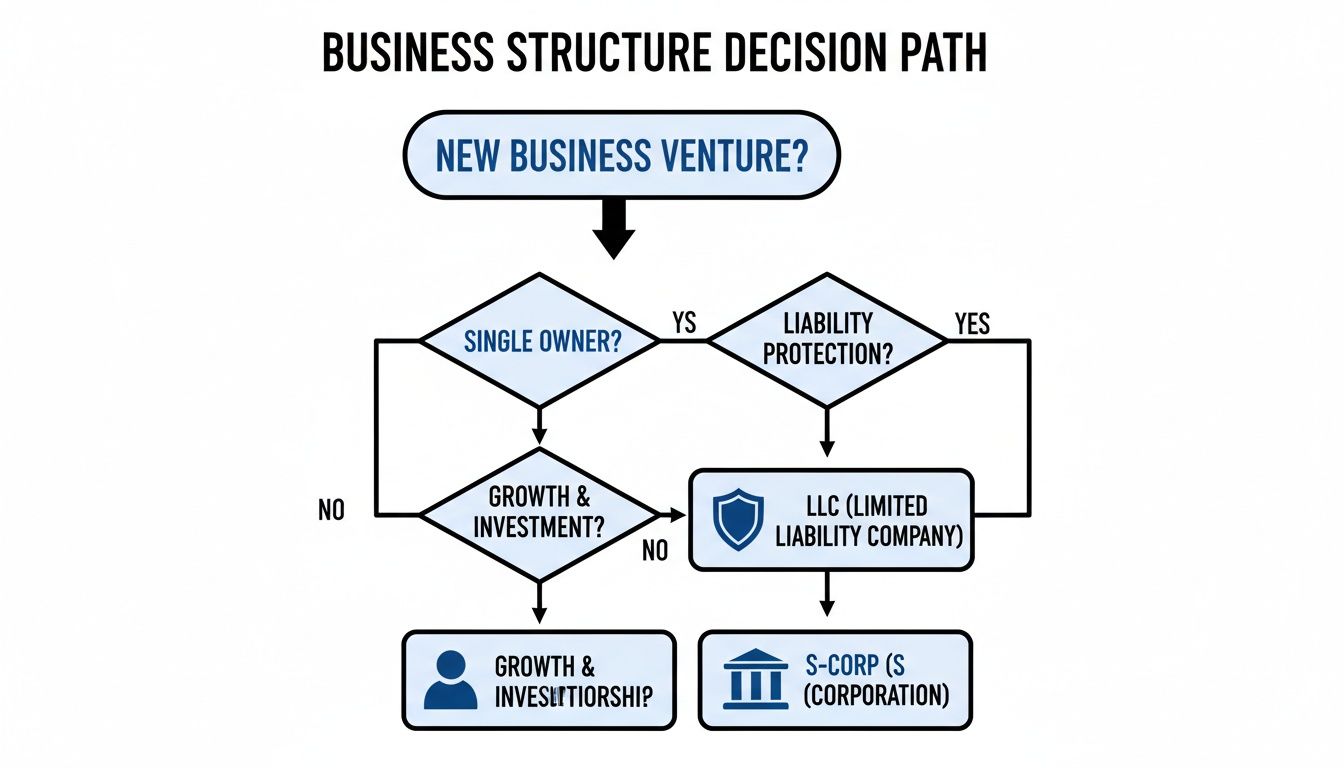
As you can see, a Sole Proprietorship is the simplest to launch, but an LLC is often the smarter move. It creates a vital firewall between your business and personal assets—a crucial layer of protection when you're out on the road.
Finding Freight and Managing Daily Operations

Alright, your business is legal, your truck is ready, and the open road is calling. Now comes the real work: keeping those wheels turning with freight that actually pays the bills. This is the part of the job where being a sharp business owner is just as important as being a great driver.
Finding good loads and running your daily operations like a well-oiled machine is what separates the owner-operators who thrive from those who just survive. It all boils down to your ability to work the market, negotiate solid rates, and keep a tight grip on your costs.
Let's dig into how you make that happen.
Mastering the Art of Finding Loads
When you're just starting out, your lifeline to the freight world is the spot market, which you'll tap into using load boards. Think of these as digital marketplaces where brokers post jobs and carriers like you can find them. They're essential for getting your business off the ground and cash flowing in.
But here’s a rookie mistake to avoid: don't just grab the first cheap load you see to stay busy. You have to know your numbers. Before you even look at a board, you need to have your cost-per-mile (CPM) calculated down to the penny. That number is your absolute floor—anything less, and you're literally paying to haul someone else's freight.
You'll be pulling loads from a few main sources:
- Load Boards: These are your go-to for finding opportunities, checking what rates are like in different lanes, and plugging any gaps in your schedule.
- Freight Brokers: The middlemen connecting shippers to trucks. Finding and building a solid relationship with a handful of good brokers can become your source for consistent, quality work.
- Direct Contracts with Shippers: This is the ultimate prize. Landing a direct contract means you’ve cut out the broker, which almost always means better rates and a more predictable schedule.
Building Relationships with Freight Brokers
While load boards get you started, you don't want to live there forever. The smart move is to start building real relationships with freight brokers. A good broker gets to know you, your truck, and where you like to run. Eventually, they’ll start calling you with loads before they even post them for everyone else to see.
How do you build that trust? Simple. Be a pro. Communicate everything clearly, be on time for pickups and drops, and send updates before they have to ask. Brokers remember the drivers who make their lives easier and will reward that reliability with better freight.
The freight market is a roller coaster. When it’s hot, you might see 200 loads available for every one truck. When it cools off, that can plummet to just 60 loads, with rates to match. Independent operators feel these swings the most, but the ones who consistently come out on top are those who are obsessive about fuel economy and maximizing their loaded miles.
Optimizing Your Daily Operations
Finding a good load is only half the job. The other half is running that load as profitably as possible. Every single decision you make out there—from where you buy fuel to how you drive—eats into your profit margin.
Here's where smart habits make a huge difference:
- Plan Your Route Strategically: Don't just blindly follow the GPS. Look at the big picture. Are there major cities you can bypass during rush hour? Is there a route with fewer steep grades? Where are the cheapest fuel stops? A few minutes of planning can save you serious time and money.
- Manage Your Fuel: Fuel is easily your biggest and most volatile expense. Use a good fleet fuel card for discounts, cut down on idling, and find that sweet spot with your speed. These small changes can add up to thousands of dollars in savings over a year.
- Be Proactive with Maintenance: Downtime is the ultimate profit killer. A truck that isn't moving isn't making money. Stick to a rigid maintenance schedule for everything—oil, tires, brakes. Catching a small problem before it becomes a major breakdown on the side of the highway is key.
- Stay Compliant and Log Properly: Hours-of-Service (HOS) rules are not suggestions. Your Electronic Logging Device (ELD) is your best friend here. Managing your clock effectively keeps you safe, legal, and efficient. As you learned in training, this is non-negotiable. If you need a refresher, our guide on Entry-Level Driver Training (ELDT) standards walks through these core requirements.
When you pair smart load selection with disciplined, efficient operations, you build a business that can handle the market's ups and downs and stay profitable for the long haul. That’s the true mark of a successful owner-operator.
Burning Questions for Future Owner-Operators
Making the leap from company driver to owner-operator is a huge decision, and it’s natural to have a ton of questions. Even after you’ve done your research, the real-world, rubber-meets-the-road concerns are what keep you up at night. Let's tackle some of the most common ones I hear from drivers looking to go out on their own.
How Much Cash Do I Really Need to Get Started?
This is the big one, and there's no single answer, but you need a realistic number in your head. Forget what you see on social media; to do this right and give yourself a fighting chance, you should have $15,000 to $40,000 in the bank. And no, that’s not just for the truck.
That startup fund gets eaten up fast. Here’s a typical breakdown of where that money goes:
- Truck Down Payment: Lenders will want to see you have skin in the game. Plan on putting down 10% to 25% of the truck's price.
- Insurance Down Payment: This is a big one that surprises a lot of new owner-operators. You'll likely have to pay a hefty chunk of your annual premium upfront, often $3,000 to $5,000.
- Plates and Permits: Getting legal isn't cheap. Your IRP plates, IFTA decals, and other permits can easily run you $2,000-$3,500.
- "Oh Crap" Fund: This is non-negotiable. You need an emergency stash of at least $5,000 to $10,000 for when a tire blows, your alternator dies, or you hit a slow freight week.
Starting on a shoestring budget is a recipe for disaster. Having this capital means you can handle the inevitable bumps in the road without going broke in your first six months.
Is Being an Owner-Operator Actually Worth It?
Honestly, that depends entirely on you. Can you make great money? Absolutely. Top-tier owner-operators can gross well over $200,000 a year. You're the boss, you set your home time, and you're building equity in a major asset. The freedom is real.
But that freedom has a price. You're not just a driver anymore; you're the CEO, the accountant, the mechanic, and the dispatcher. Every single expense—fuel, tires, insurance, repairs—comes out of your pocket. The stress of keeping that truck moving and profitable is immense. It’s a high-risk, high-reward game.
The drivers who truly make it are the ones who think like business owners first and drivers second. They live by their spreadsheets, track every penny, and are obsessed with keeping their cost-per-mile as low as possible.
How Much Experience Do I Need Before I Make the Jump?
I can't stress this enough: jumping into your own truck too soon is one of the fastest ways to fail. There's no law, but the unwritten rule—and what most lenders and insurance companies demand—is two to three years of clean, verifiable OTR experience as a company driver.
Think of that time as your paid apprenticeship. It's where you learn the ropes for real—how to manage your clock in bad weather, deal with shippers from hell, find a safe place to park at 2 a.m., and build a flawless driving record. If you rush this part, you won't have the street smarts or the history to get decent financing and insurance.
Can I Pull This Off with Bad Credit?
It’s tough, but not a deal-breaker. Forget about walking into a traditional bank; they'll likely show you the door. You’ll need to look for specialized lenders who work with truckers, but they're going to want to see you make up for that low credit score in other ways.
To even have a shot, you’ll probably need:
- A much bigger down payment, think 25% or more.
- A squeaky-clean driving record and a stable work history.
- A rock-solid business plan that shows you know your numbers.
Be prepared to pay a much higher interest rate, too. Lease-purchase programs are another option, but you have to read every word of that contract to avoid getting trapped in a predatory deal.
No matter where you're at, it all starts with having the right license and a firm grasp of the rules. It never hurts to refresh your memory on the fundamentals, like studying for the CDL general knowledge test, to ensure your foundation is solid.
Ready to take the first step toward the driver's seat of your own career? At Patriot CDL, we provide the expert, hands-on training you need to earn your CDL and build the foundation for a successful future as a professional truck driver.
Learn more and enroll in a program today at https://patriotcdl.com