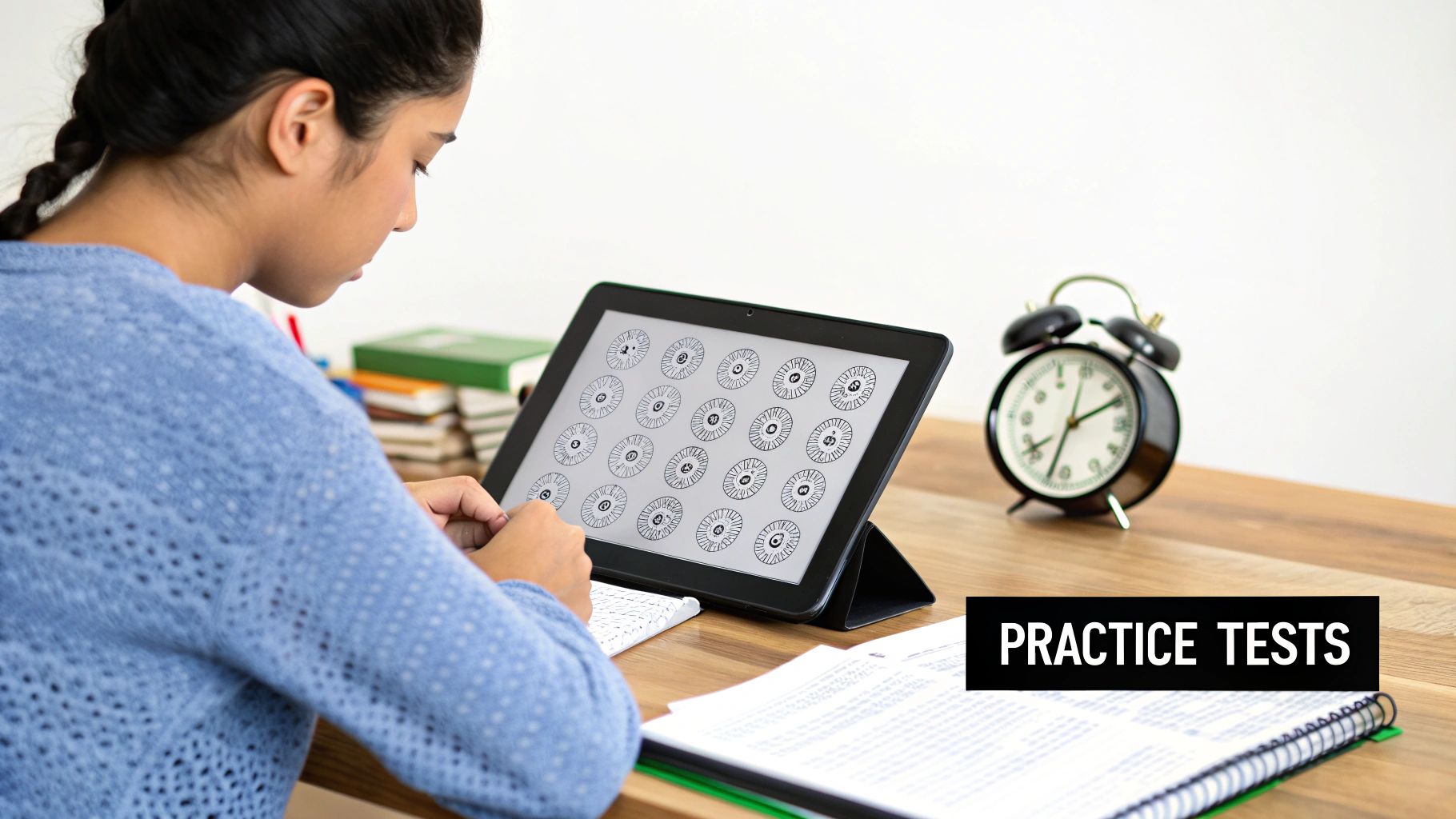
If you want to ace your CDL passenger endorsement test, there’s no better way to prepare than by taking practice exams. Think of them as a full dress rehearsal for the real thing. They’re built to mimic the official test, so you get a feel for the question formats and can root out any weak spots before you sit for the actual exam.
Why Practice Tests Are Your Secret Weapon
Getting your Passenger (P) endorsement opens the door to driving buses, shuttles, and other vehicles carrying multiple people. It’s a huge step in your career, but just reading the CDL manual from front to back won't cut it. Practice tests are what really bridge the gap between knowing the rules and knowing how to apply them when it counts.
By simulating the pressure of the real exam, you’re forced to think on your feet and recall information quickly. It’s about more than just memorizing facts; it’s about building the confidence to walk into that testing center knowing you're ready for whatever they throw at you.
Move Past Just Memorizing Facts
The official P endorsement exam is smart. It won’t just ask you to spit back regulations. Instead, it will drop you into realistic scenarios that test your split-second judgment and your grasp of safety protocols. A good practice test does the exact same thing, pushing you beyond basic memorization.
When you work through these scenario-based questions over and over, you start training your brain to see the patterns and apply the right rule without even thinking about it. This kind of active learning sticks with you far better than just passively reading a book.
It’s like the difference between reading a manual on how to drive a bus and actually sitting in the driver's seat. The practice test is your simulator, and it’s a crucial piece of the puzzle that supports everything else you’ll study for the main CDL exam. For more on that, check out our General Knowledge Test guide.
Find and Fix Your Weak Spots
A passenger endorsement qualifies you to operate vehicles built for 16 or more people (yourself included). To earn it, you absolutely have to master critical safety topics—everything from pre-trip inspections and prohibited practices to handling special equipment.
This is where a practice test really shines. It gives you instant feedback, showing you exactly which topics are tripping you up. Instead of wasting time re-reading the whole manual, you can zoom in on the specific areas where you need to improve.
- Vehicle Inspections: Are you stumbling on questions about checking emergency exits or ensuring ADA equipment is secure and functional?
- Passenger Management: Do you get confused about the proper procedures for handling a disruptive passenger or stowing luggage correctly?
- Emergency Procedures: Could you confidently answer questions about evacuating the vehicle or navigating railroad crossings with passengers on board?
This targeted study method makes every minute count. You’ll be shoring up your knowledge where it matters most, ensuring you’re truly prepared for test day.
Taking Apart the Passenger Endorsement Test
Before you dive into any cdl with passenger endorsement practice test, you've got to understand what you're up against. The official P endorsement exam isn't just a random quiz. It’s a very specific test built to make sure you grasp the massive responsibility that comes with transporting people. Getting a feel for its structure is your first real step toward passing.
The whole test is designed around the real-world situations and federal rules you'll live by on the job. They aren't trying to trick you; they just need to know you have the knowledge to keep passengers safe, no matter what.
Pre-Trip Vehicle Inspections
A big chunk of your test will focus on pre-trip inspections, but with a passenger-focused spin. Sure, every commercial driver inspects their rig, but you'll be quizzed on the parts unique to buses. This is where being detail-oriented really pays off.
You'll have to prove you know how to inspect all the safety and emergency gear that you wouldn't find on a standard semi-truck. Your practice tests are going to hit these points hard:
- Emergency Exits: You need to know how to check every emergency exit—roof hatches, windows, you name it—to make sure they work correctly and aren't damaged.
- Passenger Seating: Expect questions about making sure every single seat is bolted securely to the floor.
- Public Address Systems and Communication: You’ve got to know how to confirm the PA system is working for making announcements.
- Handrails and Stanchions: The test will check if you know how to inspect these for sturdiness and safety.
These aren't just boxes to tick on a form. A stuck emergency exit or a wobbly handrail can cause serious problems, which is why the exam puts so much emphasis on them.
The table below breaks down the key knowledge areas you'll need to have down cold.
Core Knowledge Areas for the P Endorsement Exam
| Topic Area | Key Focus Points |
|---|---|
| Vehicle Inspection | Knowing how to inspect emergency exits, seating, PA systems, and handrails. |
| Loading & Unloading | Proper procedures for boarding and exiting, managing baggage, and ensuring clear aisles. |
| On-the-Road Safety | Stricter rules for railroad crossings, managing passengers, and avoiding distractions. |
| Emergency Procedures | Handling evacuations, accidents, and knowing when and where to stop. |
| Prohibited Practices | Unbreakable rules like fueling with passengers on board or towing a disabled bus. |
Mastering these topics will put you in a great position to not only pass the exam but to be a competent, safe driver from day one.
Safe Loading and On-The-Road Protocols
Once you've cleared the vehicle for service, your focus shifts to managing your passengers and driving safely. The test will throw different scenarios at you to see how well you handle loading, unloading, and a moving bus full of people. This part of the test is a direct reflection of what you’ll be doing every single day.
The name of the game here is proactive safety. The exam is trying to see if you can spot potential problems involving passengers before they happen and use the right procedures to prevent them.
For instance, you'll definitely get questions about baggage. You have to know that aisles and stairwells must stay completely clear—no exceptions. You also need to be an expert on the rules for railroad crossings, which are much stricter for passenger vehicles. While some general CDL requirements apply everywhere, the P endorsement adds a whole new layer of responsibility.
Prohibited Practices and Special Situations
Finally, the test will make sure you know the absolute "no-go" actions. These are the things you are strictly forbidden from doing. Honestly, these are often the easiest points to get on the test if you just memorize them, because the rules are black and white.
You can bet you'll be tested on these key prohibited practices:
- Fueling: You cannot fuel your bus with passengers on board. The only exception is in an absolute emergency, and even then, you have to follow very specific safety steps.
- Towing or Pushing: You are not allowed to tow or push a disabled bus if there are passengers inside, unless getting them off the bus would be even more dangerous.
- Driver Distractions: The exam will cover the strict rules against having long chats with passengers or doing anything else that distracts you while the bus is moving.
Knowing these rules isn't just about passing a test. It's about building the solid, professional habits that will protect you, your career, and every person who trusts you to get them to their destination safely.
Getting the Most Out of Your Practice Test
Just running through a cdl with passenger endorsement practice test isn't enough to get you across the finish line. There’s a strategy to it, and a smart, disciplined approach is what really separates the drivers who pass from those who don't. The secret is to treat every single practice session like it’s the real deal at the DMV.
So, where do you start? First, set the scene. Don't try to cram in questions while you're on the couch with the game on. Find a quiet spot, silence your phone and stick it in another room, and give yourself a strict time limit. This gets you used to the focus and pressure you'll feel when it actually counts.
How to Tackle the Questions Like a Pro
When you start the test, your mission isn't just to fly through the questions—it's to be dead-on accurate. You have to read every question carefully, and I mean every single word. Read it twice if you have to. The official exam is notorious for using tricky wording to check if you're paying attention. Keep an eye out for absolute words like "always," "never," or "except."
A classic mistake I see all the time is drivers picking an answer because it looks vaguely familiar, without really processing the question itself. If you hit a question and are genuinely stumped, make your best-educated guess instead of just clicking randomly. More importantly, flag it so you can circle back to it when you review your results. This isn't just about answering questions; it's about building the mental muscle for test day.
The Smart Way to Break Down Your Results
Alright, you've finished the test. Now the real work begins. Your score is just a number. Seeing 85% is nice, but the gold is hidden in that 15% you missed.
Don't just look at the right answer and nod. That’s a waste of a good mistake. For every single question you got wrong, you need to grill yourself with these three questions:
- Why did I get this wrong? Was it a simple misread? Did I not understand a specific term? Or did I just not know the rule?
- Why is the correct answer the right one? You need to be able to connect that answer back to a specific regulation or safety concept in the CDL manual.
- How am I going to make this stick? Maybe you need to make a flashcard. Or maybe you need to re-read that chapter on vehicle inspections. Whatever it is, make a plan.
This kind of deep dive turns a mistake from a point-deduction into a powerful lesson. It's a fundamental part of the structured training that prepares drivers for success. For those who want more hands-on guidance, a dedicated CDL training program offers the expert instruction to really nail these concepts.
The point of a practice test isn't to get a perfect score. The point is to find every single hole in your knowledge and patch it before you walk into the testing center.
By following this review process, you ensure you won't get tripped up by the same thing twice. You're not just hoping for a better score on the next attempt; you're actively building the solid foundation you need to pass with confidence. This is how you transform a simple quiz into your single most effective study tool.
Turning Your Results Into a Targeted Study Plan
Getting a low score on a CDL with passenger endorsement practice test isn't a failure—it's feedback. I tell all my students to think of it as a diagnostic tool, a map that shows you exactly where to focus your energy. Instead of just re-reading the entire manual cover-to-cover, you can now zero in on the specific topics that are tripping you up.
The first thing to do is stop looking at your score as a simple pass or fail. Dig into the questions you got wrong. Every single mistake falls into a specific category, and that's your golden ticket to studying smarter, not harder.
This breakdown shows a simple but powerful process to use after every single practice test you take.
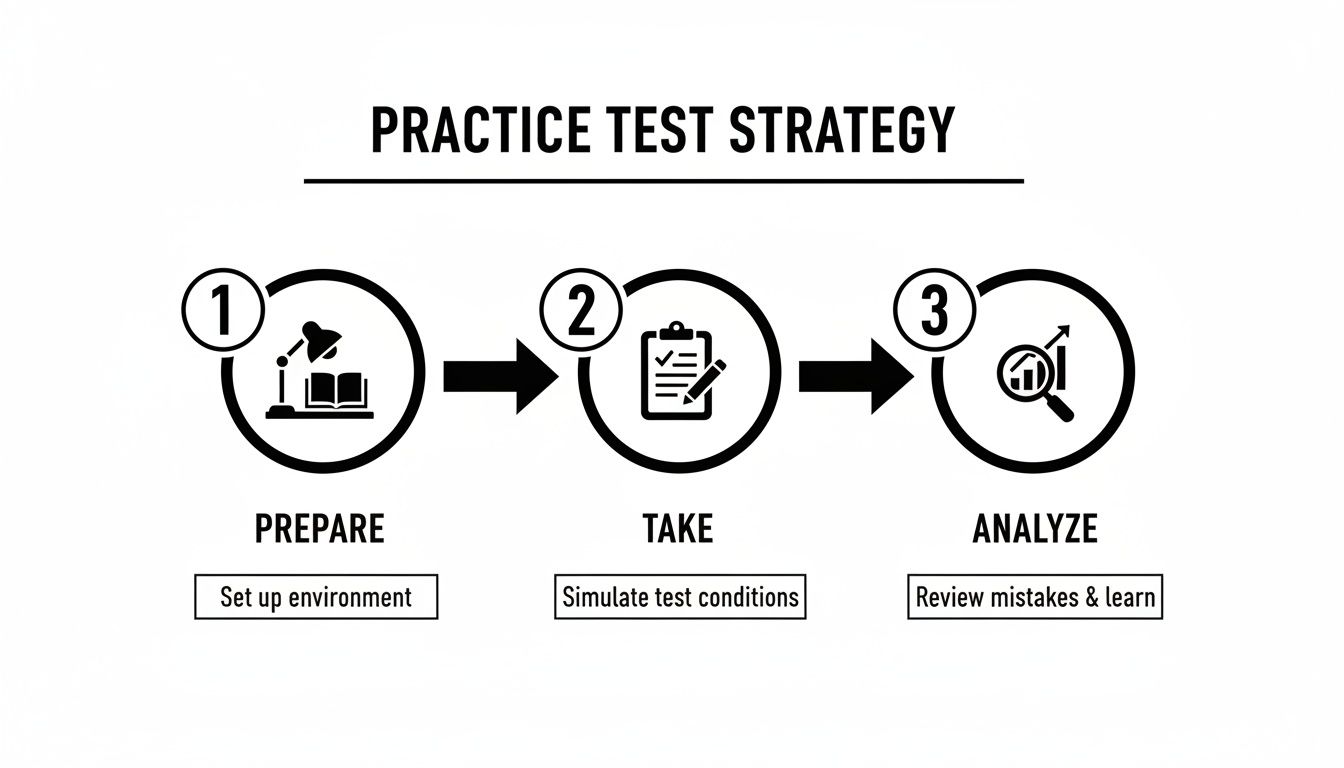
Remember, just taking the test is half the battle. The real learning happens when you sit down and analyze your results.
Identify Your Weakest Areas
Grab a piece of paper or open a note on your phone and start a simple tally. Did you miss three questions on emergency procedures, but only one on prohibited practices? That pattern tells you a story. Your time is far better spent drilling emergency protocols than going over rules you already know cold.
Group your mistakes into the main knowledge areas:
- Vehicle Inspection: Anything about checking emergency exits, ADA lifts, seats, or tires.
- Passenger Management: Questions on handling baggage, dealing with unruly riders, or making proper announcements.
- Safety & Emergency Procedures: Scenarios involving evacuations, what to do at railroad crossings, or handling an accident.
- Prohibited Practices: The absolute "never do" rules, like fueling with passengers on board.
Once you spot a clear pattern—maybe you're consistently fumbling inspection questions—you know exactly what to hit in the manual. This methodical approach is more important than ever, especially with federal and state agencies cracking down on compliance.
Just look at the recent audits. The FMCSA has found instances where a high percentage of sampled non-domiciled CDL records were issued in violation of federal law. That kind of scrutiny means there's zero room for error, and you have to be perfectly prepared.
Create Targeted Study Drills
Now that you know your weak spots, it's time to get active. Passive reading won't cut it. You need to create "study drills" that force the correct information to stick. This is way more effective than just glazing over a chapter for the third time.
Your goal isn't just to memorize the answer. It's to understand the why behind it. A good study drill makes you actively recall and apply the information, which is exactly what you'll do on the real test.
Here are a few drill ideas I give my students:
- Weakness: Vehicle Inspection. From memory, recite the entire pre-trip inspection for a passenger bus out loud. Don't just list the parts; explain what you're looking for. "I'm checking the emergency exit windows to ensure they open freely and the warning buzzer works."
- Weakness: Emergency Procedures. Write down three different emergency scenarios (like an engine fire, a disruptive passenger, or a medical issue). For each one, write out a step-by-step list of the actions you would take, using the CDL manual as your guide.
- Weakness: Passenger Management. Explain the rules for stowing baggage to a friend or family member. Pretend they're a new passenger and you need to be perfectly clear and confident.
Sometimes, a specific weakness might require a bit of extra training. For instance, if you're struggling with concepts related to different vehicle setups, our guide on the E-Restriction Removal Course can offer some valuable insights. By actively drilling your problem areas, you'll turn those weaknesses into strengths and walk into test day ready for anything.
Preparing for Test Day and Your Career Ahead
You've put in the hours and hammered through every cdl with passenger endorsement practice test you can find. Now it's time to bring it all home. The final 24 hours before your official exam are crucial, and how you approach them can be the difference between a pass and a fail.
Your top priority the night before? Rest. Seriously. Fighting the urge to cram all night is one of the smartest things you can do. A good night's sleep ensures your brain is sharp and ready to access all the information you've worked so hard to learn.
Your Test Day Checklist
On the morning of the exam, a little bit of prep work will do wonders for your nerves. Getting your documents in order means one less thing to worry about, letting you focus entirely on the questions ahead. You don't want to get turned away at the door over a missing piece of paper.
Run through this quick checklist before you head out:
- Essential Documents: Grab your driver's license, Social Security card, and any other ID your state requires.
- Proof of Residency: Have your utility bills or other accepted documents ready to prove your address.
- Testing Center Confirmation: Give the address and your appointment time one last look. Make sure you know their rules.
- Eat a Good Meal: A solid breakfast will keep your energy levels steady and your mind from wandering.
Try to get to the testing center about 15-20 minutes early. This gives you a nice cushion to check in, find the restroom, and just take a deep breath before you start. It’s a simple trick that really helps settle the nerves.
Beyond the Test: A World of Opportunity
Passing your P endorsement exam is a major milestone, but it's really the starting line for a rewarding career. This endorsement unlocks a wide range of stable jobs in an industry that's always moving. Your training prepares you to handle everything from city buses to more specialized vehicles, like a high-end Mercedes limousine bus.
The world of commercial driving is here to stay, and it offers real job security. With a large number of CDL drivers employed in the United States and the average driver age being over 45, there's a real need for fresh, well-trained professionals to get behind the wheel.
Your Passenger endorsement is more than just a credential; it's a mark of a professional trusted with people's safety. That responsibility brings with it a stable and fulfilling career.
Every practice scenario, from pre-trip inspections to dealing with difficult passengers, was designed for this moment. Walk into that test with confidence. You didn't just study for this—you've trained for it. Good luck
Common Questions About the Passenger Endorsement Test
As you get closer to test day, a few last-minute questions always seem to surface. That's completely normal. Getting these questions answered can make all the difference, helping you walk into the testing center feeling confident and ready.
Let's clear up some of the most common things drivers ask right before taking the real deal.
How Many Questions Are on the Test?
Everyone wants to know what they're up against. The federal standard for the passenger endorsement test is 20 multiple-choice questions. To get a passing grade, you'll need to answer at least 16 of them correctly, which comes out to an 80% score.
While this is the national benchmark, it's always a good idea to quickly check your state's official CDL manual just in case there are minor differences. But for your practice runs, aiming to consistently score above 80% on a 20-question test is a solid strategy.
Can I Take the Official Test Online?
This one trips a lot of people up, especially since we do everything online these days. While you can—and should—take plenty of practice tests online, the official CDL knowledge tests must be taken in person.
You’ll have to go to a certified DMV or a state-approved testing facility. This is all about maintaining the integrity and security of the exam.
Think of online practice tests as your sparring sessions. They're where you learn, make mistakes, and build your skills. The in-person test is the main event where you put all that training to work.
What Happens If I Fail the P Endorsement Test?
First off, don't panic. Failing isn't the end of the road. It's a setback, but a temporary one.
Most states will let you retake the test, though there's usually a waiting period. This could be just one day or maybe a week, depending on your state's regulations. You'll also likely have to pay a retesting fee.
If you do come up short, use that waiting time wisely. Dive back into your practice test results, figure out exactly what went wrong, and zero in on those weak spots. If you're unsure about the next steps, getting in touch with experts who can guide you is a great way to get personalized advice.
Is a Passenger Endorsement the Same as a School Bus Endorsement?
Good question. They are closely related, but they are not the same thing.
- The Passenger (P) endorsement is the general credential. It's what you need to drive any vehicle designed to carry 16 or more people (including you, the driver). Think city buses, tour buses, and airport shuttles.
- The School Bus (S) endorsement is a specialized certification built on top of the P endorsement. It comes with extra requirements, like a more in-depth background check and specific knowledge about safely transporting children.
The key thing to remember is that you absolutely must have your P endorsement first before you can even think about getting the S endorsement.
At Patriot CDL, we provide the hands-on training and expert guidance you need to pass your exams and launch a successful driving career. Learn more about our accelerated programs at https://patriotcdl.com.