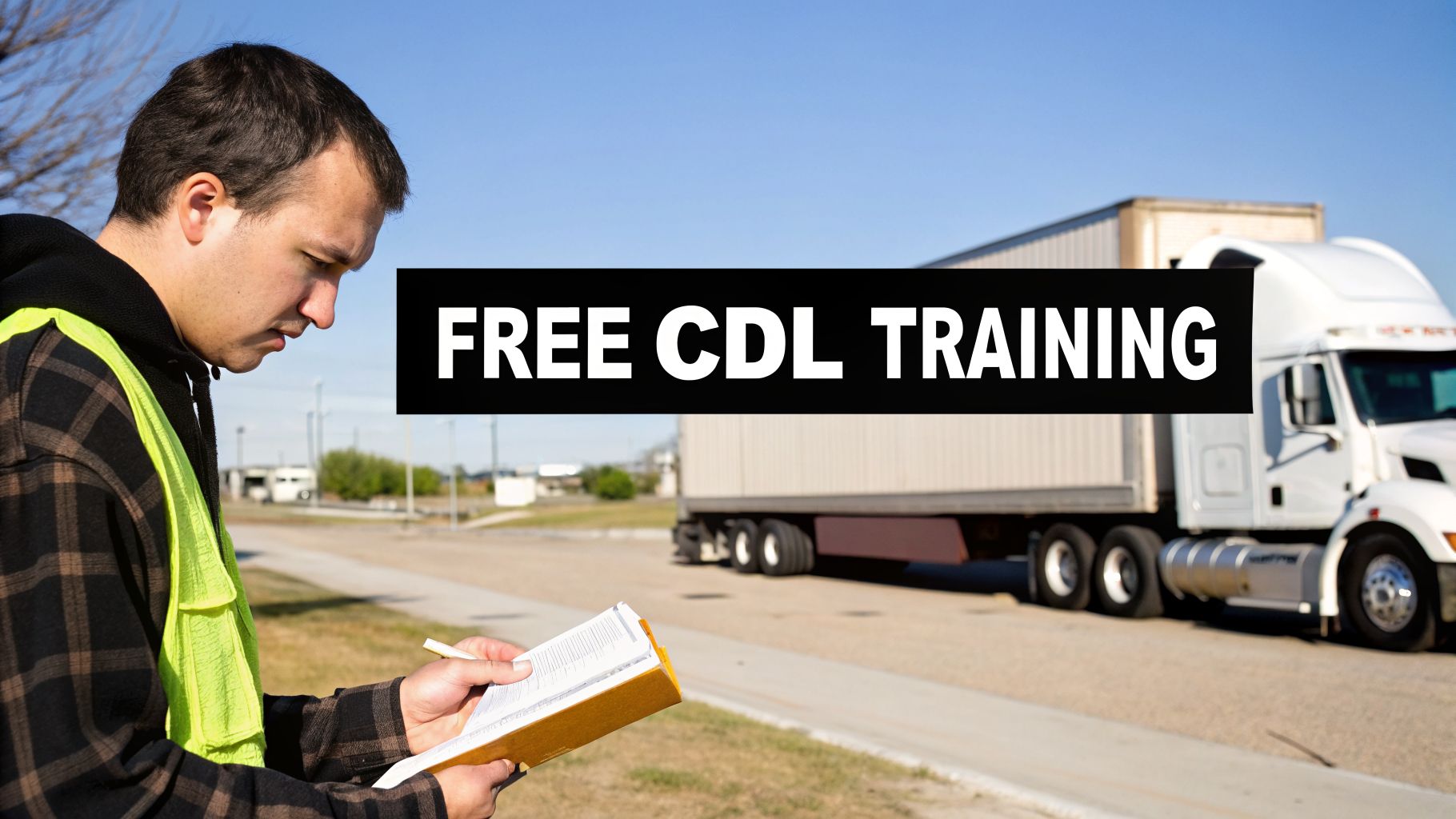
So, you’re wondering if you can get your Class C CDL training for free. The short answer is yes, but it’s rarely as simple as just showing up and getting a license without any strings attached.
Let's break down what "free" really means in the world of commercial driving.
Understanding What "Free" CDL Training Really Means
Getting a Class C license is your ticket to driving smaller commercial vehicles like shuttle buses, large passenger vans, and some straight trucks. The biggest roadblock for most people is the upfront cost of training school, which makes the promise of free programs sound pretty great.
But you have to look closely at the fine print. Most "free" training opportunities fall into one of two buckets: company-sponsored programs or government-funded grants.
The Company-Sponsored Route: A Job Contract in Exchange for Training
This is the most common path you'll find. A company that desperately needs drivers—think large transport, delivery, or passenger service companies—will offer to pay your tuition. In the industry, we call this contract training.
Sounds good, right? Here’s the catch: in exchange for covering your costs, you have to sign a contract to work exclusively for them for a set period. This commitment usually lasts anywhere from nine to 24 months.

It’s a direct pipeline to a job, which is a huge plus. But it does lock you in.
Think of it this way: you’re trading your short-term freedom to choose an employer for a debt-free start. If you decide to leave before your contract is up, you’ll almost certainly have to pay back the full tuition, which can easily run several thousand dollars.
Truly Free Training: Finding Government Grants
Now for the even better news. There are programs out there that are genuinely free, with no employment contract required. These are typically funded by government grants designed to help people enter high-demand fields.
These are the gold standard of free training because once you’re certified, you are a free agent. You can work for anyone you want.
Here’s where to look for these opportunities:
- Workforce Innovation and Opportunity Act (WIOA): These federal grants can cover 100% of your training costs if you meet the eligibility criteria.
- State and Local Grants: Check with your local workforce development board. Many states offer their own funding to tackle driver shortages in the region.
- Veterans' Benefits: If you’ve served, your GI Bill benefits can often be used to pay for CDL school at an approved institution.
The application process for grants can be a bit more intensive, but the payoff is huge. Having the freedom to choose your job right out of school is a major advantage. To get a better sense of how these work, it's helpful to research general free job training programs to see the kinds of requirements involved.
Of course, before you go down any of these paths, make sure you meet the fundamental qualifications. You can review our guide on CDL requirements to see if you're ready.
Finding Company-Sponsored CDL Programs
You’ve probably seen the ads from big carriers: "Get your CDL for free!" It’s one of the most visible ways to get free Class C CDL training, and for good reason. With a constant need for new drivers, many trucking companies will pay your tuition upfront if you agree to work for them. This deal, known as company-sponsored or contract training, can be your ticket straight into a new career.
But let's be clear: "free" rarely ever is. When you accept the offer, you’re also signing an employment contract that locks you in with that company for a set period of time.
How Contract Training Works
On the surface, the arrangement is simple. The company covers your training costs, and in return, you commit to driving for them afterward. The length of that commitment is the most important part of the deal. Most contracts will require you to stay for 9 to 12 months, but I’ve seen some that stretch out for two full years.
If the company is a great fit for you, this can be a fantastic setup. You get your training paid for and have a job waiting the second you pass your CDL exam. It takes all the stress out of the post-graduation job hunt.
But what happens if the job isn't what you were sold on? That's where the risk kicks in.
If you break that contract for any reason—you quit, you're fired, or a family emergency pulls you off the road—you are almost always on the hook for the entire cost of your training. This isn't just paying back the tuition; they often tack on administrative fees and hefty interest.
The Financial Risks of Breaking a Contract
Let's walk through a real-world scenario I’ve seen happen more than once. A new driver signs a one-year contract for sponsored training valued at $5,000. Three months in, they realize the long-haul routes are keeping them away from home way more than the recruiter promised, and they decide to quit.
The company immediately sends a bill for the full $5,000. If the driver can't pay it right away, interest starts piling up, sometimes at rates as high as 19%. All of a sudden, that "free" training has snowballed into a major debt that can wreck your credit score.
As the experts at Roadmaster Drivers School have noted, many carriers offer this kind of training but demand absolute loyalty in return. Bailing early means you could owe the full tuition plus interest, a sharp contrast to genuinely free options like federal grants, which never require repayment.
What to Ask Before You Sign
To avoid a bad situation, you have to be your own biggest advocate. Before you put your name on any contract, you need to go in armed with questions and be ready to read every single line of the fine print.
Here are the non-negotiable questions you must ask the recruiter:
- What is the exact dollar value of the training I'll be responsible for if I leave before the contract ends?
- What is the precise length of the employment contract, down to the exact end date?
- What happens if I fail the CDL exam? Am I still on the hook for any training costs?
- Can I get a complete copy of the employment contract to review before I agree to anything?
Asking these tough questions upfront is the best way to protect yourself from a financial nightmare down the road. A reputable company with a good program will have no problem answering them clearly. If a recruiter gets dodgy or tries to rush you into signing, that’s a massive red flag.
While these programs can get you into the industry, paid training programs often provide more freedom and a much faster start. You can learn more about our accelerated CDL program options to see how they compare.
Tapping into Government Grants for Truly Free Training
Company-sponsored training sounds great on the surface, but it almost always comes with a major catch: a long-term work contract. If you're looking for free Class C CDL training without those strings attached, your best bet is to explore government-funded programs. States and the federal government often set aside money to help fill critical jobs, and truck drivers are always in high demand.
This path is different from signing on with a big carrier. With a sponsored program, you're essentially trading your tuition for a work commitment.

As you can see, the process locks you into one company right from the start. Government grants, on the other hand, give you the freedom to choose your own path after you’re certified.
To give you a clearer picture, here’s a breakdown of the most common ways people get no-cost CDL training.
Types of Free Class C CDL Training Programs
| Training Type | How It Works | Typical Commitment | Primary Pro | Primary Con |
|---|---|---|---|---|
| Company-Sponsored | A trucking company pays for your training upfront. | 1-2 year employment contract. | Guaranteed job placement after training. | You're locked into one employer; leaving early means repaying tuition. |
| Government Grants | Federal or state funds cover your tuition costs at an approved school. | None. No work commitment is required. | Total freedom to choose your employer after graduation. | Competitive application process and eligibility requirements (income, etc.). |
| Veteran Benefits | The GI Bill or other military benefits pay for your training at a VA-approved school. | None. You earned these benefits through service. | Uses your existing benefits to get top-tier training at no cost. | Only available to eligible veterans and service members. |
Each option has its trade-offs, but for complete career flexibility, nothing beats a grant.
Finding and Applying for Government Grants
Unlike a company contract, a grant is money you don't have to pay back. It covers your tuition, and once you have your CDL, you’re free to work for any company you want.
The biggest program out there is the Workforce Innovation and Opportunity Act (WIOA). WIOA is a federal initiative designed to help people get the skills they need for high-demand jobs. If you're unemployed or underemployed, you might qualify. The first step is always to get in touch with your local American Job Center or county workforce development board.
Fair warning: grant applications can feel a lot more complicated than signing a company training contract. But the payoff is huge—graduating with zero debt and total control over your career is a massive advantage.
State-Level Programs and Veteran Benefits
Many states are also putting their own money on the table to get more drivers on the road. Iowa, for example, recently invested $4.84 million into its community colleges to train more than 1,300 new drivers a year. These state programs often partner with local schools to offer top-notch training completely free of charge.
If you’re a veteran, don't forget about your GI Bill. A lot of great truck driving schools are VA-approved, meaning you can use your benefits to cover the entire cost of tuition and walk away with your CDL for no out-of-pocket expense.
Here’s where to start looking for these opportunities:
- Find Your Local Workforce Board: Just search for "[Your County] workforce development board" to find the office that serves your area.
- Check the Requirements: Every program is different. Eligibility is often based on your income, employment status, or military service.
- Get Your Paperwork Ready: You’ll likely need to show proof of who you are, where you live, what you earn, and your current driving record.
The process can seem a little bureaucratic at times, but the people at these centers are there to guide you. They want you to succeed. Just know that funding can change and programs vary by location. For instance, our neighbors to the north have programs like the Alberta Class 1 Learning Pathway Grant that offer similar financial aid.
Securing a grant is one of the smartest ways to kickstart your career. For a deeper dive into the rules and programs in specific areas, check out our guide on CDL training in California.
On paper, "free Class C CDL training" sounds like a no-brainer. But as someone who's seen countless aspiring drivers go this route, I can tell you it often comes with hidden strings attached. The biggest risk isn't about money—it's about wasting weeks or even months of your time on a program that doesn't get you to the finish line.
The truth is, many of these no-cost programs are plagued by shockingly high dropout rates. When you have no financial skin in the game, it’s a lot easier to walk away when the training gets tough. That "nothing to lose" mentality can quickly turn into a casual attitude, making it easy to quit at the first sign of trouble.
Why Do So Many People Drop Out?
It often boils down to a double-whammy: low student commitment and bare-bones program support. If you haven't invested your own hard-earned money, are you really going to take it as seriously? Some people don't. They might show up late, blow off studying, or just give up after a frustrating day behind the wheel because, hey, it didn't cost them anything.
We see this play out in real-world numbers. Take a look at North Carolina's taxpayer-funded program for school bus driver candidates. Statewide, the completion rate is a mere 46%. It gets even worse in some districts—Wake County Public Schools, for example, reported that only about 25% of the people who signed up actually finished the training this year.
Here’s the bottom line: when you have no financial stake in your own training, the motivation to quit is always going to be higher. A structured environment where you've made an investment in yourself almost always produces better, more consistent results.
There's another angle, too. Some people use these free programs purely as a stepping stone. They get the free license and immediately jump ship to a different company offering better pay, leaving the original sponsor right back where they started—needing more drivers.
The Problem with Bare-Bones Support
Those low completion rates aren't just on the students. They're also a huge red flag about the quality of the program itself. Publicly-funded or company-sponsored "free" programs are often running on shoestring budgets, which means they can't always provide the support you need to actually succeed.
Here’s what that often looks like:
- Overcrowded Classes: When there are too many students for one instructor, you get far less time behind the wheel to practice tricky maneuvers.
- Minimal Follow-Up: If you're struggling with a specific skill, there might be no one available to give you that extra bit of one-on-one help.
- Rushed Schedules: To keep costs down, some programs try to cram everything into an impossibly short timeline, leading to burnout and frustration.
Knowing these pitfalls helps you understand why a quality, structured learning environment is so critical. As you prepare to meet the federal Entry-Level Driver Training (ELDT) requirements, you need a school that's built for your success. You can find more details on the ELDT mandate here to make sure any program you consider is fully compliant.
Ultimately, the best path forward is one that respects your time and commitment by giving you the support you need to not just pass the test, but to launch a successful career.
Is Paid CDL Training a Smarter Investment?
After digging into the realities of "free" CDL training—the high dropout rates, the restrictive contracts, the long waits—you might be wondering if there’s a better path. While the allure of free Class C CDL training is strong, putting a little skin in the game with a paid training school is often the fastest and most direct route to a profitable new career.

Think of it this way: you're making a strategic investment in yourself. When you pay for training, the school works for you. Their success is directly tied to yours, creating a partnership laser-focused on one thing—getting you licensed and on the road with a great job.
Get Your License (and a Paycheck) Faster
The single biggest advantage of a paid program is speed. Company-sponsored training or government grant programs can take months to get started. A dedicated school like Patriot CDL, on the other hand, can get you licensed and ready to work in just a few weeks. That accelerated timeline means you start earning a real salary much, much sooner.
Instead of waiting your turn for a few minutes behind the wheel in an overcrowded class, a quality paid program offers:
- More one-on-one time with experienced instructors who can actually coach you.
- A curriculum built for one purpose: to master everything you need to pass your CDL exam.
- Real support that guides you through getting your permit, scheduling your test, and cutting through the red tape.
This kind of focused environment is designed to see you across the finish line.
Unlock Your Earning Power from Day One
Here’s the part that really matters: graduating from a paid school makes you a free agent. You aren't shackled to a contract with one specific company. This gives you incredible leverage. You can shop around, field multiple offers, and choose the job with the best pay, benefits, and home time.
The numbers don't lie. A driver locked into a company training contract might start around $44,000 a year. A free agent with the exact same license can often find local or regional jobs starting at $50,000, $60,000, or even more.
Your tuition pays for itself, often within the first few months. The pay difference between a contract driver and a free agent can easily top $15,000 in your first year alone.
A Clear Return on Investment
Let's break that down. Say a good paid program costs a few thousand dollars. If it lets you earn an extra $15,000 in your first year, you've not only made your money back—you're thousands of dollars ahead. You aren’t just buying training; you're buying career freedom and immediate access to better jobs.
This is exactly why so many new drivers decide paying for school is the right move. The upfront cost makes sense when you see the long-term financial gain. Rather than spending a year or more in a low-paying contract, you start your career on your own terms.
This same logic applies to experienced drivers who’ve been off the road for a while. Investing in a refresher CDL course is a fast and effective way to sharpen your skills, get current on regulations, and jump back into the industry with confidence.
Common Questions About Class C CDL Training
Getting into the world of professional driving brings up a ton of questions. When you're weighing the pros and cons of free programs versus paid schools, the confusion can really pile up. Let's clear the air and tackle some of the most common things aspiring drivers ask us.
How Is a Class C License Different From Class A or B?
I get this question all the time. The main difference is simply the type of vehicle you’re licensed to drive. Think of it as a ladder, with each class opening up bigger and heavier rigs.
A Class C license is your ticket to driving vehicles built for 16 or more passengers (that includes you, the driver!) or for transporting certain hazardous materials that need a placard.
- Class C: This is perfect for jobs driving shuttle buses, large passenger vans, and some of the smaller HAZMAT trucks.
- Class B: A step up, this lets you operate single vehicles weighing over 26,000 pounds, like dump trucks, box trucks, or city buses.
- Class A: This is the top tier. It covers combination vehicles—think tractor-trailers—with a gross weight of over 26,000 pounds.
What Are the Basic Eligibility Requirements?
The rules can have slight quirks from state to state, but the starting line is pretty much the same everywhere. Before you can even begin your search for free class cdl training, you'll need to have a few ducks in a row.
Generally, you must:
- Be at least 18 years old (or 21 if you want to drive across state lines).
- Have a valid, standard driver's license already.
- Pass a Department of Transportation (DOT) physical exam.
- Show proof of U.S. citizenship or lawful permanent residency.
What Kind of Jobs Can I Get with a Class C CDL?
This is where the Class C really shines for a lot of people. It opens doors to a whole range of local and regional jobs that offer a fantastic work-life balance. You could find yourself driving for airport shuttle companies, hotel transport services, non-emergency medical transport, or community paratransit services.
One of the biggest draws for these roles is that they almost always keep you close to home. Unlike many long-haul Class A jobs, Class C drivers typically enjoy predictable schedules and get to sleep in their own bed every night.
How Long Does Class C Training Take?
The timeline really depends on the route you take. Company-sponsored programs or courses funded by grants at a community college might be spread out over several weeks, sometimes even a couple of months.
On the other hand, accelerated paid programs are built for speed. They're designed to get you skilled, licensed, and ready to work in just a few short weeks.
At the end of the day, choosing the right training path comes down to your career goals and your financial situation. While "free" sounds great, these options often hide long-term commitments or other costs. A dedicated school like Patriot CDL gives you a fast, focused, and affordable path to get on the road and earning money sooner. See how we can jumpstart your driving career by visiting our website.