A lot of people who search for truck driving schools atlanta ga are in the same spot. They’re working a job that pays the bills but doesn’t build much of a future, then they sit in traffic on I-285 or I-20 and start wondering whether the trucks around them point to a better lane.
That thought is practical, not reckless. Atlanta sits in the middle of freight movement, warehouse activity, regional delivery routes, and interstate traffic that never really stops. If you want a career that doesn’t require a four-year degree, CDL training is one of the clearest paths into that world.
Your New Career on the Atlanta Horizon
A career change often starts with a small moment. You’re driving home, boxed in by commuter traffic and tractor-trailers, and you realize those trucks represent a different kind of work. More independence. A skill you can carry anywhere. A job tied to something real, because freight still has to move.

That’s not just a feeling. Atlanta is a major logistics hub for the Southeast, and schools such as TransTech train over 3,000 new truck drivers annually to meet regional demand. Its location near I-85, I-20, and I-285 makes it a strategic center for the trucking industry in this part of the country (https://trans-tech.net/our-locations/atlanta-ga/).
Why Atlanta makes sense for CDL training
The local market matters. In some cities, a CDL can feel like a gamble. In Atlanta, it connects directly to a freight-heavy economy.
A strong school market also gives you options. If you’re comparing schedules, license types, or training formats, you’re not stuck with one provider or one pace. You can review programs in Georgia and see how different routes into the industry line up with your budget, work schedule, and career goals at https://patriotcdl.com/georgia/.
Trucking can offer freedom, but it also carries responsibility. If you want a plain-English look at the serious legal implications of truck accidents, it’s worth understanding that side of the profession before you start training.
The best students I’ve seen don’t enter this business because it sounds romantic. They enter because they want stable work, a marketable skill, and a path they can start now.
Decoding Your CDL Training Options in Georgia
The first real decision isn’t which school to pick. It’s which CDL class fits the work you want.

Class A and Class B are not the same career
Class A CDL training is the broader option. It prepares you for combination vehicles, including tractor-trailers, and usually opens the widest range of freight jobs.
Class B CDL training is different. It applies to single vehicles such as certain straight trucks, buses, and dump trucks. For some students, that’s exactly the right lane, especially if they want more local or route-based work.
Here’s the practical trade-off:
- Choose Class A if you want the broadest job flexibility, including over-the-road, regional, and many freight-focused positions.
- Choose Class B if you already know you want work tied to local delivery, passenger transport, construction support, or other single-vehicle roles.
- Think about endorsements early. Tanker, HazMat, Passenger, and Doubles/Triples can expand your options, but the right endorsement depends on the kind of carrier or employer you plan to target.
Fast programs versus slower formats
Program length matters, but not in the way marketing pages usually frame it.
Some students do well in an accelerated course. If you’re focused, available, and ready to treat training like a full-time job, a shorter program can get you from permit prep to road test quickly. If you need more repetition, have a full-time job, or haven’t been in a classroom in years, a standard pace may fit better.
Practical rule: Don’t ask only, “How fast can I finish?” Ask, “How much wheel time and skill repetition will I get before test day?”
A fast course works when the school has structure. It fails when “accelerated” really means “less individual coaching.”
Match the training to the job
Before you enroll anywhere, decide what your first year should look like.
A simple way to sort it out:
- Start with lifestyle. Home daily, regional, or long-haul.
- Choose the vehicle path. Combination vehicle or single-unit vehicle.
- Ask whether the school trains for the endorsements you may need later.
- Review the actual curriculum, not just the headline promise, at https://patriotcdl.com/program/.
Students waste time when they pick a license first and only later think about the job. The better approach is the reverse. Pick the work. Then pick the license and program that lead to it.
Evaluating Atlanta Schools Beyond the Brochure
Atlanta has plenty of CDL schools. That’s good for students, but it also means weak programs can hide behind polished websites and generic promises.

The market here is mature. Georgia Driving Academy has been operating since 1995, which means over 30 years in the field, and the statewide environment includes at least 34 schools listed on Schneider’s platform. That level of competition gives students choices, but it also means you need a real screening process (https://gda.edu).
What to verify before you visit
The brochure doesn’t matter much. The checklist does.
- Training Provider Registry status: If a school handles entry-level CDL training, verify that it’s properly listed for ELDT purposes.
- Instructor quality: Ask who teaches road work, backing, and pre-trip. A school can have a nice yard and still have weak coaching.
- Truck access: Ask how often students get behind the wheel versus watching other students drive.
- Fleet condition: Late-model equipment isn’t everything, but broken or poorly maintained training trucks usually signal larger problems.
- Recent reviews: Ignore generic praise. Look for specific comments about scheduling, instructor involvement, and test preparation.
Questions that expose weak schools
A good admissions rep can answer direct questions without getting defensive.
Ask these:
- How much time do students spend practicing backing maneuvers?
- How many students are assigned to one instructor or one truck at a time?
- What happens if a student struggles with pre-trip memorization?
- What retest support is available if someone doesn’t pass the first attempt?
- Do you offer a refresher path for drivers returning after time away from the industry? Schools that do often have a more realistic understanding of skill gaps. If that matters to your situation, review what a refresher option looks like at https://patriotcdl.com/refresher-cdl-course/.
A lot of students also learn by seeing the training environment in action. This gives a useful look at what practical CDL instruction can involve:
If a school won’t answer basic questions about truck time, instruction style, or testing support, keep moving.
Red flags you shouldn’t ignore
Some warning signs show up quickly:
- Vague pass-rate talk: If they boast but won’t explain how they teach, that’s a problem.
- No yard visit allowed: You should be able to see the trucks, the range, and the pace of instruction.
- Everything sounds easy: Good schools don’t tell you CDL training is effortless. They tell you it’s learnable, structured, and demanding.
The best school usually isn’t the loudest one. It’s the one that gives clear answers, lets you inspect the process, and treats your training like skilled trade preparation, not a quick sale.
Understanding the True Cost of Your CDL
The biggest pricing mistake students make is comparing advertised tuition instead of total cost to get licensed.
That gap matters in Atlanta. Some schools show a tuition number, but they don’t clearly spell out the full investment. Separate costs can include the DOT medical exam, state testing, and required online coursework, which makes true comparison harder for students trying to budget carefully (https://www.atlantacdltrainingschool.com).
Tuition is only one line item
When you call a school, don’t stop at “What’s your tuition?” That question is too narrow.
Ask for the full path from application to CDL in writing.
Ask for an itemized cost sheet that includes tuition, permit support, required theory coursework, DOT physicals, drug screens, state testing fees, and any materials or retest charges.
If a school can’t provide that, you’re comparing guesswork against real numbers.
What belongs in your cost comparison
Some costs are obvious. Others show up later and catch students off guard.
Use this framework:
- Tuition: The base instructional charge.
- Medical and screening requirements: DOT physical and any required testing tied to enrollment or compliance.
- Testing-related charges: State fees and road test costs if billed separately.
- Course components outside tuition: Online theory or ELDT-related coursework if it isn’t bundled.
- Retest policy: Find out what happens financially if you need another attempt.
- Time cost: A longer program may reduce weekly pressure. A shorter one may get you working sooner.
Decision Criteria for Atlanta Truck Driving Schools
| Factor | What to Look For | Patriot CDL Approach |
|---|---|---|
| Tuition clarity | A written breakdown, not a verbal estimate | Presents itself around competitive tuition and straightforward access to training |
| Extra fees | Clear disclosure of medical, testing, coursework, and materials | Prospective students should ask for a full itemized estimate before enrolling |
| Schedule fit | Day, evening, or accelerated options that match your life | Offers accelerated and flexible scheduling options |
| Retest support | Clear explanation of what happens after a failed attempt | Includes retest strategy support in its general training approach |
| Permit help | Guidance before range and road training begin | Offers permit guidance as part of the student journey |
| Funding conversation | Direct answers about payment options or veteran benefits | Students should ask for available funding and payment details up front |
Cost transparency is a trust test
Plenty of schools say they’re affordable. That word means almost nothing without a breakdown.
A school that gives you clean numbers usually runs a cleaner operation overall. A school that dances around fees often creates stress later, especially for career changers who need to plan child care, job transitions, and monthly bills while they train.
The cheapest published tuition isn’t automatically the best deal. The best deal is the program that tells you the full cost before you commit.
If you’re comparing truck driving schools atlanta ga, build your own spreadsheet. Put every school in one column. Add every charge you can verify. Then ask what isn’t included. That single habit will save you more grief than any promotional discount language ever will.
From Permit to Passing Your CDL Exam
CDL training feels more manageable once you separate it into stages. Students get overwhelmed when they think of “the test” as one giant event. It’s really a sequence.

Start with the permit
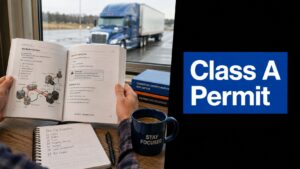
First comes the Commercial Learner’s Permit. That means studying the state material, passing the written knowledge tests that apply to your license path, and handling the required paperwork before behind-the-wheel instruction starts.
If you need a structured starting point for that step, review the permit process at https://patriotcdl.com/permit/.
Students who rush the permit phase often carry that same habit into yard training. That’s usually where preventable mistakes start.
The skills test has three parts
Most CDL schools train you toward the same practical milestones:
- Pre-trip inspection
- Basic control skills
- Road driving
Each one matters. A lot of students obsess over road driving because it feels the most dramatic, but weaker candidates often lose points long before they ever leave the range.
Where students usually fail
Quality instruction shows up here.
Data from Atlanta Truck Driving School says pre-trip inspection omissions account for 40% of CDL test rejections, and alley dock backing is failed by 25% to 35% of students initially. The same source says schools using one-on-one instruction report 85% to 90% first-time pass rates compared with lower results in group formats (https://atlantatruckdrivingschool.com/why-atlanta-truck-driving-school-is-the-best-choice-for-your-class-b-cdl/).
That lines up with what many instructors see on the ground. Students don’t usually fail because they’re incapable. They fail because they miss sequence, skip details, or don’t get enough corrective feedback before test day.
What good preparation looks like
Strong programs build habits, not just familiarity.
- Pre-trip repetition matters: Students need repeated walkthroughs until they can explain components clearly and in order.
- Backing needs coaching: Alley dock and other maneuvers improve faster when an instructor corrects sight lines, setup, and steering timing immediately.
- Road work should include traffic reality: Atlanta-area training should prepare students for lane decisions, intersections, mirrors, braking discipline, and city pressure.
On test day, calm usually beats confidence. The student who follows the sequence cleanly often outperforms the student who “felt ready” but didn’t drill the basics.
Manual versus automatic training
One more issue deserves attention. Ask what transmission type you’ll train and test on.
That choice can affect your restriction status and your job options later. Even if a student prefers an automatic for learning, it’s smart to ask how the school explains the trade-off and whether other training paths are available.
The schools that prepare students best don’t treat the exam as a mystery. They break it into parts, drill the failure points, and make sure you know exactly what the examiner is looking for before the key ever turns.
Securing Your First Trucking Job in Atlanta
Graduation matters. Job launch matters more.
A CDL school can teach you enough to pass and still do very little to help you get hired. That’s one of the most overlooked differences between programs.
Placement help can be active or passive
Some schools say they offer job placement, but what they really provide is a list of carriers and a handshake.
That isn’t worthless, but it isn’t strong support either.
Real placement help usually includes:
- Application guidance: Help filling out forms accurately and completely
- Resume support: A school should help you present transferable work history, especially if you’re changing careers
- Interview prep: Students need to know how to discuss schedule expectations, endorsements, safety record, and work history
- Employer access: Recruiter conversations, referrals, or introductions are stronger than “go apply online”
If you need resume structure, even a resource on crafting a powerful Europass CV for truck drivers can help you think more clearly about how to present driving qualifications, licenses, and practical skills in a professional format.
Ask for proof, not promises
Here, many schools get vague. They talk about partnerships, demand, and opportunity, but they don’t share verifiable outcomes.
That’s a known gap in the market. Many schools make broad claims about carrier relationships but don’t provide concrete employment data, so students should ask for specifics such as placement rates within 30 days and realistic starting salary information by employer type (https://www.drivebigtrucks.com/apply/atlanta/).
Ask direct questions:
- What do graduates typically do first?
- Which carriers or employers hire from this program?
- How does the school help students who have no logistics background?
- What happens if a student doesn’t land a job quickly?
A school that stands behind its training should be willing to discuss outcomes in concrete terms, even if it presents them carefully.
The best schools understand that your first job is part of the product. Not a side issue. If training gets you licensed but leaves you alone on the job hunt, the school finished early. If training includes serious hiring support, you’re much more likely to turn your CDL into income quickly.
Frequently Asked Questions About Atlanta CDL Schools
Is an automatic restriction a problem
It can be. Some employers are fine with it, while others prefer or require broader flexibility. Ask every school what equipment you’ll train on and how that choice may affect your options.
Can I use veteran education benefits
Many veterans can use education benefits for approved training, but eligibility and process details depend on the program and approval status. Ask the school’s admissions team to walk you through the paperwork before you enroll.
What if I fail the CDL test the first time
It happens. The important question is how the school handles remediation. Ask whether they provide additional practice, how retesting is scheduled, and whether there are extra charges.
Do I need experience before enrolling
No. Most entry-level students start with no trucking background. What matters is whether the school has a clear process for taking you from permit study to road skills.
What basic requirements should I review first
Start with the licensing and eligibility standards so you know where you stand before you apply. A practical first stop is https://patriotcdl.com/cdl-requirements/.
If you’re ready to move from research into action, Patriot CDL offers accelerated commercial driver training with permit guidance, hands-on instruction, and practical support designed to help students enter the industry quickly and confidently.