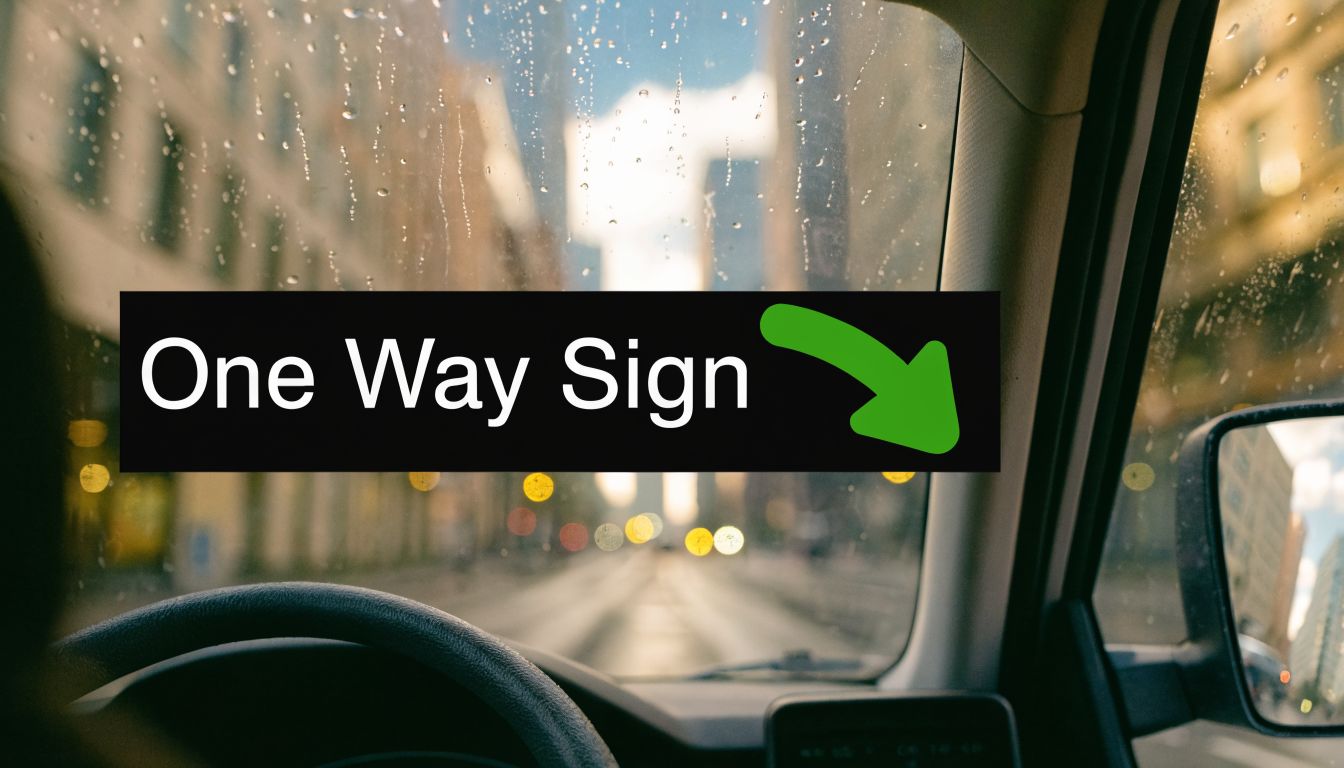
You're probably here because you saw the sign in a practice question, on a permit test app, or at a city intersection and paused for a second. That pause matters more in a truck than it does in a car.
When a new driver asks, what does this sign mean one way, the simple answer is easy. Traffic on that street moves in only the direction of the arrow. The professional answer is bigger. It affects where you set up before the turn, which lane you enter, whether your trailer tracks safely, and whether you just protected or ruined your CDL test.
A one-way sign is basic. But basic signs cause plenty of serious mistakes because drivers rush past the basics. In city driving, especially with a combination vehicle, one missed sign can put you nose-to-nose with traffic, force a bad correction, or trap your trailer in the wrong lane with nowhere to go.
Why One Way Signs Are Critical for Your CDL Career
You are easing a loaded training rig into a tight downtown intersection. The light is changing, cars are pressing from behind, and your attention is split where it should be. Mirrors, pedestrians, signal timing, trailer swing, lane space. Then you catch the ONE WAY sign. If you spot it late, you can set up in the wrong lane before the turn even begins, and in a combination vehicle, that mistake gets harder to fix with every foot you roll forward.
That is why a one-way sign matters so much in CDL training. For a car driver, it is a basic direction sign. For a truck driver, it affects lane choice, turn setup, trailer tracking, and whether you leave yourself enough room to finish the maneuver without crossing into danger or breaking the law.
If you are still working through permit and training steps, review the state-by-state basics for CDL requirements and eligibility before you get deep into road skills. Many trainees spend most of their study time on air brakes, backing, and shifting, then lose points on city driving because they read a simple sign too late.
A one-way street works like a funnel. Once you commit your tractor and trailer in the wrong direction or from the wrong position, your options shrink fast. In a passenger car, a bad setup may mean an awkward correction. In a tractor-trailer, it can mean a wide turn into the wrong lane, a blocked intersection, or a stop in a place where backing is unsafe or illegal.
Good instructors teach students to call out the sign early and build the turn from that information.
A one-way sign matters to your career because it affects three areas that employers and examiners watch closely:
- Safety: Wrong-way movement can put your truck nose-to-nose with traffic or force a sudden correction in a crowded street.
- Compliance: The arrow gives a legal direction of travel. Ignoring it is a traffic violation, not a minor judgment error.
- Vehicle control: Early sign recognition helps you choose the proper lane, manage off-tracking, and set up cleanly for turns and backing moves such as alley docking after you clear the street.
That last point is where new CDL students often get caught. They treat the sign as a written-test question instead of a setup signal. A professional driver reads it early, places the truck correctly, and protects the space the trailer will need next. That is the standard on the road, and it is the standard on the CDL test.
Identifying the One Way Sign and Its Variations
The standard one-way sign is built to be read fast. It's rectangular, and the message is carried by a bold arrow plus the words ONE WAY. The arrow tells you the legal direction of travel. Don't overthink it. If the arrow points left, traffic flows left. If it points right, traffic flows right.

A lot of trainees get mixed up because the sign doesn't always look identical in every location. The message stays the same, but the layout may change to fit the street, the pole location, or the type of intersection.
If you're studying for the written exam, a focused review of general knowledge test practice helps because sign recognition often gets buried under bigger topics like brake systems and hazard awareness.
What to look for at a glance
Train your eyes to spot these features:
- Arrow direction: This is the first thing to read. It tells you the only legal flow.
- Rectangular shape: That helps separate it from warning signs and many prohibition signs.
- Placement at entrances and intersections: It usually appears where you need direction before committing.
- Black-and-white regulatory style: The sign is there to command movement, not to warn or advise.
Common variations drivers see
Not every one-way sign is the classic horizontal panel.
| Variation | What it tells you | Why it matters to a truck driver |
|---|---|---|
| Standard horizontal sign | Traffic moves left or right as shown | Most common at city intersections |
| Vertical alignment sign | Same rule, different layout | Easy to miss on narrow streets or crowded poles |
| Supplemental one-way placement | Reinforces flow through a complex approach | Helps when lane markings, medians, or offset intersections create confusion |
Some locations also use additional one-way markers at the start or end of a traffic pattern. You may hear people refer to signs such as Begin One Way or End One Way in training. What matters in practice is simple. Watch for any sign that tells you when a street changes from normal two-way flow to a restricted single direction, or when that condition ends.
When you're approaching a dense urban block, don't just look for the street name. Look for the directional signs mounted near it.
Where trainees usually get confused
The usual mistakes aren't about reading the words. They're about reading the situation.
- Drivers see the sign too late: They focus on the light, not the corner.
- They confuse lane direction with turn permission: A one-way sign controls street flow. It doesn't automatically mean every lane is open for every turn.
- They miss repeated signs: On a busy commercial block, the first sign may be partly hidden, but another marker is often posted farther along.
With experience, you stop asking only what does this sign mean one way, and start asking the better question. What does this sign require me to do with my truck before I get there?
The Law Behind the Arrow What One Way Really Means
A one-way sign is a regulatory sign. That means it creates a rule you must obey. It doesn't suggest the best route. It sets the only legal direction of travel on that roadway entrance.

Under verified background on one-way signage, variants are addressed under MUTCD Chapter 2B, including R6-2 series supplemental versions at more complex urban locations. The same verified material states that specifications call for retroreflective sheeting for nighttime legibility at 600 feet, and that in high-density logistics corridors, one-way designations reduce intersection delay by 30-50%, according to traffic engineering details for one-way regulatory signs.
For a CDL driver, the legal meaning breaks down into a few essential rules.
What the sign requires
- Travel only in the direction of the arrow
- Do not enter from the opposite end
- Do not treat open pavement as permission
- Do not improvise because your route, GPS, or delivery stop is inconvenient
If your truck is pointed against the arrow, you're wrong. It doesn't matter if the street looks empty.
How it differs from similar signs
Trainees often blend this sign together with others. Keep them separate in your mind.
| Sign | Primary meaning | Key difference |
|---|---|---|
| One Way | Traffic on this street moves only in the arrow's direction | Controls legal direction of travel |
| Do Not Enter | You may not enter from this approach | Focuses on prohibited entry point |
| No Left Turn or No Right Turn | You cannot make that specific turn | Restricts one maneuver, not the whole street direction |
Those signs often appear together. A one-way sign tells you how the street flows. A Do Not Enter sign tells you that your approach is forbidden. A turn prohibition sign tells you a specific turn movement isn't allowed even if the street itself is one-way.
A professional driver reads the full message at the corner, not just the first sign that catches the eye.
That distinction matters in city freight work, where lane control, curb space, and delivery access can make intersections feel crowded and rushed.
Maneuvering Your Rig on One Way Streets
You are in a day cab with a 53-foot trailer, rolling into a tight downtown grid before sunrise. The light turns green, a delivery van is on your right, parked cars are tight on the left, and the street you need is one-way. At that moment, the sign is no longer a definition on a practice test. It is a lane-control order that shapes how you turn, where your trailer tracks, and whether you have a safe setup for the next block.
One-way streets can make truck handling easier because you do not have opposing traffic crossing your turn path from one direction. They can also trap a driver who commits too early. A bad entry angle, the wrong approach lane, or a rushed correction can leave a combination vehicle with very little room to recover.

For a CDL driver, the essential skill is execution at the corner.
If you are still building judgment on trailer swing, off-tracking, and lane use, extra reps with combination vehicle practice questions can help connect the rule on the sign to what the trailer does in a city turn.
Turning from a two-way street onto a one-way street
This turn causes trouble because the truck enters a street that has only one legal direction, but the available space can make drivers feel like they have more options than they really do.
- Read the corner early. Spot the one-way sign before you reach the stop line so you can decide on lane position without rushing.
- Set up in the correct lane before the intersection. Do not wait until the last few feet to slide over. In a tractor-trailer, late lane changes create blind-side risk and confuse nearby traffic.
- Turn into the nearest legal lane unless signs or pavement markings direct a different lane. Open pavement is not extra permission.
- Manage off-tracking. The tractor may clear the corner while the trailer cuts toward the curb, a pole, or a parked car.
- Check your landing area as soon as the cab straightens. On a one-way street, your next problem often appears immediately. A stopped delivery truck, rideshare stop, or pedestrian cluster can block the lane you planned to use.
A good turn onto a one-way street works like placing a trailer into a narrow dock. The setup determines the finish.
Turning from a one-way street
A one-way street often gives you more usable intersection space, but only if you match your lane choice to the turn you are making.
Right turn from a one-way street
Stay in the correct right-side approach lane if the lane is designated for that movement. Slow early, keep the turn controlled, and watch the right mirror as the trailer comes around. City corners invite curb strikes because the tractor can clear while the trailer still has work to do.
Do not let the extra width of a one-way street make you lazy with your setup. Wide pavement can hide a bad angle until the trailer starts tracking over the curb line.
Left turn from a one-way street
A left turn from a one-way street often gives a truck more room than a left turn from a two-way street. That does not mean it is automatic. You still need to confirm the receiving street's direction, lane markings, and any overhead controls.
Trainees often make one of two mistakes here. They start from the wrong lane, or they drift into the wrong lane after the turn because the street feels open. Examiners notice both. So do police officers. So do four-wheelers who expect your truck to be predictable.
Rule to remember: The sign controls the street's direction. Your lane position controls whether the trailer can follow that direction safely.
Lane choice on a multi-lane one-way street
On a multi-lane one-way street, do not drive only for the block you are on. Drive for the next turn, the next stop, and the space your trailer will need if traffic tightens up.
Choose the lane that supports your next legal move. If your turn or delivery is coming soon, get set up early. Avoid the habit of cruising in a middle lane and forcing a late move across traffic.
Watch the curb lane carefully. It may look convenient, but buses, parked cars, bike activity, and standing delivery vehicles can take that lane away with little warning. The safest lane for a truck is often the one that gives you the best sight lines and the fewest forced adjustments.
A quick visual example can help reinforce what proper city handling looks like in motion:
Alley docks and delivery setups
One-way street knowledge becomes job-site skill here. Your dock approach may depend on street direction, available swing room, and whether the trailer needs to back from the driver side or blind side.
If the one-way pattern gives you a poor angle, keep going and circle the block for a better approach. That is not hesitation. That is professional planning. A clean second setup is safer than forcing a bad first one with traffic stacking up behind you.
Many local delivery incidents start with a driver trying to save thirty seconds. Then the trailer blocks a lane, the tractor loses angle, or the driver backs blind into a space that never should have been attempted from that direction. The crash risk in those situations is part of the broader dangerous wrong-way driving risks that come from ignoring directional control and trying to recover after the mistake.
A one-way sign tells you more than where traffic flows. For a CDL driver, it tells you how to set the truck up before the turn, where to place the trailer after the turn, and when to abandon a weak approach and come back with a better plan.
The High Cost of a Wrong Turn Penalties and Consequences
A wrong-way move isn't a small city-driving mistake. For a CDL driver, it tells an examiner, employer, or officer that you missed a regulatory sign and then kept going with a vehicle too large for guesswork.
On a skills test, this kind of error can end the drive quickly. Even outside the test, a wrong turn can trigger citations, put points on your record, and create problems with insurance and hiring. Carriers don't just look at whether you can move a truck. They look at whether you can move it legally, calmly, and predictably.
The bigger risk is what happens after the violation. Wrong-way entries can place a tractor-trailer directly into a conflict that leaves little room for recovery, especially on tight urban streets. If you want a plain-language explanation of dangerous wrong-way driving risks, that overview is useful because it focuses on what happens when a driver enters the roadway in the wrong direction.
Why employers care
A bad directional violation can suggest deeper habits:
- Late scanning: You didn't read the corner in time.
- Poor decision-making: You committed before you understood the street.
- Unsafe correction patterns: You may brake hard, swing wide, or reverse where you shouldn't.
Those are the same habits that lead to preventable incidents in local delivery work.
Why trainees should take it personally
You're not only protecting a test score. You're protecting your start in the industry. If your city driving needs work, a CDL refresher course for weak areas can be a smarter move than repeating the same rushed mistakes and hoping they disappear on test day.
One wrong turn in a car is embarrassing. One wrong turn in a combination vehicle can become a record, a claim, or a crash.
Your On-Road and Pre-Trip Safety Protocol
Good drivers don't rely on catching one-way signs at the last second. They build a routine that makes the sign hard to miss.

Before you move the truck, review the route for downtown segments, loading zones, and likely delivery approaches. If you're hauling specialized equipment or want to understand how trailer construction affects handling and space management, these Baraga-built trailer engineering details offer useful background on equipment design and trailer structure.
A disciplined route review works best when it sits beside your normal pre-trip inspection routine. The mechanical check gets the truck ready. The route check gets the driver ready.
The pre-trip habit
Use a short planning checklist before city driving:
- Review the route: Watch for downtown grids, alley access, and delivery approaches.
- Flag one-way segments early: Don't let the GPS voice be your first warning.
- Plan your setup lane: Think about the turn before you reach the block.
- Know your escape option: If the approach is bad, know where you can safely continue and circle back.
The on-road habit
At each city intersection, clear it the same way every time.
| Check | What you're looking for |
|---|---|
| High scan | Street name, lane-use signs, one-way signs, overhead restrictions |
| Mid scan | Traffic signal, crossing vehicles, pedestrians |
| Mirror scan | Trailer position, curb risk, lane encroachment |
| Commitment point | Decide only after signs and space both make sense |
The mental cue
Some trainees benefit from saying the rule out loud. That sounds simple because it is simple. It works.
“One way right. Land in the correct lane. Watch the trailer.”
That short verbal check slows the mind just enough to stop automatic mistakes. Over time, it becomes part of your driving rhythm.
The question what does this sign mean one way should end in a habit, not just an answer. It means one legal direction. It means plan early. It means turn with purpose. And for a truck driver, it means your mirrors, lane position, and route choice all have to match the arrow before the truck rolls forward.
If you want hands-on help turning road-sign knowledge into real CDL skill, Patriot CDL offers training built around the things new drivers struggle with, including pre-trip inspection, city driving, backing maneuvers, and safe lane positioning in real-world traffic.