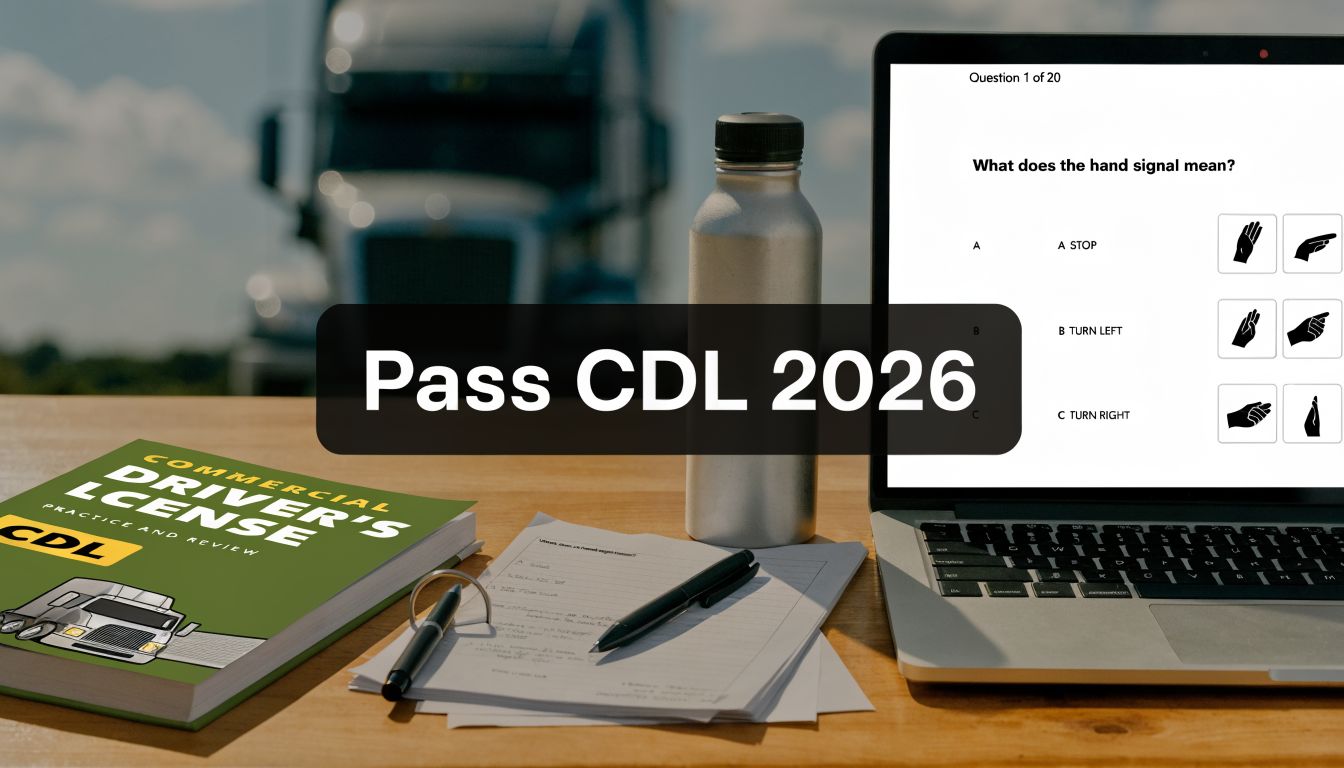
You're probably in one of two spots right now. Either you've taken an il cdl practice test and your score keeps bouncing around, or you haven't started because every site looks the same and none of them tell you what matters.
After working with CDL students, the pattern is obvious. People who pass on the first try usually don't study more. They study with a tighter system. They use the manual as the base, practice tests as a measuring tool, and missed questions as a map. People who fail usually do the opposite. They bounce from quiz to quiz, memorize answer patterns, and never fix the weak areas that keep showing up.
A practice test can help, but only if you use it the right way. Random repetition won't carry you through the Illinois permit process. A deliberate study rhythm will.
Finding Your Core Study Materials
The first tool you need isn't a quiz site. It's the official Illinois CDL manual. That manual is the source material behind the actual knowledge tests, which means every outside study tool should be judged by one standard. Does it match the manual, or does it drift into made-up shortcuts and vague summaries?
If a practice site conflicts with the manual, trust the manual.

Start with the source of truth
A lot of new applicants waste time hunting for “the best” il cdl practice test before they've read the material the test is based on. That's backwards. Read the Illinois manual with a pen in your hand and mark anything tied to safety procedures, inspection steps, vehicle systems, and terminology.
Don't read it like a novel. Read it like a mechanic reading a work order. You're looking for exact meanings, not general impressions.
Use this sequence:
- Read once for familiarity. Get the lay of the land.
- Read again by test section. Keep General Knowledge separate from Air Brakes and Combination Vehicles.
- Mark weak spots. If a paragraph feels confusing, that's exactly where your test problems will come from.
Practical rule: If you can't explain a topic in plain language after reading it, you're not ready to trust your score on a practice quiz.
If you're building from the core permit material first, a focused General Knowledge test prep resource can help organize your review, but it should support the manual, not replace it.
How to judge a practice test
Not all online quizzes are useful. Some are built to teach. Some are built to get clicks. You can usually tell the difference in a minute.
A stronger practice test does a few things well:
- It mirrors the official structure. One Illinois Class A practice source says its set contains 95 multiple-choice questions drawn from the Illinois CDL Handbook 2026, while the official combination-vehicles knowledge exam still requires an 80% score. That same source also warns that skipping air-brakes prep can leave an L restriction on the license, which is why study should stay modular across General Knowledge, Combination Vehicles, and Air Brakes rather than treated as one giant subject (Illinois Class A practice details).
- It explains wrong answers. A bare score doesn't teach anything.
- It looks current for 2026. Outdated wording creates bad habits.
- It separates topics cleanly. You should be able to study one subject at a time.
- It uses manual language. Sloppy paraphrasing usually leads to sloppy recall.
What wastes your time
The weakest practice tests share the same flaws. They repeat the same small pool of questions, hide explanations, and train you to recognize answer order instead of understanding content. Students often feel “ready” after using those quizzes, then get rattled by different wording on the actual exam.
That's why your core stack should stay simple: official manual first, then topic-based practice tests, then review notes you write yourself.
Structuring Your Study Plan for Success
Many applicants don't fail because the material is impossible. They fail because their studying is scattered. They read a few pages one night, take a random quiz three days later, then cram the night before the test. That approach feels busy, but it doesn't build retention.
The Illinois permit path is commonly organized into three knowledge sections: General Knowledge with approximately 50 questions, Air Brakes with approximately 25 questions, and Combination Vehicles with approximately 25 questions, and applicants need 80% or better on all three sections to get a Commercial Learner's Permit, according to an Illinois practice-test provider's breakdown of the exam structure (Illinois CDL permit section breakdown). That's why your study plan has to be section-based, not random.

Build a two-week rhythm
A short, disciplined plan works better than endless loose studying. For most beginners, a two-week rhythm keeps the material fresh without turning into burnout.
Try this approach:
- Days 1 to 4: Read and review General Knowledge chapters. Take short topic quizzes after each study block.
- Days 5 to 7: Shift to Air Brakes. Focus on parts, function, inspection order, and failure symptoms.
- Days 8 to 10: Study Combination Vehicles. Coupling, uncoupling, trailer movement, and rollover risk need clean understanding.
- Days 11 to 12: Mix sections. Take separate practice tests and review mistakes by topic.
- Days 13 to 14: Simulate test conditions. No cramming. Tight review only.
This works because you're stacking concepts instead of flooding yourself with unrelated questions.
Keep your daily sessions narrow
Don't sit down and say, “I'm going to study CDL tonight.” That's too vague. Pick one target before you start.
A better daily goal looks like this:
- One chapter or one system.
- One related quiz set.
- One page of handwritten corrections.
That last part matters. Writing down what you missed forces your brain to process the error, not just glance at the right answer and move on.
The students who improve fastest aren't always the ones who study longest. They're the ones who can tell me exactly what they missed yesterday and why they missed it.
If you've been away from school for a while or need more structure, a CDL refresher course option can help turn loose studying into a schedule with accountability.
Avoid the three common planning mistakes
A study plan fails when it's too ambitious, too vague, or too passive.
Here's what that looks like in real life:
- Too ambitious: trying to master all three major subjects in one weekend.
- Too vague: saying you'll “review air brakes” without defining what that means.
- Too passive: reading page after page without testing recall.
You want repetition, but not mindless repetition. Read, quiz, correct, repeat. That cycle is what makes an il cdl practice test useful instead of just familiar.
Mastering the Test with Smart Practice Strategies
Most students use practice tests the wrong way. They chase a high score. What they should be chasing is a clean diagnosis.
The Illinois General Knowledge exam is widely described as 50 multiple-choice questions with an 80% passing score, meaning 40 correct answers out of 50. One Illinois prep source also says you have one hour to complete that section and can miss only 10 questions before failing the attempt (Illinois General Knowledge exam format). That should shape how you practice. You need accuracy first, then pacing.

Phase one with no clock
Start with untimed practice tests. Ignore speed. Your only job is to expose weak areas.
After each quiz, sort every missed question into one of three buckets:
- You never learned it. Go back to the manual and study the full concept.
- You mixed up similar answers. Compare the wording and figure out what detail changed.
- You rushed. Slow down and look for trigger words like always, never, safest, or best.
This review step is where actual learning happens. A practice score by itself won't fix anything.
Review mistakes like an instructor would
When a student misses a question, I don't want them staring at the correct option and moving on. I want them to answer three things:
- What topic was this testing?
- What word in the question mattered most?
- Why were the wrong answers tempting?
That process trains judgment. It also prepares you for the skills side later, where vague understanding causes trouble in areas like inspection language and sequence. If you need more hands-on context around inspections, this pre-trip inspection guide connects written knowledge to what you'll say and do.
Don't measure progress by how many quizzes you took. Measure it by how many mistakes you can now explain correctly.
Phase two under realistic pressure
Once your untimed scores are stable, switch to timed practice. That's when you start training for test-day pressure instead of just content recognition.
Use the same rules each time:
- Sit in one block. No interruptions.
- No notes open.
- Review only after you finish.
A timed practice test isn't for cramming. It's for checking whether your knowledge holds up when the clock is running.
Here's a good point to watch a walkthrough and compare your own process to a more disciplined one:
Three question types that trip people up
| Question type | What usually goes wrong | Better approach |
|---|---|---|
| Safety wording | Students pick the answer that sounds familiar | Match the answer to the exact rule or procedure in the manual |
| Air brake concepts | They memorize terms without understanding function | Connect each part to what it does and what failure looks like |
| Combination vehicle handling | They answer from car-driving instincts | Think in trailer movement, offtracking, and coupling safety |
If you treat each missed question like a lesson instead of a loss, your il cdl practice test scores will start moving for the right reason.
Navigating Specific Endorsements and Classes
Not every CDL applicant needs the same knowledge tests. That's where people overstudy the wrong material or ignore a required section until late in the process.
The cleanest divide is between Class A and Class B. If you're going after Class A, Combination Vehicles matters in a way it doesn't for most straight-truck Class B paths. That's because tractor-trailer operation adds another layer of knowledge around coupling, uncoupling, trailer swing, and handling.
A focused Combination Vehicles practice resource helps if that's your route, but only if your target job requires Class A.
Class A and Class B side by side
| License path | Main knowledge focus | Typical fit |
|---|---|---|
| Class A | General Knowledge, Air Brakes, Combination Vehicles | Tractor-trailers, many over-the-road and regional freight jobs |
| Class B | General Knowledge, often Air Brakes depending on vehicle setup | Straight trucks, local delivery, dump trucks, some bus and utility roles |
A lot of students assume Class A is always the right move. Sometimes it is. Sometimes it isn't. If your planned job doesn't involve combination vehicles, studying that material too early can split your focus.
Illinois CDL Endorsement Test Focus
| Endorsement | Test Focus | Common Career Paths |
|---|---|---|
| Tanker N | Liquid surge, tank loading behavior, vehicle handling concerns | Fuel hauling, liquid food grade, chemical transport |
| Hazardous Materials H | Hazard awareness, handling rules, security and safe transport principles | Chemical hauling, specialized freight |
| School Bus S | Loading procedures, student safety, mirror use, hazard response | School transportation |
| Passenger P | Passenger loading, emergency procedures, safe operation with riders | Transit, shuttle, coach services |
Pick endorsements by job target, not ego
Students sometimes stack endorsements because they think more is always better. That can create extra study load and extra failure points. If an employer doesn't need a certain endorsement, you may be better off getting the core license first, then adding more later with a clear purpose.
For example, someone aiming at tanker work should study tank behavior early because the safety logic is different from dry van thinking. Someone aiming at school transportation needs a completely different mindset centered on passengers, loading zones, and controlled procedures.
A smart license plan matches the truck you want to drive, not the letters you want to collect.
One more practical point. Written testing isn't the only part of being job-ready. Once you move into yard work, gear and visibility start mattering too. If you're working around trucks in low light, this guide on choosing compliant hi-vis gear gives a useful overview of what to look for.
Beyond the Practice Test Permit and Retest Tips
A lot of il cdl practice test pages stop at the written exam. Real life doesn't. Passing the knowledge tests is important, but it's only one checkpoint in the licensing path.
An Illinois CDL-focused career resource points out that many practice pages over-focus on written prep and miss the full process after that. Applicants still have to pass CLP knowledge sections, complete the skills test components, and meet eligibility requirements tied to federal rules such as medical certification and disqualifying offenses. That same resource also notes that many pages don't explain how pre-trip inspection and on-road evaluation fit into the path after the written exam, even though those gaps can delay licensing, and it adds that the industry shortage remains in the tens of thousands of drivers (Illinois CDL pathway and hidden delays).
What to handle before test day
Don't let paperwork sink you after you've done the studying. Before you head to the testing facility, confirm your documents, your appointment details, and any medical requirements tied to your eligibility.
Keep your prep practical:
- Check your documents early. Missing paperwork can ruin a good testing day.
- Know which tests you're taking. Don't show up assuming one section covers everything.
- Confirm endorsement needs. Extra knowledge tests may apply depending on your path.
- Handle medical requirements ahead of time. Don't wait until after you pass the written side to discover a delay.
If you need a cleaner view of the next steps, a CDL permit guidance page can help you line up the permit stage with the rest of the process.
If you fail, use the failure correctly
Failing a test doesn't mean you're not cut out for trucking. It usually means your study process was loose, your pacing slipped, or one topic kept leaking points and you didn't isolate it.
The wrong response is emotional studying. Don't retake quiz after quiz hoping a better score appears. Pull the test apart.
Use this retest method:
- Write down every topic that gave you trouble.
- Re-read only those manual sections first.
- Take short topic quizzes, not full mixed exams.
- Return to full practice only after your weak area stops dragging you down.
Think beyond the permit
Students who move fastest from testing to employment usually think in sequence. They don't stop at “pass the written exam.” They ask what comes next. Skills work, pre-trip inspection, backing, road evaluation, medical paperwork, and employer expectations all matter.
That mindset changes how you study. You stop treating the permit as a school test and start treating it as the front gate to a driving job.
Your Roadmap to a First-Time Pass
Passing the Illinois written tests doesn't come from luck, and it doesn't come from memorizing answer order on a free quiz site. It comes from a system that holds up under pressure.
The strongest approach is simple. Start with the Illinois CDL manual. Break the material into separate subjects instead of trying to absorb everything at once. Use each il cdl practice test to diagnose what you don't know, then go back and repair that exact weakness. When your understanding is stable, switch to timed practice and learn to perform under the same kind of pressure you'll face at the testing center.
That method works because it fixes the actual problem. Many applicants don't fail from lack of effort. They fail from unfocused effort. They spend time, but they don't build a feedback loop.
Keep these principles in front of you:
- Use the manual as your base.
- Study General Knowledge, Air Brakes, and Combination Vehicles as separate jobs.
- Review every missed question until you can explain it clearly.
- Practice under realistic conditions before test day.
- Treat the permit as the start of the licensing path, not the finish line.
You don't need perfect study habits. You need repeatable ones.
If you do that, you'll walk into the test center with something better than confidence. You'll have proof from your own preparation that you're ready to pass.
Patriot CDL offers practical help for students working through the permit process, including written test prep, skills training, and guidance that connects the permit stage to the full CDL path. If you want structured support instead of guessing your way through it, take a look at Patriot CDL.