You're probably here because you've already noticed the pattern. The loads that look steadier, the routes that open up faster, or the job listings that ask for just one more credential often have the same extra requirement attached to them. HazMat.
A lot of Texas drivers assume the hazmat test for texas is just another state written exam. That misunderstanding causes problems early. Drivers study the wrong material, show up without handling the security side first, or treat the endorsement like a simple add-on instead of what it really is: a state-issued credential built on federal safety and security rules.
That split matters. Texas handles the license and the testing through DPS, but the endorsement also depends on a federal TSA security review. If you understand that from the start, the process gets much easier to manage.
Why a HazMat Endorsement is Worth the Effort in Texas
For many CDL holders, a HazMat endorsement is less about prestige and more about access. It can put you in the running for freight that other drivers can't legally touch. That matters whether you want fuel work, chemical loads, tanker combinations, or local and regional jobs where specialized freight keeps equipment moving year-round.
It also signals something important to employers. A driver with HazMat has gone through added screening, studied stricter handling rules, and shown they can deal with regulated freight responsibly. Carriers notice that. So do shippers.
What drivers usually misunderstand
Most new applicants think they need to learn “Texas hazmat law” as if the whole exam is built around state-only rules. That's where people go off track. Texas administers the endorsement, but the core knowledge is largely federal. The testing topics are centered on hazardous-material compliance, safe handling, placards, emergency response, and security requirements rather than a grab bag of Texas-specific quirks.
That changes how you should prepare. If you spend your time hunting for shortcuts labeled “Texas-only HazMat answers,” you'll likely miss the foundation that shows up on the exam.
Practical rule: Treat the hazmat test for texas as a Texas-administered test on federal hazmat knowledge, plus a separate federal security screening.
Why the process feels harder than other endorsements
A standard endorsement usually feels like study, test, done. HazMat doesn't work that way. You're dealing with two tracks at once:
- State administration: Texas DPS handles the endorsement on your CDL and the written exam.
- Federal security review: TSA requires fingerprints, eligibility verification, and a background check before the endorsement can be finalized.
- Operational knowledge: You're not just proving you can drive. You're proving you understand how to identify, handle, document, and respond to hazardous cargo safely.
That's why this endorsement has a different feel from doubles/triples or tanker. It's tied to public safety and security, not just vehicle operation.
Where the effort pays off
Drivers who approach this endorsement seriously usually make the process smoother for themselves in two ways. First, they stop expecting a quick state-only appointment to solve everything. Second, they study the handbook material that matches the test.
If you do those two things, the path gets much clearer. The rest comes down to paperwork discipline, study habits, and showing up ready.
Confirming Eligibility and Navigating the TSA Security Check
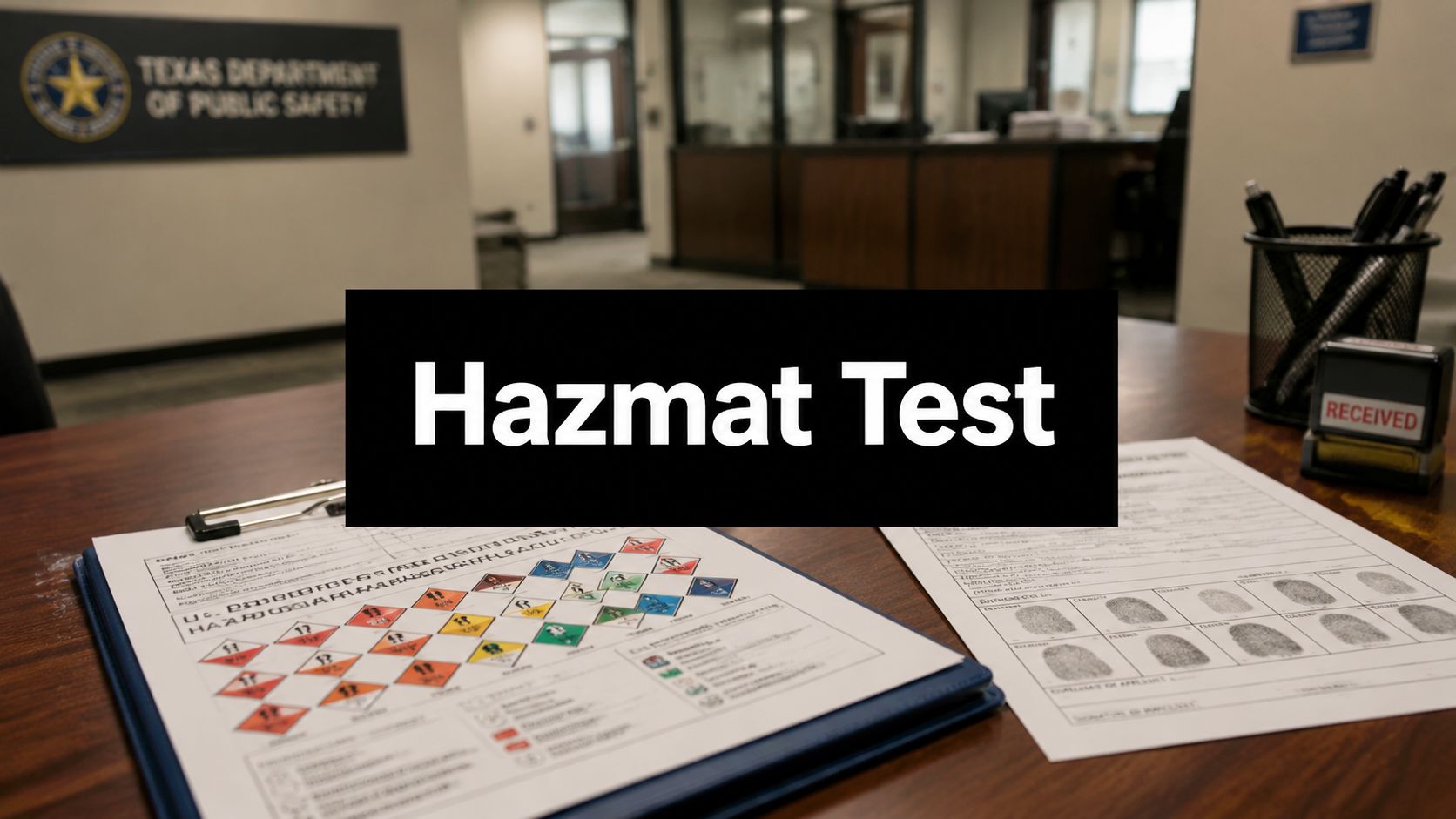
Texas makes it clear that a HazMat endorsement involves more than passing a written test. The Texas Department of Public Safety says an H endorsement allows drivers to transport hazardous materials such as flammable liquids, gases, and explosives, and applicants must complete a TSA security threat assessment that includes fingerprints, verification of U.S. citizenship, permanent residence, or immigration eligibility, and a background check through the Texas DPS HazMat endorsement page.

That means your first real obstacle isn't memorizing placards. It's getting your documents, identity records, and fingerprinting process lined up correctly.
What to confirm before you apply
Start by checking the basics before you spend time on forms or appointments.
- License status: Your Texas CDL should be current and in good standing.
- Identity and status documents: TSA review includes verification of U.S. citizenship, permanent residence, or immigration eligibility.
- Medical readiness: Make sure your DOT medical paperwork is current and there aren't any loose ends with your commercial driving eligibility.
- General CDL requirements: If you need a quick refresher on baseline licensing items, Patriot CDL's overview of Texas CDL requirements helps organize the checklist.
If any of those items are messy, fix them first. HazMat applications fall apart when a driver treats document prep as an afterthought.
How the TSA portion usually feels in real life
The federal side can feel slow because it's administrative by design. You submit your application, schedule fingerprinting, show up with matching identity information, and then wait for the review to run its course. The process is straightforward when your records are clean and your documents match exactly.
Where people lose time is on small mistakes. A name mismatch. An expired ID. Forgetting what document they used on the application. Showing up to a fingerprint appointment underprepared.
Bring the exact identity documents that match your application details. Most delays I see start with mismatched paperwork, not hard test questions.
A workable checklist for the security review
Use a simple order and don't skip around.
- Review eligibility first. Confirm your CDL status and gather identity documents.
- Complete the TSA HazMat application. Fill it out carefully, especially your legal name and identifying details.
- Book fingerprinting promptly. Don't wait until after you feel “ready” for the test. The security side moves on its own timeline.
- Keep your records together. Save confirmations, appointment details, and any receipt or reference number you receive.
- Watch your notifications. Read every message you get from the process. Don't assume no news means no action is needed.
If you're dealing with fingerprint paperwork questions or want to understand the format used in identity record handling, Business Mail Boutique's FD-258 guide is a useful plain-English reference.
What doesn't work
Some drivers try to “wait and see” before starting the TSA side. Others assume they can pass the written test first and clean up the security steps later. That approach creates stress because you've split a process that already has enough moving parts.
The better approach is to treat the security review like the gatekeeper it is. Get it moving early, keep every document consistent, and don't rely on memory. Write things down, save emails, and carry a folder.
Mastering the Federal Knowledge for the Texas HazMat Test
If you want to pass the hazmat test for texas, study the right universe of rules. The knowledge domain is standardized around federal regulations covering substance handling, packaging, quantity limits, transport configurations, placarding and labeling, emergency response, and TSA security requirements, so applicants should study the federal hazmat framework in the CDL handbook rather than expect a state-specific law exam, as summarized by this Texas HazMat practice guide.

That's the central study mistake I see. Drivers search for “Texas answers” when they should be learning the federal framework built into the handbook.
What to study instead of chasing shortcuts
Your study time should stay close to the CDL handbook material, especially the hazardous materials section Texas DPS points applicants toward. Don't build your prep around random quiz banks alone. Practice questions help, but they work best after you understand why an answer is right.
Focus on these knowledge areas:
- Hazard classes: You need to recognize how hazardous materials are grouped and why classification affects handling and communication.
- Placards and labels: These are not decoration. They tell emergency responders, inspectors, and facility personnel what risk they're dealing with.
- Shipping papers: You need to know what information matters and where it belongs.
- Loading and segregation rules: Some materials can't be loaded or positioned together casually.
- Security awareness: HazMat knowledge includes security responsibilities, not just spill response.
- Emergency procedures: The test expects you to understand what a driver should do when something goes wrong.
How to make the material stick
Abstract reading isn't enough for most students. Turn every topic into a road scenario.
For example, don't just memorize that placards matter. Ask yourself what happens if you arrive at a shipper, the paperwork says one thing, and the trailer markings suggest another. Which signal do you trust first? What should you verify before moving?
Don't just memorize “separation.” Picture the load plan. Think about what can ride together, what cannot, and why a bad loading decision creates trouble long before an inspection or emergency.
If you can explain a rule in plain language, you usually understand it well enough to answer the test question even when the wording changes.
A simple way to organize your study sessions
Use a rotating pattern instead of rereading the same pages.
| Study block | What to do |
|---|---|
| First pass | Read the handbook section slowly and mark unfamiliar terms |
| Second pass | Rewrite major rules in your own words |
| Scenario round | Apply the rule to a shipper, roadside, or emergency example |
| Practice round | Use practice questions to find weak spots |
| Review round | Go back only to the areas you missed |
That method is better than hammering practice tests for hours. Memorization without comprehension creates false confidence.
What strong students do differently
Strong HazMat students pay attention to wording. They notice terms like must, may not, before transport, and in an emergency. Those words often decide the answer.
They also study categories, not isolated facts. If you know how classification connects to marking, paperwork, loading, and response, you'll handle unfamiliar questions much better.
If you want another useful comparison point for how regulated dangerous-goods training is framed outside the U.S., learn about ADR with HGV Learning. It's a different system, but it helps reinforce the idea that these endorsements are built around structured compliance, not guesswork.
One good tool and one bad habit
A good tool is a general CDL knowledge review source that strengthens your question-reading discipline before you specialize. Patriot CDL's general knowledge test practice resources are one example of that kind of support.
A bad habit is relying on answer patterns. HazMat questions punish that. If you don't know why an answer is correct, the next wording change will trip you up.
Scheduling and Taking Your Exam at a Texas DPS Office
The Texas HazMat test is commonly described by study providers as a 30-question exam with an 80% passing threshold, which means 24 correct answers are needed to pass, and those same guides note that the test is given at Department of Public Safety offices and based on the Texas CDL Handbook through this Texas HazMat exam guide.

That should lower your anxiety a bit. The target is clear. You're walking into a known testing environment, not some mystery process.
Before you leave for DPS
Get your appointment and your documents together ahead of time. Don't count on sorting it out in the parking lot.
Bring what supports your identity and licensing status, and keep any HazMat-related paperwork from your application process organized in one folder. If you're still working through permit-stage CDL items in general, Patriot CDL's guide to the Texas CDL permit process is a useful planning reference.
A clean test-day routine usually looks like this:
- Night before: Confirm appointment details, ID, CDL, and any supporting paperwork.
- Morning of: Arrive early enough that a traffic problem doesn't turn into a missed appointment.
- At check-in: Listen carefully and answer only what you know. If the clerk asks for something specific, hand over that exact item.
- At the terminal: Read every question twice before touching the answers.
What the exam feels like
This isn't a trick test, but it does punish rushing. Most misses happen because drivers read half the question and answer the version they expected to see.
Watch for questions that hinge on one condition. A loading rule might change because of class, configuration, or emergency context. A paperwork question might turn on where a document must be placed, not just whether it exists.
Slow is smooth here. Drivers who miss easy questions usually knew the material. They just answered too fast.
Here's a quick visual walkthrough before test day:
A smart test-day approach
Use a two-pass method. Answer the items you know cleanly, then revisit anything that feels wordy or easy to overthink. If two choices look close, ask yourself which one fits the stricter safety rule. HazMat questions usually reward the safer and more compliant action.
Don't walk in trying to “beat” the test. Walk in trying to read carefully and apply the rule you studied. That mindset usually performs better.
Understanding the Full Costs and Timelines
HazMat applicants get frustrated when they try to treat the process like a single errand. It's not. It's a stack of separate actions handled by different offices on different timelines.
The key is budgeting for both money and waiting. Even without quoting every fee here, you should expect separate charges tied to the federal security review and the state licensing side. The practical move is to plan for both from the start instead of acting surprised when one payment doesn't cover the whole process.
Where the time usually goes
Most of the delay is administrative, not academic. Studying is the part you control. Security processing and office availability are the parts you don't.
A realistic sequence looks like this:
| Phase | What affects the pace |
|---|---|
| Document prep | Missing IDs, name mismatches, expired records |
| TSA application | How quickly you complete the form accurately |
| Fingerprinting | Appointment availability and showing up prepared |
| Security review | Federal processing time |
| DPS testing | Appointment slots and your study readiness |
| License update | Final office handling after approval |
How to avoid self-created delays
A lot of extra waiting is preventable. The most common time-wasters are scattered paperwork, missed appointments, and studying too late because the driver underestimated the knowledge side.
Use one folder, physical or digital, for every confirmation, receipt, and ID copy. Book appointments early. Start studying while the security review is moving rather than after it.
If you've been away from CDL written testing for a while, a structured brush-up can help tighten your timeline. Patriot CDL offers a CDL refresher course that can help returning drivers rebuild test habits before they add endorsements.
The right mindset about timing
Don't promise yourself you'll “knock this out in a day.” That mindset causes sloppy applications and rushed studying. A better plan is to move each piece forward cleanly and assume the federal review may require patience.
That's not wasted time. It's part of how this endorsement is designed.
Tips for First-Pass Success and Your Retesting Strategy
Most drivers can pass this exam on the first try if they stop treating it like a memorization contest. The hazmat test for texas rewards careful reading, rule-based thinking, and solid preparation under normal test pressure.

What improves first-pass odds
A strong first attempt usually comes from habits, not talent.
- Study the handbook first: Practice tests are a checkup, not the main treatment.
- Read for trigger words: Watch for terms that change the whole meaning, especially around safety, paperwork, and emergency action.
- Use missed questions properly: Don't just note that you got one wrong. Figure out what rule you misunderstood.
- Practice under mild pressure: Sit down, remove distractions, and answer questions in one stretch sometimes. Test stamina matters.
- Keep your broader CDL habits sharp: If you tend to rush inspection or terminology study, work on that too. The discipline used in pre-trip inspection practice carries over to written exams more than people think.
If you don't pass the first time
Don't turn one failed attempt into a bigger story than it is. Many drivers miss because they rushed, guessed through weak spots, or overused practice tests without really learning the rules.
The right response is simple:
- Identify the category problem. Was it placards, paperwork, loading, or security?
- Go back to the handbook. Fix the weak area from the source material.
- Change your method. If you only did quizzes, add written notes and scenario review.
- Retest calmly. Don't carry the first result into the next sitting as panic.
A failed attempt doesn't mean you can't handle HazMat work. It usually means your study method needs tightening.
What not to do before a retest
Don't cram random answer sheets. Don't tell yourself the next test will be “totally different” and impossible to prepare for. And don't avoid the retest because you're embarrassed.
This endorsement belongs to drivers who stay methodical. If you miss, regroup fast, study the weak areas thoroughly, and go again with a cleaner process.
If you want guided help preparing for the permit, written exams, and endorsement path, Patriot CDL offers practical CDL training resources for Texas drivers who want a clearer route from study to test day.