If you're looking at truck driving jobs in San Diego, you're probably in one of two spots right now. You either have no CDL and want to know where to start, or you already know how to drive but keep running into job posts that say “entry-level” while still asking for a license, endorsements, or experience.
That confusion is normal. A lot of guides mix up no experience with no CDL, and those are not the same thing. In San Diego, the path is simpler once you separate it into stages. First, get qualified. Then, target employers that hire new CDL holders. Then, show up with the documents, habits, and road-test skills carriers care about.
I've seen plenty of students lose time because they applied too early, aimed at the wrong companies, or treated the hiring process like a generic job search. Trucking doesn't work that way. Employers hire for safety, insurability, and reliability first. Everything else comes after that.
The San Diego Trucking Market Opportunity
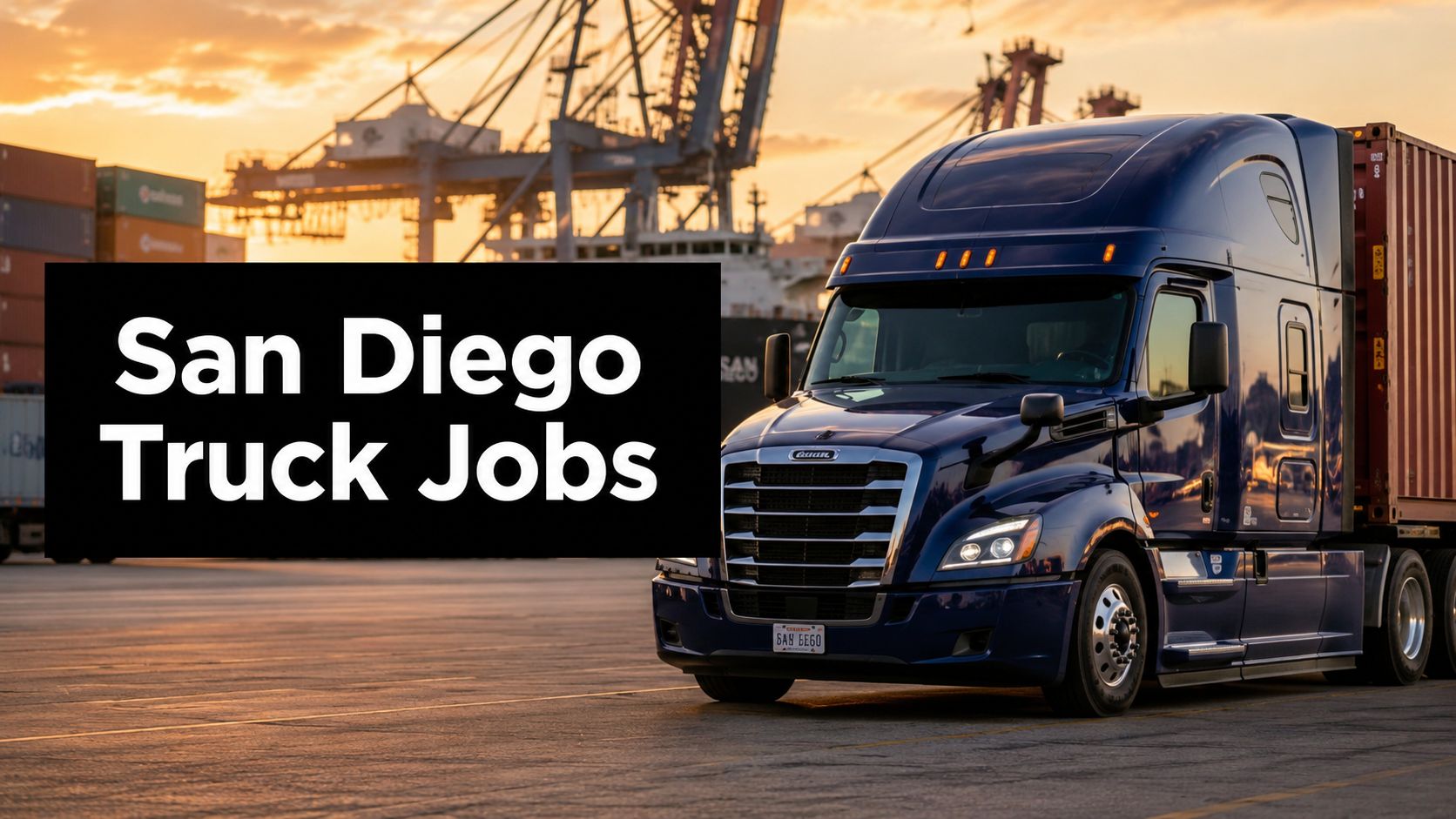
San Diego gives new drivers something worth paying attention to. It isn't just a place with trucking jobs. It's a logistics-heavy region where freight keeps moving through ports, warehouses, local distribution, construction supply chains, and cross-border lanes.
That matters because the local market can pay better than the national baseline. CPC Logistics reports an average annual wage of $77,340 for truck drivers in San Diego, and says drivers with more than 10 years of experience could make $87,238 locally. By comparison, the U.S. Bureau of Labor Statistics lists the national median for heavy and tractor-trailer truck drivers at $57,440 per year in May 2024. For someone comparing careers, that gap is a serious reason to look closely at San Diego rather than treating it like just another city job market. You can review the local wage snapshot through CPC Logistics' San Diego market page.

Why San Diego works for new drivers
San Diego's freight environment gives you more than one lane to enter the business. Some drivers want local delivery and daily home time. Others want regional work with longer runs and steadier highway miles. Some build toward port work or cross-border freight after they get experience and the right endorsements.
That variety helps because your first job doesn't have to be your forever job. It just needs to be a job that gets you legal, safe, and employable in the market.
A few local advantages stand out:
- Multiple freight types: San Diego supports local distribution, construction materials, retail replenishment, food movement, and container-related work.
- Different schedule options: You can find employers offering local, regional, and route-based work instead of being forced into one lifestyle.
- A premium local wage picture: The pay ceiling for experienced drivers is strong enough to make trucking a serious long-term trade in this area.
Practical rule: In San Diego, the smart move is to choose your first job for training value and stability, not just the biggest number in the ad.
What makes this a practical career move
Truck driving is also more accessible than many career changes. The occupation doesn't require a college degree. In the national outlook for heavy and tractor-trailer truck drivers, the Bureau of Labor Statistics says the role typically requires a commercial driver's license, plus usually a postsecondary nondegree award and short-term on-the-job training. BLS also estimates 2,235,100 people were employed nationally in this occupation and projects 237,600 openings per year over the decade, with 4% growth from 2024 to 2034. That's a big labor market with steady replacement demand, not a niche field that disappears if one employer slows down. The full occupation profile appears on the BLS truck driver outlook page.
For California-specific licensing routes and training pathways, this overview of CDL options in California is a useful starting point.
Your First Step Getting Your Commercial Driver's License
If you don't already have a CDL, stop worrying about job boards for a minute. Your first assignment is getting qualified. Employers can work with a new driver. They can't work with someone who isn't licensed for the equipment.
When pursuing truck driving jobs in San Diego, a Class A license is generally the recommended starting point. That's the license tied to tractor-trailers and the broadest range of freight work. Class B can still be a good fit if you're targeting straight trucks, buses, dump trucks, or certain local fleet roles, but it doesn't open as many entry points in long-haul or combination-vehicle work.

The sequence that actually works
Most successful students handle the process in a clean order:
Confirm eligibility and medical readiness
Get clear on California residency, identification, and medical fitness requirements. If you need a DOT medical card, handle that early so it doesn't become a last-minute delay.Pass the permit tests
Your Commercial Learner's Permit is the gateway to legal training behind the wheel. Treat the written tests seriously. Students who rush the permit stage usually struggle later with inspection language, air brake logic, and road rules.Choose real training, not just test prep
Good programs prepare you for the exam and for San Diego roads. That's different from memorizing enough to squeak through the state test.Practice pre-trip, backing, and road driving until they're repeatable
One clean run isn't enough. You need repeatable habits under pressure.Take the skills test when you're steady, not just eager
A rushed test date creates retests, lost time, and more nerves.
What strong training looks like
Beginners frequently make the wrong trade-off. They look for the fastest path, not the most complete one. Speed matters, but control matters more.
CET says truck-driver programs typically use 20 to 25 students per class, include classroom instruction plus full-size tractor and open-road practice, and aim to make students eligible for the CDL exam during the program. CET also states that its program runs 6 to 7 months. That matters in a place like San Diego, where city turns, traffic density, lane management, and freeway merging expose weak habits fast. The details are outlined on CET's truck driver program page.
The highest-value training sequence is simple. Master pre-trip inspection, then 53-foot trailer control, then city-street turns, then interstate merging, then endorsements that fit the lanes you want.
A practical checklist helps here:
- Pre-trip inspection: Learn the script and the meaning. If you only memorize words, you'll freeze under pressure.
- Backing control: Straight back, offset, and alley dock work all expose poor mirror discipline.
- Urban turns: San Diego punishes lazy setup. You need patience, lane awareness, and trailer tracking.
- Highway merging: New drivers often hesitate too long or fail to build speed cleanly.
- Endorsement planning: Think ahead if you may want specialized work later.
For a plain-English overview of the process, CDL requirements in California lays out the basics.
Don't confuse passing the test with being hire-ready
A lot of students think, “Once I pass, I'm done.” You're not done. You're employable only when you can do the job without creating worry for a trainer, dispatcher, or safety manager.
That's why I'd rather see a student take a little longer and leave with calm, consistent habits than rush into a license they can't use well. In San Diego traffic, shaky fundamentals show up immediately.
Finding and Targeting San Diego Trucking Employers
Once you have your CDL or you're close enough that employers will talk to you, the search gets more specific. This isn't the moment to spray applications everywhere. San Diego has different kinds of trucking work, and each type comes with a different day, different home time, and a different tolerance for new drivers.
A lot of new CDL holders waste energy applying to employers that were never realistic fits. Port-oriented work may ask for experience and sharper yard skills. Some local delivery fleets care as much about customer service and hand-unloading attitude as driving ability. Regional carriers may be more open to new graduates if they have a solid finishing process.
Common San Diego Trucking Job Types
| Job Type | Typical Routes | Home Time | Common Employers |
|---|---|---|---|
| Port drayage | Port, rail, warehouse, yard, short container moves | Often local, but schedule can be irregular | Container carriers, intermodal fleets, drayage operators |
| Local delivery | City routes, retail stops, foodservice, building supply | Usually home daily | Local distributors, beverage fleets, construction suppliers |
| Regional haul | Southern California and nearby western lanes | Often weekly or several times per week | Regional carriers, national fleets with local terminals |
| Dedicated account work | Repeating customer routes and scheduled lanes | Depends on account structure | Contract carriers, private fleets, larger logistics companies |
Read the pay structure carefully
In San Diego, job ads don't always talk in the same language. Indeed reports an average posted pay of $1,553 per week for truck drivers in San Diego, while Class A listings show an annual range of $40,000 to $87,000. If you're comparing offers, you need to convert and compare correctly instead of getting distracted by whichever ad sounds bigger at first glance. The local pay snapshot is available on Indeed's San Diego truck driver salary page.
A weekly ad can look attractive, but ask what sits underneath it:
- Mileage-based pay can fluctuate with route assignment and dispatch quality.
- Hourly local work may offer steadier weeks, but sometimes more physical labor.
- Salary-like dedicated work may sound stable, but the key question is what duties are bundled into that expectation.
How employers actually screen drivers
Most transportation employers use a straightforward screening order. They verify your CDL class and endorsements, review your driving record and work history, then move into background checks, drug testing, and a practical maneuvering test.
That order matters. If your paperwork is sloppy, your job history is inconsistent, or you can't explain gaps, you make yourself harder to insure and harder to trust.
The fastest application isn't usually the strongest one. The strongest one is complete, truthful, and matched to the fleet's equipment and route type.
The other mistake is relying only on job boards. Good driver recruiting usually combines ads, referrals, job fairs, and direct outreach. In trucking, volume doesn't win. Fit wins. A carrier wants to know whether you can drive their equipment, follow policy, and show up safely every day.
Nailing Your Application and Truck Driver Interview
The application is where a lot of new drivers talk themselves out of a job. Not because they can't drive, but because they look unprepared.

A trucking recruiter is usually checking three things before anything else. Can this person be insured? Can this person follow instructions? Will this person create less risk than the next applicant?
Build a resume that matches trucking, not office jobs
Your resume should be short, clean, and specific. If you're new, don't try to fake road experience. Use what you do have. Safe work history, equipment operation, delivery work, warehouse experience, military service, construction, route discipline, attendance, and customer-facing roles all matter.
A practical way to tighten your resume is to compare your wording to the actual posting and adjust it appropriately. This effective resume tailoring guide is useful for understanding how to match your experience to what the employer is screening for without stuffing in nonsense keywords.
Good trucking resumes usually highlight:
- License status: CDL class, permit status, and endorsements.
- Safety-related experience: Any role where procedures, inspections, or equipment mattered.
- Reliability markers: Attendance, route completion, shift work, or time-sensitive work.
- Physical readiness: If the role involves touch freight, make that clear if it's true.
Bring the documents before they ask twice
Treat your first interview like a compliance event, not a casual conversation. Have your documents organized. If a recruiter has to keep chasing you for basics, you look like a future headache.
Bring or prepare:
- CDL and medical documents
- Work history with accurate dates
- Driving record details you can explain clearly
- Any endorsements or permit paperwork
- References who will answer the phone
For inspection prep, this pre-trip inspection guide is a helpful review before a road evaluation.
Show up early, dressed like someone who respects equipment and other people's time. You don't need a suit. You need to look ready for a safety-sensitive job.
Expect a road test, not just interview questions
A lot of new drivers spend all their energy rehearsing answers and forget that the actual interview may happen in the truck. The evaluator is usually watching for mirror use, lane control, turn setup, speed management, braking, backing awareness, and whether you take corrections well.
Common interview questions are still predictable. Why trucking? What kind of route are you looking for? Are you comfortable with nights, weekends, touch freight, or regional work? But your demeanor matters as much as your answers. Calm beats flashy every time.
Here's a useful visual walkthrough that can help you think through hiring expectations and driver presentation before you sit down with a recruiter:
The best applicants don't oversell themselves. They answer directly, admit what they're still learning, and show they can take instruction without getting defensive.
Entry-Level Jobs and Programs for New Drivers
This is the part people worry about most. They see “entry-level” and assume it means they can apply with no CDL. In many San Diego listings, that isn't true.
Indeed shows 184 entry-level truck driver jobs in San Diego, but many listings still require a valid CDL-A or a willingness to obtain one, and some say 0 to 6 months of experience is enough only after certification. That's the line too many job seekers miss. “No experience” often means no driving experience after licensing, not no license at all. You can review that entry-level listing pattern on Indeed's San Diego entry-level truck driver results.
What counts as truly beginner-friendly
A beginner-friendly path usually falls into one of these buckets:
- CDL training first, then placement support
This is the cleanest route for someone starting from zero. - Trainee or finishing programs
These are for new CDL holders who need supervised miles and structured onboarding. - Employers open to recent graduates
They still want the CDL in hand, but they don't require long prior experience.
That distinction matters because it saves you from applying blind. If you don't have a CDL yet, focus on training and licensing. If you have the CDL but no experience, focus on recent-graduate-friendly fleets.
Why carriers keep building entry paths
Carriers don't create trainee pipelines out of charity. They do it because they need drivers. The Bureau of Labor Statistics projects about 237,600 openings each year for heavy and tractor-trailer truck drivers over the next decade, and many of those openings come from replacement needs. That's why carriers keep building on-ramps for new talent. The underlying demand picture appears in the earlier BLS occupation profile.
For people starting from scratch, that demand creates room for structured hiring. Not every employer wants a rookie. Some absolutely do, as long as the rookie is licensed, trainable, and insurable.
How to make yourself look hireable fast
Once you've earned the CDL, your next job is presentation. A clean, trucking-specific resume helps a lot. If you want examples of what hiring managers in this field expect to see, Hiration's truck driver resume advice gives a useful breakdown of sections and wording.
A simple plan works well:
- Pick a lane
Decide whether you're targeting local, regional, or dedicated work first. - Apply where your profile fits
Recent graduate means recent graduate. Don't burn time on fleets demanding seasoned backing or specialized freight history. - Call after applying
In trucking, polite follow-up still matters. - Stay flexible on the first seat
The first job is often about learning dispatch, trip planning, customer expectations, and company procedure. - Use schools and programs with placement support
If you're looking at structured training, Patriot CDL's program page shows the type of school-to-employer pathway many beginners need.
Veterans often have an advantage here. Fleet discipline, equipment respect, chain of command, punctuality, and mission focus transfer well into trucking. Civilian carriers may not understand every military duty title, so translate your background into plain language a recruiter can use.
If you're brand new, don't ask, “Who will hire me with no experience?” Ask, “Which employers hire new CDL holders and train them correctly?” That's the real question.
Starting Your Career Your First 90 Days on the Road
The first 90 days can make or break your confidence. New drivers usually don't fail because they can't move the truck. They struggle because they're juggling too many small things at once. Dispatch communication, route timing, fuel stops, paperwork, backing in unfamiliar places, customer expectations, and fatigue management all hit at the same time.
What good rookies do early
The drivers who settle in fastest usually keep their world small and disciplined.
- They ask questions before they move. If the route note is unclear or the receiver setup looks tight, they stop guessing.
- They build repeatable habits. Same pre-trip rhythm. Same document check. Same mirror routine. Same backing setup.
- They protect their record. No rushing. No gambling on a turn. No trying to “make it work” in a bad dock approach.
Working with dispatch and fleet managers
Your dispatcher doesn't need perfection. They need honesty. If you're running late, say it early. If a stop is unsafe, say it clearly. If you need help with a route or backing plan, ask before the problem gets bigger.
A new driver also needs practical planning off the road. Parking is one of the easiest places to create stress, especially when you're tired and unfamiliar with an area. That's why tools and references for truck parking and route planning become useful once you're running loads.
Early in your career, boring is good. Boring means no incidents, no preventable damage, no missed communication, and no surprises in your file.
Building toward better jobs
Your first position is your platform. After you've proven you can run safely and consistently, more doors start to open. Some drivers move into better local schedules. Some aim for dedicated freight. Others work toward endorsements or specialized freight where the hiring bar is higher but so is the long-term upside.
If you treat your first months like paid apprenticeship instead of instant freedom, you'll advance faster. San Diego is a strong place to start because it gives you different ways to build a career once you've earned trust behind the wheel.
If you're serious about getting into trucking and want a clear path from permit to first job, Patriot CDL is one training option to consider. The school focuses on practical CDL preparation, including permit guidance, pre-trip work, backing maneuvers, and road-test readiness, which is exactly what new San Diego drivers need when they're starting from scratch.