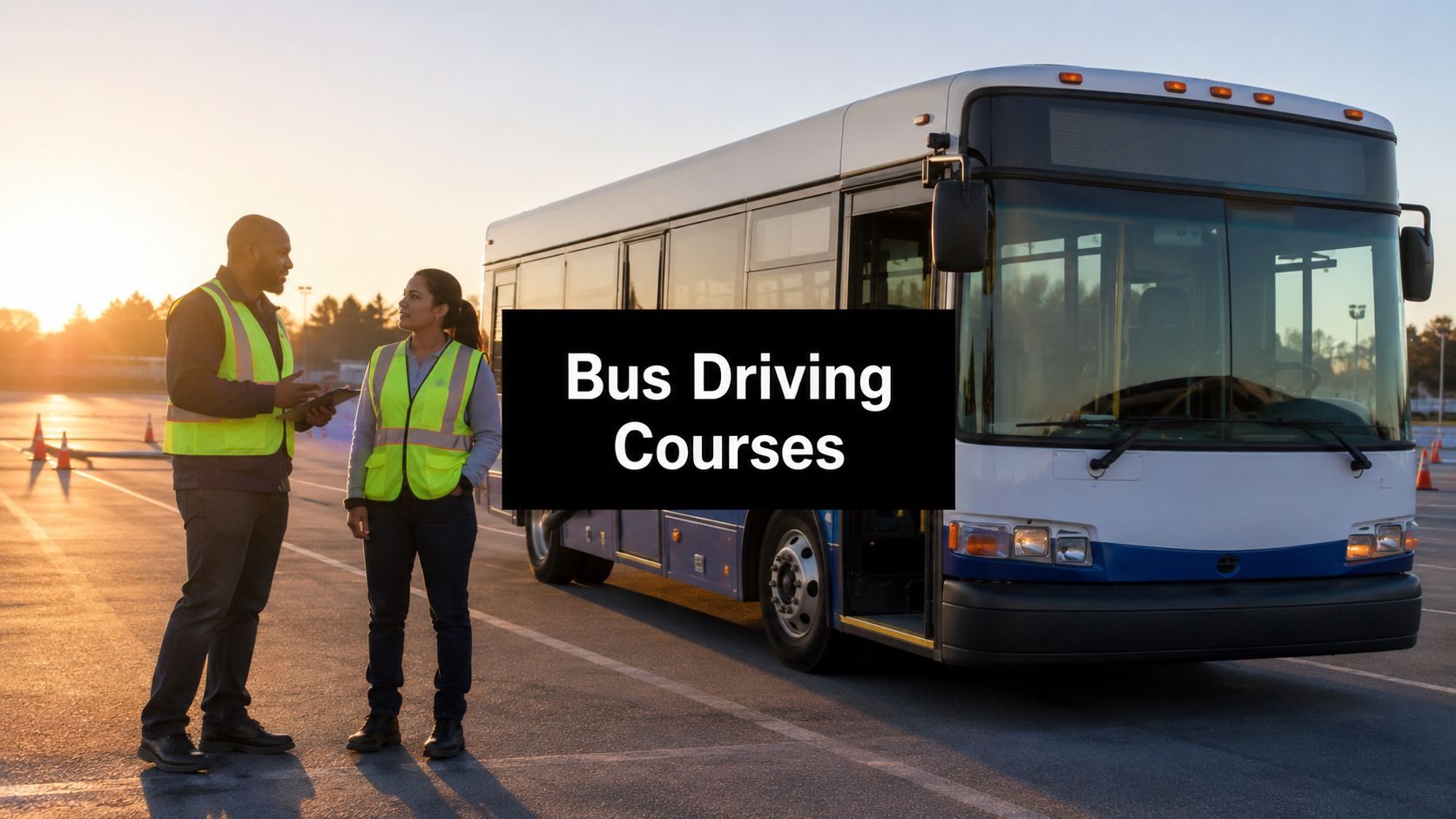
You might be reading this during a lunch break, after another day at a job that feels flat. Maybe you want steadier work. Maybe you want a role that gets you out from behind a desk. Maybe you like the idea of doing something concrete, useful, and visible in your community.
That's one reason bus driving courses appeal to so many career changers. The work is practical. The training is structured. And unlike careers that require years of schooling before you can even test the waters, this path is built around a defined licensing process.
The Road to a New Career Starts Here
A lot of people first look into bus driving because they want a job that feels more real.
I've spoken with adults leaving office work, warehouse workers looking for a cleaner schedule, parents returning to the workforce, and drivers who already enjoy being on the road but want a more focused career path. They often start in the same place. They type a few searches into Google, see course ads, and then hit the same wall of questions. What kind of license do I need? How long does training really take? What's the difference between a CDL class and school bus endorsement training?
Those questions matter because this isn't casual driver education. In the United States, bus operators make up a substantial workforce. The Bureau of Labor Statistics reported 162,850 bus operators nationally in 2020, with 24,600 annual job openings projected from 2020 to 2030 for growth, retirements, and turnover, as summarized in this transit workforce briefing on bus driver recruitment and retention.
That demand helps explain why bus driving courses are now tightly connected to formal CDL preparation instead of informal on-the-job learning. You're preparing for regulated testing, safety procedures, and a job that carries real responsibility.
What makes this career path different
Bus driving asks for two things at once:
- Technical skill: You need to handle a larger vehicle safely and consistently.
- Public responsibility: You may transport children, commuters, or passengers who depend on you every day.
If you're comparing career paths that involve commercial driving, it also helps to understand the business side around the vehicle itself. For example, if you want a practical overview of coverage issues tied to commercial vehicles, this guide to New York commercial auto insurance gives useful background.
Some learners start by reviewing a formal training option like this CDL training program so they can see how classroom prep and road practice usually fit together.
Bus driving looks simple from the curb. From the driver's seat, it's a professional skill set.
The good news is that the path becomes much less intimidating once you see it in order. You don't need to know everything today. You just need to know the next step.
Decoding the Different Bus Driving Programs
Not all bus driving courses work the same way.
Some are short and focused. Some are tied directly to an employer. Others sit inside a broader educational setting. If you don't understand those differences early, it's easy to compare programs unfairly.
Three common training paths
Most future bus drivers look at one of these routes:
| Feature | Dedicated CDL School | In-House Transit Training | Community College Program |
|---|---|---|---|
| Main focus | Commercial license and test prep | Training for that employer's fleet and standards | CDL instruction within a broader school setting |
| Pace | Usually faster and more concentrated | Often aligned with hiring timelines | May follow an academic calendar or term structure |
| Best for | Career changers who want a direct route into training | People who want a job path tied to one agency | Learners who prefer a campus environment |
| Curriculum style | Classroom plus driving practice built around licensing | Agency procedures plus route-specific expectations | Formal instruction with institutional support |
| Flexibility | Often designed for working adults | Depends on employer scheduling | Depends on course availability |
| Trade-off | You may still need to line up the right employer afterward | Training may be specific to one system | The timeline can feel less direct |
Dedicated CDL schools
This option works well for people who want a straightforward, skills-first path.
A dedicated school usually centers the course around permit prep, vehicle inspection, yard maneuvers, and road skills. If you're already comfortable making a fast career move, this structure often feels clearer than a broader academic program. Some students also use a CDL refresher course when they have prior driving experience but need to rebuild confidence before testing.
In-house transit authority training
This path can be a strong fit if you already know where you want to work.
Public transit systems and school transportation departments sometimes train drivers to meet their own operating standards. That can simplify the jump from training to employment, but it also means the process may be shaped by that agency's hiring cycle, policies, and service needs.
Community college programs
These appeal to learners who want a more traditional classroom setting.
Some people feel more comfortable in that environment, especially if they want access to student services, a campus schedule, or a program that sits alongside other workforce training. The trade-off is that the route may feel less direct if your main goal is to get licensed and start working as soon as practical.
The right program isn't the one with the shortest ad. It's the one that matches your schedule, your learning style, and the kind of driving job you want afterward.
A common mistake is picking based on one phrase like “fast” or “affordable.” A better question is this: what process will get you from first class to legal driving status with the fewest surprises?
Meeting Essential Prerequisites and Medical Standards
Before you spend time applying, make sure you're looking at bus driving courses with a realistic picture of what schools and employers will expect.
Many people become nervous, mostly because they hear terms like medical card, background check, endorsements, and driving record all at once. It sounds bigger than it is. The process is manageable when you treat it like a checklist.

Your first eligibility check
Most training providers and employers will want you to confirm a few basics early:
- Valid driver's license: You'll need a current non-commercial license before you move toward a CDL.
- Driving history: Schools and employers usually review your record for issues that could affect training, hiring, or insurance.
- Age and route type: Some driving work has different age requirements depending on the kind of operation involved.
- Identity documents: Expect to gather standard records used for licensing and employment.
- Medical readiness: You'll likely need to complete the required physical steps before full certification.
If you want a practical overview of what schools often ask for before enrollment, this CDL requirements guide is a useful starting point.
Why the medical exam matters
A bus driver's job isn't just about knowing how to steer a large vehicle.
You need to stay alert, monitor passengers, respond calmly, and manage long stretches of seated driving. Some official labor information for school bus work also shows that the role is heavily centered on sitting, while still requiring people-management ability in daily interactions. That's part of why the medical and safety standards exist.
Safety rules start before the first route
Bus driving courses don't save safety instruction for the end. In states with detailed training rules, that material is built in from the beginning. New Jersey, for example, requires instruction in areas including student management and discipline, accident and emergency procedures, emergency exit drills, loading and unloading procedures, stop-loading zone safety, defensive driving, and railroad crossing procedures, according to New Jersey school bus driver requirements.
That tells you something important. Eligibility is not just about whether you can drive. It's about whether you can handle a regulated safety role.
Practical rule: If you have a question about your record or medical status, ask before you enroll, not after you've paid for training.
That single habit saves a lot of stress.
Inside a Typical Bus Driving Course Curriculum
Once you know you're eligible, the next question is usually, “What will I be doing in class?”
The answer is more balanced than many people expect. Good bus driving courses don't throw you straight into traffic, and they don't keep you buried in a classroom forever either. They build skill in layers.
A simple way to think about it is this. You learn the rules first, then the routine, then the vehicle, then the road.

In the classroom
The classroom portion gives you the language and logic behind commercial driving.
That often includes traffic laws, CDL knowledge preparation, vehicle systems, inspection routines, and the specific safety expectations tied to passenger transport. School bus training places special weight on loading, unloading, route awareness, and emergency response. That emphasis makes sense when you consider that the National Highway Traffic Safety Administration says about 26 million children ride school buses every day, which is why official curriculum guidance covers handling, loading and unloading, and evacuation procedures in depth through the NHTSA school bus driver service curriculum.
You may also spend time learning how to think like a professional driver instead of a private motorist. That shift matters. Passenger transport leaves less room for improvising.
Behind the wheel
Then the training becomes physical and repetitive in a good way.
You start with habits that feel small but matter on test day and on the job. Mirrors. Seat position. Entry routine. Brake checks. Pre-trip order. Then instructors usually move students into basic yard skills before road driving.
Common hands-on areas include:
- Pre-trip inspection practice: Learning how to check the bus in a sequence you can repeat under pressure.
- Closed-course maneuvers: Backing, turning, lane control, stopping, and positioning without the distraction of live traffic.
- Public-road instruction: Applying judgment in traffic with an instructor present.
- Passenger-related procedures: Safe boarding, unloading, and managing attention between the road and the people onboard.
A focused pre-trip routine is one of the first things students struggle with, so reviewing a guide to pre-trip inspection steps can make the learning curve feel less steep.
Here's a visual example of how training topics come together in practice:
Where learners often get stuck
Most students don't struggle because the material is impossible. They struggle because they expect to feel comfortable too soon.
You're not supposed to feel polished in the first days of training. Repetition is part of the curriculum, not proof that you're behind.
If you keep showing up, ask clear questions, and practice the same sequence the same way, the course starts to feel far more predictable.
Understanding Course Duration and Costs
You sign up for a bus driving course expecting a straight path. A few weeks of training, one test, then work. For many new drivers, the process feels more like a checklist with waiting rooms between the boxes.
That gap between the course calendar and your full timeline causes a lot of confusion.
A training program may run for a set number of weeks, but your total path to legal driving status can stretch longer if you still need permit testing, a medical card, endorsement steps, or a scheduled skills test date. Some schools explain the class schedule well but say less about the time before and after training. That is often where people get frustrated.
For practical CDL preparation, training is commonly described as taking 6 to 12 weeks and combining classroom instruction with behind-the-wheel practice, according to the Transit Workforce Center briefing on bus driver recruitment and retention. That gives you a useful starting range, not a guaranteed finish date.
State rules can add another layer. In Pennsylvania, for example, school bus endorsement training includes a minimum number of hours, including classroom time and one-on-one in-bus instruction, as outlined in the Pennsylvania school bus driver training guide. Requirements like that explain why two programs with similar ads can lead to different real-world timelines.
Cost works the same way. The tuition number matters, but it is only one part of the bill.
A lower-priced course can end up costing more in time and stress if you have to arrange extra practice, retest fees, or paperwork help on your own. A higher-priced program may include more drive time, permit preparation, or scheduling support. The better question is not "What does the course cost?" but "What does the full process require me to pay for, in money and time?"
Use these questions when you compare programs:
- Which license path does the program cover? A general CDL course is not always the same as training built for passenger or school bus work.
- How much actual bus time is included? Seat time with an instructor is where many students build confidence.
- What fees are outside tuition? Ask about permit fees, medical exam costs, endorsement testing, and retest charges.
- Who handles scheduling? Help with test dates and documents can shorten delays.
- How closely does the course match your state rules? Local compliance details can affect both your timeline and your budget.
Budget for the training, the testing, and the waiting periods between them. That fuller roadmap is what keeps a "short program" from turning into a longer and more expensive surprise.
From Training to Certification The Final Steps
You finish your last training day, feel more comfortable behind the wheel, and assume the hard part is over. For many new drivers, this is the point where confusion starts. Training teaches you how to operate the bus. Certification asks you to prove it, in the right order, with the right paperwork, before any deadlines expire.
It helps to treat the final stage like a checklist at the end of a long trip. Miss one item, and the bus does not leave the yard.
Step one is the permit
Before you can take the full CDL skills test, you usually need to pass the written knowledge exams and get a Commercial Learner's Permit, or CLP.
That sounds simple, but at this stage, many applicants lose time. A future bus driver may need several knowledge tests, depending on the license class and endorsements required for the job. A school bus path can involve more steps than a standard passenger route, so the order matters.
The safest approach is to confirm three things early: which tests you need, how long your permit or passing scores stay valid, and whether your training provider schedules any parts of the process for you.
Step two is the skills test
Once you are cleared for testing, the CDL skills exam usually has three parts:
Vehicle inspection test
You explain and identify safety items before driving.Basic control skills test
You show that you can handle the bus in a controlled space, including backing, positioning, and low-speed maneuvers.On-road driving test
You drive in traffic and demonstrate safe decisions, awareness, and control.
Each part checks a different skill. Pre-trip inspection is memory plus safety judgment. Basic control is precision. The road test is where the examiner sees whether you can stay calm, read traffic well, and operate the vehicle consistently.
A student can be strong in one area and still need more practice in another. That is normal.
Step three is matching your license to the job
Many bus jobs require more than a base CDL.
If you plan to carry passengers, you may need a Passenger endorsement. If you plan to drive a school bus, you may also need a School Bus endorsement and extra state qualification steps. Those extra steps can include behind-the-wheel training requirements, background checks, medical clearance, or state-specific testing rules.
This is one of the biggest hidden timeline issues in the whole process. Two students can finish class in the same week and still reach certification at different times because one is pursuing a simpler passenger route and the other needs school bus approval with added requirements.
Certification usually slows down because of sequence errors, expired paperwork, missed scheduling windows, or unclear endorsement requirements.
That is why organized applicants often finish sooner. They keep copies of documents, track deadlines, and ask what must happen before the next step can be booked.
If you are nearing the end of training, ask your school for a written testing sequence. A simple page that shows permit, practice requirements, skills testing, endorsements, and employer or state clearance steps can remove a lot of anxiety. It also gives you a realistic picture of how close you are to being job-ready.
How to Choose a Quality Program and Enroll
By the time you're ready to enroll, the biggest risk isn't lack of motivation. It's choosing a program based on marketing language instead of training reality.
A polished website can't tell you whether the school has enough vehicle access, whether instructors teach clearly, or whether the timeline in the ad leaves out half the process.
Questions that reveal program quality
Ask questions that force a school to explain the actual student experience.

A strong checklist includes:
- Who teaches the course: Ask about instructor background and whether they've trained new drivers, not just driven professionally.
- How training time is scheduled: Find out how often students get into the vehicle.
- What equipment you'll train on: The condition and type of training fleet affect confidence and realism.
- How the school handles testing steps: Ask what happens after the class portion ends.
- What support exists if you struggle: Some learners need extra help with pre-trip order, backing patterns, or permit prep.
- Which documents you should gather first: A good school should answer that immediately.
If you want a general consumer mindset for evaluating instruction quality, this article on comparing driving schools offers a helpful way to think through your options.
Watch for hidden timeline gaps
One of the most overlooked questions is also the most important.
Ask, “What is the full timeline from day one to legal work eligibility in my state?”
That matters because official rules can stretch the path beyond the advertised course length. As noted earlier, North Carolina requires multiple test stages and limits training and testing attempts, which is exactly the kind of detail “quick training” ads often leave out in the North Carolina school bus licensing process.
One practical way to narrow your options
Once you've identified a few schools, compare them side by side using your own notes. Include schedule fit, vehicle access, clarity of admissions answers, and how honest they are about the full process.
If you're ready to move from research into application, you can review the enrollment steps on Patriot CDL's sign-up page. Treat that as one example of how a school presents next actions, then compare it with the others on your list.
A quality program doesn't just teach the test. It helps you avoid avoidable delays.
Before you enroll, do three things:
- Tour the training location if possible
- Speak with admissions and ask process-specific questions
- Start gathering your license, identification, and medical paperwork early
That's how you turn uncertainty into momentum.
If you're ready to take the first practical step, Patriot CDL offers commercial driver training for students working toward CDL skills and test preparation. Review the program details, confirm your eligibility, and ask direct questions about schedule, endorsements, and the full licensing timeline before you enroll.