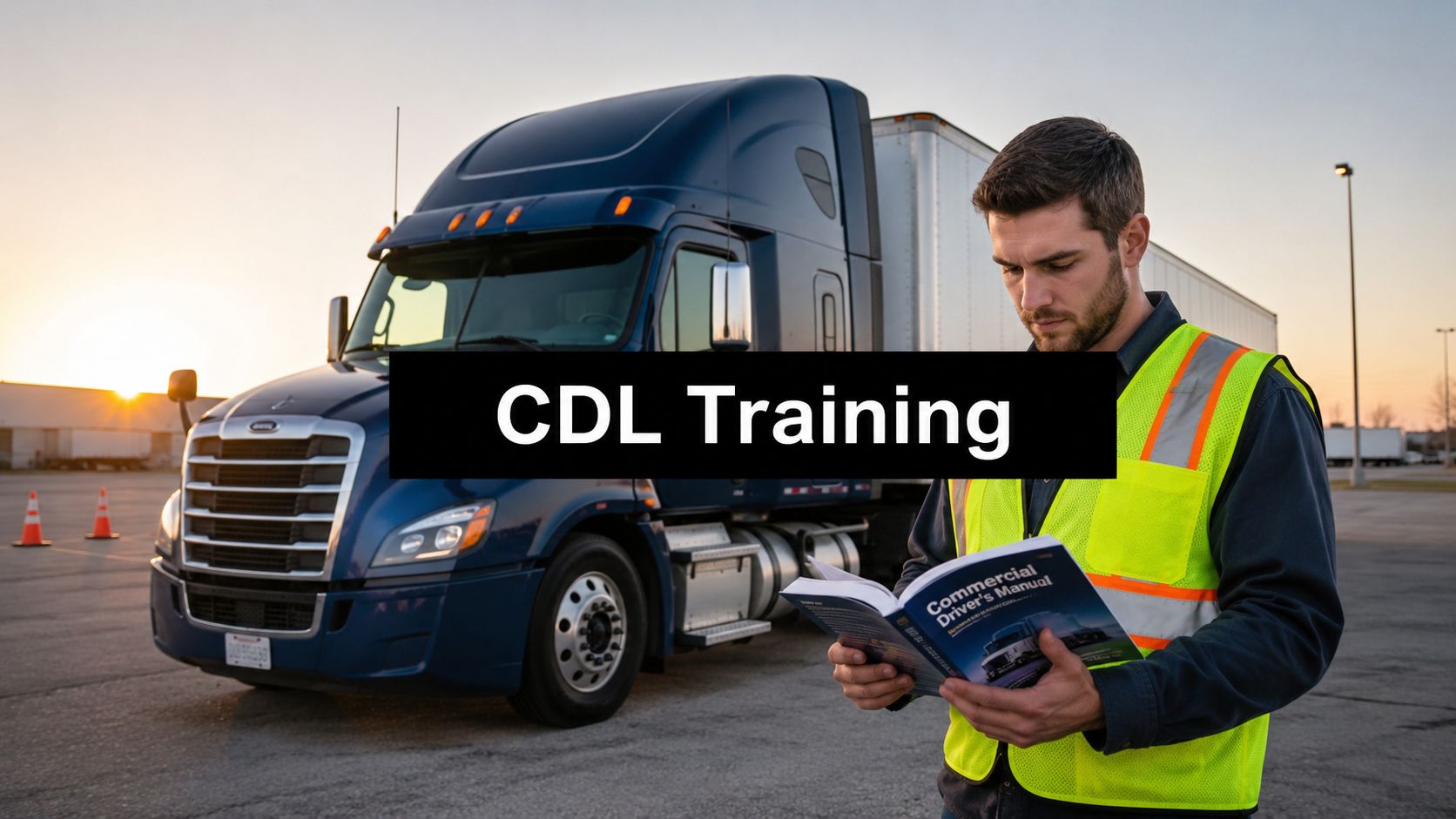
You're probably looking at trucking for one of three reasons. You want steadier work, you want out of a job that tops out too early, or you want a career path that doesn't require spending years in school first. That's exactly why CDL training keeps pulling in career changers, recent graduates, and people who just want a cleaner line between effort and income.
The value is straightforward. The U.S. Bureau of Labor Statistics reports a median annual wage of $57,440 for heavy and tractor-trailer truck drivers as of May 2024, with about 237,600 openings per year projected on average from 2024 to 2034 in this occupation (BLS truck driver outlook). That's a large hiring pipeline for a credentialed trade, and it helps explain why a CDL is often one of the fastest routes into skilled work.
Training for a CDL license can move quickly, but only if you stop treating it like a simple driving class. It isn't. It's a sequence of permit prep, compliance steps, school selection, yard work, road practice, and testing. People who respect that sequence usually save time and money. People who guess their way through it usually pay for retests, delays, and missed start dates.
If you want a practical read on the process, the Patriot CDL blog covers common topics from the student side. What matters most is learning how to get licensed with the fewest wasted steps.
Your Roadmap to a High-Demand Trucking Career
A CDL makes sense when you want a job market with volume, not just possibility. Trucking fits that description because the work is tied to freight movement, replacement hiring, and a long pipeline of employers that need licensed drivers. You don't need to chase a four-year degree first to get into that lane.
What makes this path attractive isn't just speed. It's the combination of access and payoff. Most employers expect a high school diploma or equivalent, and the occupation often channels people through short-term vocational training rather than long academic programs. That's a very different setup from careers where the entry cost is years of school before you can earn a paycheck.
Practical rule: A CDL is valuable because it shortens the distance between training and employability. The people who win are the ones who keep that distance short.
There's also a mindset shift that helps. Don't think of training for a CDL license as “going back to school.” Think of it as a controlled launch sequence. Every step should answer two questions. Does this move me closer to the test? Does this help me avoid spending extra money later?
That approach changes how you study, how you choose a school, and how you budget. It also keeps you from getting distracted by flashy promises. A short advertised program doesn't automatically mean the fastest outcome. The fastest outcome comes from getting your permit early, choosing a compliant training provider, practicing the exact tested skills, and protecting your first test attempt.
Laying the Groundwork Before You Start the Engine
The biggest delays usually happen before class even starts. Students focus on tuition and schedule, then realize they still need paperwork, screening, and permit clearance. If you want the cheapest and fastest route, handle the gatekeeping items first.

Start with what can block enrollment
Before you compare schools, make sure you can begin training without interruption.
- Check your eligibility: Confirm your license status, residency requirements, and driving history. A problem on your record can slow everything down.
- Get your DOT medical exam handled: Many programs require this before class. If you wait until the last minute, your start date can slip.
- Prepare for drug screening: Treat this like a fixed requirement, not a maybe.
- Pull your motor vehicle record if a school asks for it: Some programs want it before they'll finalize your seat.
A lot of applicants burn time here because they treat these items like side errands. They're not. They're part of the admissions process.
For a practical overview of early entry requirements, Patriot CDL's CDL requirements page is one example of the kind of checklist you should review before committing to a class date.
Get your CLP as early as possible
Your Commercial Learner's Permit, or CLP, is the lever that moves the rest of the schedule. In Michigan, once a student gets the CLP, they must wait a minimum of 14 days before taking the on-road skills test (Michigan CDL application guidance). That waiting period is why smart students don't delay permit prep.
If you get the CLP late, the calendar keeps moving anyway. Your class may start, but your testing window gets pushed back. That creates dead time, and dead time costs money if you're paying for transportation, taking time off work, or trying to line up a job quickly.
Get the permit process moving early. Even when school training is efficient, state waiting periods still control part of your timeline.
Use a simple pre-class checklist
A clean way to approach the front end is this:
- Study for the written permit tests first. Don't enroll and hope motivation shows up later.
- Book the medical exam and complete any required screening.
- Gather your documents in one folder. Don't let paperwork create a missed start date.
- Only then lock in a school date.
That order works because it removes avoidable surprises. It also keeps you from paying tuition before you know you're fully ready to begin.
Choosing the Right CDL Training Program for You
A lot of students lose a week here, a few hundred dollars there, and do not notice the mistake until they are stuck waiting on a test slot. The wrong school usually does not fail on the brochure. It fails on scheduling, extra fees, weak yard time, or training that does not line up cleanly with the license they want.

Your first filter
For first-time Class A or B applicants issued a CLP on or after February 7, 2022, federal rules require Entry-Level Driver Training, or ELDT, from a provider listed on the FMCSA Training Provider Registry before the applicant can take the skills test (FMCSA CDL licensing steps). If a school is not listed, the training does not count.
Check that before you compare anything else.
A polished sales pitch does not matter if the school creates a compliance problem that forces you to start over or change plans late. Fast and cheap only matter if the training gets you to the test.
Accelerated versus part-time
This choice affects both your finish date and your total cost.
| Program type | Better for | Main upside | Main trade-off |
|---|---|---|---|
| Accelerated full-time | Students who can commit daily | Quicker path to testing and job start | Harder to balance with work, childcare, or other obligations |
| Part-time or weekend | Working adults and caregivers | More scheduling flexibility | Longer completion timeline and more chances for delays |
In practice, full-time programs usually move better because skills stay fresh from one day to the next. Students back more consistently, remember the pre-trip sequence better, and reach test readiness with fewer warm-up laps. Part-time training can still work well, especially for someone who cannot step away from a current job, but it often stretches the calendar and adds hidden costs such as extra commuting, more unpaid time off spread across weeks, and a higher chance that life interrupts your momentum.
That trade-off is real.
A school that looks cheaper on tuition can cost more overall if the timeline drags out long enough to create missed work, extra rides, retest fees, or more practice hours than you expected.
What to ask before you enroll
Skip broad questions. Ask the ones that expose bottlenecks.
- Is the provider ELDT-registered? If the answer is unclear, keep looking.
- How much actual behind-the-wheel time do students get? Observe whether they answer directly or hide behind total program hours.
- How are drive times scheduled? A crowded program can leave students standing around more than driving.
- What happens if I need extra help on backing or pre-trip? Some schools build in remediation. Others charge separately or push you to the next opening.
- What fees are not included in tuition? Permit costs, DOT physicals, drug screening, retests, and road test rental fees add up fast.
- How soon can graduates usually test after finishing? A strong training schedule means less if testing access is backed up.
One factual example is Patriot CDL's training program, which is presented as an FMCSA-approved CDL training option with accelerated scheduling. That is the kind of detail worth checking because it speaks to compliance and pace, not just marketing language.
The best value is the program that gets you licensed on schedule with enough seat time to pass the first time. That is how you save money.
What to Expect in the Classroom and Behind the Wheel
Most students feel less anxious once they know what training days look like. The process gets easier when it stops feeling mysterious.

The classroom side
Early training usually starts with the knowledge base. That includes safety rules, vehicle systems, road awareness, hours-of-service concepts, and the material you need for permit and test prep. It's not abstract if the instructor does it right. Every lesson should connect back to either the written exam or a decision you'll make in the truck.
A good classroom block also starts building your pre-trip language. You're not just learning parts of the vehicle. You're learning how to identify them clearly, inspect them in order, and explain what you're checking without freezing up.
If pre-trip is the part that feels intimidating, spending extra time with a structured pre-trip inspection guide helps because it turns a long verbal sequence into repeatable chunks.
The yard is where habits form
Once students move to range work, they start learning how big a combination vehicle really feels. Overconfidence usually gets corrected fast during this phase. Backing, setup, pull-ups, mirror use, and pace control all matter.
A normal progression starts with simple control work and builds toward more technical maneuvers. Students repeat the same moves until they stop reacting late and start thinking ahead. That's what instructors want to see. Not flashy driving, just controlled driving.
Smooth is faster than rushed. In CDL training, the student who slows down enough to be precise usually progresses sooner.
A typical training rhythm
A week in training often feels like this:
- Morning theory review: Road rules, safety items, permit content, or pre-trip structure.
- Skill block in the yard: Backing patterns, stopping points, setup angles, correction habits.
- Road time later: Lane position, turns, speed management, traffic scanning, and instructor feedback.
After students get a feel for the basics, seeing a live walk-through can make the whole process easier to picture.
The biggest adjustment isn't technical. It's mental. You're learning to stay deliberate under pressure while someone evaluates everything from mirror checks to word choice during inspections.
Strategies for Passing Your CDL Written and Skills Tests
You can lose two weeks with one bad test day. A missed permit exam means another trip to the DMV, another wait for an opening, and sometimes another fee. A failed skills test can cost even more if the school charges for retesting or extra truck time.
The cheapest, fastest path is simple. Prepare well enough to pass before the clock and the fees start stacking up.
Why first-attempt prep saves time and money
Students who treat the tests like a formality usually pay for it. The written exams look easy until the wording gets specific. The skills test looks manageable until nerves break your routine.
Retakes create three problems at once:
- Direct cost: testing fees, school retest charges, extra practice hours
- Schedule delays: the next appointment may not be available right away
- Income delay: every failed attempt pushes back the date you can start working
That last part matters most. A preventable failure does not just cost test money. It delays your first paycheck.
For adults balancing rent, childcare, or a current job, schedule discipline matters just as much as study discipline. Prentice helps adult apprentices explain that reality well, and it applies here too. Training has to fit real life, or real life starts disrupting training.
Written test strategy
The written side rewards recall, not recognition. Reading the manual once and saying “yeah, I know that” is how people burn an attempt.
A better method is boring, but it works.
- Study every day in short blocks: Twenty to thirty focused minutes beats one long cram session.
- Split the subjects: General knowledge, air brakes, and combination vehicles each have their own traps.
- Review missed questions out loud: If you cannot explain why an answer is right, you do not know it yet.
- Practice the wording: A lot of misses come from rushing through the phrasing, not from missing the concept.
If you are still tightening up permit prep, use focused practice for the general knowledge CDL test questions and explanations. That helps build speed on the basics before you pile on endorsements or air brakes.
One more tip from the yard. Study the same way you plan to test. Sit down, put the phone away, answer in one pass, then review mistakes. Casual studying creates casual results.
Skills test strategy
The skills test is less about raw driving talent and more about sequence, control, and keeping your head straight under pressure.
Here is where students usually lose points:
| Test segment | What sinks students | What fixes it |
|---|---|---|
| Vehicle inspection | Jumping around, vague labels, forgetting parts | Follow one repeatable order and use clear, specific wording |
| Basic control | Rushing, poor setup, too much steering input | Slow down, set up early, use pull-ups before the mistake gets bigger |
| Road test | Late signals, drifting lane position, weak observation habits | Build a simple routine for mirrors, turns, speed, and space checks |
Pre-trip is usually the first place avoidable failures happen. Students know the truck, but they do not know their order. Pick one walkaround pattern and stick to it every time. Front to side to rear. Or cab first, then outside. The exact route matters less than keeping it consistent.
Backing failures usually start before the truck even moves. Bad setup costs more than bad correction. If the angle is wrong, stop and fix it early. One controlled pull-up is cheaper than a boundary violation or a full retest.
Smooth and repeatable beats fast and impressive.
What works on test day
Test day is not the time to try a new routine, a new breakfast, or a new way to calm yourself down. Keep the day plain.
Use a short checklist:
- Get there early enough to settle in
- Run your usual pre-trip sequence
- Listen all the way through before acting on an instruction
- Take legal corrections instead of forcing a bad position
- Keep your pace under control, especially in backing
The students who pass consistently are rarely the flashiest drivers in the class. They are the ones who stay organized, protect points, and avoid expensive mistakes.
Creating a Realistic Budget for Your CDL License
A lot of people ask what CDL training costs, but the better question is what it costs all the way to the license. Tuition matters. It just isn't the whole bill.

The costs schools don't always highlight first
A full CDL budget often includes items before class even starts. Some programs require a DOT physical, drug screening, and a Motor Vehicle Report before training begins. Some also charge a $250 retesting fee if a student fails the licensing exam (FDTC commercial CDL training details).
That's why the advertised tuition number can be misleading by itself. You need to budget for the path, not just the classroom seat.
Build your budget in layers
A practical way to plan is to separate fixed and risk-based costs.
- Base entry costs: Tuition, permit-related expenses, medical exam, screening, record checks.
- Training-period living costs: Food, transportation, childcare, and time away from current work.
- Contingency money: Retests, rescheduling, extra practice, and administrative hiccups.
This is especially important for adults supporting a household. If that's your situation, this article on how Prentice helps adult apprentices is useful because it addresses the broader budgeting pressure that comes with short-term training transitions.
Where people overspend
The expensive mistakes are usually predictable.
One is starting class without enough permit preparation, then paying in time and retesting later. Another is underestimating living expenses during an accelerated schedule. A third is choosing a school only by tuition and ignoring how the program handles testing readiness.
Budget reminder: The cheapest route is usually the one with the fewest repeat steps.
Training for a CDL license is affordable when the plan is tight. It gets costly when you have to redo parts of the process.
From New License to Your First Trucking Job
Once you've got the license, the next goal is simple. Convert it into your first seat fast.
Start with school connections if your program offers them. Ask which carriers hire new graduates, what kind of freight those fleets run, and what their onboarding process looks like. A weak first application often comes from not asking basic questions about route type, home time, and equipment.
Keep your resume short and useful. Lead with the CDL class you earned, any endorsements you hold, your permit-to-license completion, and the core skills you trained on. Yard maneuvers, pre-trip discipline, and road safety habits matter more than filler language.
Before interviews, spend a little time reviewing truck basics outside the licensing mindset. A practical resource like this preventive maintenance checklist for trucks can help new drivers speak more confidently about inspection awareness and equipment care.
Then do one more thing most rookies skip. Answer your phone. Carriers move fast, and missed calls slow hiring down just like missed paperwork slowed training down.
You don't need to know everything on day one. You need to be licensable, coachable, and ready to work safely. That's enough to get rolling.
If you want a straightforward path from permit prep to road test readiness, Patriot CDL offers CDL training built around practical skill development, hands-on instruction, and a faster route into the trucking workforce.