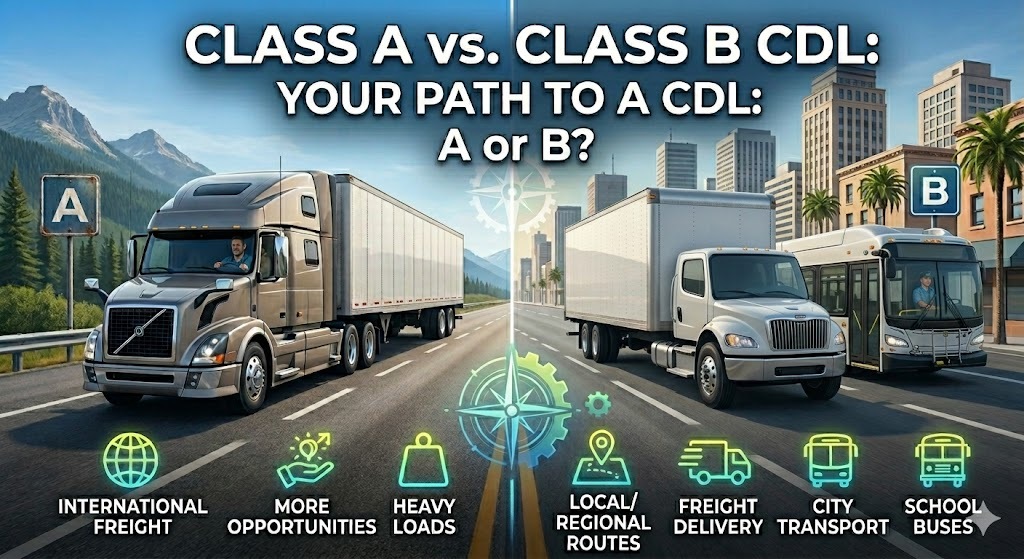
When you decide to launch a rewarding career in professional commercial driving, the very first and most crucial question you will face is: “Should I get a Class A or a Class B CDL?”
The fundamental difference between the two comes down to the weight of the vehicle you are legally allowed to operate and whether or not that vehicle utilizes a detachable trailer. Let’s break down the exact differences so you can choose the perfect program for your career goals.
⚖️ The Technical Difference: Weight & Configuration
Federal Entry-Level Driver Training (ELDT) standards classify commercial motor vehicles based on their Gross Vehicle Weight Rating (GVWR):
CDL Class A (Combination Vehicles)
This license is designed for operating combination vehicles—meaning a truck that is hooked up to a heavy trailer.
Total Weight Capability: Permits you to drive any combination of vehicles with a total weight rating of 26,001 pounds or more.
The Trailer Factor: The vehicle being towed (the trailer) must weigh more than 10,000 pounds.
What You Can Drive: Massive tractor-trailers (semi-trucks), flatbeds, livestock carriers, auto transporters, and tankers.
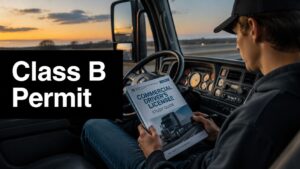
CDL Class B (Heavy Single Vehicles)
This license is designed for operating single, solid-frame vehicles where the driver’s cab and the cargo area are attached as one unit.
Total Weight Capability: Permits you to drive any single vehicle with a weight rating of 26,001 pounds or more.
The Trailer Factor: You can hook up a trailer, but the vehicle being towed cannot weigh more than 10,000 pounds.
What You Can Drive: Large delivery box trucks, concrete mixers, dump trucks, garbage trucks, city transit buses, and school buses.
💡 The Golden Rule: If you hold a valid Class A CDL, you are automatically qualified to drive Class B vehicles (as long as you have the necessary endorsements for specific cargo, like a passenger endorsement for buses). However, it does not work the other way around—a Class B driver cannot legally operate a Class A semi-truck.
📈 At-A-Glance Comparison
| Feature | CDL Class A | CDL Class B |
| Vehicle Types | Semi-trucks, tractor-trailers, big rigs | Single heavy trucks, buses, dump trucks |
| Max Trailer Weight | Over 10,000 lbs (No limit) | Up to 10,000 lbs max
|
| Maneuvering Complexity | High. Requires mastering coupling/uncoupling and advanced backing with a pivoting trailer. | Moderate. The vehicle doesn’t bend in the middle, making it easier to park and navigate. |
| Lifestyle & Routes | Mostly Over-the-Road (OTR) or long-haul. Expect to travel cross-country and spend nights out. | Mostly Local & Regional. Deliveries happen within your area, keeping your routes close to home. |
| Work-Life Balance | High-adventure, travel-oriented lifestyle. | Home every single night to sleep in your own bed. |
| Earning Potential | Top-tier earning potential due to the complexity of hauling massive freight over long distances. | Highly competitive, stable hourly pay with local infrastructure and delivery companies. |
📚 Curriculum & Training Differences (ELDT)
Because the mechanical nature of these vehicles varies, the federal ELDT training profiles focus on completely different practical skillsets:
In the Class A Program: Your practical behind-the-wheel training deeply emphasizes trailer mechanics. You will master the exact science of coupling and uncoupling trailers, complex 45-degree and 90-degree alley dock backing, and advanced hazard practices like preventing a tractor-trailer jackknife.
In the Class B Program: Your practical training focuses heavily on single-vehicle control. You will master navigating tight city corners, managing overhead clearances during urban deliveries, proper railroad-highway grade crossings, and passenger safety protocols if you are training for buses.
🏁 Which One Should You Choose?
Choose Class A if: You love the idea of the open road, want to travel across the United States, desire the absolute highest earning ceiling in the logistics sector, and want to master the biggest rigs on the highway.
Choose Class B if: You want a rock-solid, recession-proof career but prioritize being home with your family every night. It is ideal if you want to work in local construction, public transit, school districts, or regional commerce.
🛞 Made Your Decision?
Whether you want to dominate the cross-country interstate or master local deliveries, our elite, fully compliant ELDT programs are here to launch your career!
[Enroll in the Class A CDL Program] —OR— [Enroll in the Class B CDL Program]