So, how many questions are actually on the CDL test? The answer isn't a single number. It’s more like a menu where you pick what you need. Everyone starts with the main course, the General Knowledge test, which usually has 50 questions. From there, you add side dishes—endorsements for specific things like Air Brakes, which tacks on another 25 questions.
A Quick Look at CDL Test Question Counts
Getting ready for your CDL exam is a lot easier when you know what to expect. Think of it as building a custom vehicle. The General Knowledge test is your chassis—the foundation everyone needs. After that, you add on the parts you need for the job, like specific endorsements for the kind of rig you plan to drive.
This setup means you're only tested on what's relevant to you. While the exact question count can differ a little from state to state, they all follow the same federal guidelines. For instance, in California, the General Knowledge test has 50 questions, the Air Brakes test has 25, and other endorsements like Combination Vehicles or Hazmat have between 20 and 30 questions each.
Breakdown of Common CDL Tests
To give you a clearer picture, I've put together a table showing the most common CDL knowledge tests and what you can expect from each. Knowing these numbers helps you budget your study time and focus on what matters.
| Test Section | Typical Number of Questions | Passing Score Requirement |
|---|---|---|
| General Knowledge | 50 | 80% (40 correct) |
| Air Brakes | 25 | 80% (20 correct) |
| Combination Vehicles | 20 | 80% (16 correct) |
| Hazardous Materials (Hazmat) | 30 | 80% (24 correct) |
| Tanker Vehicles | 20 | 80% (16 correct) |
| Doubles/Triples | 20 | 80% (16 correct) |
| School Bus | 25 | 80% (20 correct) |
Each of these tests zeroes in on a specific area of commercial driving, ensuring you have the specialized knowledge to operate safely and legally.
The magic number for every single CDL knowledge test is an 80% passing score. That means on the big General Knowledge exam, you need to get at least 40 out of 50 questions right to move forward. No exceptions.
The General Knowledge Test: Your Starting Line
Every single journey to becoming a commercial truck driver starts in the exact same place: the General Knowledge test. Think of it as the bedrock of your entire CDL. You can't get any endorsements, and you certainly can't get behind the wheel professionally, until you pass this exam.
This test is more than just a hurdle to clear. It’s designed to make sure you have a solid grasp of the core safety principles that keep you, your rig, and everyone else on the road safe. It's the "alphabet" you need to know before you can start writing the "sentences" of advanced driving techniques.
What's On the Test and What It Takes to Pass
The General Knowledge test is a wide-ranging exam, so knowing what to expect is half the battle. You’ll be tested on the absolute essentials of operating a commercial vehicle safely and effectively.
- Vehicle Inspection: Knowing your rig inside and out, and being able to spot a problem before it becomes a disaster.
- Basic Vehicle Control: The fundamentals of getting your truck moving, steering it correctly, and bringing it to a safe stop.
- Shifting Gears: Mastering the art of smooth and proper gear shifting is non-negotiable.
- Seeing Hazards: This is all about defensive driving—spotting potential trouble long before you're in the middle of it.
- Controlling Speed: Understanding how to manage your speed for the conditions, the terrain, and the law.
The magic number for the General Knowledge test—and for all other written CDL exams—is 80%. The test typically has 50 questions, which means you need to get at least 40 of them right to move on.
It’s interesting to see how people prepare. One study of CDL applicants found that a surprising 43.5% were self-taught, while another 37.4% learned from friends or family. That's a lot of drivers learning the ropes outside of a formal classroom, which really highlights why a focused study plan for the official exam is so important.
If you want to really dig into the details and see exactly what's covered, check out our General Knowledge test guide. It gives you a complete breakdown of each topic, helping you build that solid foundation you need to pass with flying colors.
Decoding CDL Endorsement Test Questions

Once you’ve nailed the General Knowledge test, you can start adding endorsements to your CDL. Think of these as specializations that open doors to specific—and often better-paying—trucking jobs. Each endorsement has its own test, focusing on the unique knowledge required for that type of truck or cargo.
The question counts for these tests are lower than the main exam, but don't let that fool you. The material is very specific. Most endorsement tests have somewhere between 20 and 30 questions, and you still need to hit that universal 80% passing score. On a 25-question Air Brakes test, for example, that means you can only get five wrong.
Common Endorsements and Question Counts
While you might see minor differences from one state to another, the federal standards keep things pretty consistent nationwide. Here’s a look at the most common endorsement tests you’ll run into:
- Air Brakes: This one is a big deal for most Class A and B drivers. It typically has about 25 questions that cover everything about how air brake systems work and how to operate them safely.
- Combination Vehicles: If you’re going for a Class A, this test is a must. It’s usually around 20 questions and dives into the challenges of driving a tractor-trailer—think coupling and uncoupling, turning, and handling that extra length.
- Tanker (N Endorsement): With about 20 questions, this test is all about hauling liquids. You'll learn how to handle the "slosh effect" and manage the high center of gravity that makes tankers unique.
- Hazardous Materials (H Endorsement): The HazMat test is one of the more challenging ones, with around 30 questions. It covers the strict rules for placards, safe loading procedures, and what to do in an emergency when hauling dangerous goods.
Each endorsement you earn adds another layer of expertise to your license, directly impacting your job opportunities and earning potential. Mastering these specialized tests is a direct investment in your future career.
Getting a clear picture of the specific CDL requirements for your target endorsements is the first step in creating a solid study plan. Adding endorsements like HazMat or Tanker makes you a more capable driver and a much more attractive candidate to a wider range of companies. These tests are less about rote memorization and more about proving you have the practical know-how to handle specialized equipment and cargo safely out on the road.
How State Rules Affect Your CDL Test
Think of the Commercial Driver's License as a national standard, but with a local flavor. The core requirements, like the critical safety topics and that all-important 80% passing score, are set at the federal level. This ensures every commercial driver in the country meets a consistent, high standard for safety.
But here's where it gets interesting. Each state's DMV gets to put its own spin on the test. One state might decide its General Knowledge test needs 50 questions, while the state next door might use 60. The way questions are phrased can differ, too, even if they're testing the exact same safety rule. This is why you can’t just ask "how many questions are on the CDL test?" without also asking "in which state?"
Why Your State Manual Is Your Best Friend
With these state-by-state differences, your single most important study tool is your state's official CDL manual. It’s the playbook. While practice tests are fantastic for getting comfortable with the format, the manual is where the actual test questions come from.
Trust your state's official CDL manual above all else. It contains the exact information, rules, and procedures you will be tested on, making it the most reliable study guide you can find.
To give you a general idea, this infographic shows a common breakdown of question counts for the main CDL knowledge tests.
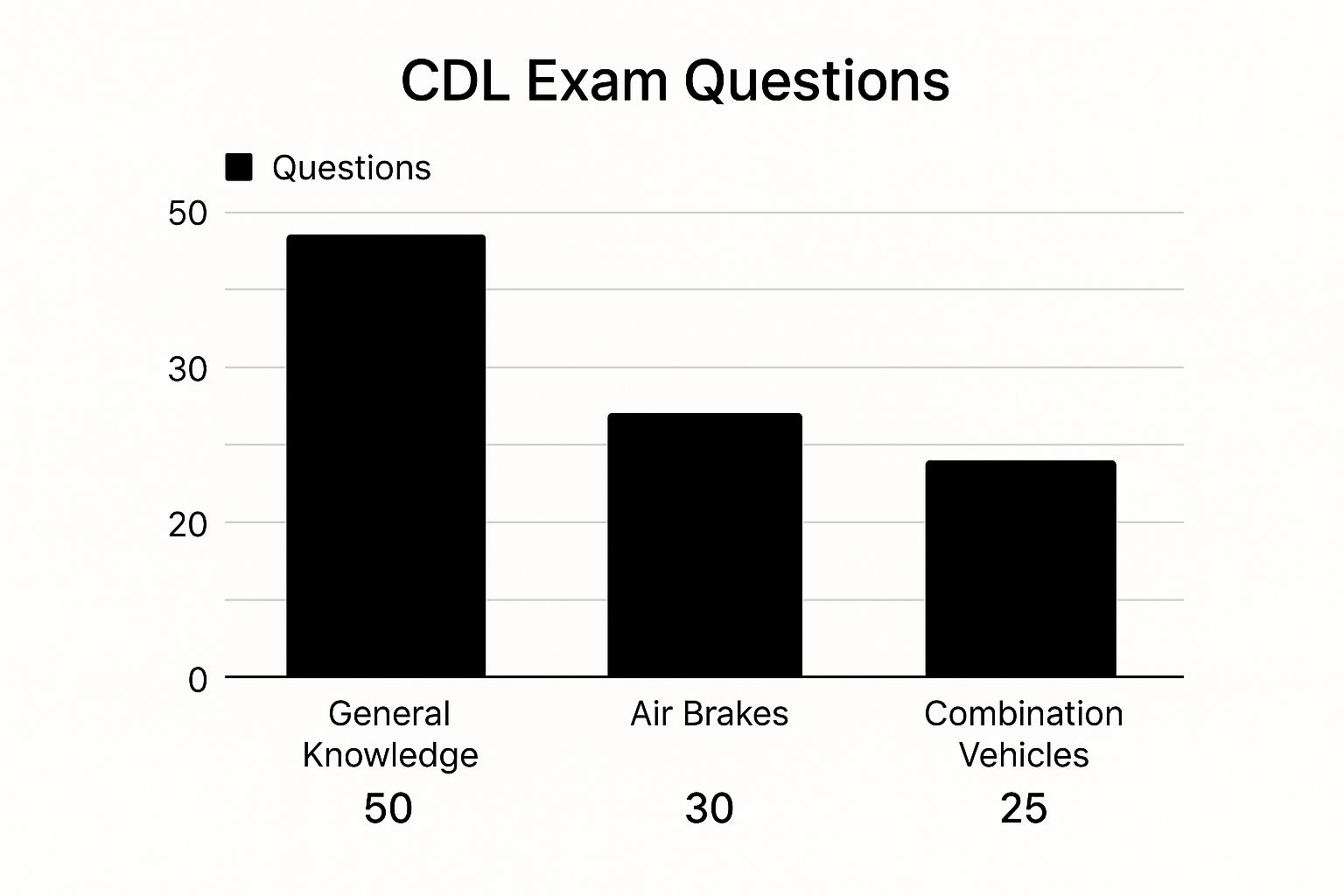
As you can see, the General Knowledge exam is the big one, which makes sense—it’s the foundation for everything else you’ll learn.
CDL Test Question Counts in Select States
To show you how much the numbers can vary, here’s a quick look at the question counts for the three core written tests in a few different states.
| State | General Knowledge Questions | Air Brakes Questions | Combination Vehicle Questions |
|---|---|---|---|
| Texas | 50 | 25 | 20 |
| Florida | 50 | 25 | 20 |
| California | 50 | 25 | 25 |
| New York | 50 | 25 | 20 |
This table really highlights that while the General Knowledge and Air Brakes tests are fairly consistent, other endorsements like Combination Vehicles can have slight differences depending on where you test.
This federal and state partnership is a well-oiled machine. Laws even require states to report their CDL testing data back to the Federal Motor Carrier Safety Administration (FMCSA). It’s all part of a system designed to keep standards high across the board.
For a real-world example of how one state lays out its requirements, you can explore the CDL process in Alabama. The core knowledge is universal, but knowing the local rules is what gives you the confidence to ace your test on the first try.
Crafting Your Test Day Strategy to Pass

Knowing the number of questions on the CDL test is one thing, but building a smart strategy to answer them is what actually gets you the pass. That 80% passing score is the standard everywhere, and it leaves very little room for error.
Think about it: on a 50-question General Knowledge test, you can only get 10 wrong. For a shorter endorsement test like Air Brakes, which might have 25 questions, you can only miss five. This is why having a solid plan for test day isn't just a good idea—it's essential.
Your Approach to Answering Questions
When you finally sit down for the exam, resist the urge to fly through the questions. A calm, methodical approach is your best friend, especially when you hit a question that makes you pause.
- Read. Then Read Again: Before you even glance at the answers, make sure you understand exactly what the question is asking. Sometimes, one word can change the entire meaning.
- Process of Elimination: With multiple-choice, you can almost always spot a couple of answers that are just plain wrong. Get rid of them first. This instantly boosts your odds of picking the right one from what's left.
- Don't Get Bogged Down: It’s easy to get stuck on a tough question and waste precious time. If you’re not sure, flag it and move on. Circle back to it after you've answered all the ones you know for sure.
Here's the good news about failing a section: you don't have to start completely over. If you ace the General Knowledge test but stumble on an endorsement, you only have to retake that specific part.
What Happens If You Don't Pass
Failing a section feels lousy, but it’s definitely not the end of the road. Every state allows you to retest, though you might have to wait a day or two. This is a huge relief because it lets you zero in on the specific areas where you struggled instead of re-studying everything.
Remember, your preparation isn't just about the written tests. Getting confident with the hands-on skills is just as important. For example, mastering the steps in this detailed pre-trip inspection guide will build the kind of real-world confidence that carries you through every single part of the CDL process.
CDL Test FAQs: What You Need to Know
Even with all the study guides in the world, you probably still have a few practical questions about how the CDL test actually works. It's one thing to know the material, but it's another to understand the logistics of test day.
Let's clear up some of the most common questions we get from students. Think of this as the final rundown before you walk into the DMV, feeling prepared and confident.
Do I Have to Take All Endorsement Tests at Once?
Nope, you don't. The whole system is designed for flexibility. You'll start with the mandatory General Knowledge test—everyone has to pass that one first.
After that, you can pick and choose. If you're going for a Class A license, you'll naturally take the Combination Vehicles and Air Brakes tests next. But you can always come back later to add more endorsements, like Tanker or HazMat, as your career path takes shape.
Are Practice Test Questions the Same as the Real Exam?
They're close, but not identical. Practice tests are fantastic for getting a feel for the question format and seeing where you're strong and where you need to hit the books again.
But remember, your state's official CDL manual is the ultimate source of truth. Every single question on the real test comes directly from the information in that manual.
How Long Is My Passed Knowledge Test Valid?
Once you pass your written tests, you'll be issued a Commercial Learner's Permit (CLP). Think of it as a countdown timer.
Your CLP is typically valid for 180 days. Most states will let you renew it once, giving you a total of 360 days to pass the hands-on skills test. If that permit expires before you pass the driving portion, you have to start from scratch—retaking all the written exams. Always double-check your local DMV's rules on this.
If you're testing in an automatic truck, looking into an E restriction removal course is a great next step to open up more job opportunities down the road.
At Patriot CDL, we provide the hands-on training and expert guidance you need to pass every part of your CDL exam with confidence. https://patriotcdl.com