So, you're ready to start a career as a commercial driver? That's a huge step, and it all begins with acing the written knowledge exam. Your single best tool for getting over that first hurdle is a solid CDL practice test. It’s the closest you’ll get to the real thing and the best way to walk into the testing center with confidence.
Your First Step to a Commercial Driving Career
Before you can even think about climbing into the cab, you need to get your Commercial Learner's Permit (CLP). This permit is essentially your green light to start the hands-on, behind-the-wheel training with a certified instructor.
Think of the CLP exam as the gatekeeper to your new career. It’s a written test that proves you've got the foundational knowledge to operate a commercial vehicle safely. This is precisely where a good CDL practice test becomes your secret weapon. It’s not about rote memorization; it's about truly understanding the rules of the road before you ever hit the ignition.
Mastering the Knowledge Exam
The General Knowledge test is the first major milestone. It's a standardized exam designed to make sure you have the core knowledge needed for safe driving down cold.
To give you a clearer picture, here’s a quick breakdown of what to expect.
CDL General Knowledge Test at a Glance
| Component | Requirement | Purpose |
|---|---|---|
| Question Count | 50 multiple-choice questions | To cover a broad range of essential safety and operational topics. |
| Passing Score | 80% or higher (40 correct answers) | To ensure a high standard of knowledge before you begin practical training. |
| Time Limit | 60 minutes | To test your ability to recall information accurately under timed conditions. |
That 80% passing score can seem a little daunting at first, but it's completely achievable with the right preparation. A well-designed CDL practice test is the key—it helps you figure out what you know and, more importantly, what you don't know. By taking these tests over and over, you get comfortable with the question formats and the specific topics that will show up on the real exam.
This turns studying from a shot in the dark into a targeted plan. If you're ready to get started, you can find out more about the whole process with our guide on earning your CDL permit.
The goal isn't just to pass a test; it's to build a deep understanding of safety that will stick with you for your entire career. Think of a practice test as the first pre-trip inspection you'll ever do—only this one is on your own knowledge.
Building Confidence for Test Day
Confidence makes all the difference. Walking into the DMV feeling prepared and knowing what's coming can be the deciding factor between passing and failing. Using a CDL practice test regularly is the best way to get rid of those test-day jitters.
Here’s how they help build that rock-solid confidence:
- It Feels Like the Real Deal: Practice tests are timed and structured just like the official exam. When you sit down for the actual test, there won't be any surprises.
- You Find Your Weak Spots: You'll quickly see which topics—whether it's air brakes, combination vehicles, or hazardous materials—need more of your attention.
- It Makes the Information Stick: Every time you get a question right, you're reinforcing what you've learned, making it easier to recall under pressure.
When you make practice tests a core part of your study routine, you're doing more than just memorizing facts. You're training your brain to perform when it counts, making sure you're ready to pass the CLP exam and get on to the fun part: learning to drive.
What's Actually on the CDL General Knowledge Test?
If you want to pass the CDL General Knowledge test, you have to know what you're up against. This isn't a test you can cram for overnight; it’s about proving you understand the fundamental principles of being a safe, professional driver. Think of it less like a final exam and more like getting the keys to a house—you need to know how the foundation, the plumbing, and the electrical all work together before you can live in it safely.
The test is built to make sure you have a solid grasp of core driving concepts before you ever climb into the cab. It's not just about knowing the rules, but understanding why they exist. For example, memorizing the steps of a pre-trip inspection is one thing, but understanding that a single missed check could cause a catastrophic failure on the highway is what truly matters.
The questions you'll face fall into a few major categories. This diagram gives a great visual of how the different CDL knowledge tests fit together.
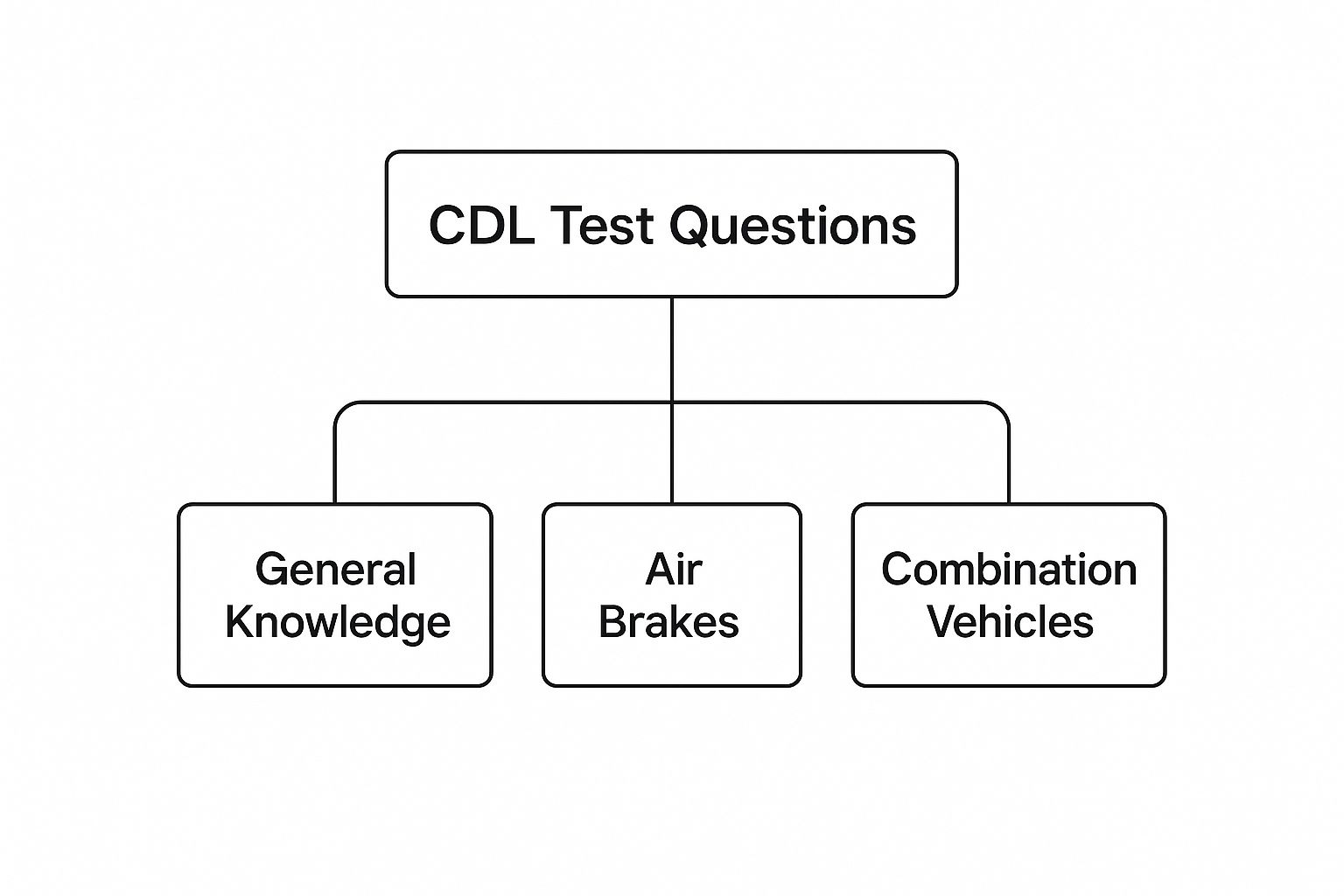
As you can see, the General Knowledge test is the big one—the foundation for everything else. For Class A drivers, the Air Brakes and Combination Vehicles endorsements are almost always the next essential pieces of the puzzle.
The Pillars of General Knowledge
The General Knowledge section is the largest and most diverse part of your written exam. Its job is to confirm you understand the universal rules of the road for commercial vehicles. A good CDL practice test will be weighted just like the real thing, which is a huge help in focusing your study time where it counts.
Here's a look at the main areas it covers:
- Safe Driving Practices: This is the heart and soul of the test. You'll see questions on everything from managing your speed and following distance to handling hazards like black ice, steep mountain passes, and unpredictable four-wheelers. It really tests your judgment and your ability to see trouble coming before it happens.
- Transporting Cargo Safely: This part is all about the freight. It covers the proper ways to load, balance, and secure cargo. Expect to be tested on things like legal weight limits, how to prevent cargo from shifting in transit, and the special rules for different types of loads. For a deeper dive, check out our complete guide to the General Knowledge Test.
- Vehicle Inspection and Control: A thorough pre-trip inspection is non-negotiable. This section of the test makes sure you know exactly what to look for—from tire pressure and brake connections to fluid levels. It also touches on basic vehicle control, like proper shifting, making tight turns, and backing up safely.
Breaking the test down like this makes it feel much more manageable. Instead of one giant, intimidating exam, you can see it as a series of smaller subjects. Each one plays a critical role in building your competence as a professional driver.
A classic mistake is getting tunnel vision on one topic, like vehicle inspections, while barely touching on cargo rules. The real test is balanced across all these areas, and your study plan should be, too. Each pillar is equally important.
How the Questions are Weighted
While the exact numbers can shift a bit from state to state, the distribution of questions is pretty consistent. The lion's share of the test—often over 50%—is dedicated to safe vehicle operations. That alone tells you how important it is.
Here's a rough idea of how the topics are weighted on the exam:
| Topic Area | Approximate Question Weight | Why It's Important |
|---|---|---|
| Basic Vehicle Control & Safety | 50-60% | Covers speed, space management, and hazard awareness. |
| Vehicle Systems & Inspections | 20-25% | Ensures you can identify and prevent mechanical failures. |
| Cargo and Special Conditions | 15-20% | Focuses on securing loads and handling unique situations. |
This table makes it crystal clear why your CDL practice test sessions need to be loaded with scenarios about safe driving decisions. If you can master those concepts, you’re well on your way to hitting that magic 80% passing score. By deconstructing the exam this way, it stops being a huge obstacle and becomes what it really is: a clear roadmap to earning your CDL.
Mastering Key Endorsements for Career Growth

Passing the General Knowledge test is your ticket to get in the door. But endorsements? That's how you build a real, high-paying career in trucking. Think of your standard CDL as a foundational degree—it's essential, but the specializations are what truly set you apart and open up bigger opportunities.
Each endorsement you add to your license proves you’ve mastered the skills for a specific type of vehicle or cargo. Getting one means passing a dedicated knowledge test on that subject. This is precisely why a targeted CDL practice test is so vital; it lets you zero in on the unique safety rules and operating procedures for each specialty you’re aiming for.
Unlocking Specialized Driving Roles
Different endorsements pave the way for entirely different career paths. A driver hauling hazardous materials lives by a completely different rulebook than someone driving a city bus. Figuring out which endorsements match your career goals is the first, most important step.
To get a clearer picture, it’s helpful to see how these endorsements break down and what each test really focuses on.
Common CDL Endorsements and Test Focus Areas
| Endorsement | Vehicle/Cargo Type | Typical # of Questions | Key Practice Test Focus |
|---|---|---|---|
| H – HazMat | Hazardous Materials | 30 Questions | Placard rules, loading/unloading security, and emergency response protocols. |
| N – Tanker | Bulk liquids or gases | 20 Questions | High center of gravity, liquid surge ("slosh"), and specialized vehicle inspections. |
| T – Doubles/Triples | Multiple trailers | 20 Questions | Coupling/uncoupling, managing the "crack-the-whip" effect, and turning radius. |
| P – Passenger | 16+ passengers (buses) | 20 Questions | Pre-trip inspections, railroad crossings, and safe passenger management. |
| S – School Bus | School Buses | 25 Questions | Student safety procedures, danger zones around the bus, and specific laws. |
This table gives you a snapshot, but it’s always smart to confirm the exact CDL requirements in your state before you start studying.
The real value of an endorsement is specialization. A general freight driver is always in demand, but a certified HazMat tanker driver is a specialist with a much rarer and more valuable skillset.
Tailoring Your Practice for Each Test
Since every endorsement has its own unique test, your study habits have to be just as specific. You simply can't prep for the HazMat exam using a general knowledge practice test—the questions are worlds apart, covering critical information you won’t find anywhere else.
A tanker practice test, for instance, will hit you with scenarios about liquid surge when you brake hard in a half-empty tank. A HazMat test, on the other hand, will challenge you to pick the right placard for a certain chemical or list the exact steps you'd take if a spill occurred.
While the general knowledge test might have 50 questions requiring an 80% to pass, endorsement tests for things like combination vehicles or school buses have their own set of distinct challenges. That’s why focused prep is non-negotiable.
Using a CDL practice test built specifically for the endorsement you’re after lets you drill down on the exact knowledge you'll be tested on. This approach doesn't just get you a passing grade; it gives you the real-world, life-saving knowledge you need to safely handle that specialized equipment on the road.
How to Analyze CDL Practice Test Questions
Reading the CDL manual is one thing, but applying that knowledge under pressure is the real challenge. The best way I've found to prepare is to learn how to think like the people who write the test. That means really digging into questions from a good CDL practice test.
It’s not enough to just pick the right answer. You need to understand why it’s right and, just as importantly, why the other options are dead wrong. This approach takes you way beyond simple memorization. You start to see how a rule applies in the real world, which is exactly what the exam—and your future career—is all about.
Let’s walk through how to break down a couple of typical questions.
Deconstructing a General Knowledge Question
A solid CDL practice test won't just ask you for definitions. It will throw scenarios at you that test how you apply what you know.
Sample Question 1:
You are driving a 40-foot vehicle at 35 mph. The road is dry and visibility is good. How much space should you keep in front of you?
- A) 2 seconds
- B) 3 seconds
- C) 4 seconds
- D) 5 seconds
Analysis:
- Find the Core Concept: Right away, you should see this is about following distance. The key pieces of information are the vehicle length (40 feet) and speed (35 mph).
- Apply the Rule: The rule of thumb is pretty simple: you need at least one second of following distance for every 10 feet of vehicle length when you're driving under 40 mph. A little quick math—40 feet divided by 10—tells you that you need a minimum of 4 seconds.
- Check the Options:
- A) 2 seconds: This is way too close for comfort in any vehicle, especially a big rig. It’s an easy one to eliminate.
- B) 3 seconds: This might feel okay in a car, but it doesn't give you enough reaction time in a 40-foot truck.
- C) 4 seconds: This one matches our calculation perfectly. It's the correct application of the "one second per 10 feet" rule for this situation.
- D) 5 seconds: More space is always better, but the official rule adds that extra second for speeds over 40 mph. Since we're at 35 mph, 4 seconds is the standard minimum the test is looking for.
When you break it down like this, you’re not just memorizing an answer. You're cementing the why behind the rule, and you'll be able to apply it to any similar question they throw at you.
A good test question isn’t designed to trick you; it's there to confirm you can make safe decisions almost instinctively. Learning to spot the "distractors"—the wrong answers—is a huge part of the process.
Analyzing an Air Brakes Question
Air brake systems are complex, and the questions on the exam reflect that. They test your understanding of how all the pieces work together, not just what one part does. Think of it like a bicycle pump—you have to understand how the handle, the chamber, and the hose all work in sync to get air into the tire.
Sample Question 2:
The air compressor governor controls when the air compressor will pump air into the storage tanks. At what PSI should the governor cut out, stopping the compressor?
- A) Around 60 psi
- B) Around 85 psi
- C) Around 100 psi
- D) Around 125 psi
Analysis:
- Find the Core Concept: This question is all about the air compressor governor and its specific job. The key terms here are "governor" and "cut out."
- Think Through the System: The whole point of the air brake system is to maintain pressure within a safe range. The governor's role is to act like a boss, telling the compressor to stop working once the tanks are full. If it didn't, the pressure would build up to dangerous levels. That "full" point is a federally regulated standard.
- Check the Options:
- A) 60 psi: This is dangerously low. In fact, your low-pressure warning light and buzzer would be going off around this pressure.
- B) 85 psi: Still too low. This is actually closer to the "cut-in" pressure, which is when the governor tells the compressor to start pumping air.
- C) 100 psi: This is generally considered the minimum safe operating pressure for the system to work correctly, not the maximum.
- D) 125 psi: Bingo. This is the industry-standard pressure where the governor tells the compressor to stop pumping. The tanks are full and ready to go. This is your correct answer.
This kind of thinking helps you connect the dots. You're not just learning a number; you're learning what that number means for the safety and function of your entire rig. That deeper understanding is what separates a truly prepared driver from someone who's just trying to squeak by on the test.
Smart Study Strategies to Actually Remember What You Learn
Let's be honest: passing the CDL knowledge exam isn’t about cramming the night before. It's about building a solid foundation of knowledge that sticks with you long after the test is over. This isn't just about passing; it's about being a safe, competent driver.
For most of us juggling work and life, that means we need to study smarter, not harder. Forget pulling all-nighters. The real trick is using study methods that actually work for the adult brain, locking that critical information into your long-term memory.
Use Active Recall and Spaced Repetition
Two of the most effective techniques I've seen students use are active recall and spaced repetition. They might sound like something out of a psychology textbook, but the ideas are simple and incredibly powerful for nailing the material on your CDL practice tests.
Active recall is just a fancy way of saying "pull the information out of your brain" instead of passively reading it. Don’t just re-read the chapter on air brakes. Close the book and try to explain how the system works out loud, as if you were teaching someone else. That struggle to remember is what builds strong memory connections.
Then there's spaced repetition. Think about it like this: you don't water a plant with a firehose once and expect it to live. You give it water periodically. Studying works the same way. Instead of cramming a topic for hours, you revisit it over time.
A simple schedule might look like this:
- Day 1: Learn about pre-trip inspections.
- Day 2: Spend a few minutes reviewing the key points.
- Day 4: Look it over again.
- Day 8: Do one last quick review.
Each time you come back to the material, you force your brain to work a bit to retrieve it, making that knowledge stick.
Trying to learn everything at once is like trying to drink from a firehose. A little bit each day, revisited over time, is how you truly master the material and build lasting knowledge.
Make a Study Schedule You Can Actually Stick To
A realistic study plan is your best friend. It keeps you on track, prevents burnout, and makes sure you cover all your bases without that last-minute panic.
First, break down the CDL manual into bite-sized pieces. Don't try to tackle "Air Brakes" in one sitting. Instead, focus on "Air Brake Components" one day and "Testing Air Brakes" the next. A focused 30-45 minutes each day is far more effective than a four-hour cram session on a Sunday. Find what works for you—maybe it's right after dinner or during your lunch break. Consistency is everything.
Practice Like It's the Real Deal
The final step is to get comfortable with the test itself. When you take a CDL practice test, don't just casually click through it. Treat it like the official exam to get rid of those test-day jitters.
Here’s how to do it right:
- Set a Timer: You'll be on the clock at the DMV, so get used to that pressure now.
- Kill Distractions: Phone on silent, TV off, find a quiet spot where you can focus.
- No Cheating: Don't look at your notes! The point is to find out what you don't know yet.
This process shines a bright light on your weak spots. If you keep missing questions on vehicle inspections, you know exactly where to focus your next study session. For a deep dive into that specific area, our guide on the CDL pre-trip inspection breaks down everything you need to know. When you prepare this way, you’re not just studying—you’re training to succeed.
State-Specific Rules and the New Wave of CDL Tests
While your CDL will be recognized from California to Maine, the road to getting it runs straight through your local DMV. Every state has its own little quirks and specific regulations, which is why grabbing a generic, one-size-fits-all study guide is a rookie mistake.
You need a CDL practice test that’s built for the state where you’ll actually be taking your exam. It might seem small, but something as simple as the legal speed limit for a commercial truck can change the moment you cross a state line. Is it 65 mph? Or does this state cap it at 55 mph? Trust me, those details matter, and they will pop up on your test.
Why You Can't Ignore Your State's Rules
Think of it like this: the federal CDL manual is the official rulebook for the entire game of professional driving. But each state is a different home field, with its own specific ground rules. One state might have unique laws for making a right turn on red in a big rig, while another might have strict protocols for navigating steep mountain passes.
A solid, state-specific CDL practice test is your home-field advantage. It’s designed around these local variations, making sure you’re not just learning the general rules of the road but mastering the exact regulations you'll be tested on.
This kind of targeted prep helps you lock down the details that often differ from state to state:
- Speed Limits: Not just the maximums, but the different rules for trucks vs. cars.
- Turning Regulations: Specific laws on how to handle wide turns and control intersections.
- Chain Laws: Mandatory requirements for driving in snow and ice.
- Weight and Axle Limits: State-enforced restrictions you’ll find on certain roads.
The whole point is to walk into the DMV feeling like you've got it handled. Knowing your state's traffic laws cold is a huge confidence boost and prevents you from getting tripped up by a local curveball.
The CDL Test is Getting a Modern Makeover
On top of state-by-state differences, the CDL test itself is changing. State agencies are updating their exams to reflect the reality of modern trucking, which means a bigger focus on advanced safety systems and new technology. The test you take this year could be very different from the one a friend took just a few years ago.
For example, the pre-trip inspection isn’t just about kicking the tires anymore. The checklist now often includes modern systems like collision mitigation, electronic logging devices (ELDs), and blind-spot monitoring. To keep up, states like South Carolina have modernized their CDL testing process, rolling out redesigned road tests and updated vehicle inspections that even use pictures to test your knowledge.
This is a great thing for road safety, but it means your study plan has to be current. If you’re using an outdated CDL practice test, you could be completely blindsided by questions about technology that’s now standard in the industry. Choosing a resource that’s up-to-date and state-specific ensures every minute you spend studying is directly preparing you for what you'll face on test day.
Your Top CDL Test Questions Answered
Even with the best study plan, you're going to have questions as you work toward your CDL. It's only natural. Let's tackle some of the most common ones we hear from students just starting out.
Think of this as your quick-hit guide for clearing up those nagging uncertainties. Getting the details straight on test scores, retakes, and timelines will make your whole preparation process feel a lot less stressful.
How Many Questions Are on the CDL Permit Test?
The big one—the General Knowledge test—is the foundation of your permit exam. You can expect to see 50 multiple-choice questions on it. To get a passing grade, you need to score at least an 80%, which means getting a minimum of 40 questions right.
The endorsement tests are a bit shorter but just as important:
- Combination Vehicles: This section usually has around 20-25 questions.
- Air Brakes: Plan on seeing about 25 questions.
- HazMat: This one is a little longer, with roughly 30 questions.
The 80% passing score rule applies to all of them. A high-quality cdl practice test will be set up just like this, so you can get a real feel for the timing and content of each exam you need to take.
What Happens if I Fail the CDL Test?
First off, don't panic. Failing a test isn't the end of your driving career—not by a long shot. Every state lets you retake the exam, but you'll usually have to wait a bit. This waiting period can be as short as a day or as long as a week, so be sure to check your local DMV's specific rules.
This is exactly why practice tests are such a game-changer. They help you find your weak spots before you're sitting in the official testing center, so you can focus your study time where it counts and dramatically boost your odds of passing the first time. On a related note, if you have a restriction for only driving automatic trucks, consider looking into an E-restriction removal course to open up more job options down the road.
Think of a failed test not as a failure, but as a roadmap. It shows you exactly which areas of the manual you need to revisit before you go back for your next attempt.
Ready to stop practicing and start your professional driving career? Patriot CDL offers expert, hands-on training to get you on the road fast. Learn more at https://patriotcdl.com.