Getting your Commercial Driver's License (CDL) all starts with one major hurdle: the General Knowledge test. This exam is the first step for every single professional driver, and I've put this guide together to build your skills from square one. We're going to turn complex rules into real-world confidence behind the wheel.
Your Roadmap to a Commercial Drivers License
Think of the General Knowledge test as the concrete foundation for your entire trucking career. This isn't just about cramming facts to pass a test. It’s about truly understanding the core principles that will keep you, your truck, and everyone else on the road safe.
Passing this test opens the door to everything else—all the specific endorsements and the hands-on, behind-the-wheel training you're eager to start.
This guide is designed to be more than a simple list of regulations. We'll break down each key section of the test into bite-sized pieces, focusing on the "why" behind every rule. You'll get a solid grip on the fundamentals of:
- Vehicle Safety and Inspections: Mastering the pre-trip inspection is non-negotiable. It’s what stops a minor issue from becoming a major failure on the highway.
- Safe Vehicle Control: We'll dive into the physics of handling a massive vehicle—everything from managing your speed on steep grades to knowing your real stopping distance.
- Traffic Laws and Regulations: You’ll learn the specific rules of the road that only apply to commercial vehicles.
- Cargo Management: It's all about learning the right way to secure and balance different loads to keep them stable and safe.
Building Your Foundational Knowledge
My approach here is to build your knowledge step-by-step. We'll start with the basics and layer new concepts on top, making sure you feel solid with one topic before we move to the next. For example, you can't really get a handle on cargo safety if you don't first understand the principles of basic vehicle control. This guide connects those dots for you.
The real goal isn't just to get you to pass the test. It's to help you develop the situational awareness and professional mindset of a truly skilled driver. Competence comes from understanding why you do things, not just memorizing answers.
There's no shortage of demand for good drivers. As of 2025, there are about 3.54 million commercial drivers in the U.S., making this industry the backbone of our economy. But even with those numbers, the American Trucking Association reports we still need at least 80,000 more drivers to meet the ever-growing demand for freight.
This is a career with a ton of opportunity for people who show up prepared. Before you can even think about getting in a truck for training, you have to meet a list of federal and state rules. To get a clear picture of those first steps, you should check out our guide on CDL requirements. I've put these resources together to make sure you start off on the right foot, ready to ace the written exam and handle the real challenges of the road.
Mastering the Pre-Trip Vehicle Inspection
The pre-trip inspection is so much more than a box to check on your CDL test. For a professional driver, it’s the single most important habit you’ll form. Think of it as your first line of defense against a mechanical failure on the road, ensuring your rig is safe and sound before you even turn the key.
At first, the whole process can feel like a lot to remember. But it's actually a very logical, step-by-step sequence. It’s like a pilot's pre-flight checklist—every single step is there for a reason, designed to catch a specific problem before it can turn into a disaster. Skipping this routine isn't an option; it’s a core part of the job that protects you, your load, and everyone else on the highway.
This part of our general knowledge study guide for the CDL test will walk you through the standard seven-step inspection method. We’ll break it all down and, more importantly, explain the "why" behind each check. The goal is to turn an intimidating task into a confident, repeatable habit.
The Seven-Step Inspection Method
The entire pre-trip inspection is a systematic walk-around. You start before you even get in the cab and finish with a final check of the brakes. The whole point is to move from one area to the next without backtracking, making sure absolutely nothing gets missed. It's a structured flow built for efficiency and thoroughness.
Following this system helps build muscle memory. After you've done it a few times, the sequence becomes second nature. You'll be able to assess your vehicle's condition quickly but without cutting any corners.
The standard process follows these seven stages:
- Vehicle Overview and Engine Compartment: This is your initial approach to the vehicle, followed by a look under the hood.
- Cab and Engine Start-Up: You'll get inside the cab to check gauges, controls, and all the required safety equipment.
- Front of Vehicle: Now you're inspecting the lights, tires, wheels, and suspension components at the very front.
- Driver's Side: A methodical walk down the left side, checking everything from fuel tanks to tires and the frame.
- Rear of Vehicle: Here, you'll focus on the lights, doors, and reflective tape at the back.
- Passenger's Side: Time to walk up the right side, mirroring the same checks you did on the driver's side.
- Brake and Coupling System Checks: This is the final, and most critical, test of your air brake system and the fifth-wheel connection.
To make this easier, here is a breakdown of what to look for during each of the seven steps.
Seven-Step Pre-Trip Inspection Checklist
| Step Number | Focus Area | Key Components to Inspect |
|---|---|---|
| 1 | Vehicle Overview & Engine | Leaks, fluid levels (oil, coolant), belts, hoses, overall vehicle condition |
| 2 | Cab & Engine Start-Up | Gauges (oil, temp, air pressure), horn, lights, wipers, safety gear |
| 3 | Front of Vehicle | Headlights, signals, tires, wheels, springs, shocks |
| 4 | Driver's Side | Fuel tank, battery box, tires, wheels, frame, air/electric lines |
| 5 | Rear of Vehicle | Taillights, brake lights, reflectors, doors, splash guards |
| 6 | Passenger's Side | Same as driver's side: fuel tank, tires, wheels, frame, landing gear |
| 7 | Brakes & Coupling | Air brake checks (leakdown test), fifth-wheel security, trailer connections |
Getting comfortable with this checklist turns a complex task into a manageable routine, ensuring you hit every critical point before you hit the road.
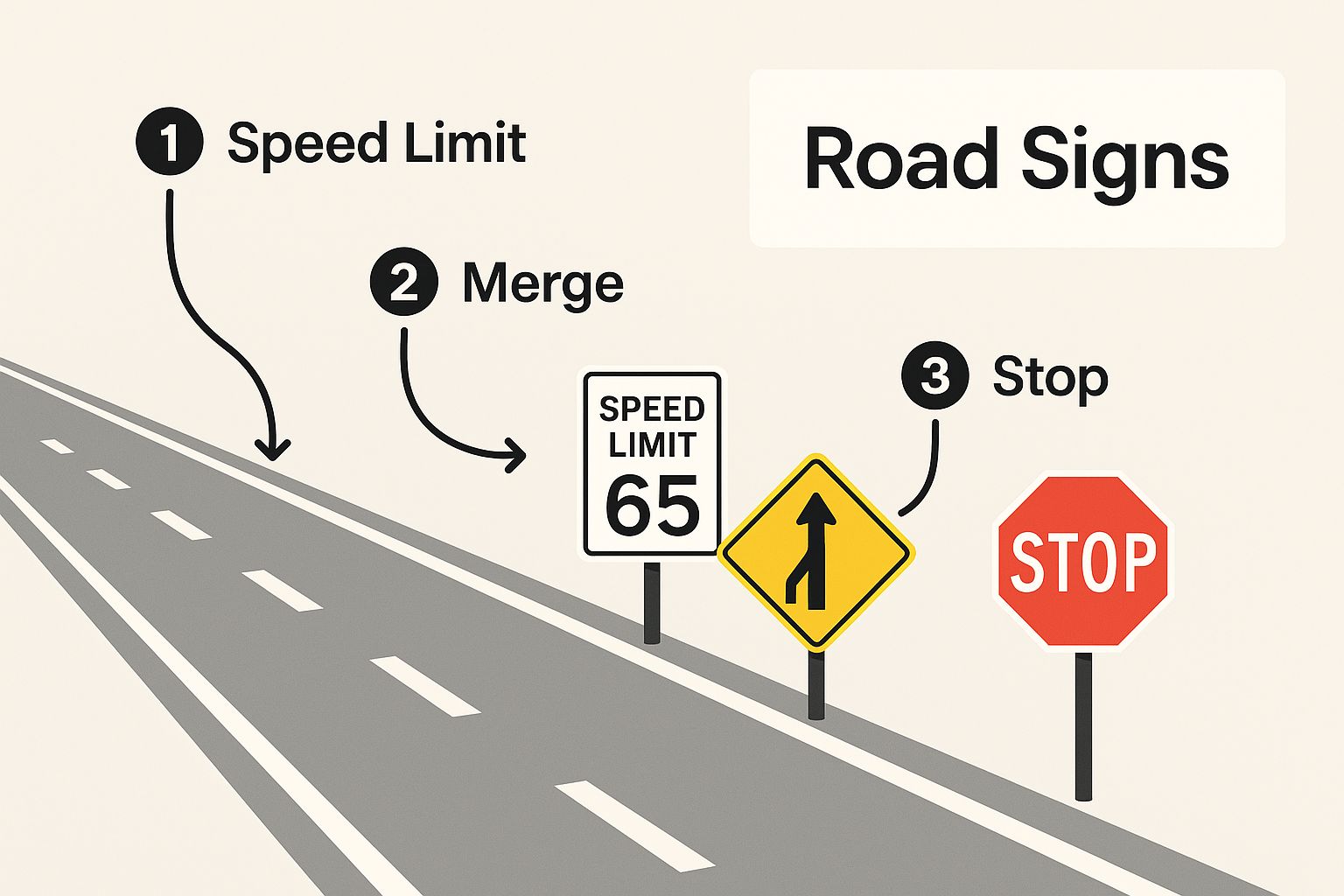
This image is a great reminder that recognizing visual cues—whether on the road or on your rig—is a fundamental skill for any driver. Your inspection is all about spotting those cues before they become a problem.
Key Focus Areas in Your Inspection
While every part of the inspection is important, examiners—and veteran drivers—pay extra close attention to a few critical systems. These are the areas where a failure can have catastrophic consequences. Think of them as the heart, lungs, and skeleton of your rig.
For instance, checking your slack adjusters is just as vital as checking your mirrors. A slack adjuster that's out of alignment means your brakes might not apply with full force, which can drastically increase your stopping distance. You need to make sure there's no more than about one inch of play.
A proper inspection is proactive, not reactive. You are actively hunting for small issues—like a worn belt, a slow air leak, or a cracked rim—before they grow into road-disabling emergencies. This mindset is what separates a driver from a true professional.
Another absolutely crucial area is the coupling system. The connection between your tractor and trailer has to be bulletproof. You need to physically check that the fifth-wheel jaws are locked securely around the kingpin and that the trailer apron is sitting flat on the fifth-wheel skid plate. A failed coupling can lead to a dropped trailer, which is one of the most dangerous things that can happen on the highway.
Finally, your tires and brakes need your full attention. For tires, look for the three C's: Cuts, Cracks, and Cord showing. Always check for proper inflation with a tire gauge. When it comes to brakes, listen carefully for any audible air leaks and check that the brake drums or rotors are free of cracks and any contaminants like oil or grease. These are the simple, non-negotiable checks that keep you safe.
Essential Skills for Safe Vehicle Control
When you’re behind the wheel of a rig that can top out at 80,000 pounds, safe handling has less to do with muscle and more to do with your brain. It's about understanding physics and, more importantly, developing a sixth sense for the road ahead. This section of the CDL general knowledge guide digs into the core principles of vehicle control—the fundamentals you'll rely on to manage your truck with confidence, no matter what the road throws at you.
At the heart of it all is space management. Think of it as creating a protective bubble around your truck at all times. This cushion of air and asphalt is your single best defense, giving you the time and room you need to react to a sudden hazard, a change in traffic, or a rough patch of road.
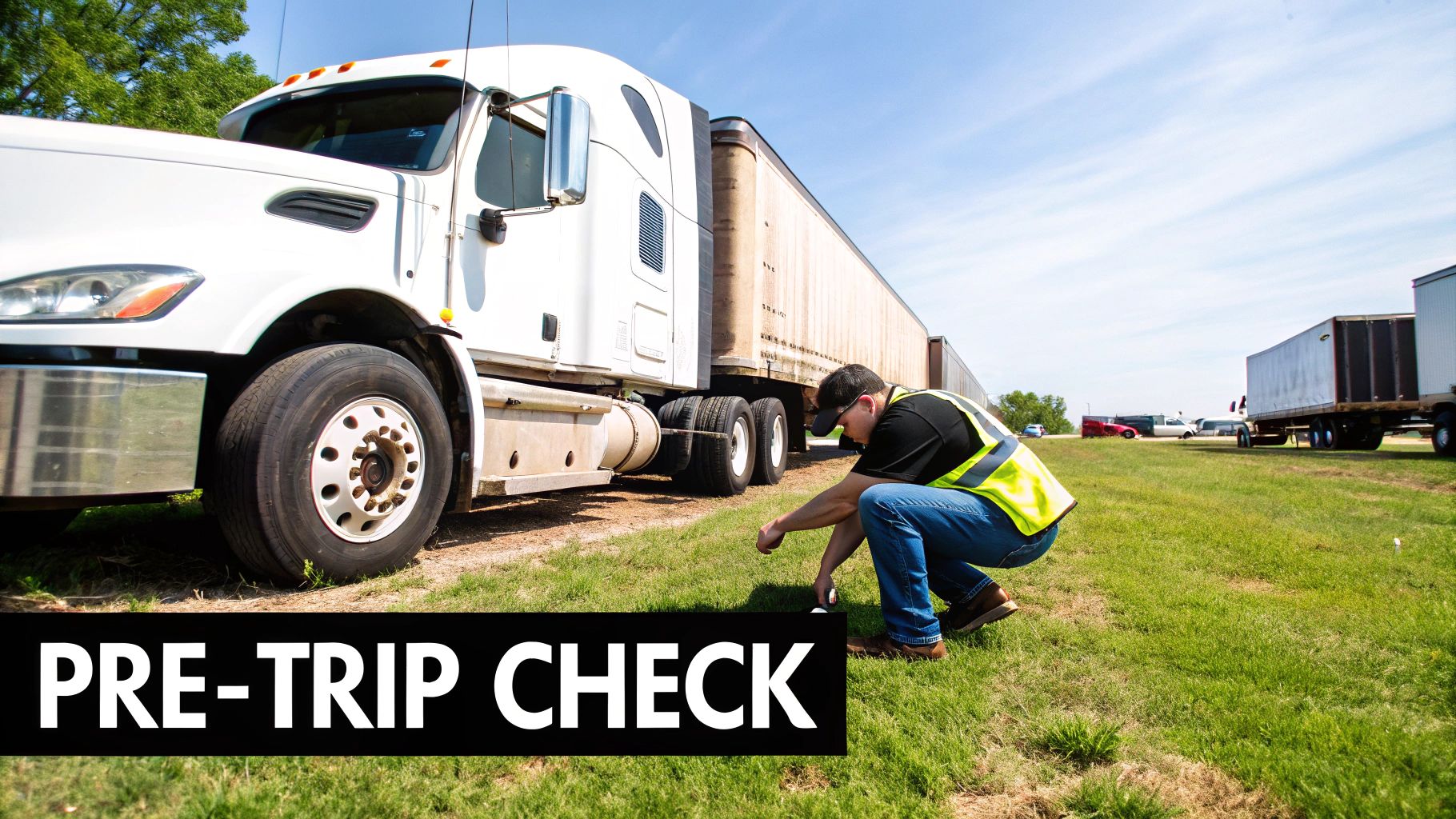
This isn't just about the vehicle in front of you, either. That space cushion needs to be a 360-degree zone of awareness. You have to live in your mirrors, constantly scanning for cars creeping into your blind spots or tailgating behind you.
Deconstructing Total Stopping Distance
One of the heaviest hitters on the general knowledge test is total stopping distance. It’s not as simple as just slamming on the brakes. Total stopping distance is actually the sum of three distinct moments, and each one adds precious feet to the space your truck eats up before coming to a dead stop.
Once you really get your head around these components, you'll understand exactly why a commercial truck needs so much more following distance than a regular car. Let's break it down.
The three parts of total stopping distance are:
- Perception Distance: The distance your truck travels from the instant your eyes spot a hazard to the moment your brain actually recognizes it as a problem.
- Reaction Distance: The distance covered in that small gap between your brain shouting "STOP!" and your foot physically hitting the brake pedal.
- Braking Distance: The distance your rig travels from the moment the brakes engage until it finally comes to a complete halt.
For the average driver, the time it takes to perceive and react is about 1.75 seconds. That might not sound like much, but at 55 mph, your truck will have traveled nearly the length of a football field before your brakes even start working. This is exactly why looking far down the road isn't just a good habit—it's a non-negotiable part of being a pro driver.
Factors That Dramatically Affect Stopping
Your total stopping distance is never set in stone. It’s a moving target that changes with every single variable on the road. The weight of your load, the shape your brakes are in, and the grip of your tires all play a huge role.
A fully loaded truck is going to take a lot longer to stop than an empty one. It’s just simple physics: more mass carries more momentum. In the same way, wet or icy pavement can easily double or even triple your braking distance, turning a normal stop into a very dangerous slide.
The total stopping distance formula (Perception + Reaction + Braking) isn't just something to memorize for the test. It's a fundamental truth of trucking that should guide every decision you make about speed and following distance.
But the biggest game-changer of all is speed. A vehicle's destructive energy increases with the square of its speed. This means if you double your speed from 30 mph to 60 mph, your stopping distance doesn't just double—it multiplies by four times. This law of physics is precisely why you have to respect speed limits, especially when you're heading down a grade.
Managing Speed and Space in Practice
Knowing the theory is one thing, but the test will expect you to know how to apply it in real-world situations. That means understanding how to adjust your driving for hills, curves, and slick roads.
Hills and Downgrades: When you start heading downhill, gravity starts working against you, pulling your truck forward and making your brakes work harder. You absolutely must select a lower gear before you start the descent. This lets the engine's compression do some of the work. If you ride your brakes all the way down, they can overheat and fail—a terrifying situation called "brake fade."
Curves and Turns: Your truck's high center of gravity makes it much more susceptible to rollovers. That speed limit sign on a curve is meant for cars, not for an 80,000-pound rig. The only safe way to take a curve is to slow down before you enter it, then gently accelerate through the turn to maintain stability.
Slippery Roads: On wet or icy roads, your first moves should always be to slow down and open up your following distance. A lot. From there, every move you make—steering, braking, accelerating—needs to be as smooth as silk. Any sudden or jerky movement can be enough to break traction and send you into a skid.
Mastering these skills is a huge part of any good training program. In fact, the federal Entry-Level Driver Training (ELDT) mandate makes sure all new drivers get proper instruction on these critical maneuvers. To see what that involves, you can learn more about the ELDT curriculum and see how it gets you ready for life on the road.
How to Handle Special Driving Conditions
The open road is rarely a straight, dry, and predictable path. A professional driver's true skill really shows when things get tough—whether it's a sudden weather change or challenging mountain terrain. This part of your CDL prep is all about the critical techniques you need for handling these special driving conditions.
Getting these skills down isn't just about passing the test. It's about building the real-world situational awareness you need to stay safe when the environment seems to be working against you. You absolutely must know how to adjust your speed, manage your traction, and keep your visibility clear when conditions are anything but ideal.

Navigating Hazardous Weather Conditions
Bad weather is one of the most common and dangerous challenges you'll face out there. Rain, fog, and snow can slash both your visibility and your truck's grip on the road, forcing you to change your driving strategy on the spot.
When it's raining heavily, the road gets incredibly slick, especially within the first 30 minutes as all the oil and grime floats to the surface. This is when the risk of hydroplaning is highest—that scary feeling when your tires lose contact with the pavement completely. To stay in control, you have to reduce your speed significantly and avoid any sudden turns or hard braking.
Fog is a different beast entirely. It cuts down your sight distance to almost nothing. Your best defense is simple: slow way down and use your low-beam headlights. Flipping on the high beams is a rookie mistake; they'll just reflect off the fog and make it even harder to see. Always leave enough following distance to stop safely within the space you can actually see ahead of you.
Driving in snow and ice? That’s the ultimate test of smooth control.
- Traction is Everything: You need to be gentle on the pedals. Smooth acceleration and braking are the only ways to keep your wheels from spinning out or locking up in a skid.
- Know Your Chain Laws: If you're heading into the mountains during winter, you have to know the chain laws. That means knowing when you’re required to put them on and, just as importantly, how to do it.
- Watch for Black Ice: Be extra careful on bridges and overpasses. They freeze much faster than the rest of the road and can be coated in a nearly invisible layer of "black ice."
Here’s a core principle that will keep you safe: always match your speed to the conditions, not the posted speed limit. If the road is slick or you can’t see well, the safe speed is always much, much lower than what the sign says.
Conquering Mountain Driving
Driving in the mountains brings a whole new set of challenges that will test your understanding of your truck and the laws of physics. Gravity suddenly becomes a powerful force that you have to constantly manage to stay in control of your rig.
The single most important skill here is choosing the right gear before you start heading down a steep grade. If you try to ride your service brakes all the way down a long hill, they will overheat and fail. This is a terrifying situation called brake fade, and it’s completely avoidable.
The right way to do it is to select a low gear and let the engine's natural resistance—what we call engine braking—do the heavy lifting. A good rule of thumb is to use the same gear to go down a hill that you would need to climb it. This simple technique keeps your service brakes cool, fresh, and ready for when you really need them to stop.
Safely Navigating High-Risk Zones
Some areas just demand more focus and a specific set of safety protocols. The CDL test will definitely cover high-risk scenarios like work zones, railroad crossings, and night driving.
In work zones, everything can change in a heartbeat. Lanes narrow, traffic patterns shift, and you’ve got workers right there next to moving vehicles. The rules are straightforward but non-negotiable:
- Slow Down: Obey the reduced speed limits in work zones. No exceptions.
- Add Space: Give yourself a much bigger cushion. You'll need the extra room to react to sudden stops or lane changes.
- Pay Attention: Put away all distractions. Keep your eyes peeled for flaggers, workers, and construction equipment.
Driving at night has its own visibility problems. Sure, there's less traffic, but it's a lot harder to spot hazards, pedestrians, or animals on the road. Make sure your headlights are clean and aimed correctly. And always, always dim your high beams for oncoming traffic at least 500 feet away—the last thing you want to do is blind another driver. Getting a handle on these special conditions is a huge part of becoming a true professional.
Understanding Cargo Safety and Regulations
Let's get right to the heart of what commercial driving is all about: hauling cargo. More than just moving goods from A to B, doing it safely is a huge responsibility—legally and ethically. The CDL exam hits this topic hard for a good reason. A load that isn't properly secured or balanced can turn a routine trip into a disaster in a split second.
Think of this section as your guide to mastering cargo management. We're not just memorizing rules to pass a test; we're building the skills to prevent rollovers, load shifts, and other serious accidents out on the road.
The Fundamentals of Weight Distribution
The way you load your trailer completely changes how your truck handles. If you remember nothing else, burn these two terms into your brain: center of gravity and weight distribution. Get these wrong, and you'll find yourself wrestling with a rig that's difficult to control, especially when you hit a curve or have to make a sudden move.
Imagine your truck's center of gravity as its balancing point. The lower it is, the more stable your rig will be. This is why the first rule of loading is always to put the heaviest items on the bottom and as close to the center of the trailer as you can get them.
Then there's how you spread that weight out. You have to distribute it evenly to make sure you don't overload any single axle or set of tires. States have strict laws about how much weight each axle can legally carry. Pushing those limits isn't just asking for a massive fine; it's incredibly dangerous. An overloaded front axle, for example, can make steering feel sluggish and heavy, putting serious strain on your steering components.
Securing Your Cargo The Right Way
Once your load is balanced, you have to lock it down. The goal is to make sure nothing can shift, slide, or fall off your trailer. Federal rules are crystal clear on this, and you'll definitely see questions about it on the exam. The most common tools for the job are tie-downs, which can be anything from straps and chains to synthetic ropes.
So, how many tie-downs do you need? It's not a guessing game. The rules are based on the length and weight of what you're hauling.
Here’s the basic breakdown:
- Cargo Length: You need at least one tie-down for every 10 feet of cargo.
- The Bare Minimum: No matter how short it is, any piece of cargo over five feet long needs at least two tie-downs.
- Holding Power: The total strength of all your tie-downs (called the aggregate working load limit) has to be at least half the total weight of the cargo you're securing.
Let's say you're hauling a 25-foot piece of machinery. Based on length alone, you'd need at least three tie-downs (one for the first 10 feet, another for the next 10, and a third for the last 5 feet). Then, you'd have to make sure their combined strength rating is at least half the machine's weight.
Proper cargo securement is non-negotiable. A load that shifts mid-trip can instantly change your truck's center of gravity, often leading to a loss of control or a rollover. Always, always double-check your work before you hit the road.
Inspecting Your Cargo During a Trip
Your job isn't over once you leave the loading dock. The road is a bumpy, dynamic place, and things can work themselves loose. That's why regulations demand that you re-inspect your cargo and tie-downs at specific points during your trip.
You are legally required to check your load at these intervals:
- Within the first 50 miles after you start.
- Whenever you take a break.
- Every 3 hours or 150 miles, whichever comes first.
When you pull over for these checks, you're on the lookout for anything that's out of place—loose straps, damaged chains, or any sign that the cargo has moved an inch. If you spot a problem, you fix it right then and there before you get back on the road. It's all about catching small issues before they become big ones.
Your CDL General Knowledge Questions Answered
Test day is getting closer, and it's completely normal to feel the pressure building. You're not the first person to feel this way, and you won't be the last. Let's walk through some of the most common questions we hear from new drivers, clear up any confusion, and give you a solid game plan so you can walk into that testing center feeling prepared and confident.
What Is the Format of the General Knowledge Test
The General Knowledge exam is a multiple-choice test. Now, don't let that fool you into thinking it’s a walk in the park. This test is designed to really dig into your understanding of what it takes to be a safe, professional commercial driver. It covers everything from pre-trip inspections to what to do in a serious emergency.
Most states will give you around 50 questions. Each one will lay out a scenario or ask a direct question, and it's your job to pick the single best answer based on the official regulations.
What Score Do I Need to Pass
The bar is set pretty high. To pass the General Knowledge test, you’ll need to get at least 80% of the questions right. If you have a 50-question test, that means you can’t afford to miss more than 10 questions. This standard isn't meant to be difficult for the sake of it; it reflects the immense responsibility that comes with getting behind the wheel of a commercial vehicle.
There isn't much room for error, which is why cramming at the last minute just doesn't work. You have to genuinely understand the concepts, not just memorize answers.
Can I Retake the Test If I Fail
Yes, absolutely. Failing the test, especially on your first try, happens more often than you'd think. The most important thing is to not let it get you down.
Every state has slightly different rules about retakes. You'll likely have to wait at least a day or two before you can try again. Some states might even limit how many times you can take the test in a certain timeframe, so it’s always a good idea to check with your local DMV to get their specific policy. Use that waiting period to hit the books and focus on the areas that gave you trouble.
What Are the Best Study Methods
Studying smart is way more effective than just studying hard. It's not about the number of hours you put in; it's about how you use that time. The best approach is to mix up your methods to really lock in the information.
- Read the Official CDL Manual: This is your bible. Every single question on the test comes from your state's official CDL handbook. Start here and treat it as the primary source for everything.
- Take Practice Tests: This is one of the most powerful tools in your toolbox. Practice tests get you used to the question style and, more importantly, they shine a bright light on your weak spots. For some great prep tips, check out our detailed guide to the CDL general knowledge test.
- Make Flashcards: For things you just have to memorize—like stopping distances, weight limits, or tie-down rules—old-school flashcards are tough to beat.
- Explain It Out Loud: Grab a friend or family member and try to teach them a concept, like how to handle a skid. If you can explain it clearly to someone else, you know you've got it down cold.
The real secret to passing isn't just memorizing rules; it's understanding why those rules exist. Once you grasp the logic behind the regulations, finding the right answers on the test becomes second nature.
This kind of preparation doesn't just get you ready for the exam—it gets you ready for the real-world challenges you'll face every day as a professional driver.
At Patriot CDL, we provide the expert instruction and hands-on training you need to pass your exams and launch a successful career. Our accelerated programs are designed to get you on the road quickly and confidently. https://patriotcdl.com