Passing the CDL General Knowledge test is your first big hurdle on the path to becoming a professional driver, and this study guide is your ticket to clearing it. We’ve built a complete roadmap that covers every essential stop, from vehicle inspections and safe driving to the nitty-gritty of regulations and cargo.
This guide is designed to give you a real-world understanding of what it takes to be a safe, competent commercial driver—not just a list of facts to cram for an exam.
Your Roadmap to Passing the CDL General Knowledge Test
Starting the journey to get your Commercial Driver's License (CDL) can feel like gearing up for a long haul without a GPS. The General Knowledge test is the first, and most important, leg of that journey. It covers a ton of ground, and every professional driver out there had to master it.
Think of this guide as your seasoned co-pilot. It’s here to help you build your knowledge from the ground up, so when you walk into that testing center, you're walking in with confidence. We’re not just going to throw dry facts at you. Instead, we'll break down each critical area into simple, practical concepts, helping you connect the "why" behind the rules to what you'll actually do on the road.
What to Expect From This Guide
Our game plan is simple: we build your knowledge one block at a time. We'll walk through each core subject on the test, making sure you feel solid about one topic before we move on to the next. This way, you start to see how everything—from inspections to logbooks—fits together.
To give you a better idea of what we'll cover, here’s a quick look at the core topics that form the backbone of the CDL General Knowledge test. Each area is a critical piece of the puzzle for becoming a safe and knowledgeable professional driver.
CDL General Knowledge Test Core Topics at a Glance
| Knowledge Area | Key Focus | Why It Matters |
|---|---|---|
| Vehicle Inspections | The systematic process of checking your vehicle before, during, and after a trip to find and fix potential issues. | This is your first line of defense. A proper inspection prevents breakdowns and accidents, keeping you and others safe on the road. |
| Basic Vehicle Control | Mastering the fundamentals of handling a large vehicle, from steering and backing to proper gear shifting and mirror usage. | A big rig isn't a car. Knowing how to control its size and weight is fundamental to avoiding tight spots and dangerous situations. |
| Safe Driving Practices | Defensive driving techniques, managing the space around your truck, and adapting to hazards like bad weather or heavy traffic. | It's all about anticipation. Safe driving is proactive, not reactive, and it's what separates the pros from the amateurs. |
| Cargo Transport | The principles of properly securing, balancing, and inspecting different types of cargo to ensure stability and safety. | Unsecured or poorly balanced cargo can cause rollovers or spills. Your job is to make sure the load gets there safely. |
| Rules and Regulations | Understanding federal and state laws, including Hours-of-Service (HOS) rules, weight limits, and traffic laws. | Staying compliant isn't just about avoiding tickets; it’s about ensuring you're rested, legal, and operating professionally. |
This table lays out the what and the why, showing how each piece of knowledge contributes directly to your success and safety behind the wheel.
This isn't just about passing a test. It's about building the foundation for a long, safe, and successful career. The things you learn here are the same skills you'll rely on every single day on the job.
This structured approach is everything. While the exact questions on your test will vary, the core principles never change. By the time you're done with this guide, you’ll be ready for whatever the exam throws at you.
For an even closer look at the exam format, take a look at our detailed overview of the general knowledge test.
Mastering Your Vehicle Before You Start the Engine
Before you even think about putting a commercial vehicle in gear, you need to know the machine you’re about to command. A professional driver’s responsibility starts long before the wheels ever turn. This is all about the pre-trip inspection, knowing your vehicle's controls, and understanding its safety systems inside and out.
Think of it like a pilot's pre-flight check. It’s not just a list of items to tick off; it’s a deliberate, systematic process designed to catch small issues before they snowball into catastrophic failures on the road. The CDL general knowledge test puts a huge emphasis on this because, plain and simple, it's your first and best line of defense against breakdowns and accidents.
This guide will help you move past simply following a checklist. The goal is to get you to understand the why behind each step, so you can learn to listen to your truck, understand what it's telling you, and build a solid mental map of its most critical systems.
The Foundation of Safety: The Pre-Trip Inspection
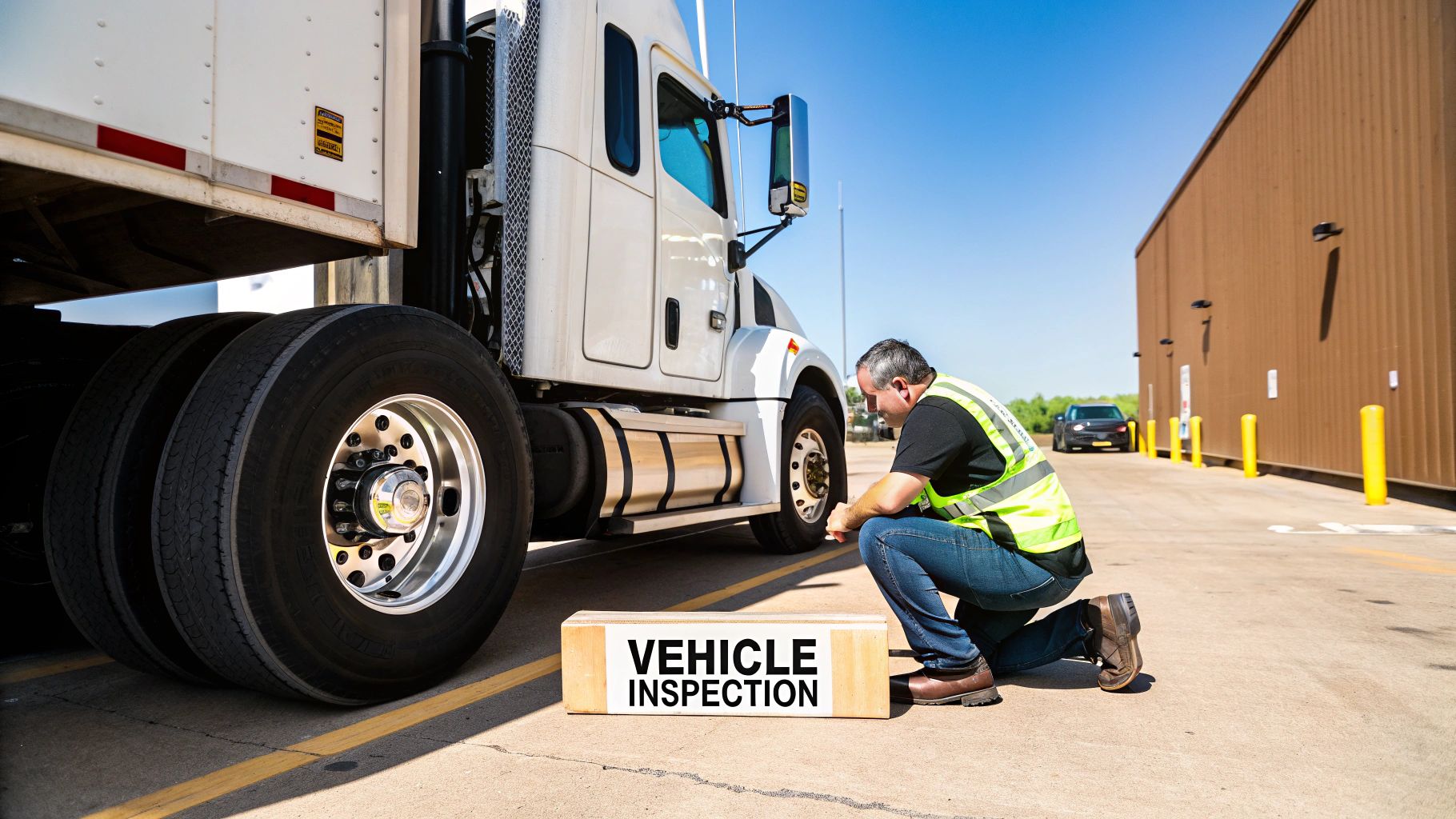
The pre-trip inspection is the most fundamental skill you’ll learn. It's also one of the most important parts of your daily routine as a driver. Federal regulations demand a thorough inspection before every single trip to make sure the vehicle is safe to be on the road. And for good reason—statistics show a massive percentage of roadside breakdowns come from problems that a proper pre-trip check would have caught.
You have to be methodical. Rushing through it or just assuming everything is fine from yesterday is a recipe for disaster. The trick is to develop a consistent pattern. Always start at the same point and work your way around the vehicle the same way, every time. This routine is what ensures you don't miss something critical.
A systematic approach generally looks something like this:
- Engine Compartment: You're checking fluid levels (oil, coolant, power steering fluid), hunting for any signs of leaks, and inspecting belts and hoses for cracks or obvious wear.
- Vehicle Exterior (Driver's Side): Look closely at the tires for proper inflation and tread depth. Check the wheels and rims for damage, and make sure all lights and reflectors are clean and working.
- Trailer and Coupling: This is huge. Verify you have a secure connection between the tractor and trailer, checking the fifth wheel and landing gear. Inspect all air and electrical lines for damage or wear.
- Vehicle Rear: Make sure brake lights, turn signals, and reflectors are all functioning correctly. Double-check that cargo doors are latched and secure.
- Vehicle Exterior (Passenger's Side): Now you just repeat the same checks you did on the driver's side—tires, wheels, lights, and reflectors.
This isn't just a quick walk-around. A real inspection involves touching components, listening for strange sounds, and even smelling for potential leaks. To get the full picture of what's expected, it’s a good idea to understand the core CDL requirements from the ground up.
Decoding Your Vehicle's Controls and Systems
Once you're confident the rig is safe on the outside, your attention moves into the cab. This is your command center. You need to know what every gauge, switch, and light means without having to stop and think about it. The general knowledge exam will absolutely test you on these components, especially the ones unique to commercial vehicles.
The air brake system is a major focus. These aren't like the simple hydraulic brakes in your car; they're complex systems that require their own specific checks.
A faint hiss from an air brake line might seem like nothing, but it could be a leak that leads to total brake failure under a heavy load. Knowing how to perform a full air brake test—checking for leaks, testing the low-pressure warning alarm, and verifying the emergency brakes—is completely non-negotiable.
Beyond the brakes, you’ve got to be familiar with:
- Gauges: Your oil pressure, coolant temperature, voltmeter, and air pressure gauges are giving you a real-time health report. Knowing the normal operating range for each one is vital.
- Emergency Equipment: You must know exactly where your fire extinguisher, spare fuses, and reflective triangles are stowed and confirm they are in good working order.
- Mirrors and Visibility: Before you move an inch, you need to properly adjust your mirrors to shrink those dangerous blind spots as much as possible.
Tires: The Unsung Heroes of a Safe Journey
It’s easy to overlook tires, but they're your only connection to the road. The CDL exam hammers on their importance for a very good reason. A tire failure on a commercial vehicle, especially a steer tire, can be absolutely catastrophic.
Your inspection must always include checking for proper inflation. This is crucial for stability, effective braking, and preventing blowouts. A tire that's underinflated by just 20% can have its lifespan cut by 30%.
You also have to check for adequate tread depth. The legal minimum is 4/32-inch for steer tires and 2/32-inch for all other tires. Don't forget to look for any cuts, bulges, or foreign objects stuck in the rubber. This is the kind of detailed attention that separates a true professional from an amateur.
The Art and Science of Driving a Commercial Vehicle

Alright, you've got a handle on the rig when it's standing still. Now comes the real test: commanding that beast while it's rolling. Driving a commercial vehicle is so much more than just steering and working the pedals. It's a constant dance between physics, looking ahead, and communicating with everyone around you. This is where a solid CDL general knowledge study guide really earns its keep, taking you from book smarts to road smarts.
We're now moving into the dynamic relationship between you, your truck, and the world outside your windshield. We’ll dig into the techniques and heightened awareness that separate a true professional from everyone else on the road. The principles you nail down here are what will keep you, your load, and the public safe day in and day out.
Mastering Space: Your Most Valuable Asset
Out on the road, space is your best friend. It’s your safety net, your reaction time, and your margin for error, all in one. The CDL General Knowledge test hammers on space management for a good reason—it's the most important part of defensive driving. Think of it like maintaining a protective bubble around your truck at all times.
A pro driver is always actively managing space in four directions:
- Ahead: This is the big one. You need at least one second of following distance for every 10 feet of your vehicle's length. Tack on another second if you're going over 40 mph. For a standard 60-foot rig, that means a bare minimum of 7-8 seconds of following distance in good weather.
- Behind: You can't control a tailgater, but you can manage the situation. By adding more space in front of you, you can slow down more gradually, making it less likely for them to slam into your trailer.
- To the Sides: Stay centered in your lane. It gives you an escape route if someone beside you makes a sudden move.
- Overhead and Underneath: You have to be constantly aware of bridge clearances, low-hanging wires, and road hazards that could tear up your undercarriage.
This isn't passive driving; it's about proactively owning the space around your vehicle.
Navigating Turns and Understanding Off-Tracking
Turning a big rig is a calculated maneuver, not something you do on a whim. Unlike a car, your trailer won't follow the same path as your tractor. This is called off-tracking, and it’s when the rear wheels cut the corner much tighter than the front wheels. The longer your rig, the worse the off-tracking.
To make a safe turn, especially a right turn, you have to swing wide. Some call it a "button hook" or "jug handle" turn. You steer out into the intersection to give your trailer enough room to clear the curb, street signs, and utility poles. Get it wrong, and you're looking at serious damage or a nasty accident.
Think of your truck’s blind spots as 'no-go zones' for other vehicles. These are huge areas where a car can completely vanish from your mirrors, making lane changes and turns incredibly dangerous if you’re not paying close attention.
Knowing your blind spots isn't optional. It demands constant scanning of your mirrors and a mental map of where those invisible zones are on your specific truck.
The Language of the Road: Communication and Anticipation
Good communication is a bedrock of professional driving. You don't have the luxury of making surprise moves. You have to signal your intentions clearly and way ahead of time to give other drivers a chance to react.
And it’s more than just flicking on a turn signal. True road communication involves:
- Tapping your brakes to flash your brake lights, warning drivers behind you that you're slowing down when they might not expect it.
- Using your horn with a quick, light tap to get another driver's attention—not to lay on it in anger.
- Flashing your headlights to let another trucker know they have enough room to merge back in front of you.
The other side of that coin is anticipation. A pro is always looking 12 to 15 seconds down the road. On a highway, that’s about a quarter of a mile. This gives you time to see trouble developing long before you get there, so you can adjust your speed or lane smoothly. The United States has roughly 3.54 million CDL holders, and every single one of them relies on this forward-thinking to stay safe.
Shifting Gears Smoothly and Efficiently
Knowing how to shift gears properly is about more than just moving. It’s crucial for maintaining control, saving fuel, and preventing wear and tear on your transmission. Most big trucks have complex manual transmissions with 10, 13, or even 18 speeds. The whole game is about matching your engine speed (RPMs) to your road speed.
You'll need to learn how to double-clutch to make your shifts smooth. More importantly, you have to know which gear to be in before you start up or down a big hill. Being in the wrong gear on a downgrade can quickly lead to overheated, useless brakes—a terrifying situation you never want to be in. If you want to dive deeper into the systems that rely on this skill, our guide on the air brakes test is essential reading. Nailing these techniques gives you the control you need for any situation, from merging onto a packed highway to maneuvering through a tight city street.
Handling Challenging Conditions and Emergencies
Let’s be honest: professional driving isn't just about cruising down the highway on a perfect, sunny day. The real test of a pro is keeping complete control when the weather turns nasty, the road gets tough, or something goes completely wrong out of the blue. This is where a proactive mindset becomes your most valuable tool on the road.
Think of this section as your playbook for those moments that define a truly skilled driver. We'll break down how to handle bad weather, navigate tricky terrain, and react with calm confidence when an emergency hits. The goal isn't just to pass the test; it's to build the instincts you need to see risks coming and shut them down before they turn into disasters.
Adapting to Adverse Weather
Bad weather isn't a maybe; it's a guarantee. Rain, snow, ice, and fog completely change how a heavy vehicle behaves, and they demand immediate adjustments to your speed and the space you keep around your rig. Just tapping the brakes isn't enough—you have to understand what each type of weather is doing to your traction.
- Heavy Rain and Hydroplaning: When the road is wet, a layer of water gets between your tires and the asphalt. Go too fast, and your tires will literally start to surf on that water, leading to a total loss of steering and braking. That’s hydroplaning. The only way to beat it is to slow way down and make sure your tires have good, deep tread.
- Snow and Ice: Packed snow can easily cut your traction in half. Ice can take it away completely. The most dangerous stuff is black ice, which is a thin, clear sheet that just looks like a wet patch on the road. In these conditions, you need to slow to a crawl, make every move smoothly, and open up your following distance to at least 8-10 seconds.
- Dense Fog: Fog is like driving with a blindfold on; you simply can't see what's ahead. Your only safe move is to slow down and use your low-beam headlights. Your high beams will just bounce off the moisture in the air and make your vision even worse. If it gets too thick, the smartest thing you can do is pull over safely and wait it out.
When the weather turns, you have to give yourself more time and space. Here’s a quick guide on how to adjust your driving.
Driving Adjustments for Hazardous Conditions
| Condition | Recommended Speed Reduction | Minimum Following Distance |
|---|---|---|
| Wet Roads | Reduce speed by 1/3 (e.g., 60 mph becomes 40 mph) | 4-6 seconds |
| Packed Snow | Reduce speed by 1/2 or more | 6-8 seconds |
| Icy Roads | Slow to a crawl; get off the road if possible | 8-10+ seconds |
| Heavy Fog | Slow down to a speed where you can stop within your visibility | 6-8+ seconds |
Remember, these are just starting points. The right speed is always the one that is safe for the current conditions, period.
Navigating Challenging Environments
Not all roads are flat and straight. Steep mountain grades and driving through the night bring their own set of challenges that demand specific skills to handle safely.
Mountain driving, especially, will test everything you know about your brakes. If you ride your service brakes all the way down a long, steep grade, they will overheat and stop working. This is called brake fade, and it’s terrifying. The right way to do it is to select a low gear and let the engine's natural resistance (engine braking) do most of the work. You'll then apply the brakes just enough to feel a definite slowdown, release them to let them cool, and repeat.
The old-timers have a saying that’s still true today: go down a hill in the same gear you’d need to climb it. This simple rule keeps your speed in check and saves your brakes for when you really need them.
Night driving brings a different kind of risk. While only about a quarter of all driving happens at night, roughly 50% of traffic fatalities occur during those hours. Your world shrinks to the beam of your headlights, so you have to drive slow enough to be able to stop inside that lighted area.
Responding to On-Road Emergencies
Even the best drivers can face an emergency. What you do in those first few seconds makes all the difference. The CDL test will expect you to know exactly how to handle things like tire blowouts, brake failure, and skids.
A steer tire blowout is one of the scariest things that can happen. Your truck will lurch violently to the side of the blown tire. The key is to fight your instinct to slam on the brakes. Instead, get a death grip on the steering wheel, keep your foot off the brake, and focus on keeping the truck straight until you've slowed down enough to pull over.
If your brakes fail, you have to act fast. Start by downshifting to use engine braking, pump the brake pedal to try and build up any leftover pressure, and apply the parking brake. If all else fails, you might have to use a truck escape ramp or even sideswipe a guardrail to scrub off speed. This is where a good pre-trip inspection pays off—catching a brake problem in the lot can prevent a disaster on the road.
The image below shows the key pressure readings for your air brake system. Knowing these numbers helps you spot trouble early.
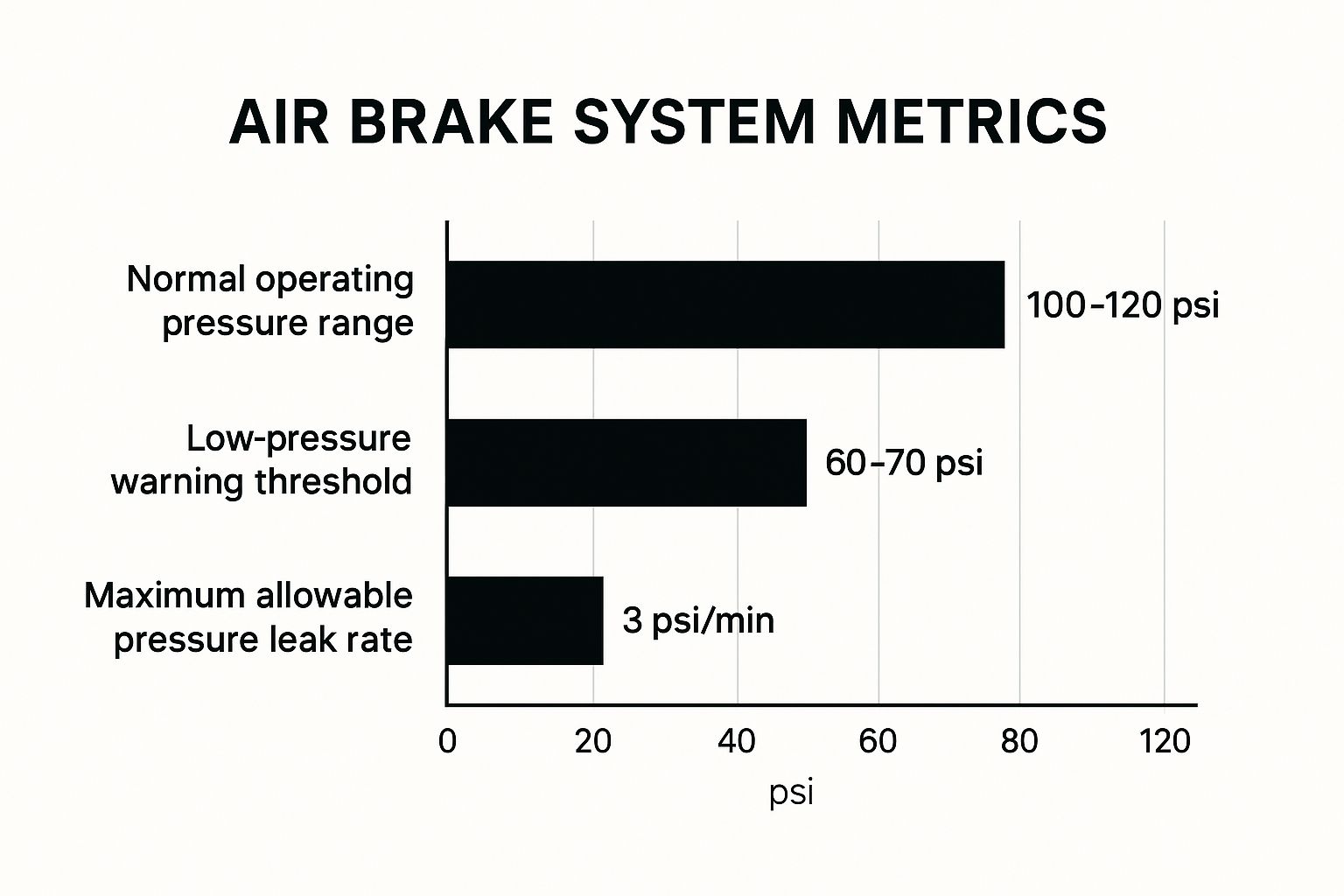
Keeping an eye on these gauges is critical. They give you a clear window into the health of your brakes and can warn you of a problem long before it becomes a full-blown emergency.
Getting to Know the Rules of the Road
When you get behind the wheel of a commercial truck, you’re held to a much higher standard than the average driver. That standard is built on a specific set of rules and regulations. These aren't just there to make your life difficult; they create a framework that keeps everyone on the road—including you—safe. You can bet the CDL general knowledge test is going to hit these topics hard.
Think of these regulations as the professional code every driver has to live by. We’ll break down the essentials you absolutely have to know, but more importantly, we’ll get into the why behind them. This isn't about memorizing a rulebook word-for-word. It’s about truly understanding the foundation of a long, safe, and successful career in trucking.
Hours-of-Service: The Safety Mandate
Let's be blunt: a tired driver is a dangerous driver. Driver fatigue is one of the biggest risks out on the road, and the Hours-of-Service (HOS) regulations are the government's primary way of fighting it. These rules spell out exactly how long you can drive, when you have to take breaks, and how much downtime you need between shifts.
The entire point is to ensure the person behind the wheel is alert, focused, and ready for anything. Bending the HOS rules isn't just risking a ticket—it's putting lives on the line.
For property-carrying drivers, here are the core rules you live by:
- 11-Hour Driving Limit: After being off duty for 10 consecutive hours, you can drive for a maximum of 11 hours.
- 14-Hour On-Duty Limit: Your driving must be done within a 14-hour window from when you first come on duty. This window doesn't stop for breaks or loading; once it starts, it runs.
- 30-Minute Break: You're required to take a 30-minute break sometime after driving for 8 cumulative hours.
- 60/70-Hour Limit: You can't drive after being on duty for 60 hours in 7 consecutive days or 70 hours in 8 consecutive days. This clock can be reset by taking at least 34 consecutive hours off duty.
Knowing these rules isn't optional. It's a fundamental part of the job.
Weight Limits and Cargo Securement
What you're hauling and how you're hauling it is just as critical as how long you've been driving. Federal and state laws have strict limits on vehicle weight to protect our roads and bridges, not to mention your own truck's stability. An overloaded or poorly balanced rig is a ticking time bomb—it can lead to brake failure, tire blowouts, or even a rollover.
The general federal limits to keep in mind are:
- 80,000 pounds total gross vehicle weight
- 20,000 pounds on a single axle
- 34,000 pounds on a tandem axle group
But it’s not just about total weight. How you secure that cargo is a science in itself. The general knowledge exam will definitely test you on proper tie-down methods, blocking, and bracing. A good rule of thumb is to use at least one tie-down for every 10 feet of cargo. And no matter how small the load, it needs a minimum of two tie-downs.
Proper cargo securement isn't just about keeping stuff from falling off the trailer. It's about preventing the load from shifting, which can dangerously change your truck's center of gravity and make it unpredictable in a turn or a sudden stop.
This is where true professionalism shows. Paying attention to these details ensures your freight arrives in one piece and you stay in control of your vehicle.
Navigating Special Traffic Laws
Driving a big rig means you play by a different set of traffic rules than passenger cars. These laws exist because of the sheer size, weight, and limited maneuverability of your vehicle. Railroad crossings, for example, require extreme caution. A long truck can easily get stuck on a raised crossing—a dangerous situation known as "hanging up."
You also have to become obsessed with clearance heights on bridges and overpasses. Getting that wrong by just a few inches can lead to a devastating accident. This is why careful route planning and actually reading the road signs are non-negotiable skills for any professional driver.
The world of CDL regulations is also constantly changing. For instance, with over 60,000 non-domiciled CDLs issued (licenses from a state where the driver doesn't live), federal authorities are now taking a closer look at licensing practices. They're working to make sure safety standards are consistent for every single commercial driver, no matter where they got their license.
Frequently Asked Questions About the CDL Test
Stepping into the world of commercial driving can feel like learning a new language, and the final exam—the CDL test itself—often brings up the most questions. I've heard them all over the years. This section is here to give you straight, no-nonsense answers to the things drivers worry about most.
Think of it this way: a good study guide prepares you for the "what," but knowing the "how" of test day is just as important. Let's clear up the practical stuff so you can walk in feeling ready, not stressed.
What Should I Bring to My CDL Test?
Nothing’s worse than showing up for the big day only to be turned away because you forgot a piece of paper. You absolutely have to bring the right documents to prove who you are and that you’re eligible to test. While you should always check your local DMV’s website for their specific list, you can count on needing these core items.
- Your Valid Driver's License: This is non-negotiable. It’s your main photo ID.
- Your Commercial Learner's Permit (CLP): You can't even get in the truck for the skills test without it.
- Proof of Residency and Citizenship: Think passport, original birth certificate, or Social Security card.
- DOT Medical Card: You must have your current, valid medical examiner's certificate with you.
My advice? A few days before your test, lay everything out and check it against your state’s official list. Don't leave it for the morning of.
How Is the CDL Test Scored?
First off, the "CDL test" isn't just one test. It's a series of hurdles, and you have to clear each one. For the written knowledge tests (like General Knowledge, Air Brakes, etc.), you’re aiming for a score of at least 80% to pass.
The hands-on skills test is where it gets more detailed. It’s a three-part challenge, and you must pass one section to even attempt the next.
- Pre-Trip Inspection: This is all about memory and process. You'll be asked to point out and explain different vehicle components. The examiner scores you on how accurate and complete your inspection is.
- Basic Control Skills: This is the backing and maneuvering part. They score you on precision. You lose points for things like hitting cones, pulling up too many times, or crossing a boundary line.
- On-Road Driving Test: Here, the examiner rides along to see how you handle the truck in real traffic. They'll deduct points for mistakes like wide turns, not checking your mirrors enough, or poor lane control.
A word of warning: the pre-trip inspection is the biggest roadblock for new drivers. In my experience, a staggering 8 out of 10 failures on the skills test happen right here. Why? Because it demands you memorize a very specific, standardized routine.
What Happens If I Fail the Test?
Failing a part of the CDL test feels awful, but it's not the end of your career before it starts. If you fail one of the written exams, you can almost always retake it, though some states make you wait a day or two.
If you fail any of the three parts of the skills test, you have to start the whole three-part test over from the beginning on your next try. Most states have a mandatory waiting period before you can retest, usually somewhere between seven and 14 days. Just keep an eye on your CLP’s expiration date—you need to pass everything before it runs out.
And if you're thinking ahead about a license with an automatic transmission restriction, it's good to know your options. Once you have your CDL, taking an e-restriction removal course is a straightforward way to upgrade your license to drive a manual.
At Patriot CDL, we provide the hands-on training and expert guidance you need to pass every part of your CDL test with confidence. We turn aspiring drivers into qualified professionals. Learn more about us.