One of the first questions on every aspiring trucker’s mind is, "So, how long does this all take?" The short answer is anywhere from three weeks to six months, but let's be realistic—most people in a full-time program are looking at about seven weeks.
That's a pretty big range, and for good reason. The actual time it takes to get your Commercial Driver's License (CDL) really boils down to the intensity of the program you choose and the specific type of license you're aiming for.
Your CDL Training Timeline at a Glance
Deciding to hit the road professionally is a huge step. Figuring out the time commitment is crucial for planning everything else—your finances, your family life, and when you can actually start earning money. The path to getting your CDL isn't the same for everyone.
Think of it like this: you can either go the boot camp route or take a more relaxed, semester-long approach. An accelerated, full-time program is an intense, all-in commitment designed to get you behind the wheel and on the payroll as fast as humanly possible. On the other hand, a part-time program lets you juggle training with your current job, which naturally stretches out the timeline.
Comparing Program Timelines
The type of license you need is the other big piece of the puzzle. A Class A license, the one you need for driving big rigs and tractor-trailers, involves the most in-depth training and takes the longest. If you're going for a Class B license to drive something like a dump truck or a city bus, the training is usually quite a bit shorter.
To give you a clearer picture, here’s a quick comparison of what you can generally expect.
Typical CDL Training Program Durations
This table breaks down the common timeframes you'll encounter based on the program style and license class.
| Program Type | License Class | Typical Duration |
|---|---|---|
| Full-Time Accelerated | Class A | 3-7 Weeks |
| Part-Time / Flexible | Class A | 8-12 Weeks |
| Full-Time Accelerated | Class B | 2-4 Weeks |
| Part-Time / Flexible | Class B | 5-8 Weeks |
As you can see, your personal timeline is very much in your own hands.
The time it takes to earn a CDL can be as quick as three weeks or stretch out to six months. It all hangs on the school's structure, the license you need, and any special endorsements you add on. For most folks committing to a full-time school, the sweet spot is right around seven weeks.
Setting Your Personal Pace
So, how long will it take you? It really comes down to what you need and what you can handle. If you're eager to start earning a paycheck and can fully dedicate yourself to training, an accelerated program is a no-brainer.
But if you have a job to keep or other responsibilities you can't just drop, a part-time schedule is a perfectly good path to the same destination. It just takes a little longer to get there. Knowing this from the start helps you pick the right route for your life and your career goals.
Choosing Your Pace: Full-Time vs. Part-Time Programs

One of the biggest things that will shape your training timeline is the structure of the CDL school you choose. You'll generally find two main paths: immersive, full-time programs and more flexible part-time schedules. Each one is built for a different kind of student with different life demands.
Full-time programs are essentially the express lane to your new career. You can think of them as a boot camp where your only job is to learn the ins and outs of being a professional driver. These courses are intense, often running eight hours a day, five days a week, and they cram a ton of learning and practice into a very short window.
Part-time options, on the other hand, are designed for people juggling training with other big commitments. This path lets you learn around an existing job or family life by offering classes on evenings or weekends. It definitely stretches out the timeline, but for many, it’s the only practical way to switch careers without sacrificing a paycheck.
The Full-Time Accelerated Path
If getting on the road fast is what you're after, an accelerated program is your ticket. For a Class A license, you can expect to earn your CDL in about 3 to 4 weeks by going the full-time route. This timeframe is typically built around a standard 160-hour curriculum—think 40 hours in the classroom learning the rules of the road and 120 hours behind the wheel and on the practice range.
This all-in approach has some serious perks. You’re completely immersed in the material, which really helps with retaining information and building muscle memory quickly. The daily practice keeps everything from pre-trip inspections to tricky backing maneuvers fresh in your mind as you head toward the final exam.
The biggest upside to a full-time course is how fast you can get to work. You can go from a student to a licensed, employed professional in a matter of weeks, meaning you start earning a driver's salary that much sooner.
Of course, that level of intensity isn't for everybody. It demands a huge commitment of your time and focus right from the start, making it almost impossible to hold down another job while you're in school.
The Part-Time Flexible Route
Going with a part-time schedule is more like taking the scenic route. It takes longer to get to your destination, but the journey is often far more manageable for those who can't just drop everything. These programs take the exact same curriculum and spread it out over several weeks or even a couple of months.
The number one benefit here is flexibility. You can keep your current job and attend classes when they fit your life, which takes a lot of financial pressure off. For some students, that slower pace is also a bonus, giving them more time to really absorb complex regulations and master difficult driving skills without feeling the constant pressure of a ticking clock.
If this sounds like a better fit, you can explore our flexible CDL training program options to see how we can make it work for you.
The trade-off, of course, is time. It might take two or three months to finish a program that a full-time student knocks out in under a month. In the end, figuring out how long CDL training will take really comes down to what your life looks like right now and which learning style works best for you.
How CDL Classes and Endorsements Shape Your Timeline
The kind of truck you want to drive plays a huge role in how long your CDL training will take. Not all commercial licenses are the same, and the career path you choose directly impacts the time you'll spend in school before you can hit the road.
Think of the different CDL classes like tiers of certification. Each one gives you the green light to operate bigger, more complicated vehicles, and naturally, getting to the highest tier takes the most training.
Breaking Down the CDL Classes
The three main license classes you’ll hear about are Class A, Class B, and Class C. Knowing the difference between them is the first step in figuring out your training schedule.
Class A CDL: This is the big one. It's the top-tier license that lets you operate combination vehicles like a classic tractor-trailer. The training is the most in-depth because you're learning advanced skills like managing an articulated vehicle and handling massive loads. As you might guess, this class takes the longest to earn.
Class B CDL: This license is for single, heavy vehicles that don't have a separate trailer—think straight trucks, dump trucks, or city buses. Since you aren't dealing with a pivoting trailer, the training is more straightforward and usually quite a bit shorter than a Class A program.
Class C CDL: This is the most basic commercial license, typically needed for smaller passenger vans or vehicles transporting certain hazardous materials in smaller quantities.
Each class comes with its own set of skills and safety rules, so the time you need to invest scales up with the complexity of the vehicle. To get a better feel for what's involved, you can dive into the specific CDL requirements for each license class and see which one fits your career goals.
The Impact of Endorsements
On top of your primary license class, you can also earn special certifications called endorsements that will add some time to your training. These are required for hauling specific types of cargo and mean you'll need extra classroom hours, more testing, and in some cases, federal background checks.
Think of endorsements as specializations for your CDL. They prove you have the extra knowledge to handle more complex or potentially dangerous loads, which often translates to better pay and more job opportunities down the road.
The table below gives you an idea of how your choice of license and endorsements can tack on extra training time.
How License Class and Endorsements Extend Training Time
| License Type / Endorsement | Vehicle Type | Estimated Additional Training Time |
|---|---|---|
| Class A | Tractor-trailers, combination vehicles | 4-7 weeks (baseline) |
| Class B | Straight trucks, buses, dump trucks | 1-3 weeks (baseline) |
| H (HazMat) | Vehicles carrying hazardous materials | 1-2 days of specialized classroom instruction |
| N (Tanker) | Tank trucks carrying liquids or gases | 1-2 days of focused training on liquid surge |
| T (Doubles/Triples) | Tractors pulling multiple trailers | 2-3 days of advanced coupling and driving practice |
| S (School Bus) | School buses | 2-4 days of passenger safety and procedure training |
As you can see, each endorsement you pursue adds a little more time to your initial training period. While it means a slightly longer stay in school, it pays off by opening up a much wider range of career paths once you have your license in hand.
What the ELDT Mandate Means for Your Training

If you're new to the trucking world, you'll hear a lot about the Entry-Level Driver Training (ELDT) mandate. This federal rule completely changed the game by creating a national standard for what every new driver needs to know. It’s less about how long you sit in a classroom and more about proving you’ve mastered the essential skills.
Think of it like a universal checklist. Before the ELDT, training quality could vary wildly from one state—or even one school—to the next. Now, every approved school in the country has to teach the same core curriculum, ensuring you graduate with a solid foundation no matter where you get your training.
The Focus on Proficiency Over Hours
The old way of thinking was often about "seat time." The ELDT flips that on its head. Instead of just logging a certain number of hours, you now have to demonstrate that you are truly proficient in both theory and practical, behind-the-wheel skills.
What does that look like in practice? The federal rules, which went into effect on February 7, 2022, lay out a curriculum of roughly 35 key classroom subjects. Before you can even think about getting behind the wheel for training, you have to pass a theory assessment with a score of 80% or higher.
This mandate adds a much-needed layer of quality control. It's designed to make sure every new driver hitting the road is genuinely prepared for the job, which ultimately makes everyone safer.
The ELDT mandate is all about making sure new drivers have truly mastered the fundamentals. It’s not about counting the hours; it's about your ability to safely and effectively operate a commercial vehicle when it really counts.
How ELDT Affects Your School Choice
With this federal standard in place, choosing the right school is more critical than ever. Your training only counts if it comes from a school that is officially listed on the federal Training Provider Registry (TPR). If they're not on that list, you won't be eligible to take your CDL skills test.
Basically, the government won't recognize your training unless it's from an approved provider. So, one of your very first steps when researching schools should be to confirm they are ELDT-compliant. It’s a simple check that ensures your time and money are well spent.
You can dive deeper into what an ELDT certification program involves to fully understand the requirements. This federal standard is designed to ensure that the answer to "how long does cdl training take" includes all the time needed to become a truly qualified professional.
Mapping Your Journey Through CDL School
So, you're thinking about getting your CDL. It's a journey with a clear roadmap, and understanding each stop along the way helps answer that big question: "How long is this actually going to take?"
Your adventure doesn't start behind the wheel. The real first step is getting your Commercial Learner's Permit (CLP). Think of it as your passport to the world of professional driving. To get it, you'll need to pass a written test that covers the rules of the road, critical safety regulations, and the basics of how these big rigs work. This permit is what makes it legal for you to start driving a commercial truck on public roads, as long as you have a certified instructor right there with you.
With your CLP in hand, the training program really kicks into gear, moving through two very different, but equally critical, stages.
From Classroom Theory to Practical Skills
First up is the classroom. This isn't just about reading a textbook; it's where you build the foundation for your entire career. You'll get into the nitty-gritty of federal regulations, learn how to manage your logbook (a huge part of the job), and figure out the strategy behind planning a successful trip. This knowledge is what you'll rely on to pass your exams and, more importantly, to make smart, safe decisions when you're out on the road alone.
Once you’ve got the theory down, it’s time for the fun part: the behind-the-wheel (BTW) training. This is where everything you learned in the classroom comes to life. You'll start on a closed driving range, a safe space where you can get a feel for the truck without the pressure of traffic.
The whole point of behind-the-wheel training is to build muscle memory. You'll practice everything from shifting gears to backing into tight spots over and over until it feels completely natural. It's all about building the confidence you need for the final test and your first solo run.
As you get more comfortable, you'll graduate from the range to the open road. With your instructor guiding you, you'll tackle city streets, merge onto highways, and navigate the unpredictable nature of real-world traffic. The training zeroes in on three core skills you absolutely have to master:
- Pre-Trip Inspection: This is non-negotiable. You’ll learn how to conduct a bumper-to-bumper inspection, spotting potential safety problems before you even turn the key. It's a skill you'll be tested on and use every single day.
- Backing and Maneuvering: Get ready to master some challenging moves. This covers everything from simple straight-line backing to more complex maneuvers like offset backing and the infamous alley dock.
- On-Road Driving: This is the final piece of the puzzle. You'll have to prove you can handle the truck safely in traffic, making proper turns, changing lanes smoothly, and navigating intersections like a pro.
The infographic below lays out how you'll progress from the classroom to the final exam.
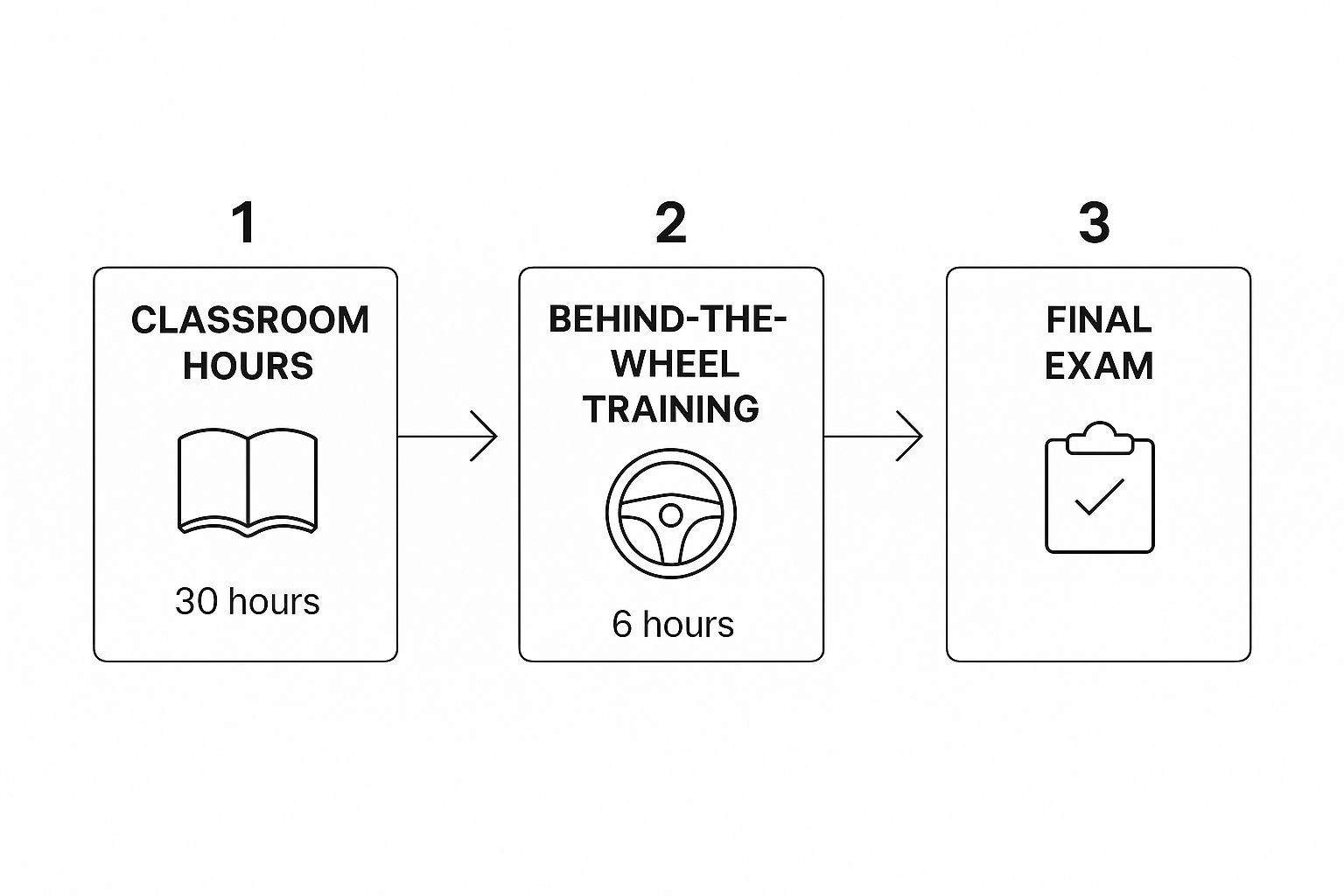
As you can see, each phase is a building block for the next. It all comes together during the final three-part CDL skills test, where you'll have to demonstrate you've truly mastered all of it. To get a head start on that first crucial step, take a look at our detailed guide on how to get your commercial learner's permit.
What Can Speed Up or Slow Down Your CDL Training?
While every CDL school has a set program length, the reality is that your personal timeline can look a little different. Think of the school's schedule as the map, but your own journey might have a few detours or shortcuts along the way.
Knowing what these variables are ahead of time is key. It helps you set realistic expectations and pick a school that can help you steer clear of common roadblocks.
Your Personal Pace and Past Experience
How quickly you pick things up is a huge piece of the puzzle. If you grew up driving a tractor on the family farm or handled heavy vehicles in the military, you’re already ahead of the game. You'll likely find that backing up a 53-foot trailer or judging your turns feels more natural, which can shave off valuable practice time.
On the flip side, if you’ve never driven a manual vehicle, a commercial truck's transmission can feel like a whole different beast. It's a common hurdle. Some folks need extra practice to get the hang of it and might even take a specialized https://patriotcdl.com/e-restriction-removal-course/ to get comfortable, adding a bit more time to their training.
Your ability to really dig in and master the material matters. Students who spend their evenings studying the pre-trip inspection checklist or quizzing themselves on air brake systems tend to move through the program much more smoothly.
School Logistics and Other Hurdles
Sometimes, delays have nothing to do with you at all. The school you choose and how it’s run can have a massive impact on how long it takes to get your license.
Here are a few common bottlenecks to watch out for:
- Instructor Availability: If a school has too many students and not enough instructors, you won't get the one-on-one coaching you need. Progress can really stall when you're waiting around for feedback.
- Access to Trucks: Nothing is more frustrating than showing up for class ready to drive, only to find you have to wait for a truck to free up. Limited equipment means less time behind the wheel for you.
- The DMV Backlog: This is a big one. In many states, getting an appointment for your final skills test can take weeks. A good school will be on top of this, booking your test date far in advance so you aren't stuck in limbo after finishing your training.
Ultimately, choosing a well-organized school with plenty of trucks, instructors, and a smart scheduling process is one of the best things you can do to stay on the fast track.
Answering Your Top Questions About CDL Training Timelines
Even with a clearer picture of the process, you probably still have a few lingering questions. That's completely normal. Let's walk through some of the most common ones people ask before they decide to jump into a new trucking career.
Can You Really Get a CDL in Just 3 or 4 Weeks?
You bet. It’s absolutely possible, but you have to know what you’re signing up for. These accelerated programs are intense, full-immersion courses. Think of it like a boot camp for truckers.
You can expect to be at the training facility for 8-10 hours a day, five days a week, completely dedicated to learning the ropes. It’s a fantastic option if you can clear your schedule and just focus, but it’s not for everyone. The pace is fast and the pressure is on, so you have to be honest with yourself about whether that kind of high-octane environment is where you’ll thrive.
The trade-off for speed is intensity. A three-week program compresses months of learning into a very short window, demanding your full focus and commitment from day one to graduation.
Does the Timeline Change Depending on the State?
This is a great question. While the federal ELDT mandate sets a national standard for what you learn, it doesn't actually specify a minimum number of hours behind the wheel. That part is left up to the states.
Because of this, you might find that one state requires more driving time than another. A school in Ohio might have a slightly different program length than one in Texas, even if they cover the same core curriculum. Your best bet is to always check with your state's DMV and talk directly to the schools you're considering to get the specifics.
How Much Extra Time Does a HazMat Endorsement Add?
Adding any endorsement will tack on some extra time, and the Hazardous Materials (HazMat) endorsement is a perfect example. It's more involved than just taking a simple test.
To get your HazMat, you'll need to go through additional classroom training, pass a specialized written exam, and complete a full federal background check. Depending on how the school structures its course and how quickly the background check clears, this can add anywhere from a few extra days to several weeks to your total training time.
Ready to start your journey on the fast track? Patriot CDL offers accelerated programs designed to get you licensed and on the road efficiently. Find out more about our courses.