If you're looking to jumpstart a career in trucking, you've probably heard about fast track CDL training. This isn't about drawn-out semesters; we're talking about an intense, focused path to get your commercial driver's license in as little as four to six weeks. It’s designed to give you the essential skills and knowledge you need to get on the road and start earning, fast.
Why Fast Track CDL Training Is Your Next Move
Let's be real: the American economy runs on trucks, and right now, there's a serious need for qualified drivers. This isn't just a job; it's a golden opportunity for a stable, well-paying career. Instead of spending months in a traditional program, an accelerated course gets you behind the wheel and earning a paycheck in a fraction of the time.

Don't mistake speed for cutting corners. This approach is all about efficiency. These programs are built to immerse you in everything you need to know, right from day one. You'll quickly transition from classroom lessons to hands-on driving practice, first on a dedicated range and then out on public roads.
Meeting an Urgent Industry Need
The demand for truck drivers has been off the charts for years, which is exactly why accelerated training has become so popular. Think about it: some schools can get you licensed in just four weeks, with new classes kicking off every single Monday. This pace is a direct response to a massive industry need. In fact, the U.S. Bureau of Labor Statistics projects over 240,000 job openings for heavy and tractor-trailer truck drivers every year through 2032.
This ongoing driver shortage puts you in the driver's seat, literally. Companies are desperate to fill their trucks, and they're actively recruiting newly licensed drivers. That often means competitive pay, good benefits, and even signing bonuses right out of the gate.
The real advantage of accelerated training is momentum. You go from learning to earning without the long delay of a traditional semester, putting you in a high-demand job while others are still studying.
The Financial and Career Advantages
Choosing a fast track program is a smart financial decision. The shorter timeline means less time spent not working and a quicker path to a steady income. Many new drivers find they can earn back the cost of their training within their first year on the job.
But the perks go beyond just speed.
- High Earning Potential: You can start earning a solid salary almost immediately after graduation, with plenty of room to grow your income as you gain experience.
- Job Security: As long as people need things moved from one place to another, there will be a need for truck drivers. That's a level of stability you don't find in many other fields.
- Immediate Opportunities: Most reputable schools have built strong connections with trucking companies. Many even offer job placement assistance, making your transition from student to professional driver seamless. Our CDL training program is specifically designed to give you the skills that top employers are looking for right now.
How to Choose the Right Accelerated CDL Program
Picking the right fast track CDL program is a huge first step in your new career. Honestly, not all schools are created equal, and what works for one person might be a terrible fit for another. You've got to look beyond the slick marketing and really dig into what makes a program worthwhile.
The trick is to focus on what actually matters. Look at their job placement rates, the instructor-to-student ratio, and—this is the big one—how much time you'll actually spend behind the wheel. A school that prioritizes your hands-on drive time is one that's truly invested in your success.
Class A vs. Class B: What's Your Path?
Before you even start comparing schools, you need to have a clear goal. Deciding between a Class A and a Class B license is foundational, as it dictates the kind of rigs you can drive and the job opportunities that will be open to you.
- Class A License: This is the king of commercial licenses. It gives you the freedom to operate any combination of vehicles with a gross weight of 26,001 pounds or more, as long as the trailer you're hauling is over 10,000 pounds. We're talking tractor-trailers, tankers, and flatbeds—the big stuff.
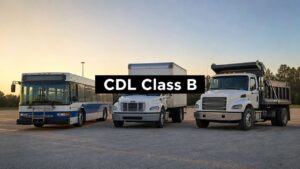
- Class B License: This license is your ticket to driving a single heavy vehicle (over 26,001 pounds) or towing a smaller trailer (under 10,000 pounds). Think dump trucks, cement mixers, and local delivery box trucks.
Making this choice first thing streamlines your search and helps you focus only on the schools that offer the specific training you need. If you're still weighing the options, you can dive deeper into the official CDL requirements for a full breakdown.
Any quality program should have a curriculum that’s well-rounded, covering both practical driving skills and the essential knowledge needed to ace your exam and stay safe on the road.
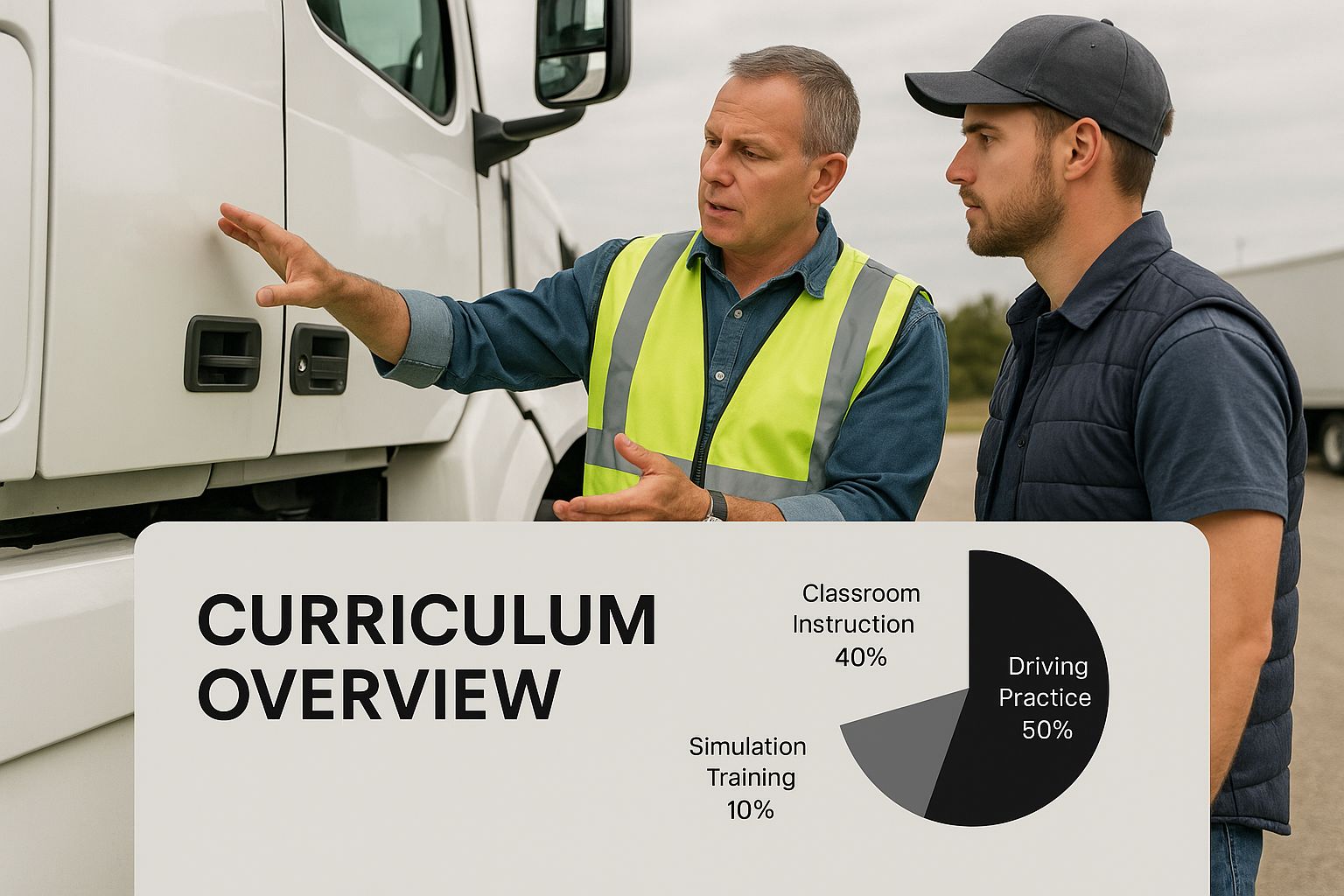
A balanced approach like this ensures you’re not just learning to pass a test, but learning to be a professional driver.
Comparing Your Training Options
When it comes to accelerated CDL training, you're generally looking at two main paths: private trucking schools or programs at a community college. Each has its pros and cons, and the best choice really depends on your personal situation.
You've probably heard about the driver shortage. It's real. The industry needs over 300,000 new drivers every year, which is why so many schools have popped up to meet the demand from people looking for a stable, high-demand career.
Your decision will likely come down to three things: how fast you want to get on the road, your budget, and the kind of career support you expect. A private school can get you certified in weeks, but a community college might have better financial aid options.
Comparing Fast Track CDL Training Options
To help you decide, here’s a straightforward comparison of what to expect from community colleges versus private trucking schools.
| Feature | Community College Programs | Private Trucking Schools |
|---|---|---|
| Duration | Typically longer; often follows a semester schedule. | Highly accelerated; often 3-6 weeks. |
| Cost | Can be lower, especially with grants or state aid. | Generally higher, but may offer in-house financing. |
| Job Placement | Varies; some have career services, others don't. | Strong focus with dedicated placement teams. |
| Flexibility | Often less flexible, with set class start dates. | More flexible, with frequent start dates. |
Ultimately, there's no single "best" option. Take a hard look at your timeline, finances, and career goals to figure out which path will set you up for success.
Getting Enrolled and Covering the Cost of Your Training
So, you’ve picked a school. Great! Now comes the part that can feel a little intimidating: the enrollment process and figuring out how to pay for it all. Don’t worry, it’s not as complicated as it looks. Schools have this process down to a science to get you from applicant to student as smoothly as possible.
Before you can get behind the wheel, you'll need to clear a few basic hurdles. You generally need to be at least 18 years old to drive within your state and 21 to haul freight across state lines. You’ll also need a standard driver's license with a good record, and you'll have to pass a Department of Transportation (DOT) physical and a drug test.
How to Fund Your Fast-Track CDL Program
Let's talk about the elephant in the room: the cost. Seeing the tuition number can be a shock, but don't let it scare you away. There are a bunch of practical ways to get your training funded, and many students graduate with little to no debt.
One of the best deals out there is company-sponsored training. It's exactly what it sounds like—a trucking company pays your tuition upfront. In return, you agree to drive for them for a certain amount of time, usually about a year. It’s a win-win: you get your CDL for free, and they get a qualified driver.
Think of your training not as a bill, but as a direct investment in your future paychecks. With the right funding, you can launch a new career without the financial stress.
If you’re looking at a program through a community college, you might also have access to federal financial aid, like grants and scholarships you never have to pay back.
Leave No Stone Unturned: Exploring Your Payment Options
Beyond the big two—sponsorships and federal aid—there are still more avenues to explore. It’s smart to look into every single one to see what works best for your personal situation. A little research here can save you a lot of money.
Here are a few other common ways people pay for their CDL:
- Veterans' Benefits: If you've served, your GI Bill® benefits can be a golden ticket, often covering the entire cost of training. Look for VA-approved schools; they’ll have people on staff who know exactly how to handle the paperwork.
- School Payment Plans: Many private CDL schools offer their own financing. This lets you break up the tuition into smaller, more manageable monthly payments instead of having to pay it all at once.
- Workforce Grants: Trucking is a high-demand field. Because of that, state and local workforce programs often have grant money set aside specifically to help people like you get trained and employed.
Your first move should be to get on the phone with the admissions or financial aid office at the school you're interested in. They're the experts and can lay out all the options available to you.
If you're ready to take the next step, you can sign up for our program and start exploring the possibilities right now.
What to Expect During Your Accelerated Training
Jumping into a fast-track CDL program is like hitting the fast lane on your new career. It's intense, no doubt about it, but the whole thing is built to get you from zero to a skilled, professional driver in a matter of weeks, not months. Forget everything you know about slow-paced semesters; this is total immersion from the moment you walk in.
Your time will be divided between two key environments. You'll start in the classroom, building the knowledge base every single pro driver relies on. Then comes the exciting part: hitting the driving range, where all that theory gets put into practice.
Getting the Classroom Knowledge Down Cold
The first part of your training is all about the fundamentals. This isn't just about memorizing facts to pass a test; it's about deeply understanding the rules that keep you, your rig, and everyone else on the road safe. You’ll get into the nitty-gritty of federal and state laws, figuring out how to keep a clean logbook and plan your routes like a seasoned vet.
You can expect to cover a lot of ground quickly, including:
- Safety First: You'll learn the absolute must-know safety procedures, covering everything from handling hazardous materials to mastering defensive driving.
- The All-Important Inspection: This is huge. You’ll master the complete pre-trip, in-trip, and post-trip inspection process so you can be confident your truck is 100% road-ready.
- Staying Compliant: Get a solid handle on the hours-of-service rules, weight restrictions, and other legal requirements that are part of the job.
This classroom work is the foundation for everything that follows. Schools like the one at Carroll Community College in Maryland, for example, spend a good chunk of time on route mapping, emergency procedures, and trucking regulations before a student ever climbs into the cab. It's a smart approach that makes sure you're ready for the written test and the real world.
From the Training Yard to the Highway
Once you’ve got the book smarts down, it's time to get behind the wheel. This is where accelerated training really clicks. You'll start out on a closed driving range, which is the perfect, safe environment to get a feel for the sheer size and power of a commercial truck.
Your instructors will walk you through all the basic maneuvers. You'll practice taking tight corners, making wide turns, and, of course, the one everyone thinks about: backing up a 53-foot trailer. It takes a lot of practice and a delicate touch, but you'll get there. These sessions are all about building your confidence and muscle memory.
The point of an accelerated program isn't just to be fast; it's to make you proficient. The curriculum is carefully designed to give you the hands-on skills and essential knowledge to operate a big rig safely and effectively.
After you've got the basics handled in the yard, you'll head out onto public roads with an instructor right there beside you. This is where you'll deal with actual traffic, merge onto highways, and navigate city streets. This experience is priceless because it throws you into the kind of dynamic, unpredictable situations you'll see every day on the job.
It’s also a mandatory part of the federal Entry-Level Driver Training (ELDT) standards, which set the baseline for what every new driver in the country needs to know. You can get the full rundown by checking out our detailed guide on what the ELDT mandate means for you. This on-the-road training is what ties all your learning together and gets you truly prepared to pass your CDL exam.
Mastering the CDL Exam and Landing Your First Job
Finishing your training program feels fantastic, but you're not quite at the finish line. Two big hurdles are left: passing that final CDL exam and then finding your first job behind the wheel. The exam is your moment to prove that all the information from your fast track cdl training has sunk in. With the right prep, you can show up on test day calm and ready to go.

This is where all that hard work comes together. The test is no joke—it covers everything from a detailed pre-trip inspection to handling tricky maneuvers out on the road. It’s built to make sure every new driver hitting the pavement is safe, capable, and professional.
Strategies to Ace the CDL Exam
Getting through your CDL test really boils down to two things: preparation and keeping a cool head. The exam is broken into three main sections: the pre-trip inspection, the basic control skills (think backing and parking), and the road test itself. Your instructors have likely drilled you on these constantly, but a few extra tips can make a world of difference.
When you're doing the pre-trip inspection, don't just go through the motions. You need to understand why you’re checking each hose, belt, and tire. As you do it, call out every single item you're inspecting to the examiner and explain what you're looking for. It shows them you genuinely know your stuff. The written part is just as important, so it's never a bad idea to review our comprehensive guide to the general knowledge test.
During the skills portion, the best advice I can give is to slow down. I've seen too many people fail by making these simple mistakes:
- Trying to be fast: The examiner is looking for control, not speed. Slow, deliberate movements are your best friend.
- Forgetting your mirrors: Your head should be on a swivel. Make it obvious that you're constantly checking your surroundings.
- Hitting the cones: Know where your vehicle is at all times. Those boundary lines and cones are not suggestions.
Your training school didn’t just teach you to drive a truck; it taught you how to think like a professional driver. Carry that mindset into your exam, focusing on safety, control, and precision above all else.
From License to Livelihood: Your First Trucking Job
With that fresh CDL in your pocket, it’s time to start earning a living. Your school should be your first stop. Any decent program will have established connections with trucking companies and offer solid job placement help. You paid for it—use it.
Sit down with their career services folks to get your resume in order, making sure to highlight your new license and any endorsements. Recruiters from big carriers know that people coming out of accelerated programs are eager and ready to hit the road. When you get an interview, be ready to talk about why you got into trucking and what you learned in school.
As you start looking at offers, don't let the starting pay be the only thing you see. You need to look at the whole picture.
- Home Time: Is it an OTR (Over-the-Road) gig where you're out for weeks, or a regional or local job? This is a huge quality-of-life factor.
- Benefits: What’s the deal with health insurance, retirement plans like a 401(k), and vacation time?
- Company Culture: Try to find a company that puts safety first and has a good program for new drivers, maybe with a mentor or finisher.
Picking that first company is a big deal and can really shape the beginning of your career. Look for a carrier that wants to invest in you and gives you a real path to grow. That's how you go from being the new guy to a seasoned professional making a great career on the open road.
Got Questions About Fast-Track CDL Training? Let's Talk.
Jumping into a new career path, especially one as fast-paced as trucking, is bound to bring up some questions. It’s smart to get the full picture before you commit, so let’s get into the real-world details of accelerated CDL programs.
People often wonder about the intensity. Let me be straight with you: a fast track cdl training program is a serious commitment. You're looking at long days that blend classroom learning with a ton of time behind the wheel. Think of it as a full-time job for a few weeks—often 40 or more hours—designed to get you road-ready in record time.
What if I Don't Pass the CDL Exam on the First Try?
This is probably the number one question I hear, and it’s a valid concern. The CDL exam is tough, but failing it once absolutely does not mean you've failed for good. Any school worth its salt has a plan for this.
Here’s how a good program will handle it:
- Pinpointing the Problem: Your instructor will sit down with you and break down your test results. Did you stumble on the pre-trip inspection? Was it the offset back or another maneuver? They'll help you see exactly where you need to improve.
- More Seat Time: You’ll get more practice focused specifically on your weak areas. The goal isn't just to drill you, but to build your confidence so you nail it the next time.
- Getting You Back on the Schedule: The school will help you get another test scheduled. There might be a retesting fee from the state, but the best schools are focused on one thing: your success.
A quality training program isn't just pushing you toward the exam; it's committed to getting you through it. They're invested in you and will provide the support you need to earn that license.
What Are the Job Prospects and Starting Pay Really Like?
Here’s the great news. The demand for qualified drivers is through the roof. It’s not uncommon for students to have job offers on the table from major carriers before they even have their license in hand. Most schools have dedicated job placement teams and partnerships with trucking companies that recruit directly from their graduating classes.
As for salary, what you earn your first year depends on a few things—the company you sign with, and whether you're driving over-the-road (OTR), regional, or local routes. But it's very realistic for new drivers to pull in a solid income right out of the gate. That quick return on your training investment is one of the biggest draws of a fast track cdl training program.
Ready to take the wheel and start your new career? Patriot CDL can get you on the road in as little as three weeks with expert, hands-on training. Get started today!