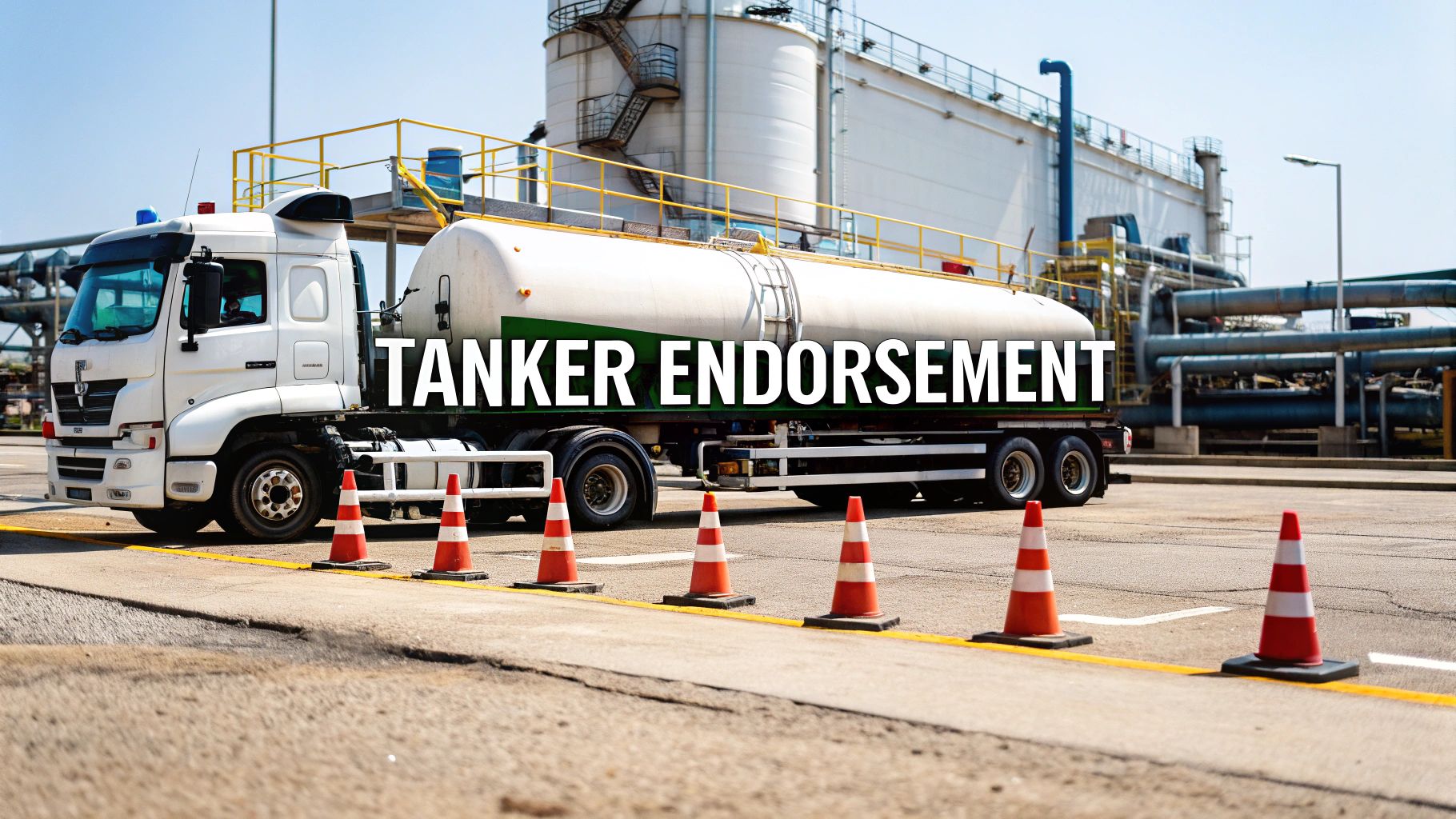
So, you're thinking about hauling liquids? A tanker endorsement is a special certification you add to your Commercial Driver's License (CDL), and it's your ticket to operating these unique rigs. It proves you have the specific knowledge to safely haul large volumes of liquid or gas—anything from milk and juice to chemicals and gasoline.
Think of it this way: driving a standard dry van is one thing, but managing thousands of gallons of moving liquid is a whole different ball game.
What Is A Tanker Endorsement?
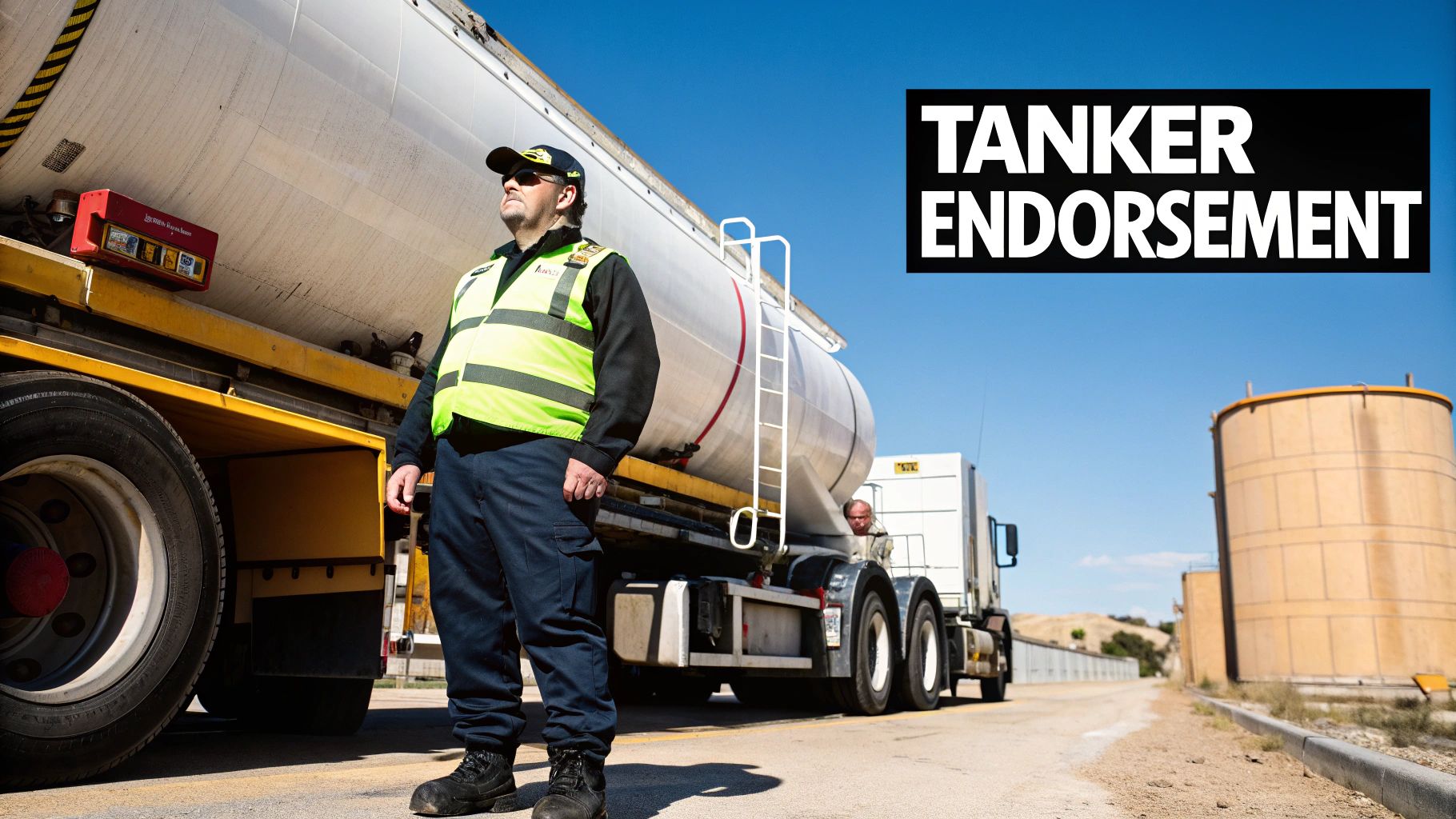
The physics of a tanker truck are unlike anything else on the road. The constant "sloshing" of the liquid, a powerful force known as surge, can feel like your trailer has a mind of its own. Combine that with a much higher center of gravity, and you've got a vehicle that demands a whole new level of skill and respect from the driver.
This is where the tanker endorsement comes in. It's a specialized certification that confirms you've passed a specific knowledge test and understand the unique challenges and safety protocols involved in hauling bulk liquids or gasses. It’s a legal requirement and, more importantly, a critical safety measure.
To give you a quick overview, here's a simple breakdown of what a tanker endorsement covers.
Tanker Endorsement At a Glance
| Aspect | Description |
|---|---|
| What It Is | A certification on a CDL that legally permits the holder to transport bulk liquid or gaseous materials. |
| Who Needs It | Any driver operating a tanker vehicle, which includes tanks that are either permanently attached to the vehicle or temporarily attached with a capacity of 119 gallons or more, and a total combined capacity of 1,000 gallons or more. |
| N Endorsement | The standard endorsement for hauling non-hazardous bulk liquids like milk or water. |
| X Endorsement | A combination endorsement that allows for hauling hazardous materials in a tanker (e.g., gasoline, chemicals). This combines the N and H (HazMat) endorsements. |
This table shows that the endorsement isn't just one-size-fits-all; it's tailored to the type of cargo you'll be hauling.
Why This Specialization Matters So Much
Getting this endorsement isn't just about ticking a box on a form; it's about mastering a skill set that protects you, your cargo, and everyone else on the road. Without proper training, the risk of a rollover or a serious accident skyrockets. The endorsement is proof that you understand the forces at play.
Here’s what the training and testing really focus on:
- Controlling Liquid Surge: You'll learn how to anticipate and counteract the powerful forward-and-back motion of liquid during braking and acceleration.
- High Center of Gravity: This is a big one. You have to understand how to approach turns, curves, and on-ramps differently to keep your top-heavy load stable.
- Specialized Vehicle Inspections: Tankers have unique components. You'll need to know how to properly inspect hatches, valves, piping, and seals for leaks or damage.
- Emergency Protocols: You’ll be trained on what to do in worst-case scenarios, like spills or leaks, especially when dealing with hazardous materials.
A tanker endorsement proves you can handle the unique physics of liquid cargo, turning a potentially dangerous load into just another day on the road.
Of course, before you can even think about adding an endorsement, you first need to meet all the foundational CDL requirements in your state. Once you've got that covered, you can start down the path to becoming a tanker driver.
When Do You Actually Need a Tanker Endorsement?
Figuring out exactly when you need a tanker endorsement isn't about guesswork; it’s about knowing the hard-and-fast rules set by the Federal Motor Carrier Safety Administration (FMCSA). Getting this wrong can lead to serious fines and put you in a dangerous spot on the road.
It all boils down to two critical numbers that define what the government considers a "tank vehicle."
The Two Rules That Matter Most
The regulations are built around a single, massive safety concern: liquid surge. When a large volume of liquid sloshes around, it can throw the entire weight of your truck off balance, especially during turns or sudden stops. The rules are designed to ensure anyone hauling a load with that kind of risk knows how to handle it.
Here are the specific thresholds you absolutely have to remember:
- The 119-Gallon Rule: You need an "N" endorsement if you're hauling any single tank—whether it's permanent or a portable tote—with a rated capacity of more than 119 gallons.
- The 1,000-Gallon Rule: You also need the endorsement if the total volume of all the individual tanks you're hauling (each over 119 gallons) adds up to 1,000 gallons or more.
Let's make that real. Imagine you're hauling ten 150-gallon IBC totes on a flatbed. Each tote is over the 119-gallon limit, and the combined total is 1,500 gallons. That's a definite yes—you need the endorsement.
The bottom line is this: if your load involves big containers and a lot of liquid, the law requires a tanker endorsement. It’s proof that you’ve been trained to manage the unique dangers that come with it.
It's also important to understand what doesn't require an endorsement. The rules are aimed squarely at bulk liquid transport.
This means you could haul a flatbed loaded with thousands of one-gallon water jugs and you wouldn't need the endorsement. Why? Because no single container is large enough to create that dangerous liquid surge effect. It’s all about the bulk.
Choosing Between the N and X Endorsements
So, you're ready to get into tanker driving. Great choice. The first thing you'll find is that there isn't just one "tanker endorsement." You've got a decision to make right out of the gate, and it's a big one that will shape your career.
You're looking at two main options: the N endorsement for general liquid cargo, and the X endorsement, which is a combination of tanker and hazardous materials (HazMat). Let's break down what each one really means for you on the road.
The N Endorsement: Your Gateway to Tanker Driving
Think of the N endorsement as your all-access pass to the world of non-hazardous liquid hauling. This is the foundational cert that proves you know how to handle the unique challenges of a liquid load.
With an N endorsement, you're qualified to haul things essential to our daily lives, like:
- Food-Grade Products: Milk, juice, water, and corn syrup.
- Non-Hazardous Industrial Liquids: Liquid animal feed or other harmless chemicals.
Getting this endorsement means you've mastered the physics of liquid surge—that powerful sloshing motion—and you understand how a tanker's high center of gravity affects every turn and stop. It's a solid credential and the perfect starting point for many drivers.
The X Endorsement: The High-Stakes Combination
If you're looking for the top-tier jobs with the highest pay, the X endorsement is your goal. This isn't just another letter on your license; it’s a powerful combination of the tanker (N) and hazardous materials (H) endorsements.
An X endorsement means you're trusted to transport the most dangerous goods on the highway. It’s a mark of expertise that comes with more responsibility and, frankly, better pay.
To get the X, you have to do everything required for the N endorsement plus everything for the HazMat endorsement. That means passing the tanker knowledge test, the separate (and tougher) HazMat test, and a full TSA security threat assessment and background check. This is the path for serious professionals who are ready to take on the biggest challenges in the industry.
How to Get Your Tanker Endorsement
Getting your tanker endorsement isn't some insurmountable hurdle. Think of it more like a clear, step-by-step process designed to make sure you have the specialized skills needed to safely manage the unique challenges of hauling liquid cargo. It all comes down to proving you understand the physics at play inside that tank.
Your first move? Preparation. Before anything else, you’ll need a valid Commercial Driver's License (CDL) for the class of truck you plan to operate. Once that’s in hand, grab your state's CDL manual and zero in on the tanker section. This isn't just suggested reading—it's the source material for every question on your exam. Knowing these regulations and safety procedures inside and out is your foundation.
Your Step-by-Step Action Plan
When you feel confident with the manual, you can start the official process. This means working with your state's DMV and, if you're going for the combined X endorsement, the Transportation Security Administration (TSA).
This flow diagram breaks down the main steps of the application.
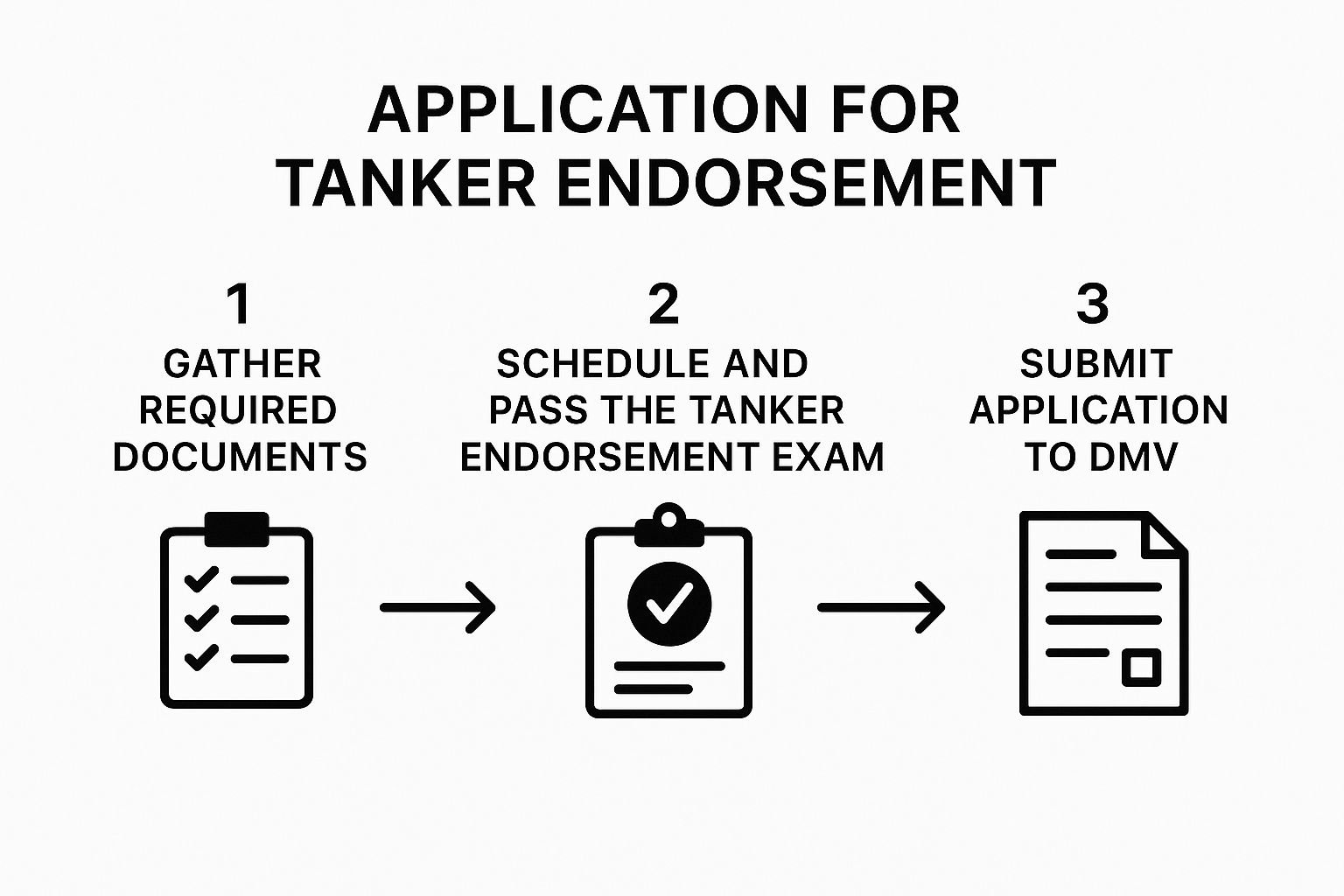
As you can see, it's a logical path from studying and training to taking your test and getting that endorsement on your license.
With your knowledge base solid, it's time for action. If you're a new driver getting your CDL for the first time with this endorsement, you'll likely need to complete Entry-Level Driver Training (ELDT) from a registered provider. After that, you’ll schedule your written tanker endorsement exam at the local DMV. For more tips on aceing that written test, check out our detailed guide on how to get your CDL permit.
Earning your endorsement is about more than just passing a test. It's about showing you truly grasp the immense responsibility that comes with hauling thousands of gallons of liquid down the highway.
Finally, if you're aiming for the X endorsement (which combines tanker and hazmat), there’s one more crucial step. You have to apply for and pass a TSA security threat assessment. This is a standard background check to clear you for transporting hazardous materials. Once you’ve passed all the required tests and cleared the background check, you'll submit everything to the DMV, and they will officially add the new endorsement to your CDL.
How to Pass the Tanker Endorsement Test
The written knowledge test is the big hurdle between you and that tanker endorsement. The key isn't just memorizing rules; it's about getting a feel for the physics and safety measures that are unique to hauling liquid freight. Think of this as your personal study guide for building the confidence and know-how to pass.
One of the first things you absolutely have to wrap your head around is liquid surge. It’s a game-changer. Imagine carrying a big bucket of water—when you stop short, all that water sloshes forward and tries to push you over. Now multiply that force by thousands of pounds. That’s what happens in a tanker, and it can easily shove your rig straight into an intersection if you aren't ready for it.
Passing the test means proving you know how to handle that massive, shifting momentum. This comes down to using different driving techniques, like braking much earlier and smoother than you would with a dry van.
Mastering the Test Content
So, what’s actually on the exam? It goes way beyond just managing surge. You'll need to show you’re an expert in all the little details that make tanker operations so different. When you sit down to study, make sure you really nail these areas.
Before you can pass the tanker endorsement exam, you need to be an expert in several critical areas of liquid transport. This table breaks down the essential topics you'll encounter on the written test.
| Key Topics on the Tanker Endorsement Test |
| :— | :— |
| Topic Area | What You Need to Know |
| Liquid Surge & Dynamics | The physics of how liquid moves in a tank and how to control it through smooth acceleration and braking. This is the big one. |
| Tanker Vehicle Inspections | The specific items you must check on a tanker during a pre-trip, like seals, valves, piping, and checking for any tank leaks. |
| Weight & Balance | How the density of different liquids impacts total weight and why proper weight distribution is crucial for a high center of gravity. |
| Emergency Protocols | Your immediate action plan for spills, leaks, or what to do if you feel the rig starting to tip in a potential rollover situation. |
| Specialized Driving Rules | Navigating curves safely with a high center of gravity and understanding "outage" (leaving room for liquids to expand). |
Knowing why a rule exists is so much more powerful than just memorizing it. For instance, knowing that baffles help with side-to-side slosh but do nothing for front-to-back surge helps you understand exactly why your braking technique has to be so different. It connects the dots.
A Smart Approach to Studying
You can absolutely pass this on your first attempt with a solid game plan. The first step is to live in your state's CDL manual—it’s the source material for every question they can ask.
Once you’ve got a good handle on the manual, start hammering practice tests. They’re perfect for finding your weak spots and getting comfortable with how the questions are worded.
A lot of drivers find that tanker knowledge builds on what you already know. It's a smart move to brush up on the fundamentals by reviewing a good general knowledge test study guide. When you combine that solid foundation with the specialized tanker principles, you'll walk into that testing center ready for anything.
Unlocking Better Career Opportunities
Getting a tanker endorsement isn't just about checking a box on your CDL. Think of it as a serious upgrade to your entire career, one that immediately puts you in the running for better jobs with better pay.
Why? Because industries from fuel transport and chemical logistics to food-grade hauling are always on the lookout for qualified drivers. These aren't just any trucking jobs; they require a higher level of skill and a deep sense of responsibility, and the paychecks definitely reflect that.
This specialization is your ticket to greater job security. When companies need to move liquids or gasses, they can't just hire any driver off the street. They need someone with your specific training, making you a much more valuable asset in a competitive market. It’s a credential that makes your resume pop.
This isn't a new idea, either. The FMCSA made the tanker endorsement mandatory back in 2011 to make sure drivers understood the unique challenges and risks of hauling large liquid or gaseous loads.
A tanker endorsement is your key to a more resilient and profitable career, separating you from the general pool of drivers and placing you in a category of specialized experts.
Many of these advanced roles require specific training. You can learn more about the necessary qualifications by exploring the Entry-Level Driver Training (ELDT) requirements.
Common Questions About Tanker Endorsements
If you're still weighing the details, you're not alone. Let's tackle some of the most common questions drivers have when they're thinking about adding a tanker endorsement to their CDL.
What’s the Real Cost to Get a Tanker Endorsement?
The good news is, it's pretty affordable. While costs can shift a bit from state to state, you’re generally looking at a small fee for the written test and another for the updated license itself.
All in, you can expect to spend somewhere between $20 and $60. Just remember, if you're going for the combined X endorsement, you'll also need to cover the cost of the TSA background check.
Do I Have to Re-Test Every Time I Renew My CDL?
That’s a big "it depends" – and it depends entirely on your state's DMV rules. Some states will ask you to retake the knowledge test for your endorsements when your CDL is up for renewal, while others won't.
For the X endorsement, however, you will have to go through a recurring TSA security threat assessment. Your best bet is always to check directly with your local DMV to get the current, official rules.
Can I Get a Tanker Endorsement if My CDL Has an Automatic Restriction?
Yes, absolutely. The tanker endorsement is all about specialized knowledge, not the kind of transmission you can drive. The core skills, like performing a proper tanker pre-trip inspection, are the same no matter what.
Keep in mind, though, that some tanker companies exclusively use manual trucks. So while you can earn the endorsement, your job prospects might be wider if you can drive both. Always double-check the requirements with any company you're interested in.
Ready to take the next step in your trucking career? Patriot CDL offers expert, hands-on training to get you on the road quickly and confidently. https://patriotcdl.com