A hazmat endorsement is a special certification you add to your Commercial Driver's License (CDL). It’s the official green light that says you’re legally qualified to transport materials the government considers hazardous.
This isn't just another piece of paper. It's a critical credential, usually marked with an "H" on your license, that shows you’ve gone through the specialized training and security checks needed to handle sensitive cargo safely and responsibly.
So, What Exactly Is a Hazmat Endorsement?
Think of your standard CDL as the key to the ignition of a big rig. A Hazmat Endorsement, or HME, is like a high-security key card that grants you access to a whole different part of the industry. Without it, you’re locked out from hauling any cargo that could pose a risk to the public or the environment.
This certification is a big deal, and for good reason—it’s a matter of national security. The process is tightly controlled by federal regulations from both the Transportation Security Administration (TSA) and the Department of Transportation (DOT). This strict oversight ensures only the most qualified and thoroughly vetted drivers are trusted with these loads.
What Kind of Stuff is "Hazardous"?
When you hear "hazardous materials," what comes to mind? The term covers a wide range of substances that could cause serious harm if they're spilled or mishandled. If a load is significant enough to require a DOT placard on the trailer, the driver must have a hazmat endorsement.
Here are a few common examples:
- Flammable Liquids: Think gasoline, diesel fuel, and certain industrial solvents.
- Gases: This includes things like compressed oxygen, propane, and liquid hydrogen.
- Explosives: Materials like ammunition, fireworks, and specific industrial chemicals fall into this category.
- Corrosive Substances: We're talking about powerful acids or industrial-strength cleaning agents.
To give you a quick, at-a-glance summary, here are the core components of the endorsement.
Hazmat Endorsement at a Glance
| Component | Description |
|---|---|
| Purpose | Legally authorizes a CDL holder to transport placarded hazardous materials. |
| Identifier | An "H" is added to the driver's Commercial Driver's License. |
| Governing Bodies | Regulated by the Transportation Security Administration (TSA) and the DOT. |
| Key Requirements | Passing a written knowledge test and a TSA security threat assessment. |
| Who Needs It? | Any driver hauling cargo that requires a DOT-mandated placard. |
This table helps break down what the HME is all about: proving you're ready for the responsibility.
A hazmat endorsement is non-negotiable for these roles. It confirms a driver has passed a written knowledge test and a comprehensive TSA security threat assessment, proving they understand the unique risks and protocols involved.
Of course, before you can specialize, you have to master the basics. If you're just getting started, the first step is understanding the permit process. Nailing down that foundation is essential before you even think about adding advanced endorsements like the HME.
Why the Hazmat Endorsement Is So Important
Getting a Hazmat Endorsement is a big deal—it’s far more than just another stamp on your CDL. Think of it as a critical pillar supporting public safety and even national security.
The whole process is intentionally tough for one simple reason: the materials you’ll be hauling can be incredibly dangerous if something goes wrong. We’re not talking about a load of lumber or produce.
Transporting things like explosives, flammable gases, or radioactive materials is a huge responsibility. One small mistake could cause a major environmental disaster, put the public in danger, or worse. The endorsement is our country's way of making sure only the most responsible, knowledgeable, and thoroughly vetted professionals are in that driver's seat.
A Response to Real-World Threats
The intense screening process we have today didn't just appear out of nowhere. The rules for hauling hazardous materials got a lot stricter after the tragic events of September 11, 2001. The Patriot Act was a direct response, mandating the in-depth background checks that are now a core part of the process.
This change turned the endorsement from a simple license add-on into a serious security clearance.
This history really drives home the gravity of the job. It’s not just about knowing how to handle a big rig; it’s about being a trusted link in a supply chain that keeps our country running safely.
The Hazmat Endorsement process is demanding by design. It reflects the high level of trust and responsibility placed on drivers who carry potentially dangerous cargo across the nation's highways.
This level of accountability means a hazmat driver has to be on top of their game, all the time. Your commitment to safety has to be second to none, and that starts with the basics. A great place to start is by mastering the CDL pre-trip inspection, because flawless fundamentals are non-negotiable in this line of work. It’s all part of why every single driver has to go through such a high level of scrutiny.
Getting Started: What You'll Need for Your Hazmat Endorsement

Before you can even think about filling out the application, you have to make sure you meet the baseline requirements for a hazmat endorsement. Think of it as laying the groundwork—these standards are non-negotiable and ensure that only qualified, responsible drivers get behind the wheel with hazardous materials.
First things first, you have to be at least 21 years old. You'll also need to have a valid Commercial Driver's License (CDL) from your home state and be able to prove you're a U.S. citizen or a lawful permanent resident.
These are just the entry-level checks. If you need a refresher on what it takes to get your commercial license in the first place, you can learn more about the general CDL requirements that every commercial driver has to meet.
The TSA Security Threat Assessment: A Critical Hurdle
This is where the process gets serious. The single most important step is passing the Transportation Security Administration (TSA) Security Threat Assessment. This isn't just a standard background check; it's a comprehensive screening to make sure you don't present a security risk.
The TSA background check is all about public safety. Its entire purpose is to prevent dangerous materials from getting into the wrong hands by vetting the history of every single applicant.
The assessment digs into your criminal history, looking for specific offenses that could disqualify you. These fall into two main categories:
- Permanent Disqualifiers: Certain crimes will permanently prevent you from ever getting an HME. This includes things like espionage, terrorism, murder, or treason.
- Interim Disqualifiers: Other serious felonies—like arson, robbery, or smuggling—can disqualify you temporarily. Usually, this means you're ineligible for seven years after a conviction or five years after you’re released from prison.
There’s no way around it. Clearing this security screening is the main gatekeeper for earning your hazmat endorsement.
Your Step-by-Step Application and Testing Guide
Getting your hazmat endorsement might seem like a mountain of paperwork, but it's really just a series of manageable steps. Let's break down exactly what you need to do, from the initial application to passing the final test.
The whole process kicks off with the application itself and a mandatory security screening. Think of it as two parallel tracks: one is the paperwork and background check, and the other is studying for the knowledge test. You can work on both at the same time.
The Application and Security Check
First things first, you'll need to fill out the HME application. You can typically get this started online through the Transportation Security Administration (TSA) Universal Enrollment Services portal.
After you submit the application, you'll schedule an in-person appointment at a TSA-approved center. This is where they'll take your fingerprints and verify your identity for the Security Threat Assessment. This background check is the most time-consuming part of the whole deal, so it’s smart to get it started as soon as possible.
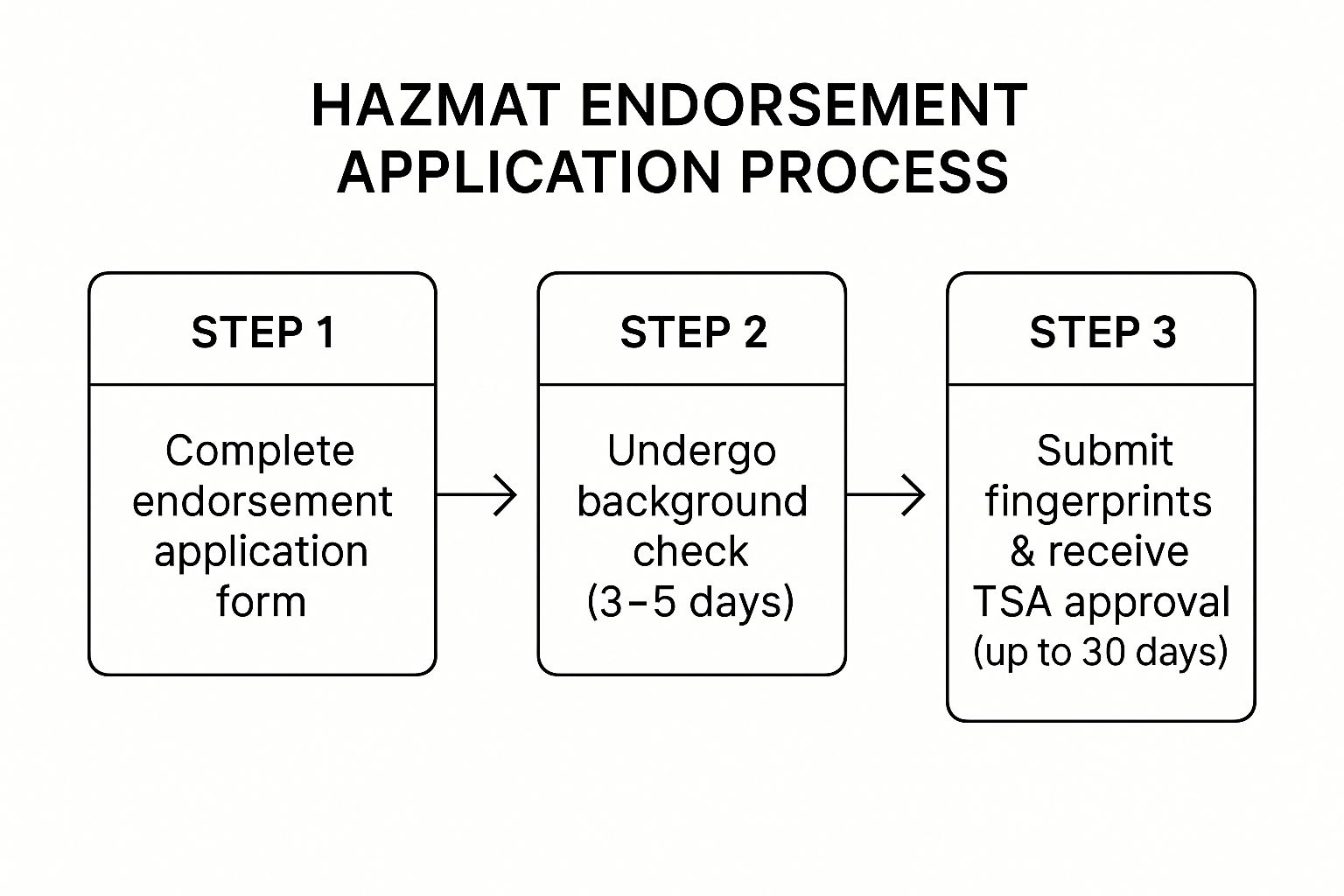
This chart gives you a bird's-eye view of the entire timeline, but the key takeaway is this: the TSA check can take 30-60 days, so plan ahead!
To give you a clearer picture, here is a quick breakdown of what to expect in terms of time and money.
Step-by-Step Hazmat Application Process
| Step | Description | Estimated Cost | Estimated Timeframe |
|---|---|---|---|
| 1. Online Application | Complete and submit the HME application online via the TSA portal. | Varies by state | 15-30 minutes |
| 2. TSA Appointment | Visit an enrollment center for fingerprinting and identity verification. | $86.50 (TSA fee) | 30 minutes (appointment) |
| 3. Security Screening | The TSA conducts a comprehensive Security Threat Assessment. | Included in TSA fee | 30-60 days |
| 4. Knowledge Test | Study for and pass the written hazmat exam at your local DMV/BMV. | Varies by state | Study time varies |
| 5. Endorsement Issued | Once the test is passed and TSA approval is received, pay state fees to get the "H" on your CDL. | Varies by state | Same day as test/approval |
Keep in mind that costs and timelines can differ slightly depending on your state, but this gives you a solid road map.
Nailing the Written Knowledge Test
While you're waiting for the TSA to complete your background check, it's the perfect time to hit the books. The hazmat written test is your chance to prove you know the specific rules and safety measures required for hauling these sensitive materials.
The hazmat knowledge test isn’t just about rules on a page. It’s about demonstrating that you can apply that knowledge in real-world situations to keep yourself, the public, and the environment safe.
You can expect around 30 multiple-choice questions on the exam. Most states require you to get at least 80% of them right to pass. The questions will focus on critical topics like:
- Proper placarding for different classes of materials.
- How to load, unload, and secure hazmat loads.
- What to do in an emergency, including leak prevention.
- Understanding shipping papers and hazard communication rules.
Your state's CDL manual is your best friend here. A lot of drivers also find that running through practice questions really helps the information stick. It's also great preparation for the broader CDL general knowledge test that every commercial driver has to pass.
Once you pass the exam and get the final green light from your security check, you just need to pay the state's issuance fees, and they'll officially add the "H" endorsement to your license.
How a Hazmat Endorsement Can Supercharge Your Trucking Career

Think of a hazmat endorsement as more than just another stamp on your CDL. It's a strategic move that tells every potential employer you’re a top-tier professional, trained and trusted to handle materials that others can't.
Getting certified makes you a more flexible and valuable driver for any company. Suddenly, you’re qualified for specialized jobs—often the ones with better paychecks—that are completely off-limits to drivers with a standard CDL.
Unlocking Better, Higher-Paying Jobs
With a hazmat endorsement (HME) in your pocket, you’ve got a serious competitive advantage. Companies in crucial industries are always on the hunt for qualified drivers to move essential, and sometimes sensitive, materials.
Some of the most consistent, in-demand jobs that require an HME are:
- Fuel Hauling: Keeping gas stations supplied with gasoline and diesel.
- Chemical Transport: Moving the raw materials that keep factories running.
- Agricultural Deliveries: Transporting fertilizers and other necessary supplies to farms.
- Medical Gas Transport: Hauling critical supplies like compressed oxygen to hospitals and clinics.
These aren't just gigs; they are solid career paths that come with more responsibility and, frankly, better compensation.
Holding a hazmat endorsement makes you a specialist. It proves you have the skills and security clearance to be trusted with loads that are critical to the economy and public safety.
This specialized skill set translates directly into better job security and a faster track for advancement. Of course, this all starts with a strong foundation. You must first complete the mandatory Entry-Level Driver Training (ELDT) before you can add any endorsements like the HME.
With a hazmat endorsement, you’re not just another driver on the road. You’re a certified expert in a field that never stops moving.
Common Questions About the Hazmat Endorsement
As you look into getting a hazmat endorsement, you're bound to have a few questions. The process has a lot of moving parts, and it’s easy to get tangled up in the details. Let's clear up some of the most common things drivers ask.
We’ll cover how long the endorsement lasts, what your options are if you don't pass the test the first time, and how a criminal record might affect your application. Getting these answers straight now will save you headaches down the road.
How Long Is a Hazmat Endorsement Valid For?
Think of your hazmat endorsement as having a five-year lifespan. That's the standard in most places, but it's always smart to double-check your state's specific rules. This timeline is locked to your TSA Security Threat Assessment, which is the federal background check that makes it all possible.
When it's time to renew, you can't just wait until the last minute. You'll need to kick off the process early to avoid any lapse in your certification. This means submitting a new application and going through the entire security screening again to prove you still meet the federal standards.
What Happens If I Fail the Hazmat Written Test?
Failing the written test is a setback, not a dead end. If you don't get a passing score on your first try, you absolutely can take it again.
Most states will make you wait a short period—often just a day or so—before you can give it another shot. Just be prepared to pay the testing fee each time you take it. Your best bet is to hit the books hard and really study the hazmat section of your state’s CDL manual before heading back.
A criminal record doesn’t automatically shut the door on getting a hazmat endorsement. The key is the type of offense. The TSA has a very specific list of disqualifying crimes, so be sure to review it on their official website before you spend any time or money on the application.
Can I Get an Endorsement with a Criminal Record?
This is a big question for many drivers, and the answer is: it depends entirely on the crime. The TSA has a clear-cut list of offenses that will prevent you from getting a hazmat endorsement (HME). They break them down into two main groups:
- Permanent Disqualifiers: These are the most severe offenses that will permanently block you from ever holding an HME. Think things like espionage, terrorism, or murder.
- Interim Disqualifiers: This category includes other serious felonies, like arson or smuggling. These will disqualify you for a set period, usually for several years after you've been convicted or released from prison.
At Patriot CDL, we're here to help you navigate every turn of your professional driving career, from getting your initial license to adding valuable endorsements. Get your high-demand career started right by checking out our programs.