Deciding to become a professional truck driver is a huge step, one that opens up a world of freedom, stability, and real opportunity. The first move on that new path? Enrolling in a top-notch CDL Class A training program. This license is the gold standard in the trucking world, giving you the keys to the biggest and most powerful rigs on the road.
Launching Your Career in Professional Trucking
Starting a trucking career isn’t just about learning how to steer an 18-wheeler; it's about becoming an essential part of the American economy. Think about it—almost everything you buy at a store got there on a truck. That simple fact shows just how critical skilled drivers are, which is why the demand for qualified pros stays so strong.
Think of your Class A Commercial Driver's License (CDL) as the master key to the industry. Other licenses might get you into smaller, single-unit trucks, but a Class A opens up the world of massive combination vehicles—tractor-trailers, tankers, and flatbeds. That kind of versatility doesn't just give you more job options; it seriously boosts your earning potential for years to come.
Why a Class A CDL is the Industry Gold Standard
Going for a Class A license right out of the gate is the smartest play you can make. It’s the most comprehensive license available, qualifying you for the widest range of jobs without ever having to go back to school for an upgrade. A driver with a Class A license can legally hop in most Class B and Class C vehicles, but it doesn't work the other way around.
That flexibility gives you a huge leg up when you're looking for work. Companies are always on the hunt for drivers who can handle different types of loads, whether it's a cross-country haul or a regional delivery route. Investing in a solid Class A program sets you up for the best jobs from day one. If you want to see what a really thorough curriculum covers, take a look at this detailed CDL Class A program.
A Class A CDL is your ticket to the widest array of opportunities in the trucking industry. It authorizes you to operate combination vehicles with a gross weight of 26,001 pounds or more, as long as the towed unit exceeds 10,000 pounds.
Preparing for Success on the Road
Your training is the bedrock of your entire career. It’s where you’ll gain the skills and, just as importantly, the confidence to handle an 80,000-pound vehicle safely and professionally. This guide is your roadmap to getting started. We'll break down what to expect from training, how to weigh your school options, and how to pick the program that fits your goals perfectly.
Getting it right from the start means you won't just be licensed—you'll be truly ready for the challenges and rewards of life on the open road.
What You'll Learn in CDL School
Stepping into a CDL school can feel like learning a whole new language, but the best CDL Class A training programs are built to bring you up to speed methodically. The entire curriculum is usually broken down into three distinct phases, each one designed to build on the last, taking you from novice to road-ready professional.
It’s a lot like learning to swim. First, you get comfortable with the theory on dry land. Then, you practice your moves in the shallow end of the pool. Only after you’ve mastered the fundamentals do you head for the deep end.
Mastering the Rules of the Road in the Classroom
Before you even think about turning the key on an 80-foot rig, your journey starts in a classroom. This is where you build your foundation, learning the "why" behind every single thing you'll do out on the road. This isn't just about memorizing traffic signs; it's about understanding the complex web of rules and systems that keep the trucking industry running safely.
During this phase, you'll tackle the core knowledge that separates a professional from an amateur.
- Federal and State Regulations: You’ll get familiar with the rulebook from the Federal Motor Carrier Safety Administration (FMCSA), which covers everything from how much you can haul to how cargo needs to be tied down.
- Hours-of-Service (HOS) Rules: This is a huge one. You'll learn how to legally manage your drive time to stay alert and avoid fatigue, which is a top priority for safety in the industry.
- Trip Planning and Logbooking: Get ready to learn the art of plotting an efficient route, planning your fuel stops, and keeping a perfect logbook, whether it’s on paper or an Electronic Logging Device (ELD).
- Vehicle Systems: You'll get a crash course in how your truck actually works, from its powerful air brakes to the complex electrical and coupling systems.
This classroom knowledge is the skeleton that all your practical skills will hang on. It ensures you're not just a "wheel holder," but a true professional who understands the job's legal and mechanical responsibilities.
Developing Hands-On Skills in the Yard
Once you've got the theory down, it's time to get behind the wheel. The next stage of your training moves outside to a large, off-road practice area, often called the "yard" or "range." Think of this as your personal sandbox—a safe space where you can practice handling a massive tractor-trailer without the pressure of other cars and trucks.
Here, you start turning all that classroom knowledge into real muscle memory. With an instructor right there beside you, you'll work on the core maneuvers you absolutely have to master for your CDL skills test.
The practice yard is where theory smacks into reality. It’s where you’ll build the spatial awareness and fine motor control needed to handle an 80,000-pound vehicle with absolute precision.
One of the first and most important skills you'll work on is the pre-trip inspection. This is a top-to-bottom, systematic check of the entire truck and trailer to make sure it's safe for the road. Nailing this is non-negotiable. To see just how detailed it is, check out our complete guide to the pre-trip inspection.
You'll also spend hours perfecting other essential skills:
- Backing Skills: You’ll practice all the key backing maneuvers—straight-line, offset, and the one everyone dreads, the alley dock.
- Coupling and Uncoupling: Learn the exact, safety-critical sequence for hooking the tractor to a trailer and dropping it again.
- Basic Control: Get a feel for making wide turns, shifting through all those gears, and braking smoothly, all while accounting for the rig’s incredible size and weight.
Applying Your Skills on the Open Road
This is what it's all been leading up to. The final, and most exciting, phase of your training is getting the truck out on public roads. With an experienced instructor in the passenger seat, you’ll start navigating real-world traffic, from quiet country roads to hectic city streets and high-speed interstates.
This is where all the pieces of the puzzle come together. You’ll practice managing your speed and keeping a safe following distance, merging onto highways, handling hills, and navigating tight intersections. This stage is all about building the confidence and quick decision-making skills you'll need when you’re driving solo.
The trucking industry desperately needs well-trained drivers, and this final step makes sure you are genuinely prepared. In fact, in response to a critical driver shortage, several states are expanding their programs. For example, Western Nebraska Community College (WNCC) recently launched its first Class A CDL course in Sidney to meet local demand, often using federal grants to boost training capacity.
Your instructor will be giving you constant feedback, helping you polish your technique and learn to spot potential hazards before they become problems. By the time you finish this phase, you won’t just be ready to pass a test—you’ll have the hands-on experience to kick off your professional career with safety and skill.
Comparing Your CDL Program Options
Deciding where to get your training is a huge first step, and honestly, not all CDL Class A training programs are built the same. The "best" one really boils down to you—your budget, how fast you need to get on the road, and how you learn best. It’s like picking a tool for a job; you wouldn't use a sledgehammer to hang a picture frame.
This infographic lays out the typical journey you'll take, starting from the basics and building up to the real deal.
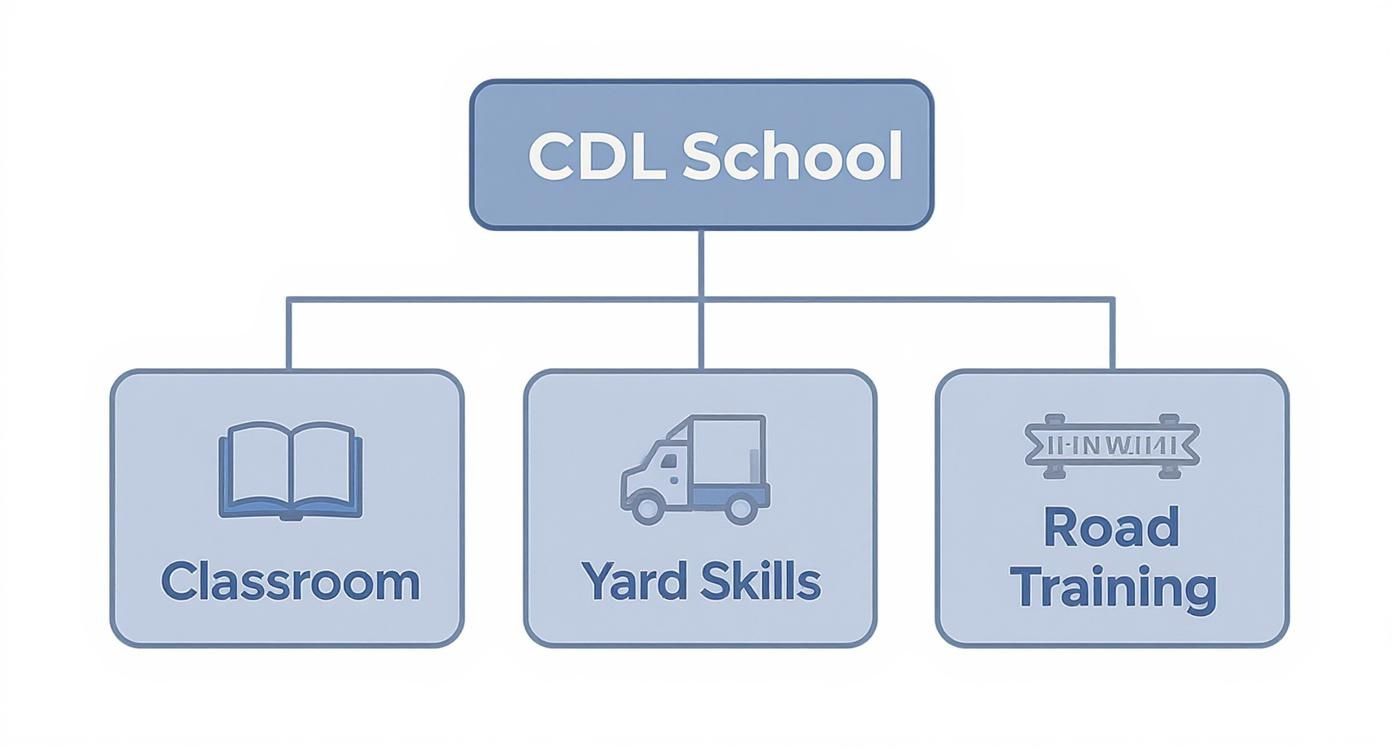
As you can see, a solid CDL education is layered. It all starts in the classroom, moves to the practice yard to build confidence, and finally puts you on the open road where the real learning happens.
To help you figure out which path is right for you, let's break down the three main options you'll encounter.
Private Truck Driving Schools
If you're looking for the fastest route from zero to licensed, private truck driving schools are your ticket. These places live and breathe one thing: getting students trained, tested, and ready for a job as quickly and efficiently as possible.
Most programs are incredibly focused and can be completed in just a few weeks if you go full-time. That speed is a massive plus for anyone chomping at the bit to start earning.
The trade-off for that speed is cost. Private schools are usually the priciest option right out of the gate, with tuition ranging from $3,000 to over $10,000. Most offer financing plans, but that initial sticker shock can be a real hurdle.
Community College Programs
Community colleges offer a more traditional, academic approach to getting your CDL. The training is often part of a larger transportation or logistics curriculum, giving you a slightly broader education beyond just what you need to pass the exam.
A huge advantage here is affordability. You can often use traditional financial aid, like federal grants and student loans, which you can't always do with private schools. The pace is also a bit more relaxed, which is perfect if you're juggling work or family and need more time to let the information sink in.
The main downside? Time. A community college program could take an entire semester, which means you're not earning a trucker's salary for several months. You might also find yourself in a larger class, which could mean less personal time with the instructor.
Key Consideration: When you're weighing the cost, don't just look at tuition. A four-week private program gets you on the road earning a paycheck months faster than a sixteen-week semester. That lost income can easily outweigh the difference in tuition.
Company-Sponsored Training
For many people, company-sponsored (or "paid") CDL training looks like the perfect deal. A trucking company covers your training costs, and in return, you agree to drive for them for a specific amount of time, usually a year or two.
This is a fantastic way to get started if you don't have the cash for school upfront. It takes the financial pressure off and guarantees you have a job waiting the moment you get your license.
But—and this is a big but—it comes with some serious strings attached. You're signing a contract. If you leave before your commitment is up, you'll likely be on the hook for the full cost of the training, sometimes with hefty interest. Your starting pay might also be a bit lower as the company recoups its investment, and you have zero say in who your first employer is.
A quick note on equipment: a lot of modern fleets use automatic transmissions, which are much simpler to learn. If you train and test in an automatic, however, you'll get an E restriction on your license, legally blocking you from driving a manual. To keep all your doors open, you might consider taking an E restriction removal course down the line to make sure you're qualified for any rig.
CDL Class A Program Types Compared
Still on the fence? This table breaks down the key differences side-by-side to help you see which option aligns best with your goals.
| Feature | Private Trucking Schools | Community College Programs | Company-Sponsored Training |
|---|---|---|---|
| Cost | High upfront ($3,000 – $10,000+) | Moderate, with access to traditional financial aid | No upfront cost, but training is paid back through service |
| Program Length | Very fast (3-6 weeks on average) | Slower (typically a full 16-week semester) | Fast (4-8 weeks), similar to private schools |
| Job Placement | Strong industry connections and job placement assistance | Some job placement help, but less direct than private schools | Job is guaranteed with the sponsoring company upon completion |
| Commitment | No post-graduation commitment; you are a free agent | No post-graduation commitment | 1-2 year employment contract is required |
| Flexibility | Offers full-time, part-time, and weekend classes | Less flexible scheduling, follows a typical academic calendar | Very little flexibility; you are on the company's schedule |
| Best For | Students who want to start working ASAP and can afford it | Students who prefer a slower pace and need financial aid | Students with limited funds who want a guaranteed job |
Ultimately, there's no single "right" answer. The best program is the one that fits your life, your learning style, and your career ambitions.
Navigating Training Costs and Financial Aid
https://www.youtube.com/embed/4XpNrVlHgbA
Let's talk about the elephant in the room: money. One of the first questions on every aspiring driver's mind is, "How much is this going to cost me?" Seeing the price tag for a quality CDL Class A training program can feel like a roadblock, but it’s better to think of it as the first investment in a stable, well-paying career.
With a little planning, funding your training is more than possible. The trick is to understand exactly what you're paying for and to explore all the financial aid options out there. A good school will be upfront about its tuition and any other fees you can expect, which helps you map out a clear financial path.
Deconstructing the Cost of CDL School
So, what exactly are you paying for? The truck driving school industry has a market size of about $509.8 million, which gives you a sense of the resources needed to deliver top-notch training. You can generally expect tuition for a solid program—one that includes classroom, simulator, and real-world driving—to be in the $3,000 to $7,000 range.
That tuition fee typically covers the essentials of your training.
- Instructional Time: This is the big one. It covers your hours in the classroom, time spent on advanced driving simulators, and—most importantly—your behind-the-wheel experience on the practice yard and out on the open road.
- Use of Equipment: You'll be learning on the real deal: full-sized tractor-trailers. Your tuition helps cover the significant costs of fuel, insurance, and maintenance for the school's fleet.
- Administrative Support: This accounts for the background work that keeps the school running, like developing the curriculum, scheduling training, and providing student services.
Keep in mind, there are usually a few extra costs you'll need to budget for. Always ask about things like the DOT medical exam, your Commercial Learner's Permit (CLP), the final CDL licensing fee, and any required drug screenings.
Uncovering Financial Aid and Funding Options
Here’s the good news: you probably don't have to foot the entire bill yourself. There are tons of programs and resources designed specifically to help students get their CDL. A little digging can significantly lower, or even eliminate, your upfront costs.
Don't let the initial sticker price scare you off. Think of CDL training as a fast track to a stable career. Most drivers see a return on their investment within the first year on the road, making it one of the smartest professional moves you can make.
For many people, the journey starts with traditional financial aid. If the program you're looking at is part of an accredited school, like a community college, you may be able to fill out the Free Application for Federal Student Aid (FAFSA) to see if you qualify for grants or federal student loans.
Tapping Into Specialized Funding Sources
Beyond federal aid, there are several other fantastic funding streams geared specifically toward aspiring truck drivers. These programs are all about getting skilled people into high-demand jobs.
- Veterans Benefits: If you're a veteran, your GI Bill® benefits are a game-changer. Many CDL schools are approved to accept these benefits, which can cover most, if not all, of your tuition.
- Trucking Scholarships: You'd be surprised how many companies and organizations in the trucking industry offer scholarships for CDL students. It takes a bit of research, but you can uncover funds you never knew existed.
- Workforce Innovation and Opportunity Act (WIOA): This is a federal grant program that helps unemployed or underemployed people get training for in-demand careers, and trucking almost always makes the list.
Another popular route is tuition reimbursement offered by trucking companies. With this setup, you pay for school initially, and your new employer pays you back in installments over your first year with them. It’s a great way to recoup your investment quickly. Before you make any decisions, you can sign up to learn more about our payment options and find a financial plan that fits your life.
How to Choose the Right CDL Training Program
Alright, you've got a handle on what the training involves, the different programs out there, and what it might cost. Now comes the most important part: picking the right school. Don’t rush this. The quality of your training will shape your confidence behind the wheel and open doors for your entire career.
Think of it like doing a pre-trip inspection, but for your future. You need to be thorough, ask the important questions, and spot the difference between a great program and one that just wants your money.
Your School Vetting Checklist
When you start reaching out to different CDL Class A training programs, don't be shy. A good school will be happy to answer your questions and will respect that you're doing your homework. Keep this checklist handy to make sure you cover all the bases.
First things first, look at the equipment. Ask them straight up: "Can I see the exact trucks I will be learning on?" The age and condition of their fleet speak volumes. You want to train on modern, well-maintained trucks—the kind you'll actually be driving out on the road.
Next, get a feel for the hands-on training environment. This question is crucial: "What is the instructor-to-student ratio during behind-the-wheel training?" One-on-one time is where the real learning happens. A low ratio means you get the focused attention you need to nail those tricky maneuvers, not just waiting for your turn.
Evaluating Instructor Quality and Accreditation
The person in the passenger seat makes all the difference. Don't just assume every instructor has a lifetime of experience. Ask about their credentials: "How many years of real-world, over-the-road trucking experience do your instructors have?" The best teachers aren't just skilled drivers; they're patient mentors who know how to break down complex skills.
Accreditation is another non-negotiable. It’s an official stamp of approval showing the school meets recognized industry standards. This isn't just about quality; it's often a must-have if you plan on using financial aid like federal student loans or VA benefits.
A school's job placement rate is one of the most powerful metrics you can look at. A high success rate (often 80% or more) shows that the school has strong industry connections and that employers trust the quality of its graduates.
Job Placement and Recognizing Red Flags
A CDL is a ticket to a job, and a good school knows that. Their responsibility shouldn't end the day you pass your test. Be direct: "What specific job placement assistance do you offer, and what is your success rate?" Look for programs with dedicated staff who help with resumes, host hiring events, and have solid relationships with top carriers.
While you're looking for the green lights, keep an eye out for red flags. High-pressure sales tactics are a huge warning. If an admissions rep is pushing you to sign on the dotted line immediately, that's your cue to walk away.
Also, be skeptical of pie-in-the-sky promises. No school can guarantee you a job, let alone a specific salary. If a program is promising a $100,000 salary right out of the gate, it’s probably too good to be true.
Finally, double-check that the school’s curriculum will fully prepare you for all CDL requirements in your state. A quality program is built to get you past the tests and ready for a long, successful career on the road.
Your Top Questions About CDL Training Answered
Jumping into a new career is a big move, and it's only natural to have a lot of questions. When that career involves getting behind the wheel of a big rig, you want to make sure you have all the facts straight before you commit.
We get it. We've heard all the questions and concerns from aspiring drivers. Think of this as your personal FAQ session, where we tackle the most common things people want to know about CDL Class A training programs.
How Long Does CDL Class A Training Take?
One of the best things about trucking is how fast you can go from the classroom to earning a paycheck. But how long it takes really boils down to the type of program you choose.
If you can go all-in, a full-time, intensive program is your fastest route. Most of these courses are designed to get you test-ready in just three to seven weeks. They're perfect if you can clear your schedule and focus completely on training.
Need more flexibility? Many schools offer part-time or evening classes to fit around your current job or family life. Naturally, these programs are spread out over a longer period, often taking a few months to complete, but they get you to the same finish line.
Do I Need a High School Diploma to Get My CDL?
This one trips a lot of people up. The short answer is no—at the federal level, you don't need a high school diploma or a GED to get your Commercial Driver's License. This opens the door for a lot of folks who might not have a traditional academic background.
Here's the catch, though: individual schools and most major trucking companies have their own rules. It's extremely common for a quality training program or a big carrier to require a diploma or GED as part of their application process. Your best bet is to always check the specific requirements for the school you're interested in attending.
Will a CDL School Help Me Find a Job?
Yes, and honestly, they should. Solid job placement assistance is a hallmark of a great CDL school. Think about it—their reputation is built on their graduates' success. So, they work hard to build strong connections with trucking companies.
This help usually looks like this:
- Carrier Partnerships: Top schools have direct relationships with local, regional, and national trucking companies that are eager to hire their students.
- On-Site Recruitment: It’s not uncommon for schools to host hiring events where recruiters from major carriers come right to the campus to meet you.
- Application Help: A good program won't just teach you to drive; they'll help you with the practical stuff, like polishing your resume and navigating job applications.
Before you sign up anywhere, make sure you ask about their job placement rate and which specific companies recruit their graduates. A long list of trusted partners is a huge green flag.
The industry is hungry for new drivers. The U.S. Bureau of Labor Statistics expects to see around 240,300 job openings for heavy and tractor-trailer drivers every year. With high demand and potential regulatory changes on the horizon, the job outlook for newly licensed drivers is incredibly strong.
What Is the Difference Between a Class A and Class B CDL?
Getting the classes straight is crucial. It all comes down to the weight and type of vehicle you'll be driving.
A Class A CDL is the king of the road. It gives you the keys to almost everything. Specifically, it lets you drive combination vehicles (like a tractor-trailer) with a Gross Combination Weight Rating (GCWR) of 26,001 pounds or more, as long as the trailer you're pulling is over 10,000 pounds. With a Class A and the right endorsements, you're qualified to operate most commercial trucks out there.
A Class B CDL is for single, heavy vehicles. We're talking dump trucks, large straight trucks, or city buses with a Gross Vehicle Weight Rating (GVWR) of 26,001 pounds or more. You can still tow a small trailer with a Class B, but it has to be under 10,000 pounds. While a Class A driver can legally operate a Class B vehicle, a Class B driver can't just hop in a tractor-trailer.
Ready to take the wheel of your new career? At Patriot CDL, we provide the expert, hands-on training you need to get on the road quickly and safely. Find out more about our training programs.