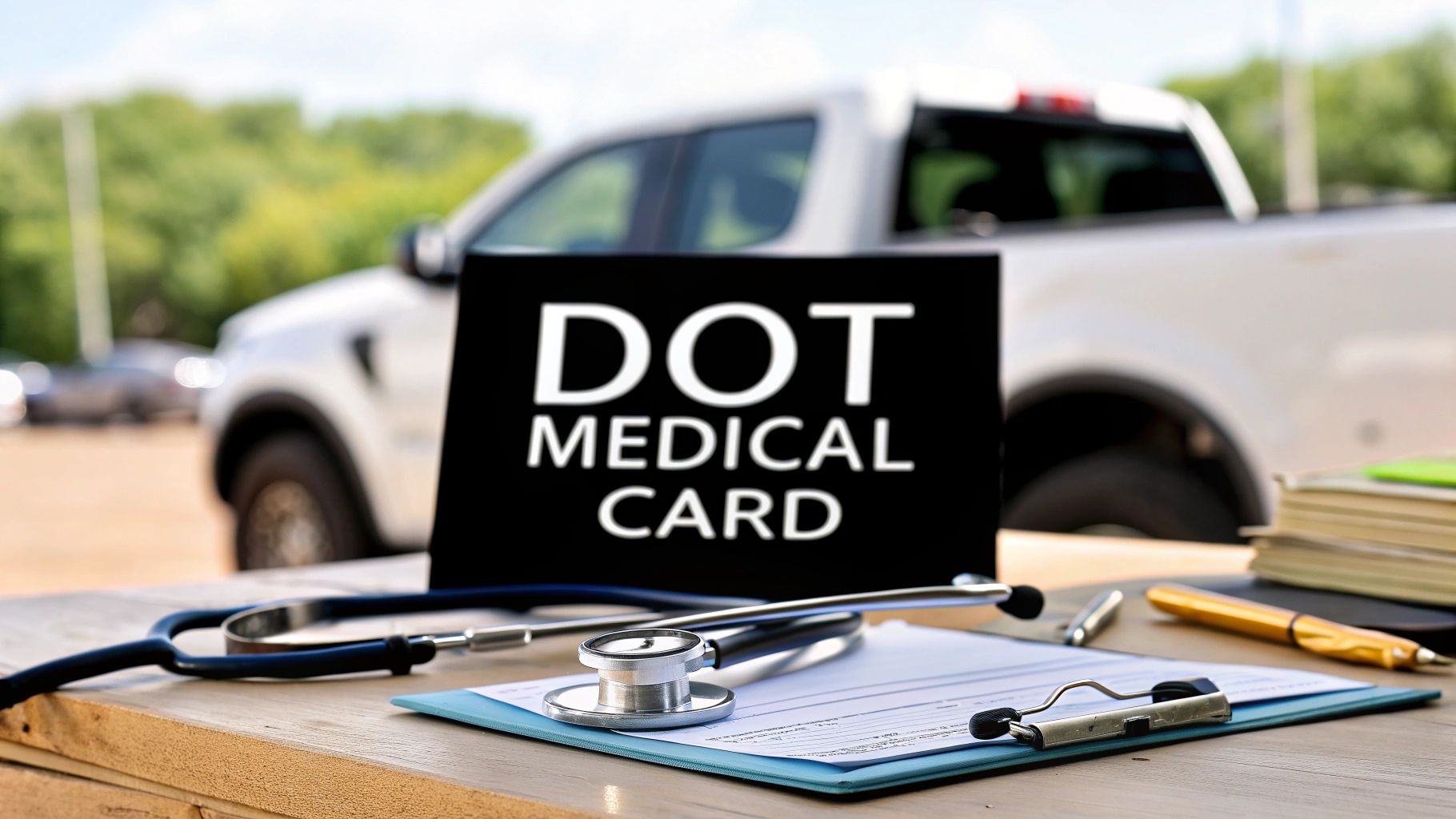
Before you can even think about getting behind the wheel of a commercial truck, you need to pass a specific physical exam and get your DOT medical card. This isn't just any check-up; it has to be done by a certified medical examiner who is officially listed on the Federal Motor Carrier Safety Administration’s (FMCSA) National Registry.
So, where do you find one? You'll typically see them at dedicated occupational health clinics, many urgent care centers, and even some clinics conveniently located at major truck stops. A quick heads-up: your regular family doctor can only do this exam if they’ve gone through the federal certification process. It's a common mistake to assume any doctor can sign off on it.
Locating a Certified DOT Medical Examiner
Knowing where to get your DOT medical card is the first real step on your CDL journey. You can't just walk into any clinic. The exam must be performed by a medical professional who knows the ins and outs of the health standards required to safely operate an 80,000-pound vehicle.
This whole process exists for one simple reason: road safety. The FMCSA made this a requirement to ensure every driver is medically fit for the job. As of 2025, there are around 22,000 certified examiners across the U.S., with another 27,000 in the pipeline. This standardization means that whether you get your exam in rural Texas or downtown Chicago, the person across the table is working from the same federal playbook.
Your Go-To Tool: The FMCSA National Registry
The absolute best way to find a certified examiner is by using the official FMCSA National Registry search tool online. Think of it as the master list—the single source of truth for every certified medical professional in the country. Just plug in your city, state, or zip code, and it will pull up a list of approved examiners nearby.
Using the registry helps you avoid a frustrating and time-wasting mistake: booking an appointment with a doctor who isn't actually authorized to issue a Medical Examiner's Certificate (MEC). Starting with the registry guarantees you're heading to the right place.
Other Smart Places to Look
While the registry is your primary search tool, it helps to know what kind of places usually have these certified examiners on staff. This can make finding a convenient spot for your physical a lot easier.
- Occupational Health and Urgent Care Clinics: These places are often a great bet. They specialize in workplace medical services, and DOT physicals are their bread and butter. Many are set up to handle walk-ins or same-day appointments, which is a huge plus.
- Truck Stop Clinics: If you’re already a driver on the road, clinics at major truck stops are incredibly convenient. You can knock out your physical during a 30-minute break or a 10-hour reset without ever leaving the lot.
- Employer-Partnered Clinics: Many trucking companies have relationships with specific medical providers. Before you book an appointment on your own, check with your employer (or a company you plan to work for). They might send you to a preferred clinic and sometimes even pick up the tab. If you need a hand navigating this, you can always contact our team for assistance.
To give you a clearer picture, here's a quick rundown of your best options for finding a certified medical examiner.
Quick Guide to Finding a DOT Medical Examiner
| Location Type | Best For | Key Tip |
|---|---|---|
| FMCSA National Registry | Every driver; it's the official starting point. | Bookmark the search page on your phone for future renewals. |
| Occupational Health Clinics | New drivers needing a scheduled appointment. | Call ahead to confirm they handle DOT physicals and ask about pricing. |
| Urgent Care Centers | Drivers needing a fast, sometimes same-day, exam. | Verify the examiner is on the National Registry before you go. |
| Truck Stop Clinics | Experienced drivers needing a renewal on the road. | Perfect for getting it done during downtime without losing miles. |
| Employer-Recommended Clinics | Company drivers or new hires. | Ask if the cost is covered by the company; you might save money. |
No matter which route you take, a little planning goes a long way. Finding the right place is the first step toward getting that medical card in hand and keeping your career in motion.
This handy visual breaks down the process of finding an examiner and getting your medical card.
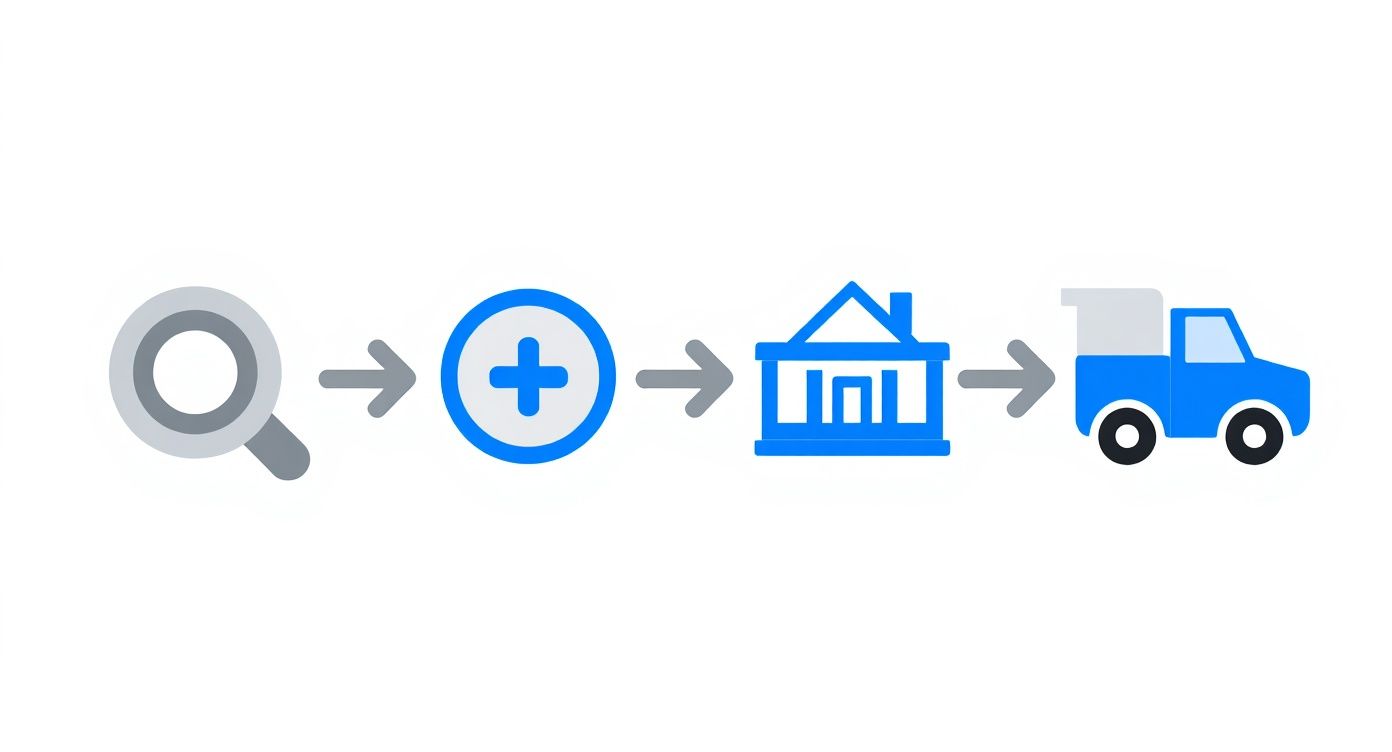
Ultimately, your search boils down to a few key actions: hitting the official registry, finding a local clinic, or stopping at a truck stop location that fits your schedule.
How to Prepare for Your DOT Physical Exam
Walking into your DOT physical unprepared is one of the easiest ways to hit a roadblock—sometimes literally. You want to give the examiner everything they need to make a quick, clear decision about your fitness to drive. Think of it as your pre-trip inspection for your own health.
It’s not just about having the right papers, either. Simple things you do in the 24 hours leading up to your exam can make a real difference in key readings like your blood pressure.
Gathering Your Essential Documents
First things first, let's talk paperwork. Showing up empty-handed is the fastest way to get turned around and told to reschedule.
At a minimum, you’ll need a valid driver’s license or another government-issued photo ID. This is non-negotiable; they have to confirm you are who you say you are.
Next, you absolutely need a complete list of every single medication you take. Don't leave anything out. Your list should have:
- The name of each medication (both prescription and over-the-counter stuff like allergy meds or vitamins)
- The dosage for each one
- The name and contact info for the doctor who prescribed it
Your medical history gives the examiner the full picture. They're not trying to be nosy; they're looking for anything that could impact your ability to safely handle a commercial vehicle. Using a standard medical history form can help you organize everything clearly.
Managing Pre-Existing Health Conditions
If you're managing an ongoing health condition, you have to prove it's under control. Being proactive here saves a ton of headaches.
For instance, if you have sleep apnea, don't just show up with your CPAP machine. You need to bring the data log from it, which usually means a printout showing at least 30 days of good, consistent use. For diabetes, bring your latest A1C lab results and a note from your specialist. And it might sound obvious, but if you wear glasses, contacts, or hearing aids, bring them! Your vision and hearing will be tested.
Having all this ready shows the examiner you're on top of your health. You should put the same effort into this as you do studying for your General Knowledge Test.
Tips for the Day of the Exam
What you do in the 24 hours before your appointment can directly affect your results, especially your blood pressure and the urinalysis. To set yourself up for success, keep these tips in mind:
- Lay off the caffeine and nicotine. Both are notorious for temporarily jacking up your blood pressure. It's tough, but skip that morning coffee or energy drink.
- Watch the salt and sugar. A big, salty meal can make you retain water and push your blood pressure numbers higher than they normally are.
- Drink water. Staying hydrated makes it much easier to provide the urine sample. Remember, this test is checking for things like sugar (a sign of diabetes), not for drugs.
Follow these simple steps, and you’ll make the whole process smoother for everyone. More importantly, you'll dramatically boost your chances of walking out with that medical card, ready to get back on the road.
What Actually Happens During the Exam
If you're heading in for your first DOT physical, it's completely normal to feel a bit anxious. But knowing what’s coming can make a world of difference. Think of it less like a regular doctor's appointment and more like a standardized safety inspection, just for you instead of your rig. The whole process is methodical and designed to ensure every driver on the road meets the same federal safety standards.
The exam really kicks off the moment you start filling out the paperwork. You’ll be handed a medical history form, and this is where honesty is crucial. Be upfront about any health conditions, previous surgeries, or medications you’re on. The examiner uses this document as a starting point to guide the rest of the physical.
The Key Health Checks
After the paperwork is sorted, the hands-on part begins. The examiner will walk you through a series of specific checks, each one directly tied to your ability to operate a commercial vehicle safely.
Here’s a quick rundown of what they’ll be looking at:
- Vision and Hearing Tests: This is a big one. You need to have at least 20/40 vision in both eyes, and it’s fine if you use glasses or contacts to get there. For hearing, you’ll need to be able to hear a "forced whisper" from a few feet away. It's all about making sure you can spot road signs and hear what's happening around your vehicle.
- Blood Pressure and Pulse Rate: The examiner is checking for high blood pressure (hypertension) or an irregular heartbeat. Both can increase the risk of a serious medical event while you’re driving, so this is a critical check.
- Urinalysis: You'll provide a simple urine sample. Let me be clear: this is not a drug test. Its purpose is to screen for underlying medical conditions, like kidney disease or diabetes, by looking for things like sugar or protein in your urine.
The Physical Examination
Next up is the general physical assessment. The examiner will do a quick but thorough head-to-toe review to spot any physical issues that might get in the way of your driving duties.
This part of the exam covers:
- General Appearance: Just an overall observation of your health.
- Eyes, Ears, and Throat: Looking for any obvious problems or abnormalities.
- Heart and Lungs: The examiner will listen to your heart for murmurs and your lungs for any breathing issues.
- Abdomen and Organs: A quick check for things like hernias or tenderness that could signal a problem.
- Spine and Extremities: They'll test your reflexes, check your grip strength, and see if you have a full range of motion.
The point of the physical exam is simple: to make sure you can safely and comfortably perform all the tasks a driver has to do. Can you turn the wheel, shift gears, and climb in and out of your truck without pain or limitation? That's what they're confirming.
At the end of the day, the medical examiner’s role is to apply the FMCSA regulations to your health. By knowing exactly what they’re looking for, you can walk into your appointment prepared and confident, ready to get that medical card and get back on the road.
Costs, Timelines, and Staying Current
Once you know where to get your DOT physical, the next logical questions are about cost, how long it's good for, and how to stay on top of renewals. Let's break down the practical side of managing your medical card.
The price tag for a DOT physical can be all over the map, usually landing somewhere between $85 and over $200. What you'll pay really comes down to where you are and the type of facility you visit. A small, independent clinic in a rural town will almost always be cheaper than a big occupational health center in a major city.
A common question I hear from new drivers is whether their company will foot the bill. For some, the answer is yes. Larger carriers often have arrangements with specific clinics and will cover the cost as part of their hiring and compliance process. If you're an owner-operator or an independent contractor, though, you should plan on paying for this out-of-pocket.
How Long Is Your Medical Card Valid?
If you're in good health and meet all the federal standards without any red flags, your DOT medical card will be valid for a maximum of 24 months. That's the best-case scenario.
However, a two-year card isn't a guarantee. The examiner has the discretion to issue a certificate for a much shorter period—say, one year, six months, or even just three months. This usually happens if you have a medical condition that needs to be watched more closely.
What kind of conditions lead to shorter certifications?
- High blood pressure (hypertension): This is a big one. An examiner might give you a temporary 3-month card and tell you to get your blood pressure down before they'll consider a longer certification.
- Diabetes: Depending on how well you manage your condition, you might be looking at an annual physical.
- Heart conditions: These almost always require a yearly evaluation to confirm your condition is stable enough for you to be behind the wheel.
With roughly 3.5 million truck drivers on the road in the U.S., this system is a critical safety measure. Every single one of them has to meet these standards to keep their commercial driving privileges. This is why any clinic you visit must have an FMCSA-certified examiner on staff, and it’s why scheduling an appointment is always a good idea.
Staying on Top of Renewals
I can't stress this enough: letting your medical card expire is a rookie mistake that can cost you dearly. If that certificate lapses, your CDL can be downgraded to a regular driver's license, and you'll be off the road and out of work until you get it sorted out.
Being proactive about your renewal isn't just a good idea—it's essential. The moment you get your new card, mark your calendar for its expiration date. Then, set a reminder for 90 days before it expires. That gives you a comfortable window to get an appointment without any last-minute panic.
Please, don't wait until the last week. If the examiner flags an issue, like a high blood pressure reading, you'll need time to see your primary doctor, get it under control, and go back for another check. Planning ahead builds in a buffer, ensuring there's no interruption to your income. This level of diligence applies to all aspects of your license, including endorsements. For drivers dealing with specific CDL requirements, like those related to automatic transmissions, staying compliant is just as crucial. You can find more information on this by checking out our E-Restriction Removal Course.
Submitting Your Certificate to the State
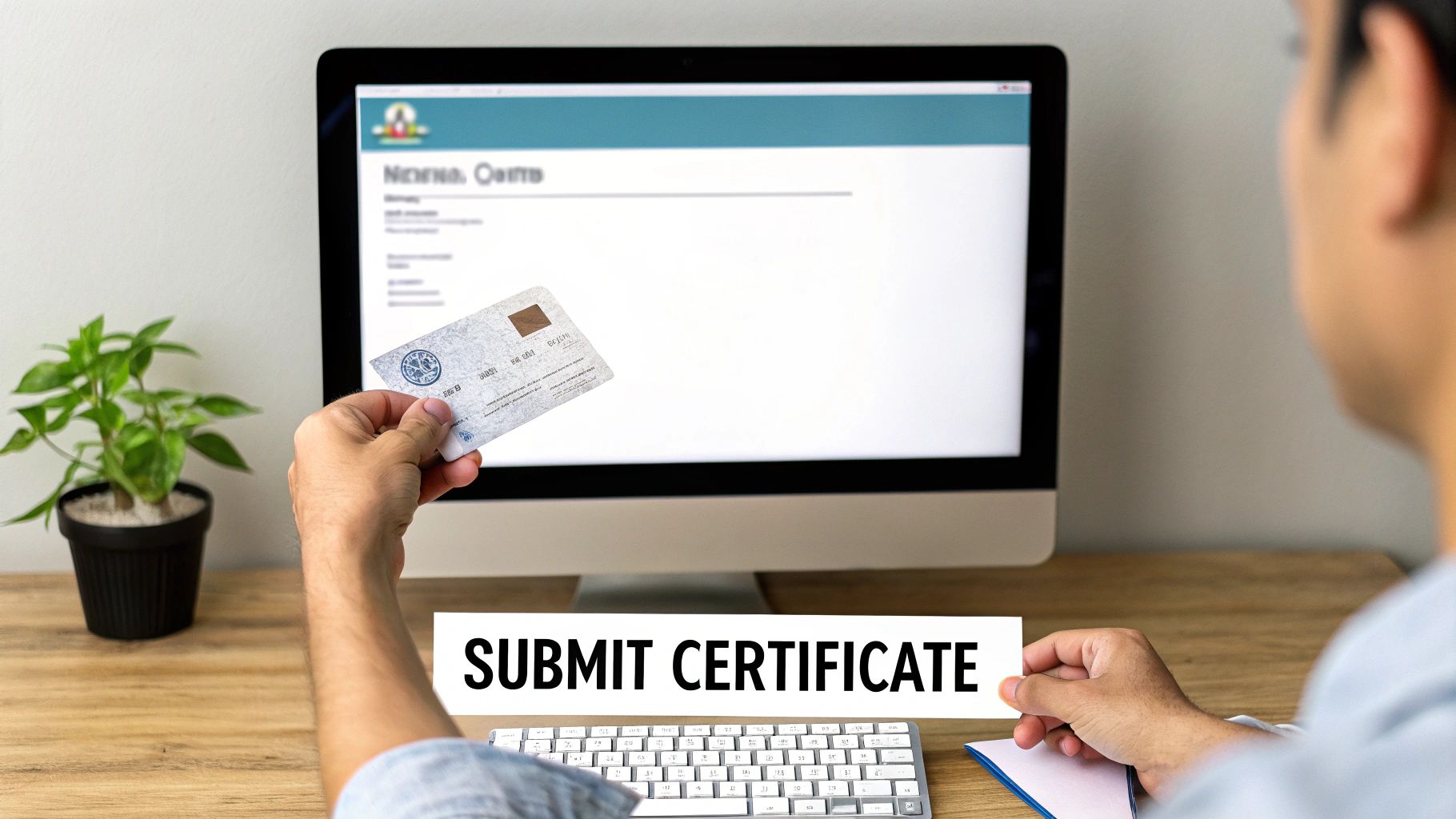
Passing your DOT physical is a huge milestone, but don't celebrate just yet—the job isn’t finished. You absolutely have to submit your new Medical Examiner's Certificate (MEC) to your State Licensing Agency (SLA). This is a critical step, and missing it can bring your driving career to a screeching halt.
Believe me, failing to submit your certificate on time is one of the most common—and completely avoidable—mistakes a driver can make. The consequences are serious. Your state can downgrade your CDL to a regular driver's license, effectively pulling you off the road until you get it all sorted out.
How State Submission Rules Differ
Here’s where things get a little tricky. Every state seems to have its own way of doing things. There's no single, nationwide method for submitting your medical card, which adds a layer of confusion to the whole process.
Some states are up-to-date with slick online portals where you can upload a digital copy in minutes. Others are still a bit old-school, requiring you to mail or fax a physical copy. A few might even make you show up in person at a local DMV. It’s on you to know exactly what your state requires.
For instance, you can find the specific requirements for CDL holders in California by checking your SLA's official website. Never just guess.
Here's a quick rundown of what you might encounter:
- Online Portals: This is usually the fastest and easiest way. You just create an account, upload a scan or a clear photo of your certificate, and you're done.
- By Mail: The classic method. If you go this route, I strongly recommend using a mailing service with tracking. That way, you have proof they received it.
- In-Person: This means a trip to the local licensing agency. It takes more time, but you get immediate confirmation that your certificate has been filed correctly.
To help clarify, here's a look at the common submission methods and what to keep in mind for each.
State Submission Methods for Medical Certificates
| Submission Method | Common Practice | Pro Tip |
|---|---|---|
| Online Portal | Uploading a scanned PDF or a clear photo of your certificate directly to the state's DMV/SLA website. | Always save the confirmation email or screenshot the confirmation page. This is your proof of submission until your record is officially updated. |
| Fax | Sending a copy of your certificate via a fax machine to a designated number provided by the SLA. | Call the SLA a day or two after faxing to confirm they received it and that it was legible. Fax quality can be notoriously poor. |
| Mailing a physical copy of your certificate to the SLA's central processing office. | Always send it via certified mail with a return receipt. It costs a few extra bucks but provides undeniable proof of delivery. | |
| In-Person | Hand-delivering your certificate to a local DMV or SLA office. | Ask for a stamped receipt or some form of written confirmation before you leave the counter. Don't walk away without it. |
Remember, your CDL is your livelihood. Taking that extra step to confirm your paperwork is filed correctly is always worth the effort.
The Shift to Electronic Verification
The good news is that this confusing patchwork of state rules is finally on its way out. The FMCSA has mandated that by June 2025, all states must switch to a fully electronic system. They'll verify your medical certification directly through your Motor Vehicle Record (MVR).
This change means that eventually, the process will be seamless. The certified medical examiner will submit your results directly to the National Registry, and your state will automatically verify your status. You won't have to physically submit the certificate yourself anymore.
However, we're not there yet. Until this system is fully up and running everywhere, you must continue to follow your state's current submission procedures perfectly. Don't just assume the examiner will handle it. Always double-check your state’s rules and submit the certificate yourself to stay compliant and keep your CDL active.
Common Questions About the DOT Medical Card
Getting your DOT medical card can bring up a lot of questions, especially if you're dealing with a specific health issue or it's your first time through the process. Let's tackle some of the most common ones we hear from drivers so you know exactly what to expect.
What Happens If I Fail My DOT Physical?
First off, don't panic. Failing a DOT physical isn't always the end of your driving career. What happens next really depends on why you failed.
If it's for something minor or a one-off issue, like a single high blood pressure reading, the examiner might give you a short-term certificate for one to three months. This gives you a grace period to see your primary doctor, get the issue under control, and come back for another check.
For more serious conditions, you can always get a second opinion from a different certified medical examiner. In some cases, the FMCSA offers exemption and waiver programs for certain disqualifying conditions—like vision loss in one eye or a history of seizures—as long as you can prove you’re not a risk on the road.
Can I Get a DOT Exam Through Telemedicine?
That’s a hard no. The FMCSA regulations are crystal clear: a DOT physical must be a hands-on, in-person examination. You just can't do it over a video call.
The examiner has to perform specific physical tasks that are impossible to do remotely. They need to:
- Listen to your heart and lungs up close with a stethoscope.
- Physically check your reflexes and coordination.
- Conduct vision and hearing tests using specialized equipment.
- Complete a full physical assessment that requires them to be in the room with you.
Any service offering a "remote" or "online" DOT physical is not legitimate. Steer clear, because the medical card you'd get from one won't be valid.
How Is a DOT Physical Different from a Regular Check-Up?
This is a really important distinction. Your annual check-up with your family doctor is all about your general wellness and long-term health. A DOT physical has a completely different goal: it’s a public safety exam.
Think of it this way: your primary doctor works for you. The Certified Medical Examiner, during your DOT physical, works for the public and the FMCSA. Their job is to answer one question: are you medically fit to safely operate an 80,000-pound vehicle according to federal rules?
The standards are black and white and non-negotiable. While your personal doctor helps you manage a condition, the CME is there to decide if that managed condition meets the strict federal guidelines for commercial driving. Understanding how this medical card fits into the broader picture is key, and you can learn more about the other CDL requirements you'll need to meet.
What if I Have a Condition Like Diabetes or Sleep Apnea?
Having a chronic condition like diabetes or sleep apnea doesn't automatically mean you'll be disqualified. It just means you have to show up to your appointment prepared. You need to bring hard proof that your condition is under control and won't interfere with your ability to drive safely.
For diabetes, you'll likely need to bring recent A1C lab results and a note from your doctor or endocrinologist. For sleep apnea, the examiner will want to see a data printout from your CPAP machine showing consistent, proper use for at least the last 30 days.
Having this documentation ready to go is non-negotiable. It shows the examiner you’re proactive about your health and serious about safety. Just like you need to understand the nuances of commercial vs personal auto insurance to protect your business, managing your health records is a core professional responsibility.
Ready to take the next step toward a rewarding career on the open road? At Patriot CDL, we guide you through every part of the process, from preparing for your permit test to mastering the skills you need to pass your CDL exam with confidence.