So, what exactly is a DOT physical? Think of it as a specialized health screening with one critical mission: to make sure you're physically up to the task of safely driving a large commercial vehicle.
This isn't your average annual check-up. The Federal Motor Carrier Safety Administration (FMCSA) requires this exam to confirm you meet the specific health standards needed to keep yourself—and everyone else on the road—safe. It's a foundational step for any professional driver.
What Is a DOT Physical and Who Needs One?
The DOT physical isn't about judging your overall fitness level or seeing if you can run a marathon. It’s about establishing a clear, federally recognized baseline of health. The goal is to ensure you can handle the unique physical and mental demands that come with operating a commercial motor vehicle (CMV).
For anyone looking to get or renew a commercial driver's license (CDL), this exam is mandatory. It's a non-negotiable part of the process, every bit as important as passing your driving skills test. To see how this medical certification fits into the bigger picture, you can check out the full list of CDL requirements.
Who Is Required to Take the Exam?
The FMCSA is very specific about who needs to pass a DOT physical. If you operate a vehicle that falls into any of these categories, you'll need to have a valid medical certificate in hand:
- Gross Vehicle Weight: The vehicle has a gross vehicle weight rating (GVWR) or gross combination weight rating (GCWR) of 10,001 pounds or more.
- Passenger Transport: It’s designed to carry more than 15 passengers (including you, the driver), even if you're not getting paid.
- Passenger Transport for Hire: It’s designed to carry more than 8 passengers (including the driver) for compensation.
- Hazardous Materials: You're hauling hazardous materials that require a placard.
The driving force behind these regulations is simple: public safety. The exam is designed to catch any medical condition that could suddenly prevent you from controlling your vehicle, heading off potential accidents before they happen.
Every commercial driver, especially professional truckers, must get a DOT physical on a regular basis. You can find more industry-specific information in helpful resources for truckers. Remember, the point isn't to push people out of the profession, but to ensure a high standard of safety for everyone on the road.
What To Expect During The Medical Examination
Walking into the exam room for your first DOT physical can be a little nerve-wracking. Even for seasoned drivers, it’s a process you have to take seriously. But once you know what’s coming, it’s a lot less intimidating. Think of it as a comprehensive safety check-up, just like the pre-trip inspection you do on your rig, but for your own health.
The whole process is a methodical series of checks designed to make sure you meet the specific health standards needed to operate a commercial vehicle safely. It kicks off with a detailed look at your medical history before the examiner gets into the hands-on physical assessments.
Sensory and Vital Sign Checks
First up, the examiner will check your senses. Your vision is critical out on the road, so they'll test to make sure you can see at least 20/40 in each eye. It doesn't matter if you need glasses or contacts to get there, as long as you meet that standard. This is non-negotiable for spotting road signs, hazards, and other vehicles with enough time to react.
Next comes a simple hearing test. The standard is being able to perceive a "forced whisper" from five feet away, with or without a hearing aid. This ensures you can hear crucial sounds like emergency sirens, another truck's horn, or unusual noises coming from your own vehicle.
It's important to know who actually needs to go through this. It's not just for long-haul truckers.
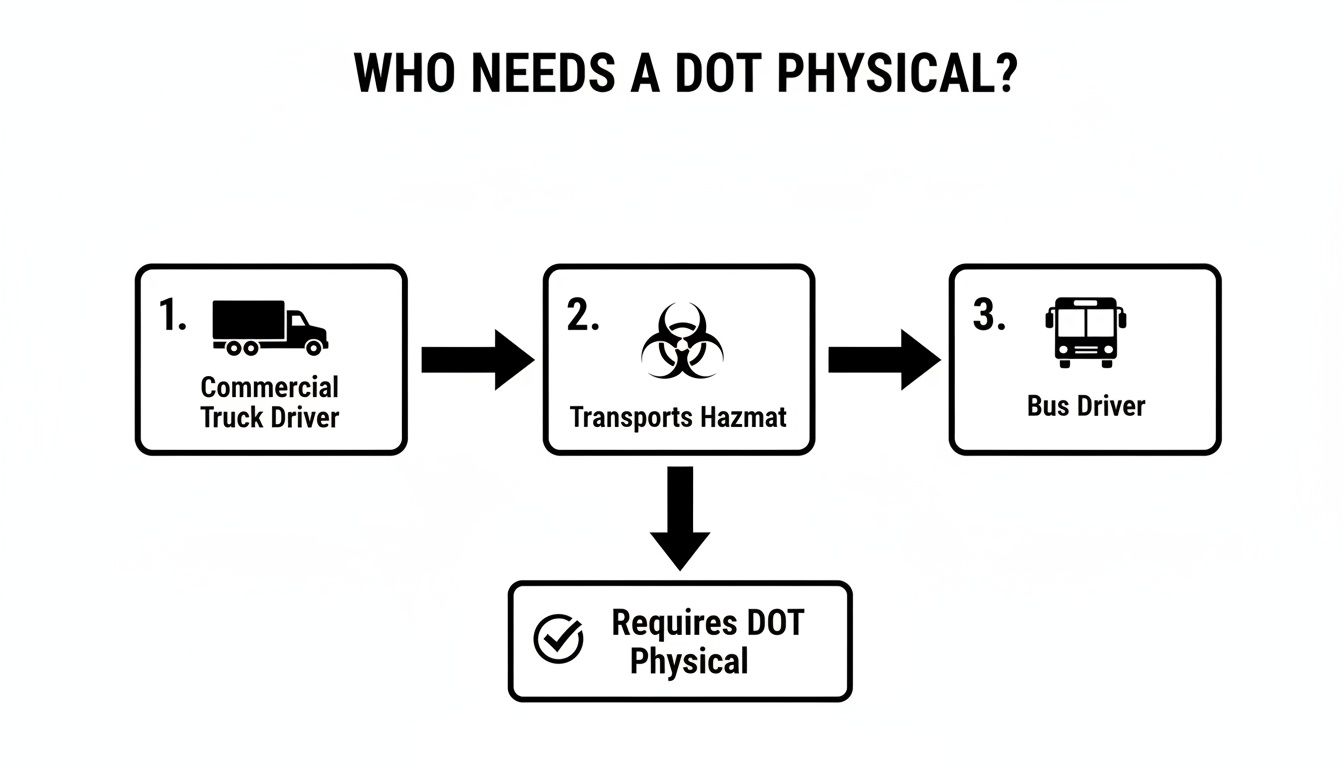
As you can see, the rules apply to a wide range of commercial drivers, from bus operators to those hauling hazardous materials, all in the name of public safety.
After the sensory tests, the focus shifts to your core health numbers. The examiner will check your blood pressure, a key indicator of your cardiovascular health. High blood pressure is a serious concern, as it raises the risk of a heart attack or stroke behind the wheel. The FMCSA has very specific cutoffs for blood pressure, and your reading will directly impact how long your medical certificate is valid for.
You'll also need to provide a urine sample. Let's clear something up right away: this is not a drug test. That’s a completely separate screening. This urinalysis is simply checking for sugar, protein, and blood, which can signal underlying conditions like diabetes or kidney disease that might interfere with your ability to drive safely.
The Hands-On Physical Assessment
With the vitals out of the way, the examiner will perform a general physical exam. They will check:
- Your Heart and Lungs: Listening for any irregular heartbeats or signs of breathing problems.
- Your Neurological Health: Testing your reflexes, balance, and coordination to ensure everything is firing correctly.
- Your Musculoskeletal System: Looking for any weakness, limb impairments, or limitations in your range of motion that could affect your ability to control a large vehicle.
To give you a clearer picture, here’s a quick summary of the key standards the examiner is checking against.
DOT Physical Exam Standards At A Glance
| Test Component | FMCSA Minimum Requirement | Purpose In Commercial Driving |
|---|---|---|
| Vision | 20/40 acuity in each eye, 70° peripheral vision | To clearly see road signs, hazards, and other vehicles |
| Hearing | Perceive a forced whisper at 5 feet (with or without aid) | To hear emergency sirens, horns, and vehicle sounds |
| Blood Pressure | Below 140/90 for a 2-year certificate | To reduce the risk of stroke or heart attack while driving |
| Urinalysis | No significant levels of protein, sugar, or blood | To screen for underlying conditions like diabetes or kidney disease |
Meeting these benchmarks is the core of what it takes to pass the physical portion of the exam.
Finalizing Your Certification
Once the exam is complete, the medical examiner pulls all the findings together on the official Medical Examination Report Form. Pay close attention here, because paperwork errors are shockingly common. One study found that examiners filled out forms incorrectly in 30% of cases! When you factor in mistakes made by drivers, a staggering 55% of exam forms had an error.
Before you walk out the door, double-check that every field is filled out correctly and that the information is accurate. If you pass, you'll be handed your DOT medical certificate, which is your ticket to legally getting behind the wheel. The process is pretty straightforward once you know the ropes, especially for students getting ready for their careers, like those looking for a DOT physical in New York as part of their training.
Don't Let a Diagnosis End Your Career: Waivers and Exemptions
Getting a tough diagnosis can feel like a career-ending blow, but it often isn't. The Federal Motor Carrier Safety Administration (FMCSA) has strict health standards for a reason—to keep everyone safe on the road. But they also know that a medical condition doesn't automatically make someone an unsafe driver.
Think of a disqualifying condition not as a permanent stop sign, but as a yellow light. It's a signal to slow down, work with your doctors, and prove that you are fit to be behind the wheel. The key isn't just having a condition; it's whether that condition is controlled.
Conditions like diabetes, certain heart problems, or epilepsy can sideline a driver if they're not managed properly. But if you can show the medical examiner that your condition is stable and under control with a doctor's help, you're often in the clear. It's all about demonstrating that you're not a risk.
So, What Are Waivers and Exemptions?
For some specific medical issues, the FMCSA has created formal programs that allow you to drive even if you don't check every single box on the standard medical form. These aren't loopholes; they are structured, official pathways for drivers in unique situations. They recognize that a one-size-fits-all rule doesn't always make sense for individual health.
Getting one of these usually means more paperwork, more frequent check-ins, and detailed reports from your specialists. The goal is to give the regulators a complete, in-depth picture of your health so they can make a decision based on your specific case, not just a general guideline.
The Skill Performance Evaluation (SPE) Program
One of the most common pathways is the Skill Performance Evaluation (SPE) certificate. This is specifically designed for drivers who have lost a limb or have an impairment of a limb but are otherwise healthy and qualified.
Think of it as a practical driving test on steroids. It’s your chance to prove that your physical limitation doesn't stop you from handling a big rig safely and professionally.
To get an SPE certificate, you’ll have to show you can master all the essential tasks, including:
- Pre-Trip Inspections: Can you get around and effectively check every part of the truck and trailer?
- Cargo Securement: Are you able to safely secure and adjust different types of loads?
- Vehicle Control: Can you confidently operate all the vehicle's controls in real-world driving situations?
For drivers who might have a physical limitation that requires them to drive an automatic, completing an E restriction removal course can be a crucial part of showing you have the skills to handle any commercial vehicle. The SPE is all about proving that your skill and experience make up for any physical difference.
The big idea behind all these programs is simple: a medical condition is only a problem if it puts the public at risk. If you can prove—with medical records and a real-world skills test—that you’re safe, you can keep your career rolling.
Your best strategy is to be prepared. Show up to your DOT physical with everything you need: recent lab results, detailed notes from your specialists, and a complete medical history. When you present an organized, well-documented case, you make the medical examiner's job easier and turn a potential career roadblock into just another bump in the road.
How To Prepare For A Successful DOT Physical
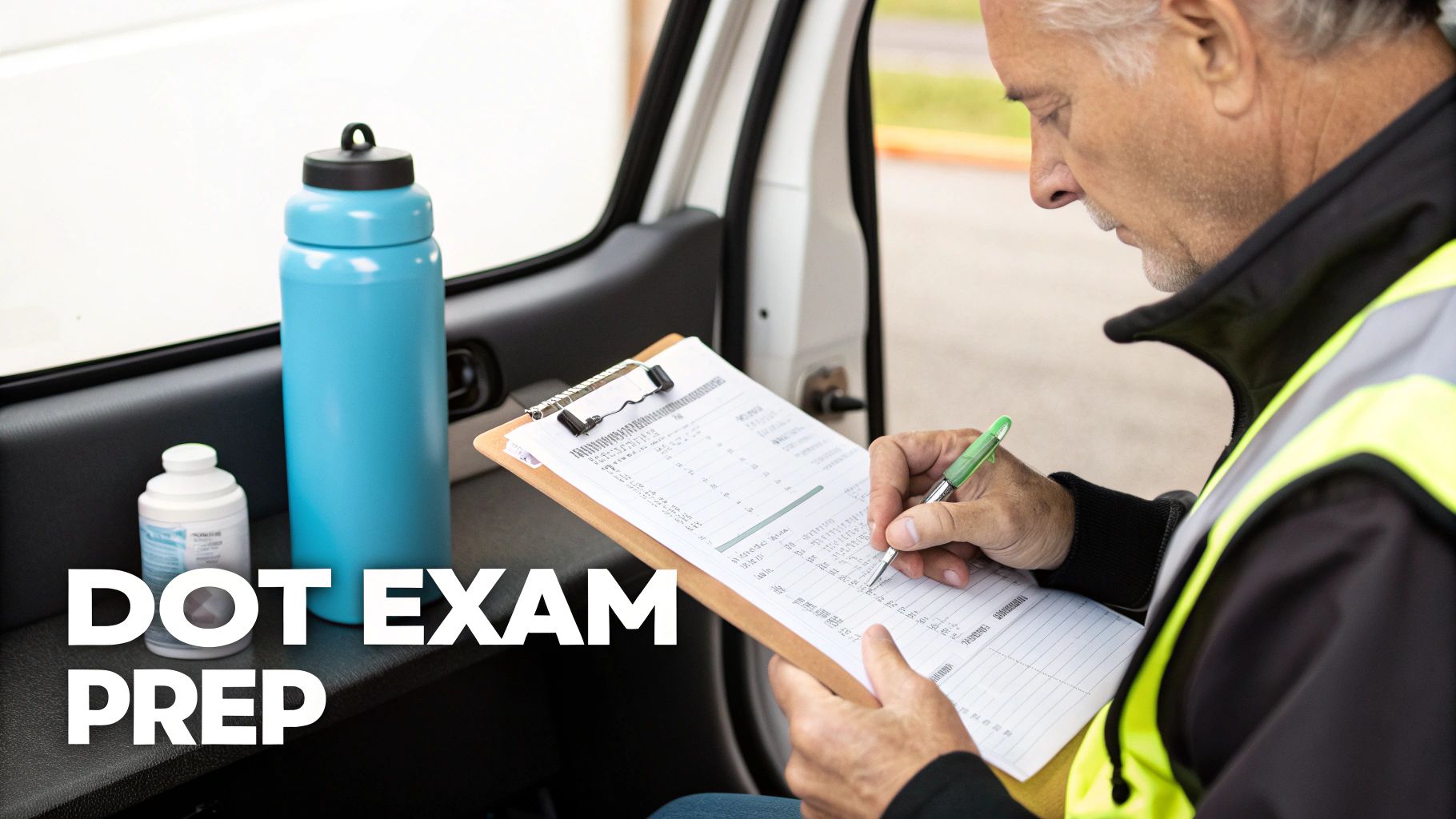
Think of your DOT physical like you would a major road trip. You wouldn't hit the highway for a long haul without giving your truck a once-over, and you shouldn’t walk into your exam without a bit of prep work. A little planning goes a long way in making sure the whole process is smooth, stress-free, and successful.
When you show up organized, it does more than just calm your own nerves; it helps the medical examiner do their job efficiently and sign off on your certification with confidence. Believe it or not, a few simple steps in the days before your appointment can make a real difference in your results.
Lifestyle Adjustments Before Your Exam
In the 24 to 48 hours leading up to your exam, focus on making a few smart choices to keep your health readings stable. High blood pressure, for example, is a common roadblock, but you can definitely take steps to keep your numbers in a good range on the day of the test.
- Limit Stimulants and Salt: Try to cut way back on coffee, energy drinks, nicotine, and salty foods. All of these can give you a temporary, and unhelpful, spike in blood pressure.
- Stay Hydrated: Drink plenty of water. Not only is it good for you, but you'll also need it for the urinalysis portion of the exam.
- Get a Good Night's Sleep: Showing up tired and stressed won't do you any favors. A solid night of rest can help you feel more relaxed and improve your overall physical state.
These aren't meant to be long-term cures, but they are smart, simple tactics to help you present the best version of yourself during the exam. Being prepared is a core skill for any professional driver, just like knowing how to do a thorough pre-trip inspection before you even turn the key.
Your Essential Paperwork Checklist
One of the most frequent causes of delays and headaches during a DOT physical is missing paperwork. Walking in with an organized folder of your medical history shows the examiner you’re serious about your health and your career.
Your goal is to give the medical examiner a complete and accurate picture of your health. Well-organized paperwork removes any guesswork and helps them confidently sign off on your medical certificate.
Before you head out the door for your appointment, double-check that you have these items with you:
- A Complete List of Medications: This isn't just the names. You need the dosage, how often you take it, and the full name and contact info for the doctor who prescribed it.
- Medical Equipment Information: If you wear glasses, contacts, or a hearing aid, bring them. If you have sleep apnea, you'll need your recent CPAP compliance report, which usually needs to show at least 30 days of use.
- Letters from Specialists: This is a big one. If you have a known condition like a heart issue, diabetes, or a neurological disorder, you must have a letter from your specialist. The letter needs to clearly state your condition is managed and you are safe to operate a commercial vehicle.
Taking care of your overall health, which includes tackling things like tobacco use, is a huge factor in a successful exam. If you’re looking to get ahead, exploring strategies for tobacco cessation can be a great move. Ultimately, being prepared—both with your health and your paperwork—is the best way to pass your DOT physical and get back to doing what you do best.
Finding A Certified Examiner And Understanding The Costs
When it's time for your DOT physical, you can't just head to any doctor's office. The exam has to be done by a healthcare professional who is specifically trained and certified by the Federal Motor Carrier Safety Administration (FMCSA). These pros are all listed on the National Registry of Certified Medical Examiners (NRCME).
This registry isn't just a list; it’s a system to make sure every examiner knows the real-world physical demands of driving a commercial vehicle and applies the same FMCSA standards across the board. Going to a certified examiner isn't just a suggestion—it's a federal rule you have to follow to get a valid medical card.

How To Find A Certified Medical Examiner
The FMCSA provides a handy online search tool that makes finding a qualified examiner in your area pretty simple. Just pop in your city, state, or zip code, and it will give you a list of every certified professional nearby. This is the best way to ensure you're booking with someone who can legally sign off on your medical certificate.
For our students who are just getting started and pursuing their CDL in California, locating a trusted examiner is one of the very first hurdles to clear before hitting the road.
What Does A DOT Physical Exam Cost?
So, you've found a few local examiners. What's this going to cost? There's no set price for a DOT physical, and the cost can swing quite a bit depending on where you live and the clinic you choose. In most places, you can expect to pay somewhere in the ballpark of $75 to $150.
Clinics in smaller towns might be on the lower end, while those in big cities could charge more. It’s always smart to call a few places on the NRCME list to shop around for the best price before you book an appointment.
A survey from the American Transportation Research Institute found that nearly 40% of drivers paid between $75 and $124 for their exam. This gives you a good idea of what most drivers are actually paying out of pocket.
That same study also looked into who's covering the cost. While plenty of drivers pay for it themselves, that’s not always the case. The research showed that about three-quarters of carriers pay for their drivers' medical certifications. On top of that, almost half of those companies send their drivers to a specific clinic. This really shows how much your company's policy can influence both the cost and where you end up going for your exam.
Your Top DOT Physical Questions Answered
Even with all the details laid out, you probably still have a few questions rolling around in your head. That's completely normal. Let's tackle some of the most common ones I hear from drivers so you can walk into your exam feeling ready and confident.
How Long Is A DOT Medical Card Good For?
For most drivers in good health, a DOT medical certificate is valid for a full 24 months. Think of it as the standard, but it's not set in stone.
The certified medical examiner (CME) has the final say. If you have a medical condition that needs a closer eye, they can issue a certificate for a shorter time. For instance, if your blood pressure is on the high side but still within the passing range, the examiner might give you a one-year or even a six-month card. This isn't a penalty; it's a practical way to ensure your condition is managed properly while keeping you safely on the road. It's a common practice for conditions like treated sleep apnea or well-managed, insulin-dependent diabetes, balancing your career with public safety.
What Happens If I Fail The DOT Physical?
Failing your DOT physical can feel like a huge setback, but it’s not the end of the road for your driving career. It’s simply a pause. It means that, right now, there's a medical issue that needs to be addressed before you can be cleared to drive a commercial vehicle.
The examiner is required to tell you exactly why you didn't pass, whether it was high blood pressure, a vision problem, or something else. Your next move is to take that information to your own doctor or a specialist. Once your condition is treated and under control, you can get the necessary paperwork from your doctor, go back to a CME, and take the exam again.
The point of a failure isn't to take you off the road for good. It's a crucial safety check designed to flag a health issue that needs your attention before you get back behind the wheel.
Does The Urine Test Screen For Drugs?
This is probably the biggest point of confusion out there. The simple answer is no—the urinalysis during a DOT physical is not a drug test. The pre-employment or random drug screens your employer requires are a completely separate thing, governed by different rules.
The urine sample you give at the physical is for a basic health screening. The examiner is only checking for three things:
- Protein: Too much can point to kidney problems.
- Blood: Could be a sign of various internal health issues.
- Sugar: This is a classic indicator of potential diabetes.
It's just a quick, non-invasive way for the examiner to get a glimpse into your overall health and spot underlying conditions that might affect your ability to drive safely.
Can I Still Pass A DOT Physical If I Have High Blood Pressure?
Absolutely. You can definitely pass the exam with high blood pressure, as long as it's managed and falls within the FMCSA's specific limits. The rules are designed to be realistic, acknowledging that hypertension is a common and treatable condition.
For example, a driver with blood pressure up to 159/99 can get a one-year medical certificate. If it's a bit higher than that, the examiner might issue a one-time, three-month certificate to give you time to get it down. However, a reading of 180/110 or higher is an automatic disqualification until you and your doctor can get it under control and into a safe range.
At Patriot CDL, we make sure our students are prepared for every part of becoming a professional driver, and that includes navigating the DOT physical. Our instructors have been through it all and provide the practical guidance you need to get your career started on the right foot.
Start Your CDL Training With Patriot CDL