Before you can get behind the wheel of a big rig, you have to prove you’re medically fit for the job. That's where the DOT CDL physical exam comes in. It’s a federally required health screening for anyone who wants to operate a commercial vehicle, and it’s all about safety—for you and everyone else on the road.
The Foundation of Your Trucking Career
Think of the DOT physical as the official green light for your professional driving career. It’s not just another doctor's visit; it’s a critical safety standard mandated by the Federal Motor Carrier Safety Administration (FMCSA). The whole point is to confirm you meet the basic health standards needed to safely handle a commercial vehicle.
This isn’t about creating hurdles. It’s about making sure every driver has the physical and mental ability to handle long hours, tough schedules, and the immense responsibility of piloting an 80,000-pound machine.
Why This Exam Is Non-Negotiable
Passing your medical evaluation is a non-negotiable part of the overall CDL requirements. It's a legal must-have to get—and keep—your commercial driver's license. If you don't have a valid medical certificate, your CDL is effectively useless, which can lead to serious fines and penalties for both you and your employer.
The exam hones in on specific health markers that directly affect your ability to drive safely. These include:
- Vision: You need sharp eyesight to spot hazards, read road signs from a distance, and navigate tricky situations. A basic vision test is standard, but if you have known issues, getting a comprehensive eye exam beforehand is a smart move.
- Hearing: Being able to hear horns, sirens, or even strange noises from your own truck is a huge part of staying aware of your surroundings.
- Blood Pressure: Uncontrolled high blood pressure is a major red flag, as it can lead to sudden, dangerous medical emergencies behind the wheel.
- Overall Physical Health: The examiner will look for any condition that could cause you to lose consciousness or lose control of your vehicle.
The DOT physical isn't meant to be a roadblock. It's a safety net for the entire industry, making sure all drivers are genuinely fit for duty.
Introducing the Medical Examiner's Certificate (MEC)
Once you pass the physical, you’ll be handed a vital document: the Medical Examiner's Certificate (MEC), which most drivers just call a "DOT medical card." This little piece of paper is your official proof that you're medically cleared to drive.
Don't just toss it in your glove box and forget it. You are legally required to have this certificate with you anytime you’re operating a commercial vehicle. You also have to submit a copy to your State Driver Licensing Agency (SDLA) to keep your CDL status up to date.
A standard MEC is good for up to 24 months. However, if you have a condition that needs monitoring, like managed high blood pressure, the medical examiner might issue a certificate for a shorter period—say, one year or even three months. Knowing what to expect in this exam is your first real step toward a long, safe, and successful career on the open road.
Getting Ready for Your DOT Physical
Walking into your DOT physical unprepared is a rookie mistake. It's one of the quickest ways to hit a roadblock, causing delays or even a temporary disqualification. A little bit of prep work can turn a stressful appointment into a routine check-up, and it all starts with having your ducks in a row.
The whole point is to give the medical examiner a clear and honest look at your health. Being transparent helps them make a confident call on your fitness to drive, which gets you cleared and back on the road without a hitch. It really just comes down to gathering a few key items.
The Paperwork You Can't Forget
Before you head out the door, grab a folder and get your documents together. This isn’t just a friendly tip; it’s essential for a smooth exam.
You absolutely have to bring these things:
- A valid driver's license: No surprises here—the examiner needs to know who you are.
- A complete list of your medications: Don't try to remember them on the spot. Write down the name of each medication, your dosage, and the name and contact info for the doctor who prescribed it.
- Your glasses, contacts, or hearing aids: If you need them to meet the standards, you have to have them with you. They'll be tested.
A driver who shows up organized and prepared immediately signals professionalism. It tells the examiner you take safety and the DOT physical process seriously.
You'll also have to fill out a detailed medical history form. Knowing what to include and how to present it can make a huge difference, so it’s worth looking at a guide on the modern medical history form beforehand. This one step can clear up potential confusion and get you through the appointment much faster.
Handling Pre-Existing Medical Conditions
This is where your preparation really counts. If you have a known medical condition, you can't just show up and expect the examiner to take your word for it. You need to bring proof that your condition is managed and won't be a risk on the road.
Forgetting your paperwork isn't a medical failure, it's a completely avoidable problem. The FMCSA gives examiners the authority to request records—medication lists, notes from specialists, recent test results—before they'll sign off on your certificate. I've seen perfectly healthy drivers get sidelined for weeks just because they didn't bring the right documents. It's no wonder medical certification issues are one of the most common roadside violations.
Here’s a quick rundown of what to bring for some common health issues:
- Heart Conditions: If you've had a heart attack, bypass surgery, or any other cardiovascular event, you need a clearance letter from your cardiologist. It should explicitly state that your condition is stable and you're safe to operate a CMV. It's also a great idea to bring recent stress test or echocardiogram results.
- Diabetes: Your latest Hemoglobin A1c (HbA1c) lab results are a must. If you use insulin, there's additional paperwork required from your doctor to show you meet the specific FMCSA protocol.
- Sleep Apnea: The number one thing you need is a compliance report from your CPAP machine. This isn't negotiable. The report must show you've been using the machine consistently for at least the last 30 days.
- High Blood Pressure: The examiner will take your blood pressure, but bringing a log of your recent home readings can be a big help. It shows you're on top of it and gives a more complete picture than a single reading in a doctor's office.
Having this documentation ready is your way of proving your condition is under control. Think of it as just another part of the process, like studying for the written exams. If you're just starting your journey, getting a handle on the requirements to get your commercial learner's permit is a great place to start.
The Day Before Your Exam
What you do in the 24 hours leading up to your physical can directly affect your results, especially your blood pressure and the urinalysis.
To give yourself the best shot, try to avoid stimulants like coffee, energy drinks, and nicotine, as they can temporarily jack up your blood pressure. Same goes for super salty or sugary foods. Get a good night's sleep, stay hydrated, and try to walk in calm and rested. This gives the examiner the most accurate snapshot of your true health.
What Happens During the Physical Exam
Knowing exactly what to expect during your DOT CDL physical exam is the best way to walk in feeling confident. The whole process is pretty straightforward, with a certified medical examiner assessing specific health markers that are directly tied to your ability to drive safely. Let's break down each component so there are no surprises on exam day.
The examiner will usually start by going over your medical history form with you before moving on to the actual physical tests. Every part of this exam is standardized by the FMCSA, ensuring every driver is evaluated against the same benchmarks, from vision and hearing to cardiovascular health.
Vision and Hearing Standards
Your eyes and ears are two of your most important tools on the road, so these tests are up first. They're quick, simple, and designed to make sure you're aware of your surroundings.
For vision, the standard is very specific: you need at least 20/40 acuity in each eye, either with or without corrective lenses. You’ll also need a peripheral vision of at least 70 degrees horizontally in each eye. The examiner will use a good old-fashioned Snellen eye chart for this.
The hearing test is just as direct. You have to be able to perceive a "forced whisper" from five feet away or less, with or without a hearing aid. This is to ensure you can hear important sounds like sirens, horns, or something going wrong with your own truck.
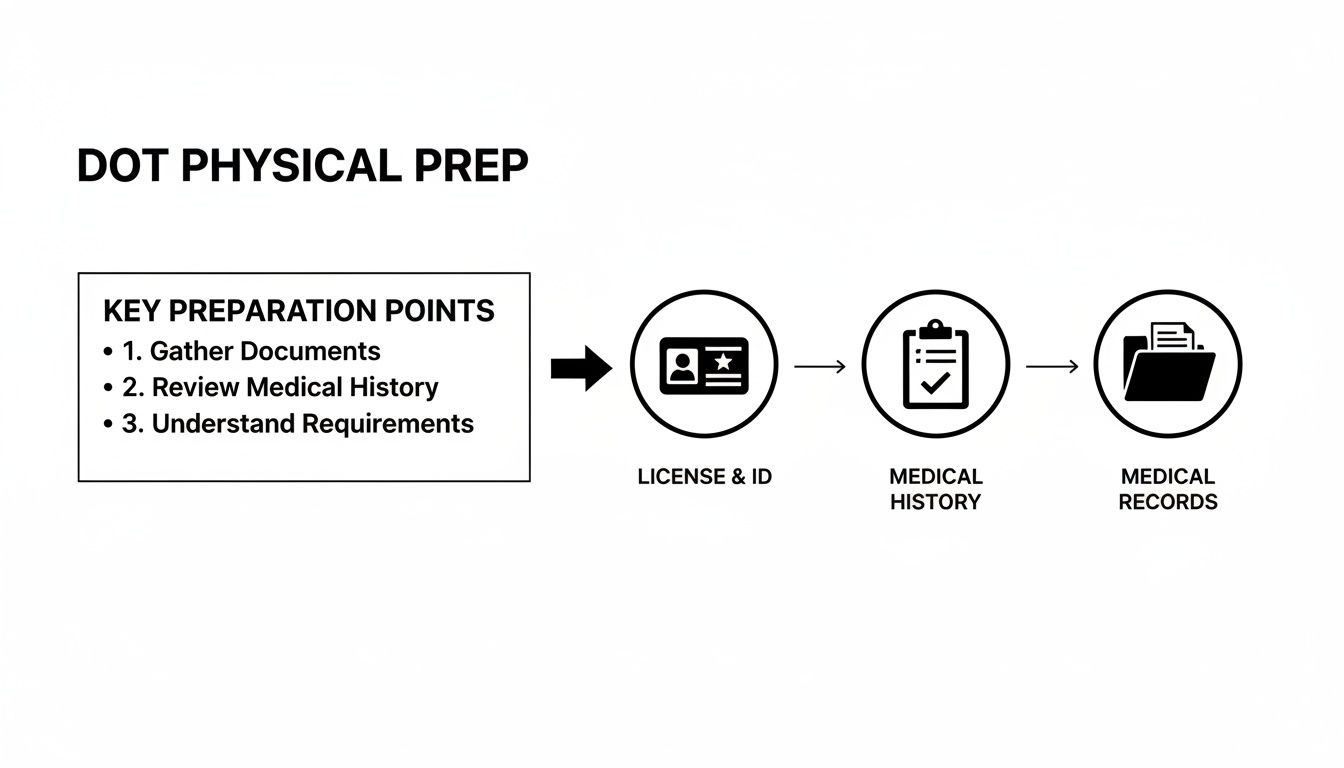
As you can see, having your license, health history, and any relevant medical records ready to go is the first step to a smooth and quick exam.
Blood Pressure and Urinalysis
Next up are your vital signs, with a big focus on blood pressure. Because uncontrolled high blood pressure is a major risk for commercial drivers, the FMCSA has set firm limits. A reading below 140/90 mmHg is what you'll need to get the standard two-year medical card.
If your reading is higher, don't panic—it doesn't automatically mean you fail. The examiner might issue a shorter certification, maybe for three or six months, to give you time to get it under control. This is exactly why walking in calm and skipping that morning coffee is such a good idea.
The urinalysis is another key part, but it's not what most people think. This isn't a drug test. The examiner is checking for things like protein, sugar, and blood in your urine, which can be early indicators of underlying problems like kidney issues or undiagnosed diabetes.
Key Components of the DOT Physical Exam
To give you a clearer picture, here’s a quick rundown of what the examiner is looking for in each part of the physical.
| Test Component | What Is Checked | FMCSA Requirement/Standard |
|---|---|---|
| Vision | Visual acuity and peripheral vision. | At least 20/40 acuity in each eye (with/without correction) and 70-degree peripheral vision. |
| Hearing | Ability to perceive whispered sounds. | Must hear a "forced whisper" at a distance of 5 feet or more (with/without hearing aid). |
| Blood Pressure | Cardiovascular health and hypertension risk. | Below 140/90 mmHg for a two-year certification. Higher readings may result in a shorter-term card. |
| Urinalysis | Kidney function and blood sugar levels. | Checks for protein, sugar, and blood, which can indicate underlying conditions like diabetes or kidney disease. |
| Neurological | Reflexes, coordination, and balance. | Must demonstrate proper neurological function to safely control a commercial vehicle. |
| Musculoskeletal | Range of motion, strength, and any impairments. | No loss of limb or impairment that interferes with driving ability. Waivers are possible. |
This table covers the main pillars of the exam, but the final step is a hands-on physical assessment to tie it all together.
The Hands-On Physical Assessment
The last part of the exam is a general physical check-up. The examiner will do a hands-on evaluation of your body's major systems. You can think of it like the detailed walk-around you do during a CDL pre-trip inspection, but for your own health.
The examiner will look over the following:
- General Appearance: Signs of fatigue, illness, or other obvious health problems.
- Eyes, Ears, Nose, and Throat: Checking for any abnormalities.
- Heart and Lungs: Listening for irregular heartbeats, murmurs, or unusual breathing sounds.
- Abdomen: Feeling for hernias or enlarged organs.
- Vascular System: Checking your pulse and looking for signs of poor circulation.
- Musculoskeletal System: Assessing for weakness, limited range of motion, or any physical issues that could make it hard to operate a truck.
- Neurological Health: Testing your reflexes, coordination, and balance.
The point of the hands-on assessment is simple: to make sure you have no physical limitations or medical conditions that would make it unsafe for you to be behind the wheel of a commercial vehicle.
Once all these pieces are complete, the examiner has a complete picture of your health. If you meet all the FMCSA standards, they'll complete the paperwork and issue your Medical Examiner's Certificate right then and there.
Common Medical Disqualifiers and How to Manage Them
Getting a concerning diagnosis doesn't mean your driving career is over. Far from it. Think of a potential red flag during your DOT CDL physical exam as a starting point for managing your health, not a dead end. Knowing the common reasons drivers get flagged—and how to get ahead of them—is the secret to staying on the road.
Most of the time, it all boils down to one thing: proving your condition is under control and won't affect your ability to drive safely. Let's walk through the most common medical hurdles and the practical steps you can take to clear them.
High Blood Pressure: The Number One Hurdle
If there’s one issue that trips up more drivers than any other, it’s high blood pressure (hypertension). The FMCSA is incredibly strict about this because a sudden spike behind the wheel could lead to a stroke or heart attack—a worst-case scenario on the highway.
Your blood pressure reading directly determines how long your medical card is valid. The guidelines are crystal clear:
- Below 140/90 mmHg: You get the full two-year certification.
- 140-159 / 90-99 mmHg: Your certificate is limited to one year.
- Over 160/100 mmHg: This results in a temporary disqualification until you can get your numbers down.
A Pro Tip: Don't panic over a single high reading. Many examiners understand that "white coat syndrome"—getting nervous in a medical setting—is real. They'll often let you sit quietly for a few minutes and then recheck it.
If your blood pressure is consistently high, it’s time to team up with your regular doctor. They can help you create a long-term plan involving medication, diet, or exercise. Proactively bringing in a log of your home blood pressure readings is a great way to show the examiner a more accurate picture of your health.
Vision and Hearing Impairments
Your eyes and ears are your first line of defense out there. The standards are firm, but luckily, failing these tests usually has a pretty simple fix.
- Vision: You need at least 20/40 vision in both eyes, with or without glasses. If you don't meet the standard, the solution is simple: see an optometrist and get a prescription for glasses or contacts. Just be sure to wear them when you drive, and you’re good to go.
- Hearing: The test is straightforward—you have to be able to hear a "forced whisper" from five feet away. If you can't, a hearing aid is a perfectly acceptable solution to meet the requirement.
These are often the easiest issues to resolve. The key is to take care of them before your exam day so you can walk in already in compliance.
Managing Diabetes and Sleep Apnea
Conditions like diabetes and sleep apnea are completely manageable, but they do require more paperwork. For both, the FMCSA’s main concern is preventing a sudden loss of consciousness, whether from a severe blood sugar event or falling asleep at the wheel.
If you have diabetes, especially if you use insulin, you'll need a clearance letter from your endocrinologist or primary doctor. You’ll also want to bring recent A1c lab results to prove your blood sugar is well-controlled and stable.
For sleep apnea, it's all about proving you're using your treatment. You must provide a CPAP compliance report showing you’ve used the machine consistently, typically for at least 30 consecutive days leading up to your exam. This report is the evidence that you’re managing your condition and reducing the risk of fatigue.
Navigating Seizure Disorders and Neurological Conditions
Any condition that could cause a sudden loss of consciousness, like epilepsy, is a major red flag. A history of seizures will disqualify you unless you have been seizure-free for a long time and are off all anti-seizure medications. This must be confirmed by a neurologist.
For other neurological issues, the decision really hinges on a specialist's opinion. You’ll need a detailed evaluation and a formal letter from your neurologist stating that your condition is stable and won't interfere with your ability to safely operate a commercial vehicle. If your physical driving abilities are impacted, it might be worth exploring options like our e-restriction removal course to adapt to different types of vehicles where applicable.
In the end, handling potential disqualifiers is about taking ownership of your health. By working with your doctors, keeping good records, and showing up to your exam prepared, you can turn a potential roadblock into proof of your fitness to drive.
What To Do After Your Exam
Passing your DOT CDL physical feels like crossing a huge hurdle, but don't spike the football just yet. The medical examiner will hand you the official Medical Examiner's Certificate (MEC)—that's your DOT medical card—but your job isn't quite finished.
Getting that certificate is only half the battle. Now you have to make it official with the state, a crucial step that, believe it or not, a lot of drivers forget.
Submitting Your Certificate to the State
Once you have your MEC, your immediate next move is to get it to your State Driver Licensing Agency (SDLA). This is what officially updates your medical status to 'certified' in the national database and ties your medical qualification directly to your commercial driver's license. If you drop the ball here, you risk having your CDL downgraded or even suspended.
How you submit it can vary a bit depending on your state, but you usually have a few choices:
- Online Portal: Most SDLAs have an online system for uploading a scan or photo of your MEC. This is almost always the quickest way to get it done.
- In-Person Visit: You can always just walk into a local DMV or licensing office and hand them the original certificate.
- Fax or Mail: A few states still allow you to submit by fax or snail mail, but these options are definitely being phased out.
Pro Tip: Before you do anything, make a copy of your MEC. Keep the original in your wallet or truck (you're required to have it with you when driving) and snap a picture of it on your phone as an extra backup.
Before sending it off, look over every single line to make sure it's filled out correctly and is easy to read. A surprising study found that a staggering 55% of commercial driver medical examination reports had mistakes or were incomplete. Don't let a simple paperwork error sideline your career.
When the Exam Doesn't Go as Planned
Failing to pass your DOT physical on the first try is a gut punch, but it’s rarely the end of the road. There are clear pathways to fix the issue and get back on track, depending on what the problem was.
For many drivers, the first step is simply getting a second opinion. You have every right to see another certified medical examiner from the National Registry. A different doctor might see things differently, especially for a borderline issue like a blood pressure reading that was just a few points too high on exam day.
Seeking Waivers and Exemptions
For certain medical conditions, the FMCSA has a formal process for getting a waiver or an exemption. These are for drivers who don't quite meet the standard requirements but can prove their condition is well-managed and they can operate a CMV safely.
Waivers are commonly pursued for conditions like:
- Vision or Hearing Issues: For when you don't meet the minimum standards but can demonstrate safe driving ability through other specialized tests.
- Seizure Disorders: A driver with a history of epilepsy might qualify for an exemption if they've been seizure-free for a long time and have clearance from their neurologist.
- Limb Impairments: Drivers with a missing or impaired limb can apply for a Skill Performance Evaluation (SPE) certificate to prove their capability.
Getting a waiver involves a lot of detailed paperwork from your specialists and a formal application. It's a serious process, but it exists to give every driver a fair shot to prove they belong behind the wheel.
If you’re just starting out and want to make sure you’re ready for every step—from the medical exam to the final skills test—getting into a structured program can make all the difference. You can explore your options and sign up for CDL training to get expert guidance right from the beginning.
Common Questions About the DOT Physical
Even after going through all the details, there are always a few specific questions that pop up when drivers are getting ready for their DOT CDL physical. Let's clear the air and tackle some of the most common ones I hear from drivers. Think of this as a quick reference to settle any last-minute jitters.
Knowing the answers to these can make all the difference, helping you walk into that exam room feeling confident instead of stressed.
How Long Is a DOT Medical Card Good For?
For a driver in good health who breezes through the exam, the medical card—officially called a Medical Examiner's Certificate (MEC)—is typically valid for a full 24 months. That's the maximum time allowed.
But it’s not always a two-year deal. If you're managing a condition like high blood pressure or diabetes, the examiner might issue a certificate for a shorter period. It's not uncommon to see one-year, six-month, or even three-month certificates. This isn't a punishment; it's a way to ensure your condition stays under control while you're on the road.
The length of your certification really comes down to your personal health. The examiner has to weigh your ability to do the job against the critical need for public safety.
Can I Use Medical Marijuana and Still Pass?
This one is a hard no. Even if you hold a valid medical marijuana card from your state, you cannot pass the DOT physical exam if you use it. This catches a lot of people by surprise.
The key thing to remember is that the Department of Transportation follows federal law, which still lists marijuana as a Schedule I drug. Any detected use of THC is an automatic disqualifier for a commercial driver. While the urinalysis during the physical is mostly for health screening (like checking for sugar in your urine), you'll also have a separate DOT drug test that screens for THC. A positive result means a failed exam, period.
What Happens If My Blood Pressure Is High on Exam Day?
First, don't panic. A good examiner knows that "white coat syndrome" is real—nerves can spike your blood pressure. They'll usually have you sit quietly for a few minutes and then take it again.
What happens next really depends on the numbers:
- Slightly Elevated (140/90 to 159/99): You'll most likely get your certificate, but probably just for one year. This is a clear signal to get your blood pressure managed before your next physical.
- Moderately High (160/100 to 179/109): In this case, you might get a temporary three-month certificate. This gives you a short window to work with your primary doctor, get on a treatment plan, and bring your numbers down before you have to come back for another check.
- Severely High (180/110 or higher): This is an immediate disqualification. It’s considered too big a risk for you to be driving commercially. You won't get certified until your blood pressure is safely under control and you can pass a re-examination.
Your best bet is to be proactive. If you know you have blood pressure issues, track it at home for a week or two and bring that log with you. It gives the examiner a much better picture of your health than a single, high-stress reading.
Do I Need a Special Doctor for the DOT Physical?
Yes, you definitely do. You can't just pop into your regular family doctor's office for a DOT physical exam, unless they happen to be specifically certified.
The exam has to be done by a medical professional who is listed on the FMCSA's National Registry of Certified Medical Examiners (NRCME). These professionals—they can be doctors (MDs, DOs), chiropractors (DCs), or advanced practice nurses (APNs)—have taken special training on FMCSA rules. They know exactly what the job demands and what health standards you need to meet. Before you book anything, make sure your examiner is on that list.
At Patriot CDL, we make sure our students are ready for every single step, and that includes the DOT medical exam. Our team guides you through all the requirements so you can stay focused on what really matters—learning the skills for a long and successful career behind the wheel. Start your training with confidence by visiting us at https://patriotcdl.com.