Let's cut right to the chase: you're probably looking at a total cost of somewhere between $3,000 and $10,000 for CDL training. This is your all-in investment to get on the road—covering tuition, must-have fees, and all the required testing. But that's a big range, right? What you'll actually pay really boils down to the type of license you're going for and the school you pick.
A Snapshot of Your Initial Investment
Think of it like buying a new truck. You could get a solid, no-frills workhorse or a top-of-the-line rig with all the bells and whistles. Both get the job done, but the price and what they can do are worlds apart. It’s the same with your CDL training; the license class you choose directly shapes the final bill.
Before we get into the nitty-gritty details, this section will give you a clear financial starting point.
Understanding Class A vs Class B Costs
The biggest factor driving the cost is the license class itself. A Class A CDL is the top-tier license that lets you operate massive combination vehicles like tractor-trailers. It's the most thorough training, so it naturally costs the most. A Class B CDL, on the other hand, is for straight trucks or buses and involves less complex training, making it a more affordable option.
Across most major US cities, you can expect the cost to get your CDL to land between $3,000 and $8,000. That number bundles tuition, exams, and other essential fees. If you're aiming for a Class A license, plan on investing $5,000 to $8,000, which covers the intensive 160+ hours of training you'll need. Class B programs are a bit easier on the wallet, typically running from $2,500 to $5,000.
Investing in a Class A license opens the door to the highest-paying jobs in the trucking industry. While the upfront cost is higher, the long-term earning potential often provides a much faster return on your investment.
To give you a clearer picture, let's look at a simple breakdown of the core expenses. Nearly every student will run into these costs, no matter which school they attend.
Estimated CDL Training Cost Breakdown
This table sums up the typical expenses you'll encounter on your way to getting licensed.
| Expense Category | Average Cost Range |
|---|---|
| School Tuition Fee | $2,500 – $8,000 |
| DOT Medical Exam | $50 – $150 |
| CLP Application Fee | $30 – $100 |
| CDL Skills Testing Fee | $100 – $350 |
| License Issuance Fee | $75 – $200 |
Keep in mind, this table covers the basics, but there’s more to the story. We'll dig deeper into what each of these costs involves in the sections ahead. If you'd like to see how these numbers apply to real-world accelerated courses, feel free to check out our CDL training program options. Getting a handle on this breakdown now helps you build a solid budget and ensures there are no surprises down the road.
Breaking Down Every Line Item of Your CDL Cost
Figuring out the total CDL training cost is a lot like budgeting for a big road trip. Your tuition is the main purchase, like buying the car itself. But you can't hit the road without also accounting for gas, tolls, insurance, and maybe a few good playlists. All those smaller costs are essential to actually reaching your destination.
Think of tuition as your core investment. It's the biggest number on the page and pays for the fundamentals: the instructor’s time and expertise, the use of their trucks for training, and access to the practice yard. Essentially, tuition is your all-access pass to the knowledge and hands-on experience you need to get licensed.
Your Core Investment: Tuition and Training
Your tuition fee is the workhorse of your budget, covering everything from classroom theory to the hours you'll spend behind the wheel. In the classroom, you’ll dig into the rules of the road, critical safety protocols, and how to properly log your hours—all foundational knowledge for passing the written part of your CDL exam.
But let's be honest, the real magic happens in the driver's seat. The hands-on training is where your investment truly pays off. You'll spend hours on a closed course, nailing maneuvers like straight-line backing, offset backing, and parallel parking. From there, you'll graduate to public roads with an instructor guiding you through shifting, turning, and navigating real-world traffic. That behind-the-wheel time is what builds confidence and competence.
This chart gives you a clear visual on how these costs typically stack up based on the license you're going for.
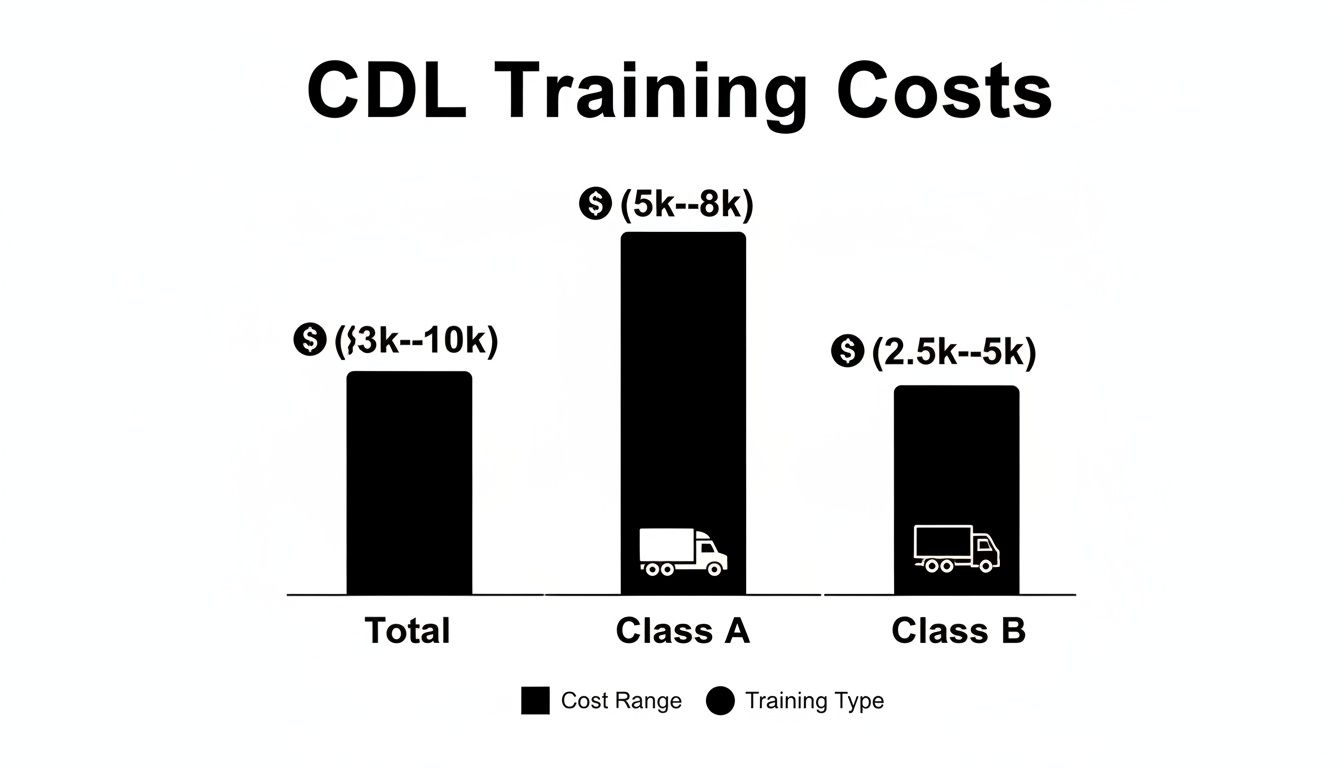
As you can see, the investment for a Class A license is higher. That's because it reflects the more intensive training needed to safely operate the biggest and most complex rigs on the road.
The Ancillary Costs You Can't Ignore
Beyond the big tuition number, there's a checklist of smaller, mandatory fees needed to complete your licensing. They might seem minor on their own, but they absolutely add up. Budgeting for them from the start is key to avoiding any last-minute financial surprises.
Here are the non-negotiables every future driver needs to plan for:
- DOT Medical Exam: Before you can even touch a steering wheel, you need a certified medical examiner to give you the green light, ensuring you’re physically up for the job. This usually costs between $50 and $150.
- Commercial Learner’s Permit (CLP) Application: This is your official "student driver" pass for a commercial vehicle. The state application fee typically runs between $30 and $100. Our guide on how to get your CDL permit walks you through this crucial first step.
- Skills Testing Fee: Once your training is complete, you'll pay a fee to take the official road test. Depending on your state and the testing facility, this can range from $100 to $350.
- License Issuance Fee: After you pass the test—congratulations!—the DMV will charge a final fee to print and issue your official CDL. Expect this to be between $75 and $200.
Forgetting to budget for these smaller fees is one of the most common mistakes new students make. Planning for them upfront keeps you on a smooth path from the classroom to the open road without hitting any financial speed bumps.
Factoring in Endorsements and Extra Fees
Finally, don't forget to account for any special endorsements you plan to add. These certifications are your ticket to more job opportunities and, often, higher pay.
For instance, the Hazmat (H) endorsement requires a separate test and a full TSA background check, which can add $80 to $120 to your total. Other valuable add-ons like Tanker (N) or Doubles/Triples (T) also have their own testing fees. By mapping out every single line item, from tuition to endorsements, you get a complete financial picture that makes your budget just as road-ready as you are.
Why CDL School Costs Vary So Much
You’ve probably noticed that the price tag for CDL training isn't a simple, flat number. It's a lot like buying a car—a basic sedan and a top-of-the-line pickup truck will both get you down the road, but their prices reflect vastly different features and capabilities. The same idea applies to trucking schools. The final cost you pay is a mix of several important variables.
Getting a handle on these factors is key. It helps you see beyond the initial sticker price and figure out which program truly offers the best value for your career goals and your wallet. Everything from the type of school you pick to its zip code plays a part in your total investment.
Private Schools vs. Community Colleges
One of the biggest forks in the road is choosing between a private truck driving school and a local community college. They operate very differently, and that has a direct impact on tuition.
Private schools are all about speed. They run accelerated programs designed to get you licensed and earning a paycheck in just a few weeks. This is perfect if you're changing careers and can't afford a long break from working. They usually offer flexible scheduling, smaller classes, and a curriculum that’s laser-focused on getting you passed and hired.
Community college programs, on the other hand, follow a more traditional semester schedule. They move at a slower pace, but this often makes them a more budget-friendly option. Plus, you might even earn some college credits while you're at it.
The trade-off is pretty straightforward. A fast-track private school might run you anywhere from $5,000 to $10,000, with the more intensive Class A programs on the higher end of that scale. In contrast, a public community college might bring that cost down to around $3,000 to $5,750. Their $5,750 Class A program, for example, covers 160 hours, all your tests, and even throws in a Hazmat endorsement.
The choice between a private school and a community college really boils down to your personal timeline and budget. An accelerated private program is an investment in getting on the road faster, while a community college offers a lower upfront cost at a more relaxed pace.
Location and Program Length
You might be surprised by how much geography affects tuition. A CDL school in a bustling city with a high cost of living is almost guaranteed to be more expensive than one in a small, rural town. That's just a reality of their own operational costs—things like rent, instructor pay, and even the price of fuel are higher.
The length and depth of the training also move the needle on price. A bare-bones course that teaches just enough to meet the minimum state requirements will be your cheapest bet. But more comprehensive programs—the ones that offer extra hours behind the wheel, advanced skills training, or prep for special endorsements—will naturally cost more. More training time means more fuel burned and more hours for the instructors, and that gets reflected in the tuition.
The Impact of License Class
As we've mentioned, the single biggest factor dictating your CDL training cost is the type of license you're going for. A Class B license, which lets you operate vehicles like dump trucks or school buses, involves less complex training and is the more economical route.
The Class A license, however, is the undisputed king of the road. Getting one requires in-depth training to master everything that comes with handling a full tractor-trailer. We're talking about complex backing maneuvers, coupling and uncoupling, and navigating tricky city streets. This kind of intensive instruction demands more time, more fuel, and more direct guidance from instructors, making it the biggest investment.
Before you commit, it’s always a smart move to make sure you tick all the boxes. You can get the full rundown by checking out our guide on CDL requirements to see exactly what’s needed.
When you start looking at schools, it helps to understand how these different pieces—school type, location, program depth, and license class—all fit together. The table below breaks it down to give you a clearer picture.
How Different Factors Impact CDL Training Costs
| Factor | Lower Cost Option | Higher Cost Option | Typical Price Impact |
|---|---|---|---|
| School Type | Community College | Private Trucking School | $2,000 – $5,000 difference |
| Location | Rural or Low-Cost-of-Living Area | Major Metropolitan Area | $1,000 – $3,000 difference |
| Program Choice | Class B License / Basic Training | Class A License / Advanced Training | $3,000 – $7,000 difference |
By keeping these variables in mind, you can compare programs more strategically and find the one that truly aligns with both your financial situation and your career ambitions.
Smart Ways to Pay for Your CDL Training
So, you've seen the price tag for CDL school and you're wondering how to make it happen. Let's talk about that. The initial number can seem daunting, but it’s crucial to see it as an investment, not a roadblock. Thousands of drivers have been in your exact shoes, and they found a way forward by tapping into the smart funding solutions available.
Think of it this way: the trucking industry needs drivers, and companies are willing to help you get behind the wheel. From employer-paid programs to government grants, there are more pathways to an affordable CDL than you might think. The key is knowing where to look.
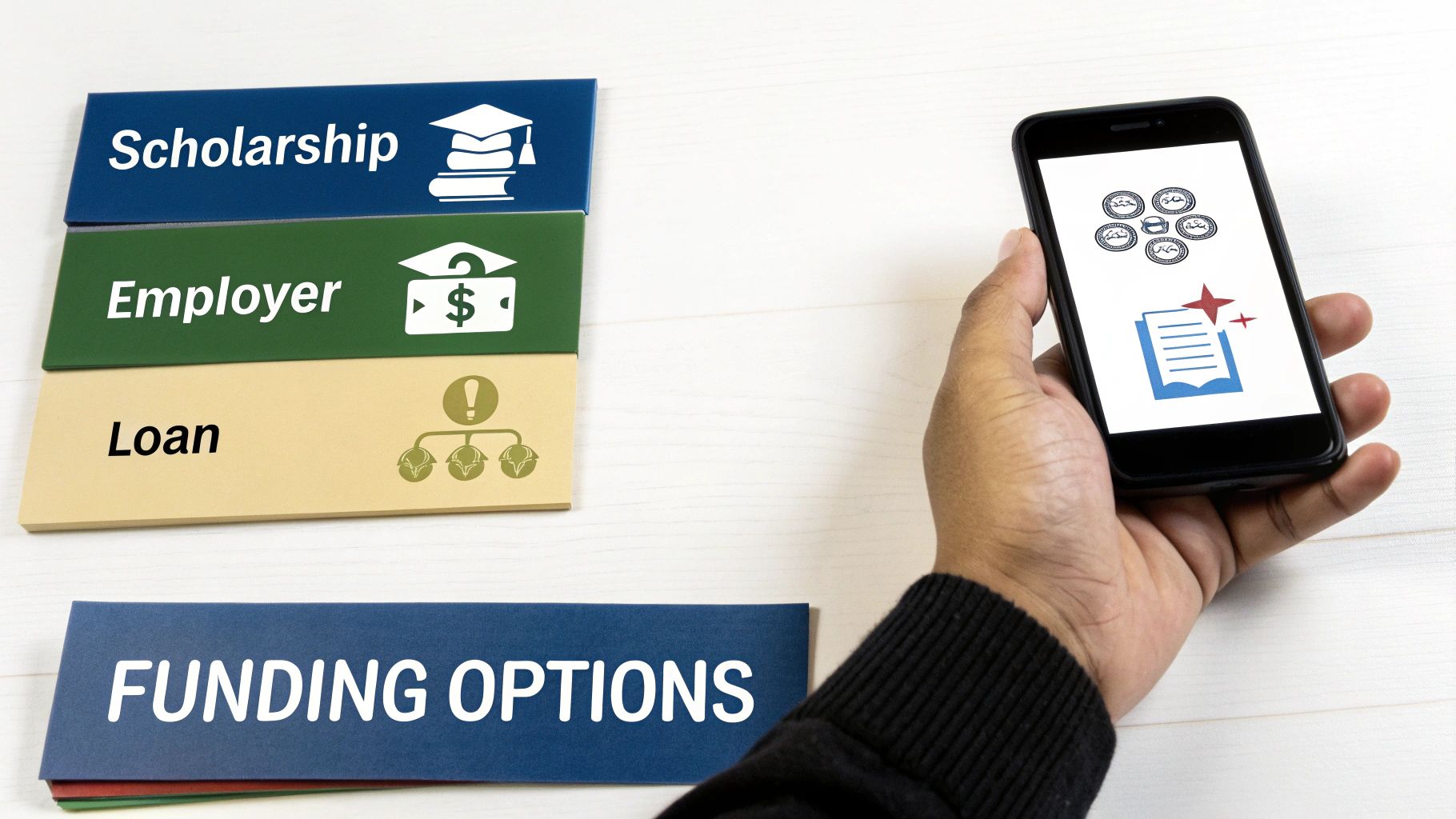
Company-Sponsored Training and Tuition Reimbursement
One of the most popular routes is to let a trucking company pay your way. Many of the big carriers are so hungry for qualified drivers that they’ll cover your training costs upfront. This is often called company-sponsored training.
How does it work? A company pays for your school in exchange for you agreeing to drive for them for a set period, usually about a year. It's a fantastic trade-off: you get your license with little to no money out of your pocket, and they get a skilled, committed driver.
Another great option is tuition reimbursement. With this setup, you pay for school initially, but once you graduate and start working, your new employer pays you back. This usually comes as an extra amount added to your monthly paychecks until your tuition is fully covered.
Grants, Scholarships, and Veteran Benefits
Beyond what companies offer, there's a lot of "free money" out there if you do a little digging. These options don't require repayment or a work contract, which makes them incredibly valuable.
- Workforce Innovation and Opportunity Act (WIOA): This is a federal program designed to get people into high-demand jobs. If you're unemployed or meet certain income criteria, WIOA grants can cover up to 100% of your CDL tuition. It's a game-changer.
- Trucking Scholarships: You'd be surprised how many industry groups and private companies offer scholarships just for CDL students. A bit of online research can turn up all sorts of opportunities based on your background or where you live.
- GI Bill® for Veterans: If you're a veteran, your GI Bill® benefits are a powerful tool. Most reputable truck driving schools are approved to accept these funds, which can make your transition to a civilian trucking career incredibly smooth.
I can't stress this enough: government grants and veteran benefits are some of the most underused resources out there. Taking an afternoon to check your eligibility can completely change the financial picture for getting your CDL.
It’s worth noting that since the ELDT regulations took effect in 2022, training costs have ticked up by about 12%. In response, an estimated 65% of students now use financing, grants, or company sponsorships that cover anywhere from 50-100% of the total cost.
Personal Loans and In-House Payment Plans
If sponsorships or grants don't pan out, financing is a perfectly good path forward. Many schools have relationships with lenders who specialize in loans for career training. These lenders get the industry and often set up repayment plans that don't even start until after you're working and earning a steady paycheck.
Some schools also offer their own in-house payment plans. This is a simple way to break the total cost into smaller, monthly installments that you pay while you're in the course. It helps you spread out the expense without needing an outside loan.
Exploring these different strategies is a big part of the journey. For more tips and industry insights, check out the articles on the Patriot CDL blog. By mixing and matching these options, you can build a solid plan that makes your new career a reality.
Calculating Your Return on a CDL Investment
Let's shift gears and stop thinking about CDL training cost as just another bill to pay. Think of it as a serious investment in a career that's always in demand. And like any good investment, the real question is about the return—how fast does that money you put in start coming back to you as cold, hard cash?
The great news for aspiring truckers is that the payback can be incredibly quick.
Once that CDL is in your hand, you've got the golden ticket to a job market that desperately needs skilled drivers. This isn't a career where you have to grind for years to see a decent paycheck. Many new drivers start bringing in solid money almost right away, putting them on the fast track to financial stability.
What Can New Drivers Expect to Earn?
Of course, your first-year salary will depend on the company you drive for, the routes you run, and where you're based. Still, it's realistic for a brand new commercial driver to start somewhere in the $50,000 to $70,000 range per year. That strong starting pay is a huge part of what makes this profession so appealing.
But that’s just the starting line. Your earning potential doesn't stop there.
After a year or two of safe driving, your income can take a significant leap. It’s common for experienced drivers, especially those who add valuable endorsements like Hazmat or Tanker, to earn $75,000 to $90,000 or even more. The more skills you add to your toolkit, the more you're worth.
Your CDL isn't just a license; it's a powerful tool for financial leverage. The initial training cost is a short-term hurdle that unlocks a long-term career with consistent, scalable income potential.
Figuring Out Your Personal Payback Period
So, how quickly can you actually earn back what you spent on school? It's pretty simple to figure out. Your "payback period" is just the amount of time it takes for your new income to completely cover your training expenses.
Let’s run the numbers. Imagine your all-in training cost was $7,000. If you land a starting job paying $55,000 a year, that breaks down to about $4,583 a month before taxes. Even after paying your regular bills, you can see how a focused driver could pay off that training loan in just a few months—often within the first half-year of working.
Here’s a simple way to map it out for yourself:
- Total Training Cost: Add up everything—tuition, fees, exams, the works.
- Estimate Your Starting Income: Do a little research on what entry-level drivers are making in your area for the kind of trucking you want to do.
- Calculate Your Discretionary Income: Be realistic about how much of each paycheck you can put toward paying off that initial investment.
For instance, if you can comfortably set aside $1,000 per month from your new salary, you'd have a $7,000 program paid off in just seven months. This lightning-fast return is one of the most powerful financial arguments for getting into trucking.
The Long-Term Value of a CDL
Looking past that quick payback, the long-term value is just as impressive. A CDL gives you a level of job security that's hard to find these days. Our economy simply doesn't function without trucks, which means good drivers are always going to have a job. You can get a deeper look into the process in our article explaining how to get a CDL in Pennsylvania.
This career gives you a solid financial foundation without needing a four-year college degree and the mountain of debt that often comes with it. As you rack up miles and experience, you open the door to better pay, better routes, and more specialized jobs. That initial CDL training cost isn't just a fee for a class; it's your entry ticket to a durable, well-paying profession for life.
Got Questions About CDL Training Costs? We've Got Answers.
When you're looking at getting your CDL, the money side of things can feel a little overwhelming. Let's clear up some of the most common questions we hear from folks just starting out. No fluff, just straight-up answers to help you map out your financial plan.
Getting these details sorted out now means you can move forward confidently, ready for every step of your new career in trucking.
Can You Really Get Your CDL for Free?
The short answer is yes, you can, but it’s not exactly a free lunch. What people are usually talking about here are company-sponsored programs. Big trucking companies are always on the hunt for good drivers, so they'll foot the bill for your CDL school to bring new talent into their ranks.
Here's how it works: a carrier pays your CDL training cost from start to finish. In return, you sign a contract agreeing to drive for them for a set amount of time, usually about a year. It's a fantastic route if you're ready to commit to a company right out of the gate. You walk away with a license, a job, and zero tuition debt.
You're essentially trading an upfront payment for a commitment. The company invests in you, and you pay them back with your time and loyalty on the road. It's one of the most powerful ways to break into the industry without draining your savings.
This is the perfect setup for anyone who wants a job waiting for them the second they graduate. It takes the financial stress off the table and gives you a clear path from day one.
What Are the "Hidden" Costs I Should Budget For?
Tuition covers the big stuff, but there are always a few smaller, non-negotiable fees that can sneak up on you if you’re not ready. Think of these as the essential extras you'll have to pay for to get your official license. They aren't part of your school bill, but you can't get on the road without them.
Here are the most common things you’ll need to have cash set aside for:
- DOT Medical Exam & Drug Screening: Every single driver has to get a physical and pass a drug test with a certified medical examiner. Plan on this costing somewhere between $50 and $150.
- Permit and Licensing Fees: The DMV has its own set of fees for issuing your Commercial Learner's Permit (CLP) and then the actual CDL. This can add another $100 to $300 to your total bill.
- Endorsement Testing Fees: Want to haul liquids, hazardous materials, or double trailers? Each endorsement like Hazmat (H), Tanker (N), or Doubles/Triples (T) has its own testing fee. The Hazmat endorsement also requires a federal background check, which will run you about $80 to $120.
- Retesting Fees: Hey, it happens. Not everyone aces every test on the first try. It’s smart to have a little buffer in your budget for a potential re-do, which can cost anywhere from $50 to $250 per attempt.
Every student has to cover these costs. Building them into your budget from the get-go makes the whole process a lot less stressful.
How Fast Can I Pay Back My Investment?
This is where a career in trucking really shines. Unlike a four-year college degree that can saddle you with debt for a decade, you can pay back your entire CDL training cost incredibly fast—often within your first year on the job.
Let's run some simple numbers. Say your all-in training cost is $7,000. You land a first-year driving job paying $60,000, which breaks down to $5,000 a month before taxes. Even after covering all your bills, it's very realistic for a new driver to put $1,000 a month toward that initial investment. At that pace, you're debt-free in just seven months.
This quick payback is a direct result of the great starting pay and the massive demand for drivers. Your CDL isn't just a piece of plastic; it's a powerful tool that starts making you serious money right away. It's one of the smartest financial moves you can make for your future.
Ready to invest in a career with a fast and powerful return? At Patriot CDL, we offer accelerated programs designed to get you on the road and earning quickly. Find out more about our training options and start your journey today. Visit us at https://patriotcdl.com.