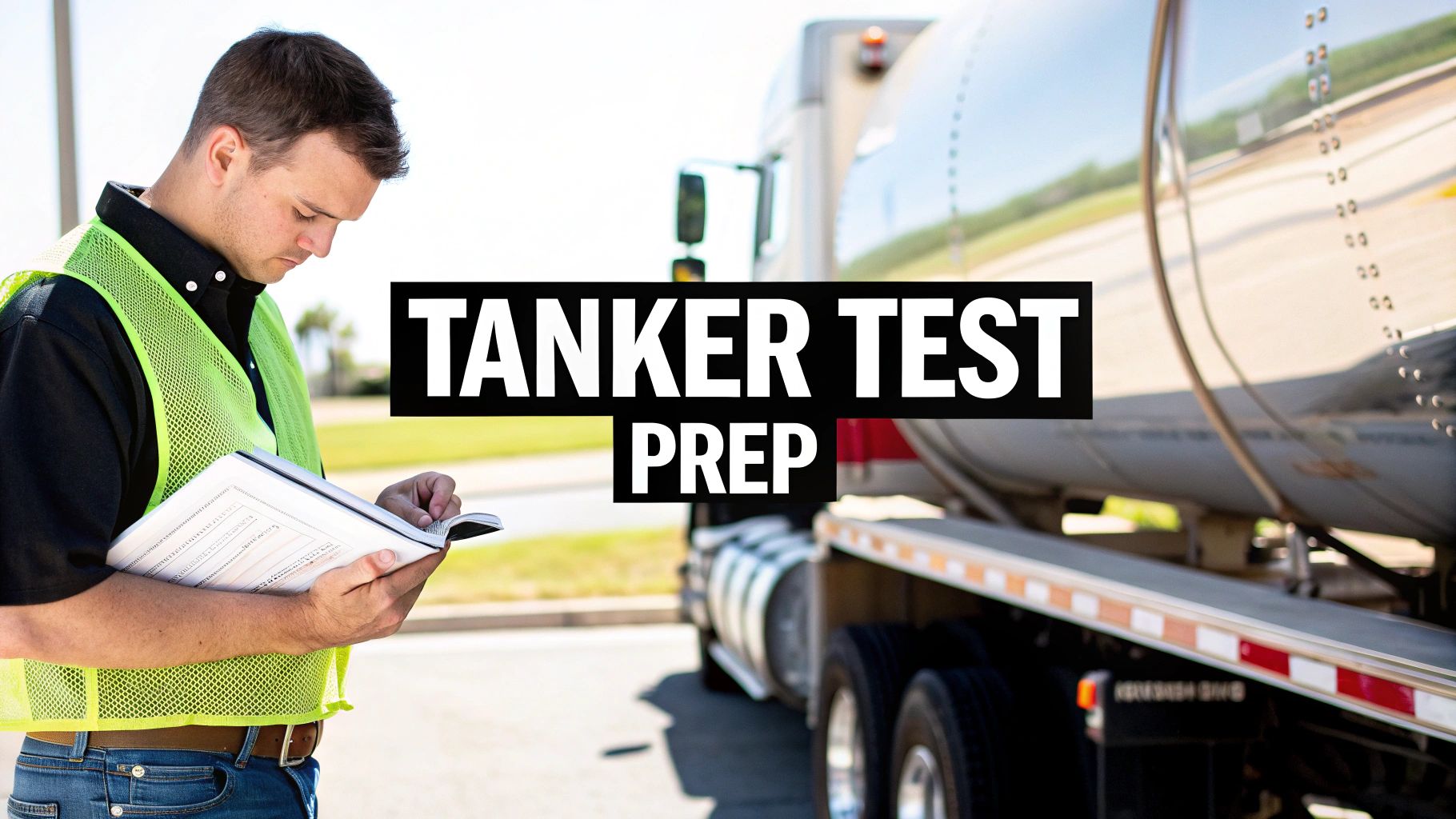
Getting ready for your exam with a solid CDL practice test for tanker endorsement is your first real step toward a more secure and much more profitable driving career. Earning that 'N' endorsement opens up specialized, high-demand jobs that frankly, most drivers aren't qualified for. That instantly makes you a more valuable asset in the industry.
Why a Tanker Endorsement Is a Smart Career Move
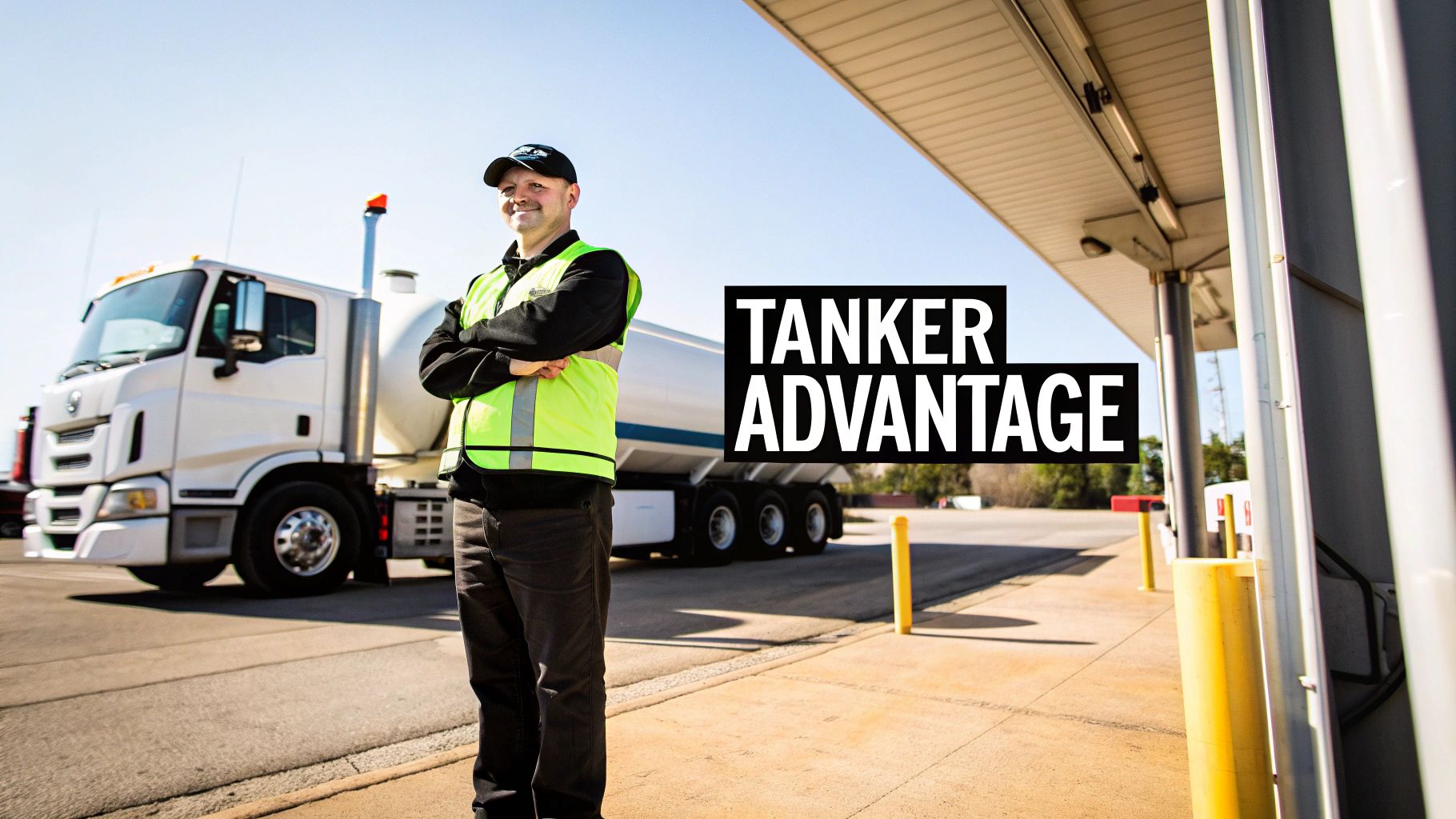
Before you even crack open a study guide or start answering practice questions, let's talk about why this endorsement is such a big deal. Securing the 'N' endorsement on your Commercial Driver's License isn't just about adding a letter to your ID. It's a strategic move for your future that pays off in better paychecks, more stability, and a wider range of career choices.
Think of it like this: a standard Class A or B license gets your foot in the door of the trucking world. But specialized endorsements? That's what makes you stand out from the crowd. The tanker endorsement is one of the most respected because it proves you have the skills to handle the unique physics and safety challenges of hauling bulk liquids.
Unlocking Higher Pay and Job Security
The most obvious benefit is the money. Let's be real, that's a huge motivator. With a tanker endorsement, you suddenly qualify for some of the best-paying gigs in trucking. Drivers who haul liquids—whether it's fuel, chemicals, or even milk—are in high demand because so few CDL holders have the 'N' on their license.
Take a look at how the numbers stack up. It’s a pretty clear picture.
Tanker Endorsement Salary Potential vs Standard CDL
| Driver Type | Average Annual Salary Range | Average Hourly Rate |
|---|---|---|
| Tanker Endorsed Driver | $75,000 – $106,250 | $36 – $51 |
| Standard CDL Driver | $48,000 – $65,000 | $23 – $31 |
As you can see, tanker pros can pull in between $75,000 and $106,250 a year, which blows the national average CDL salary of around $54,518 out of the water. To get there, you've got to pass a tough written knowledge test covering everything from safe loading procedures to managing leaks—skills that good training programs drill into you.
This high demand also means incredible job security. The industries that need tanker drivers—agriculture, energy, manufacturing, food production—are the backbone of the economy. They need qualified drivers all year long, which makes tanker hauling one of the most recession-proof jobs in the entire trucking industry.
The Responsibility of Specialized Cargo
Hauling a tanker means you're trusted with sensitive, and often critical, cargo. Your job becomes about much more than just getting from Point A to Point B. You could be responsible for:
- Fuels: Gasoline, diesel, and jet fuel that keep our country moving.
- Food-Grade Liquids: Milk, juice, corn syrup, and oils that line our grocery store shelves.
- Industrial Chemicals: Critical materials for manufacturing, farming, and water treatment.
- Pressurized Gases: Things like propane or liquid nitrogen that demand absolute precision and care.
Every type of liquid has its own quirks. You have to understand the physics of "slosh" or liquid surge in a half-full tank, master complex loading and unloading protocols, and maintain strict DOT compliance. Knowing this stuff makes you a high-value professional, not just another driver on the road.
A tanker endorsement is more than a certification; it's a declaration of expertise. It tells employers you can handle the dynamic forces of liquid cargo, manage complex equipment, and operate with a superior level of safety awareness.
At the end of the day, studying for this test is about more than just passing. It's about laying the groundwork for a career that offers financial stability, professional respect, and the satisfaction of playing a vital role in our nation's supply chain. This endorsement is your ticket to becoming an elite driver in a field that will always need your unique skills.
Breaking Down the Tanker Endorsement Exam
Before you even start studying, it's crucial to understand why this test exists. The tanker endorsement exam isn't some arbitrary hurdle designed to make your life difficult. It’s a very practical test built to make sure you can handle the unique—and often dangerous—challenges that come with hauling thousands of gallons of liquid. Once you get that, your whole approach to studying will change.
Forget about just memorizing facts and figures. The real goal here is to get a solid grip on the safety principles that drive every single question. This shift in mindset makes the whole process feel less like a chore and more like what it actually is: the first step to becoming a competent, safety-first professional.
What the Exam Actually Looks Like
When you walk in on test day, you’re not going to be hit with a massive, overwhelming exam. For the most part, you’ll be looking at a multiple-choice test with about 20 to 30 questions. The exact number can shift a bit from state to state, so it's always a smart move to confirm the details in your local CDL manual.
To get that "N" endorsement on your license, you'll need to score at least an 80%. That doesn’t leave a lot of wiggle room. You can only miss a handful of questions, which means you really need to know your stuff. The level of detail and preparation required is similar to other specialized qualifications, and looking at the process for how to get your hazmat endorsement can give you a good idea of the commitment needed.
Key Topics You Absolutely Must Know
The questions on this test are all about the real-world physics and safety rules of driving a tanker. The examiners want to know you understand what happens on the road, not just what’s written in a book. You’ll need to master a few critical areas to pass.
Think of these topics as the cornerstones of tanker safety. They will absolutely show up on your test:
- Liquid Surge: This is the big one. It's that powerful wave of liquid sloshing around in a partially full tank. You have to know how it messes with your braking, accelerating, and turning. It can even push your truck right into an intersection after you’ve already stopped.
- Outage and Ullage: These terms are just fancy ways of talking about the empty space you need to leave at the top of a tank. The test will check if you know why that space is so critical for preventing spills when the liquid expands from heat.
- Baffles and Bulkheads: You need to know the difference. Baffles are dividers with holes that slow down the liquid surge, while bulkheads are solid walls that create totally separate compartments. They affect how the truck handles in completely different ways.
- Vehicle Handling: Expect questions about driving with a high center of gravity, taking corners at safe speeds, and why your stopping distance is so much longer.
- Emergency Procedures: The test will cover what to do in a worst-case scenario. You’ll be asked about handling skids, preventing rollovers, and making emergency stops with a live load.
At its heart, the tanker exam is all about one thing: control. It’s testing your knowledge of how to control the immense forces sloshing around inside your tank, how to control your vehicle when conditions get tricky, and how to control an emergency with calm, decisive action.
Getting these concepts down isn't optional. It’s what separates a professional from a liability. If you focus on mastering these areas as you take your CDL practice test for tanker endorsement, you won't just be ready for the exam—you'll be ready for the job.
If you want to pass your tanker endorsement exam, you need to get a handle on a few core ideas that explain how thousands of gallons of liquid behave on the road. This isn't just about memorizing facts for a test. It’s about truly understanding the physics that make driving a tanker a whole different ballgame compared to hauling a standard dry van.
Getting these concepts down cold is the key. You need to see how liquid movement, the design of the tank itself, and specific safety rules all connect. This infographic gives you a bird's-eye view of what the exam covers and what it takes to pass.
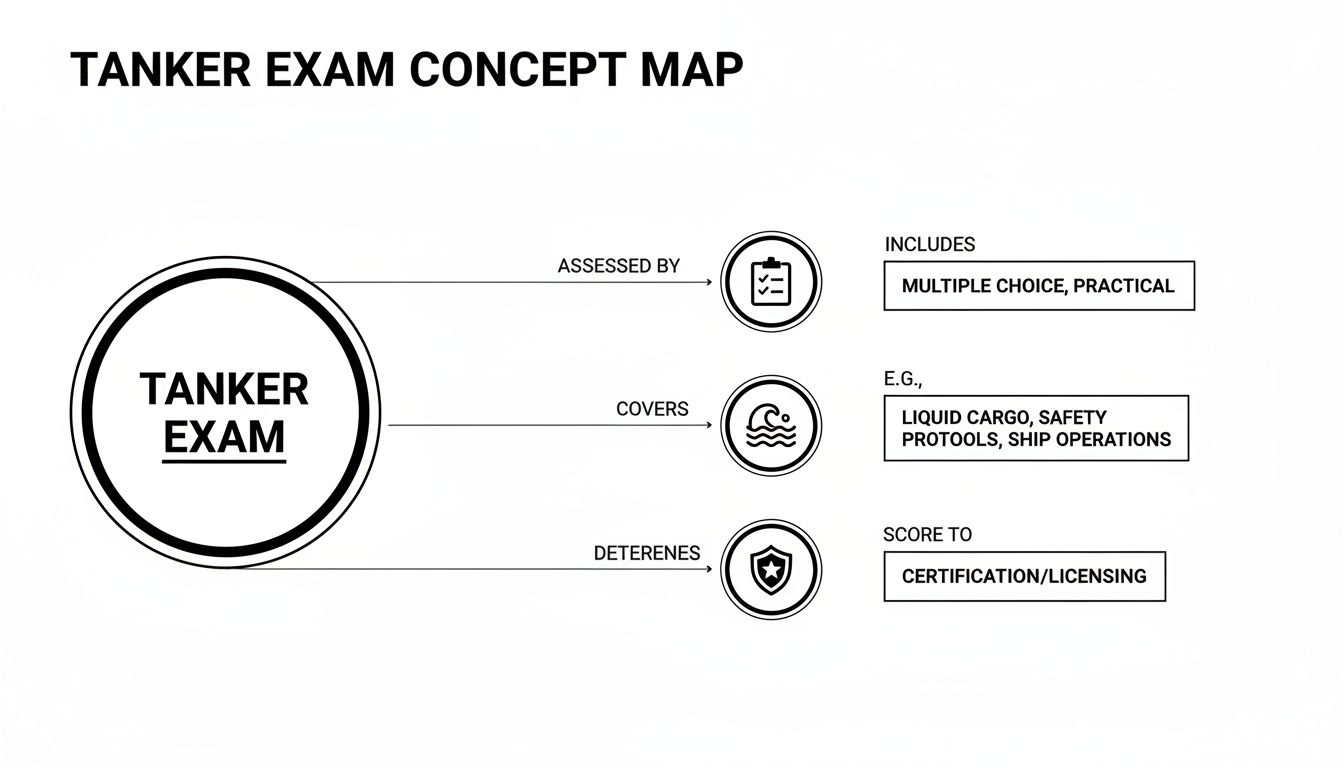
As you can see, it comes down to knowing the test format, mastering topics like liquid surge, and hitting that passing score. Let's dig into those topics, starting with the single biggest force you'll have to manage in a tanker.
The Unstoppable Force of Liquid Surge
Liquid surge is, without a doubt, the most critical concept you need to wrap your head around.
Picture it: thousands of gallons of fuel, milk, or whatever you're hauling sloshing forward when you brake or side-to-side when you take a corner. We're not talking about a gentle ripple. This is a powerful, dynamic force that can seriously mess with your truck's stability.
When you hit the brakes, all that liquid keeps moving, slamming into the front of the tank. That surge can feel like a solid shove, sometimes pushing your truck forward even after you've stopped. A classic test question scenario involves a driver getting pushed into an intersection because they didn't account for that forward momentum.
The opposite happens when you accelerate. The liquid rushes to the back, which can lighten the load on your drive axle and kill your traction. These effects are always worst in a partially filled tank where the liquid has plenty of room to build up speed. A full tank, on the other hand, doesn't have much room to surge at all.
Baffled Tanks vs. Smooth Bore Tanks
Not all tankers are built the same, and you can bet the test will ask you about the differences. The two main types you absolutely have to know are baffled tanks and smooth bore tanks. How they’re designed on the inside completely changes how you have to handle them.
- Baffled Tanks: These have dividers inside with holes in them, known as baffles. The baffles don't stop the liquid completely, but they do a great job of slowing it down by breaking up the wave's momentum. This makes the truck feel much more stable when you're braking or accelerating. You'll often see baffled tanks used for food-grade liquids.
- Smooth Bore Tanks: People also call these un-baffled tanks, and they're exactly what they sound like: a single, open compartment. There’s nothing inside to slow the liquid down, which makes the surge effect incredibly strong and unpredictable. Driving one of these safely takes real skill. They’re common for liquids that need to be completely drained or sanitized, since baffles are a pain to clean.
Here's the bottom line: Baffled tanks cut down on side-to-side surge and slow the forward-and-back motion. Smooth bore tanks give you the full, uncontrolled force of the surge. You have to drive them differently.
Why Outage and Weight Distribution Matter
Loading a tanker correctly is a science, and it all boils down to two key ideas: outage and weight distribution.
"Outage" is just the term for the empty space you leave at the top of the tank. This isn't wasted space—it's a critical safety measure. Liquids expand when they heat up. Without that outage, the pressure inside the tank could build to dangerous levels, potentially causing a spill or even rupturing the tank. Your CDL manual and practice tests will hammer this home: always leave room for liquid expansion.
Weight distribution is just as crucial, especially in tanks with multiple compartments. You have to load the tank evenly to keep your center of gravity stable and low. For example, if you put all the weight in the front or rear compartment, you could make the truck incredibly difficult to steer or cause your drive wheels to lose traction. For a deeper dive into vehicle checks, you can learn more about the crucial pre-trip inspection process in our detailed guide.
Getting your tanker endorsement can seriously boost your paycheck. Drivers with the 'N' endorsement often command salaries from $75,000 to $106,250 a year, a significant jump from the $38,000 to $54,518 that standard CDL drivers might see. When you add a hazmat endorsement for the 'X' classification, that number climbs even higher.
This pay bump reflects the specialized skill involved. The FMCSA requires drivers to be experts in handling vehicles carrying over 1,000 gallons of liquids or gases in containers larger than 118 gallons. It's all about ensuring safety with potentially volatile cargo. Across the country, 48% of tanker jobs land in the $4,333–$4,750 monthly pay range, but the top 11% of drivers earn over $5,125 a month. We help our students get there with targeted practice for these demanding tests, covering everything from pre-trip inspections to mastering the feel of a sloshing tanker.
An Actionable Study Plan That Actually Works
Trying to pass your tanker endorsement test by just reading the CDL manual cover-to-cover is a recipe for failure. It's a common mistake, but hoping the information just sticks isn't a real strategy. What you need is a smart, structured plan that combines studying the manual with tons of practice. The real goal isn't just to memorize facts for test day, but to actually understand how to operate a tanker safely.
A scattered study approach will only leave you frustrated. Instead of jumping all over the place, break your learning into focused blocks. For example, you could spend a couple of days really digging into liquid dynamics and the dangers of surge. Once you feel solid on that, move on to safety rules and inspection procedures. This keeps you from getting overwhelmed and lets you build real confidence in one area before tackling the next.
I've found the most effective method boils down to a simple, powerful loop: Test, Review, Learn. This is a form of active learning, and it beats passively reading every single time because it forces you to engage with the material and pinpoint exactly where you're struggling.
The Test, Review, Learn Cycle
This cycle takes the guesswork out of studying. First, you jump right in and take a CDL practice test for tanker endorsement. Don't study beforehand, just give it your best shot. The score isn't the point—this is about gathering intel. Think of this first test as a diagnostic tool that shows you what you already know and, more importantly, what you don't.
Once you have your results, it's time for the review stage. This is where the real learning happens. You need to go through every single question you missed. And I don't mean just glancing at the correct answer. You have to figure out why you got it wrong and why the right answer is correct. Did you misunderstand a key concept like outage? Did you forget a specific detail about baffled tanks? Or did the question's wording just trip you up?
Finally, you hit the learn phase. Now that you have a list of your weak spots, you can go back to the CDL manual with a clear mission. Instead of reading aimlessly, you're hunting for specific information. If you kept missing questions about bulkheads, you focus only on that section until it clicks.
This method makes your study time incredibly efficient. You stop wasting hours re-reading things you already understand and start patching the actual holes in your knowledge. You’re turning your weaknesses into strengths, one question at a time.
Your Two-Week Study Schedule
To help you put this all together, I’ve mapped out a sample schedule that breaks everything down into manageable daily goals. It's designed to balance learning new material with constant practice and review, which is the key to making the information stick.
Effective 2-Week Tanker Test Study Schedule
This is a template—feel free to adjust the days based on your own pace and how you're scoring on the practice tests. The important thing is to stay consistent.
| Day | Focus Topic | Action Item |
|---|---|---|
| Mon (Week 1) | Liquid Dynamics & Surge Control | Read manual sections on surge, take a 20-question practice test. |
| Tue (Week 1) | Tank Types & Characteristics | Focus on baffled vs. smooth bore tanks, review Monday's wrong answers. |
| Wed (Week 1) | Loading & Unloading Procedures | Study outage, weight distribution, and proper protocols. |
| Thu (Week 1) | Mid-Week Comprehensive Test | Take a full-length practice test covering all topics studied so far. |
| Fri (Week 1) | Review & Reinforce | Dedicate the entire session to analyzing every wrong answer from Thursday. |
| Mon (Week 2) | Driving Techniques & Emergencies | Cover high center of gravity, safe speeds, and rollover prevention. |
| Tue (Week 2) | Tanker Inspections & Safety | Learn tanker-specific pre-trip points and safety equipment checks. |
| Wed (Week 2) | Comprehensive Practice Test | Take another full-length CDL practice test for tanker endorsement. |
| Thu (Week 2) | Final Review Session | Analyze wrong answers, revisit tricky topics, and build confidence. |
| Fri (Week 2) | Light Review & Rest | Skim key concepts. Don't cram. Get a good night's sleep before test day. |
Remember, this schedule is just a starting point. If you find you're acing all the practice tests, you might be ready sooner. It’s also worth noting that a lot of the core driving knowledge overlaps with other endorsements. If you want to brush up, you can find more information about the general knowledge test on our website to see where those skills connect. Ultimately, success comes down to staying disciplined and sticking with the Test, Review, Learn cycle.
Common Mistakes That Trip Up Test Takers

Knowing the material is just one piece of the puzzle. To really walk into that test with confidence, you have to know where the common tripwires are. I’ve seen plenty of sharp drivers fail the exam, not because they didn't study, but because they fell for the same handful of tricky questions and bad habits.
Let's break down these common pitfalls. Learning from the mistakes others have made is one of the best ways to sharpen your focus and make sure you don't leave easy points on the table.
Confusing Technical Terminology
The test writers love to play games with similar-sounding words, and nowhere is this more true than with outage and ullage. They both refer to the empty space inside a tank, but they are not interchangeable.
- Outage: This is the required empty space left at the top of the tank. It’s a calculated safety margin to give the liquid room to expand when it heats up.
- Ullage: This is just a general term for the empty space in a container. It's a bit more of a generic shipping term.
You can bet you'll see a question designed to see if you can tell them apart. Just remember: outage is the planned allowance for expansion. It's the one that keeps your tank from rupturing. Getting hands-on with a CDL practice test for tanker endorsement is the best way to see how these terms pop up in real questions.
Don't just memorize the dictionary definition. Understand why it matters. Outage is what prevents a potential disaster on a hot day. That's the core safety concept the test is really checking.
Another pair that trips people up is baffles versus bulkheads. It’s easy to forget the key difference: baffles are walls with holes that slow down the surge, while bulkheads are solid walls that create separate compartments and stop the surge completely. This distinction is vital for any question about vehicle handling.
Underestimating Liquid Surge Dynamics
It’s one thing to know the definition of liquid surge. It's another thing entirely to grasp how it feels and what it does to your truck on the road. The test will absolutely quiz you on the practical effects.
A classic mistake is underestimating how that massive wave of liquid slamming forward affects your braking. That surge can easily add several feet—or more—to your stopping distance. A test question might put you in a scenario where you brake for a light, only to have the surge push you right out into the intersection.
The golden rule is to brake earlier and smoother than you would in a standard dry van. The test wants to confirm you understand this life-saving habit. When you're practicing, really dig into the questions about braking, turning, and accelerating with a partially full tank.
Bad Test-Taking Habits
Sometimes, it's not the material that gets you—it's how you handle the test itself. Nerves and a lack of strategy can lead to simple mistakes that cost you a passing score. Watch out for these:
- Rushing the Question: This is the big one. You're feeling the pressure, you skim the question, and you completely miss a tiny but critical word like "not" or "except." Slow down. Read every single word, every single time.
- Overthinking and Second-Guessing: More often than not, your gut reaction is the right one. Don't change your answer unless you have a crystal-clear reason—like suddenly remembering a specific rule that proves your first choice was wrong.
- Getting Stuck on One Question: If a question has you stumped, flag it and move on. Burning precious minutes on one tough question will only spike your anxiety and leave you less time for the easier ones you do know. You can always come back to it at the end.
By consciously working to avoid these common content traps and test-day blunders, you put yourself in a much stronger position to pass on your first try.
Answering Your Top Questions About the Tanker Test
As you start prepping for your tanker test, a lot of questions will probably come to mind. That’s normal. This section is all about giving you straight, simple answers to the most common things drivers ask about the whole tanker endorsement process. Getting these details sorted out now will help you walk into the test feeling prepared and confident.
Let's get into the practical stuff that really matters when you're working to add that 'N' to your CDL.
How Many Questions Are on the Tanker Test?
The exact number of questions can wiggle a bit depending on your state, but you can pretty much count on seeing somewhere between 20 and 30 multiple-choice questions. It's the standard format you'll find at most DMVs.
To get a passing grade, you'll need to nail at least 80% of those questions. That doesn't leave you a lot of wiggle room, which is why drilling with practice tests and really knowing the material is non-negotiable. It’s always a good idea to check your state’s official CDL manual or DMV website just to confirm the exact number of questions and the score you need to pass.
Do I Need a HazMat Endorsement for a Tanker?
Nope. You absolutely do not need a Hazardous Materials (H) endorsement to get your Tanker (N) endorsement. They're two totally separate qualifications, each with its own test. You can get one without the other, no problem.
With that said, a lot of drivers end up getting both. Think about it: a huge chunk of tanker jobs involves hauling things like gasoline, chemicals, and other stuff that falls under HazMat rules. When you earn both the H and N endorsements, they merge into a single, highly valuable 'X' endorsement on your license. An X endorsement opens up a much wider world of higher-paying jobs and gives you a serious leg up in your career.
How Long Does the Tanker Endorsement Last?
This one trips people up, especially if they're used to the whole HazMat renewal ordeal. Unlike the H endorsement, which makes you re-test and go through a TSA background check periodically, the tanker endorsement is way more straightforward.
Your tanker endorsement is good for as long as your CDL is. When it's time to renew your commercial license—usually every 4 to 8 years, based on your state's rules—your N endorsement just renews right along with it. You generally won't have to deal with any separate tests or background checks just for the tanker part.
What Is the Best Way to Use a Practice Test?
This is where the real work gets done. The secret to studying smart is to use a cdl practice test for tanker endorsement as a diagnostic tool, not just a pass/fail quiz. Your goal is to find your weak spots and fix them.
Here’s the cycle I always recommend:
- Take a Cold Test: Before you even crack open the manual, take a practice test. This gives you a raw baseline of what you know and, more importantly, what you don't.
- Review Everything: Go through each question, especially the ones you missed. Don't just glance at the right answer. Dig into the explanation and understand why it's the correct choice. This is where the learning happens.
- Target Your Study: Your review just handed you a personalized study guide. If you bombed the questions on liquid surge, that’s exactly where you need to focus in the CDL manual.
- Test Again: Take another practice test and see if your score improves in those weak areas.
This "test-review-study" loop is the key. It stops you from wasting time re-reading things you already know and forces you to confront the material you're struggling with. Keep at it until you’re consistently scoring way above that 80% mark. If you need a refresher on the basics, our guide on how to prepare for the CDL permit test is a great place to start.
The practice test isn't the final exam. Its real power is in showing you where the gaps in your knowledge are. Use it as a roadmap to patch those holes before you're sitting in front of the real thing.
Ready to turn your preparation into a professional career? Patriot CDL provides the expert guidance and hands-on training you need to pass your endorsement tests and get on the road quickly. Learn more and start your journey at https://patriotcdl.com.