If you're looking to drive a big rig but aren't drawn to the long-haul life of a tractor-trailer driver, the Class B CDL might be your perfect fit. This license is your ticket to operating some of the most essential vehicles on the road—think dump trucks, city buses, and straight trucks. These are the jobs that keep our communities functioning every single day.
What a Class B License Actually Means
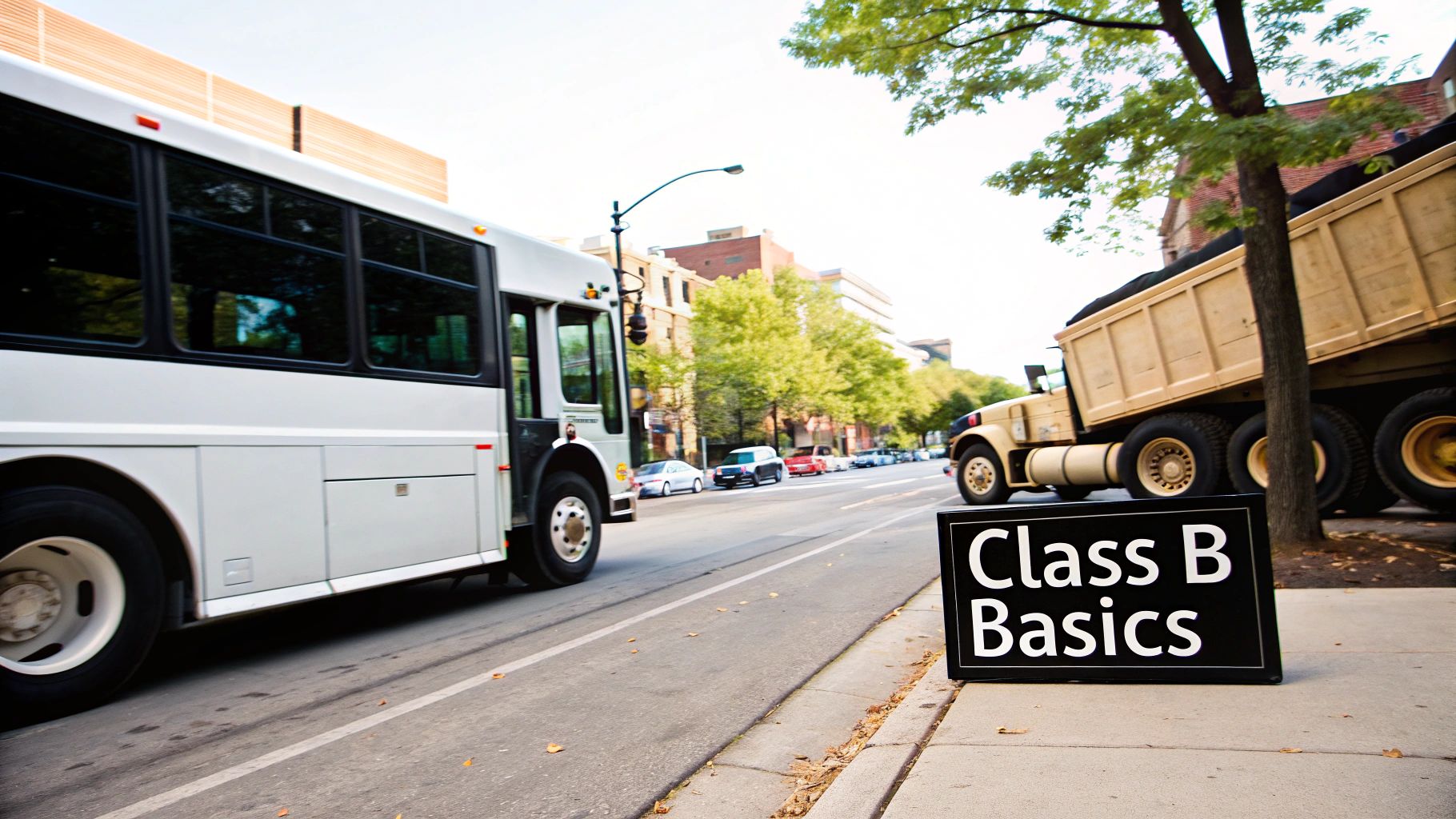
When most people picture a commercial driver, they imagine a massive 18-wheeler hauling freight across the country. But that's just the Class A side of the story. The Class B Commercial Driver's License (CDL) occupies a crucial sweet spot, authorizing you to drive heavy vehicles that are the backbone of local construction, delivery, and public transportation.
This license became a national requirement back on April 1, 1992, thanks to the Commercial Motor Vehicle Safety Act of 1986. The whole point was to create a unified standard, ensuring drivers had the specific skills needed to handle these large vehicles safely.
The core of a Class B CDL is this: it allows you to operate any single vehicle with a Gross Vehicle Weight Rating (GVWR) of 26,001 pounds or more. You can also tow a smaller trailer or vehicle behind you, as long as it weighs 10,000 pounds or less.
That weight limit is the key difference. While a Class A license is all about combination vehicles (a tractor pulling a heavy semi-trailer), the Class B focuses squarely on powerful, single-frame trucks.
Class B CDL at a Glance
To cut through the jargon, here's a quick summary of what a Class B license empowers you to do. This table lays out the core permissions and limitations in a straightforward way.
| Attribute | Specification |
|---|---|
| Vehicle Type | Any single vehicle, including buses and trucks |
| Vehicle Weight (GVWR) | 26,001 pounds or more |
| Towing Capacity | Permitted to tow trailers weighing 10,000 pounds or less |
| Common Vehicles | City buses, dump trucks, straight trucks, cement mixers |
This gives you a clear snapshot of your driving capabilities with a Class B. For a deeper dive, you can explore the full CDL requirements.
The Real-World Rigs You'll Be Driving
Getting a Class B license isn't just about learning rules and passing a test—it's your ticket to operating the heavy-duty workhorses that keep our communities running. This license puts you behind the wheel of some seriously impressive and specialized vehicles. You're not just driving; you're a critical part of construction, commerce, and public service.
This is where the theory ends and the real work begins. The federal government defines a Class B CDL as the license you need for any single vehicle with a Gross Vehicle Weight Rating (GVWR) of more than 26,001 pounds. It also lets you tow a trailer, as long as that trailer doesn't weigh more than 10,000 pounds. That specific weight limit is what really sets it apart from a Class A license. In 2023, there were over 1.2 million Class B licenses active in the U.S., making up about 25% of all commercial drivers on the road.
Straight Trucks: The Backbone of Local Delivery
Think about the box trucks you see delivering everything from furniture for a new apartment to fresh produce for a local restaurant. Those are straight trucks, and they're the quintessential Class B vehicle. Unlike a semi-truck, a straight truck is built on a single frame, which makes it much easier to handle on crowded city streets and in tight loading docks.
As a straight truck driver, you’re often the last person to handle goods before they reach the customer. It's a role that offers the huge perk of being home every night, which is a major draw for drivers who want a stable career without living on the road for weeks at a time.
Your daily routine might mean navigating downtown traffic, building relationships with the people on your route, and becoming a master of logistical efficiency. It’s a job that takes skill, patience, and a serious sense of responsibility.
Dump Trucks and Cement Mixers: Building Our World
Walk onto any construction site and you’ll be surrounded by Class B vehicles. Dump trucks are constantly moving, hauling away dirt or delivering the gravel and sand that form the foundation of new projects. Right alongside them, you'll see cement mixers churning away, delivering the concrete that becomes our roads, bridges, and buildings.
Handling these powerful machines demands more than just driving skill; you need sharp spatial awareness and a solid mechanical aptitude. A huge part of the job is making sure your rig is safe before you even turn the key. That’s why mastering the pre-trip inspection is a non-negotiable skill for anyone in this line of work.
Buses and Coaches: Connecting Our Communities
A Class B license also opens the door to a whole different world: transporting people. This is a huge field with a ton of variety.
- City Transit Buses: You could be the friendly, reliable driver who gets people to work, school, and appointments, becoming a familiar face in your community.
- School Buses: This is one of the most trusted jobs out there. It comes with the immense responsibility of getting our kids to and from school safely and requires special endorsements.
- Tour and Coach Buses: If you’ve got a bit of wanderlust and enjoy working with people, driving a tour bus could be perfect. You get to take groups on exciting trips, from cross-country journeys to local sightseeing tours.
No matter which path you choose, a Class B license gives you the power to make a real, tangible impact. You’re not just operating a vehicle—you’re moving the goods, materials, and people that make society function.
Choosing Your Path: Class B vs. Class A
Picking between a Class B and a Class A commercial driver’s license is one of the most important decisions you’ll make for your trucking career. Both licenses put you behind the wheel of a serious machine, but they open up very different worlds when it comes to your daily routine, earning potential, and long-term opportunities.
So, which one is right for you? It really boils down to your personal goals and the kind of lifestyle you want.
Imagine this: a Class B driver might spend their day maneuvering a dump truck on a local construction site, getting the job done, and heading home for dinner. On the other hand, a Class A driver could be starting a cross-country haul in a massive tractor-trailer, knowing they’ll be on the road for a week or more. That’s the core difference right there.
One of the biggest advantages of a Class A license is its versatility. A driver with a Class A CDL is automatically qualified to operate most Class B vehicles, but the reverse is not true. This gives Class A drivers a much wider range of job options from the start.
If you're leaning toward a Class B, your career path will likely specialize in a specific industry like local delivery, construction, or passenger transport. This flowchart breaks down how your industry choice connects directly to the type of vehicle you'll be driving.
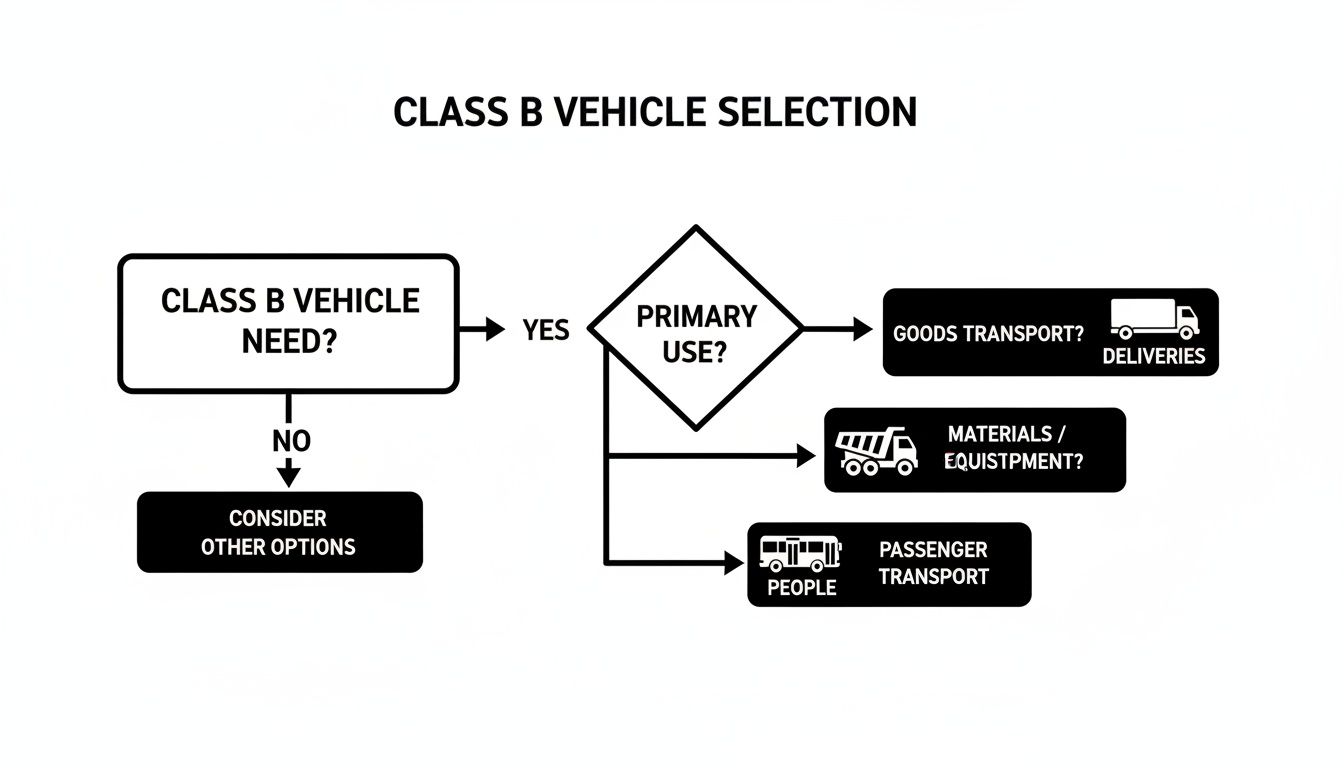
As you can see, choosing to work in logistics, building, or public service directly shapes the kind of single-unit heavy vehicle you'll master.
Core Differences at a Glance
To really make a smart choice, you have to look at these two licenses side-by-side. The training requirements, job market, and work-life balance couldn't be more different.
Getting a Class A license, for example, is a bigger commitment. The training is more intense and generally more expensive, often running between $7,000 and $10,000 for a program that takes four to six weeks.
Class B programs are usually shorter and more affordable. They focus squarely on the skills needed for those single-unit trucks, making the barrier to entry a bit lower. This is why a search for what is a class b license is such a popular starting point for people new to the industry.
Comparing Class A and Class B Commercial Driver's Licenses
Here’s a head-to-head comparison to help you decide which CDL class aligns with your career aspirations and lifestyle.
| Feature | Class B CDL | Class A CDL |
|---|---|---|
| Typical Vehicles | Straight trucks, buses, dump trucks, cement mixers | Tractor-trailers, tanker trucks, flatbeds, combination vehicles |
| Work Schedule | Primarily local or regional routes, often with daily home time | Long-haul (OTR), regional, and local routes; may be on the road for weeks |
| Job Opportunities | Local delivery, construction, public transit, waste management | Long-haul freight, regional hauling, line haul operations, specialized transport |
| Training Intensity | Shorter programs (approx. 3 weeks), focused on single vehicles | Longer programs (4-6+ weeks), focused on complex combination vehicles |
So, what's the bottom line? A Class A license generally opens more doors and can lead to higher pay down the road, with some experienced drivers earning over $90,000 a year.
However, a Class B license offers a solid, stable career with a much better work-life balance. For anyone who puts a high value on being home every night, it’s an absolutely fantastic choice.
Your Roadmap to Earning a Class B License

Getting your Class B license is a straightforward process when you know the steps. It’s less like a grueling climb and more like following a well-marked trail. Every step builds on the one before it, guiding you from where you are now to a new career as a qualified commercial professional.
The journey starts by making sure you meet the basic eligibility requirements. Think of these as the gatekeepers to the world of commercial driving, designed to ensure every new driver has a solid foundation of health and responsibility.
Step 1: Meeting the Basic Requirements
Before you can even dream of getting behind the wheel of a big rig, you have to clear a few initial hurdles. These are non-negotiable rules set by both federal and state authorities to keep our roads safe. For starters, you must be at least 18 years old to operate a commercial vehicle within your home state. To cross state lines or haul hazardous materials, you’ll need to be 21 years old.
Your driving history is also going to be put under a microscope. A clean record is a must-have. Generally, you’ll need a high school diploma or equivalent, fewer than two moving violations in the last three years, and the ability to pass both written and practical skills tests. This is where a structured training program really proves its worth by preparing you for every stage.
Once you’ve ticked those boxes, it’s time for a critical medical evaluation.
Every single commercial driver is required to pass a Department of Transportation (DOT) physical. This exam, performed by a certified medical examiner, is there to confirm you’re physically capable of safely handling large vehicles for long hours.
Step 2: Securing Your Commercial Learner's Permit
With your DOT medical card in hand, the next stop is the written exam for your Commercial Learner's Permit (CLP). The CLP is your ticket to practice; it’s basically a student driver's license for the commercial world. It allows you to get behind the wheel of a Class B vehicle as long as a licensed CDL holder is in the passenger seat.
To earn your CLP, you have to pass a few knowledge tests at your local DMV. These exams cover quite a bit of ground, so you’ll need to be prepared.
- General Knowledge: This is the main event. It covers everything from safety rules to basic vehicle control and inspection procedures.
- Air Brakes: The vast majority of Class B trucks use air brakes, so you’ll need to pass this specific test to be certified to operate them.
- Combination Vehicles: While more common for Class A, this might be required depending on your state and the specific endorsements you're after.
Studying is absolutely crucial here. A quality training school will give you all the classroom time and practice tests you need to feel confident. For a deeper dive into what that big test covers, take a look at our guide on the General Knowledge Test. Nailing these written exams proves you have the book smarts to move on to the fun part: hands-on driving.
Unlock Better Jobs with Key Endorsements
Think of your Class B license as a solid, all-purpose key. It gets you in the door for a lot of great driving jobs. But what if you want to open more specific, higher-paying doors? That’s where endorsements come in.
Endorsements are specialized qualifications you add to your CDL. They prove you’ve mastered specific skills beyond the basics, making you a far more valuable and versatile driver in the eyes of an employer. It's the difference between being a good candidate and being the perfect candidate.
An endorsement is your way of telling the industry, "I'm not just a driver; I'm a specialist." Whether it's safely transporting passengers or handling the unique physics of a tanker truck, you have the certified skills to do the job right.
Popular and Profitable Endorsements
For Class B drivers, a few endorsements are particularly powerful because they line up perfectly with the types of single-unit trucks you’ll be driving. Each one opens up a completely different career path.
Passenger (P) Endorsement: This is your ticket to driving people instead of cargo. It’s a must-have for jobs like city bus driver, tour coach operator, or airport shuttle driver. The test focuses heavily on passenger safety, managing crowds, and emergency protocols.
School Bus (S) Endorsement: If you want to take on the responsibility of transporting kids, this one's for you. It builds on the P endorsement with extra testing on child safety procedures, managing student conduct, and properly using a school bus's safety equipment, like its flashing lights and stop-arm.
Tanker (N) Endorsement: Ready to haul liquids? The N endorsement lets you operate vehicles like water trucks, fuel delivery trucks, and other bulk liquid haulers. The test covers the serious challenge of "liquid surge"—the powerful sloshing that can dramatically affect a truck's balance and handling.
Air Brakes Endorsement: While this one isn't optional for most Class B trucks, it's critical to master. The vast majority of these vehicles rely on air brake systems, so passing the knowledge test is a non-negotiable step. Get a feel for the questions by checking out an air brakes practice test.
Adding the right endorsements can have a huge impact on your job prospects and your paycheck. For example, earning a School Bus (S) endorsement can command a 10% pay premium. It's a vital skill, with 45 states relying on Class B drivers to operate over 400,000 buses that transport 25 million children daily—all with an incredible accident rate under 0.1%.
Class B Driver Careers and Salary Potential
Getting a Class B license isn't just about passing a test; it's your ticket into a stable, essential career. It’s a direct line from your training to real job security and a solid income, putting you in the driver’s seat of the local economy.
Industries are always on the lookout for skilled Class B drivers—think construction, public transit, waste management, and local delivery. The demand is steady, fueled by everything from new building projects to the nonstop growth of online shopping. Your skills won't just be wanted; they'll be needed.
A Class B license is your key to a profession that offers the independence of the open road without the over-the-road lifestyle. It’s a career that builds communities and keeps them moving, all while getting you home at the end of the day.
Exploring High-Demand Class B Industries
The beauty of a Class B license is its flexibility. It lets you find a niche that actually interests you. You're not just getting a job; you’re choosing a specific career path that keeps our communities running every single day.
- Construction and Skilled Trades: Get behind the wheel of dump trucks, cement mixers, and other heavy-duty vehicles that build and maintain our cities and towns.
- Public and Private Transit: Become the friendly face of your city as a bus driver or take on the responsibility of getting students to school safely as a school bus operator.
- Local and Regional Delivery: Drive the straight trucks that handle "last-mile" deliveries. This field is booming thanks to online retail, and you'd be the one bringing goods to businesses and homes.
- Waste Management: Play a critical role in keeping your community clean and green by operating specialized garbage or recycling trucks.
Each of these jobs requires the skills you learn in the federally mandated Entry-Level Driver Training (ELDT), so you'll be ready to go from day one. You can learn more about ELDT requirements and see how the training prepares you for success.
Realistic Salary Expectations
One of the best parts of a Class B career is the balance. You get strong earning potential without sacrificing your home life. The U.S. Bureau of Labor Statistics sees a huge demand for these jobs, with some cities reporting a 15% spike in openings.
On average, you can expect to earn around $58,000 a year. With overtime opportunities, especially in busy areas, that number can easily climb to $75,000+.
As you start looking for jobs, making your qualifications stand out is crucial. A good guide on how to write a resume (US version) can be a game-changer, helping you score interviews and land those top-paying roles. Your investment in a Class B license can quickly turn into a secure, well-paid profession that keeps our economy moving.
Common Questions About the Class B License
When you're thinking about a career change, the practical stuff always comes first. How long will this take? Is it a stable gig? Where can I go from here? Getting straight answers to these questions is what turns a vague idea into a real plan.
Let’s tackle some of the most common questions we hear from people considering a Class B CDL.
How Long Does It Take to Get a Class B License?
One of the best things about getting a Class B license is how quickly you can get trained and start earning a paycheck. Forget spending years in a classroom; a good, focused CDL program can have you ready for work in a surprisingly short amount of time.
While every student and school is a bit different, many full-time training programs can get you licensed and ready to hit the road in just a few weeks. This fast-track process covers everything from classroom prep for your permit to tons of hands-on driving practice and final test prep. How fast you get it done really comes down to your own commitment and the quality of the program you choose.
Is a Class B License a Good Long-Term Career Choice?
Absolutely. A Class B CDL is your ticket to a stable, in-demand career that keeps our communities running. Think about it—these are the jobs that form the backbone of local economies, from construction and public transit to waste management and final-mile delivery.
These jobs often come with solid benefits, predictable schedules, and the huge plus of being home every night. That combination of stability and work-life balance makes a Class B license a smart, sustainable career choice with plenty of room to grow.
Can I Upgrade From a Class B to a Class A License Later?
Yes, and it’s a very common and strategic career path. Starting with a Class B is a fantastic way to break into the trucking industry. You’ll build a solid foundation of experience and start earning a good income without the bigger time commitment of a Class A program right off the bat.
Once you’ve got some miles under your belt and feel comfortable behind the wheel, you can always go back for additional training to get your Class A. This opens the door to long-haul trucking and operating those bigger, more complex combination vehicles. Your Class B experience will make that transition much easier because you'll already have the core skills down.
Ready to take the next step toward a stable and rewarding career? The expert instructors at Patriot CDL can get you trained and on the road in as little as three weeks. Learn more about our hands-on programs by visiting our Patriot CDL Training website.