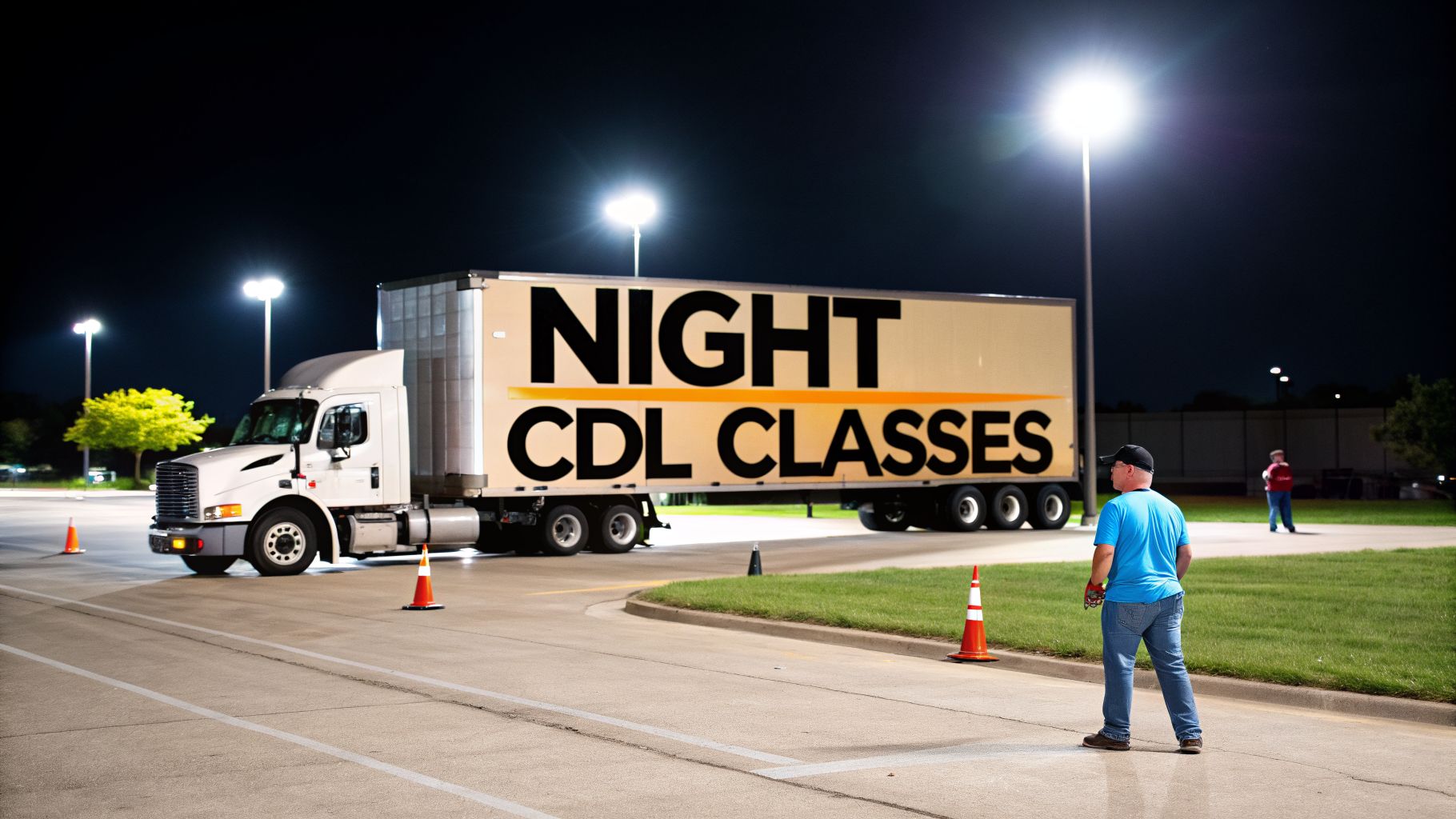
Searching for “CDL night classes near me” is often the first move people make when they're ready for a real career—one with stability and great pay—but can't afford to quit their day job to get there. These after-hours programs are built specifically for working adults, giving you a practical path to a commercial driver's license without blowing up your current life. It’s about making a smart, strategic investment in your future, on your own schedule.
Why Evening CDL Training Is a Smart Career Move

Let's be clear: choosing to get your CDL at night isn't a second-best option. It's a huge advantage. For anyone juggling a job, family, and other life commitments, daytime-only classes are a non-starter. Evening programs are the bridge that connects you to a high-demand industry that might otherwise feel completely out of reach.
This flexibility means you can keep your income steady while you train for something better. You’re learning the skills to get behind the wheel of a big rig without putting your financial life on hold.
The Opportunity in Today's Trucking Industry
The demand for qualified, professional truck drivers has never been this high. The industry is grappling with a major driver shortage, which is bad news for supply chains but fantastic news for anyone looking to get into the field. This isn't a short-term blip; it's a fundamental part of our economy.
Think about the numbers. The U.S. Bureau of Labor Statistics expects the industry will need to hire around 240,300 new heavy and tractor-trailer truck drivers every single year through 2033. That demand is driven by a freight market that moved a staggering 11.18 billion tons of goods in 2023 alone. That kind of volume means serious job security, even when other sectors get shaky.
What does this mean for you? It means solid starting pay, often over $50,000 a year right out of training, with experienced drivers pushing into six-figure territory. The price of admission isn't a four-year degree—it's your commitment to getting the job done right.
Key Benefits of Enrolling in Night Classes
Going the night-class route offers some unique perks designed for people who are serious about making a change.
Here’s why it’s such a powerful choice:
- Earn While You Learn: This is the biggest one. You keep your current job and your paycheck while you train. No need to burn through savings just to get licensed.
- A Faster Path to a New Career: With focused programs like the ones at Patriot CDL, you can be trained and ready for your CDL exam in as little as three weeks, even on a night schedule. You're not stuck in a classroom for months; you're on a fast track to earning more.
- Show Employers What You're Made Of: When you complete your training while managing a job, you're sending a powerful message to future employers. It shows you have discipline, a strong work ethic, and the drive to succeed—qualities every trucking company wants.
- Direct Entry into a High-Demand Field: You’re not just getting a license; you're getting a ticket into an essential industry where your skills will always be needed.
When you start looking for CDL night classes, you’re doing more than just finding a school. You’re taking control of your career and building a more secure future for yourself, without having to sacrifice the present.
How to Find Local CDL Night Classes That Fit Your Schedule
Finding the right CDL program when you're already working a full-time job can feel like a huge challenge. Your first instinct might be to just punch "cdl night classes near me" into a search bar, and that's a decent start. But to really find the hidden gems—the programs that are actually convenient and high-quality—you need to get a little more strategic.
The goal isn't just to find a school, but to find the right school for you. That means digging past the first few search results and thinking like someone who understands the local training landscape.
Mastering Your Search and Mapping It Out
Let’s get specific. Generic searches will give you generic results. To cut through the noise, you need to use search terms that target exactly what you’re looking for.
Think about what schools would put on their websites to attract people just like you. Try a few of these variations:
- ‘part-time CDL school [your city]’: This specifically looks for programs built for students who can't commit to a full-time schedule.
- ‘evening Class A program near me’: This zeroes in on the exact license class you want and the time of day you can attend.
- ‘[your town] CDL training after 5 PM’: Adding a specific time like 5 PM is a great way to find schools that truly cater to the 9-to-5 crowd.
Once you have a handful of potential schools, it's time for a reality check. Pull up Google Maps and plug in the address for each one. Check the commute time from your job and from your home. A school might look perfect online, but if it takes you an hour to get there in rush-hour traffic after a long day, you’re setting yourself up for failure.
A brutal commute will drain your energy before you even step foot in the classroom. When you’re learning to handle an 80,000-pound rig, you need to be sharp and focused—not exhausted and stressed out.
Vetting Schools from Your Shortlist
Now that you have a list of schools that are actually within a reasonable distance, it’s time to do some real homework. First things first: you absolutely must verify that every school is listed on the official FMCSA Training Provider Registry (TPR).
This is non-negotiable. If a school is not on the TPR, they are not authorized to provide the required training for you to get your CDL. Cross any unlisted schools off your list immediately.
With a compliant list in hand, start visiting their websites. A good, professional school won’t make you hunt for critical information. Here's what you should be looking for right on their homepage or a dedicated program page.
Website Checklist: What to Look For:
- A Clearly Posted Night Class Schedule: Does it show exact start times, end times, and days? Vague promises of "flexible options" are a red flag. You need specifics.
- Easy-to-Find Contact Details: A prominent phone number, address, and contact form are signs of a legitimate operation that wants to hear from you.
- Accreditation and FMCSA Compliance Info: Reputable schools are proud of their credentials and will display them clearly. This proves they meet federal standards.
By following this process—searching smarter, mapping your commute, and vetting for compliance—you’ll have a solid, actionable plan. You'll be able to confidently choose a program that fits your life and puts you on the fast track to a successful career.
How to Spot a High-Quality CDL Training Program
Finding a school that offers "CDL night classes near me" is just the starting point. The real work is making sure the program is worth your time and money. Honestly, not all CDL schools are the same, and with federal regulators getting serious about shutting down subpar providers, your choice matters more than ever. You need training that gets you career-ready, not just a certificate to hang on the wall.
This whole process really boils down to three phases: find your local options, do a quick check on their location and schedule, and then—most importantly—dig deep into their quality and compliance before you sign anything.

The Tough Questions You Need to Ask
When you get on the phone with an admissions rep, you're not just a potential student—you're an interviewer. It's your job to figure out if their program delivers real value. Forget the fluffy sales pitch and get straight to the point with questions that impact your success behind the wheel.
Here’s what you should be asking:
- What’s the student-to-truck ratio for actual driving time? A low ratio, like 2:1 or even 1:1, is a great sign. It means you spend more time driving and less time watching.
- Tell me about your training fleet. How old are the trucks? You want to learn on modern, well-maintained equipment that you’ll actually see on the road, not a relic from another decade.
- What kind of real-world trucking experience do your instructors have? The best teachers have spent years, if not decades, on the road. Classroom-only instructors just can't offer the same level of practical wisdom.
- How many hours are guaranteed behind-the-wheel versus in the classroom? Look for a program that heavily favors hands-on driving. That's where the real learning happens.
Don't be timid about asking these questions. The quality of your training directly affects your safety and your future paychecks. A good school will respect your diligence and have clear, confident answers ready.
A Quick Checklist for Comparing Programs
When you're juggling information from multiple schools, it's easy to lose track. Use a simple checklist like the one below to keep your notes organized and make a true apples-to-apples comparison. It helps you look past the sales talk and focus on what really matters.
Night Class Program Comparison Checklist
| Feature/Question | School A | School B | Patriot CDL |
|---|---|---|---|
| State and FMCSA Approved? (Y/N) | |||
| Student-to-Truck Ratio (e.g., 2:1, 4:1) | |||
| Guaranteed Behind-the-Wheel Hours? | |||
| Fleet Modern & Well-Maintained? (Notes) | |||
| Instructors Have Real Trucking Experience? (Y/N/Notes) | |||
| Job Placement Assistance Offered? | |||
| Total Program Cost (All-Inclusive) | |||
| Flexible Payment/Financing Options? |
By filling this out for each school you consider, you'll quickly see which one offers the most robust and valuable training for your investment.
Steer Clear of "CDL Mills"
You've probably heard the term "CDL mill." It refers to schools that are more focused on cashing checks than producing safe, competent drivers. They cut corners, rush the training, and often leave graduates unprepared for the reality of the job. These are exactly the places you need to avoid.
The government is finally cracking down. A recent review by the U.S. Department of Transportation found that a shocking 44% of truck driving schools failed to comply with federal rules. Thousands of these providers have already been kicked off the Federal Motor Carrier Safety Administration’s (FMCSA) official Training Provider Registry, with more getting delisted every day.
In this environment, choosing an established, fully compliant school is your only smart move. CDL mills often gloss over fundamental skills. A classic example is the pre-trip inspection, a critical part of a driver’s daily safety routine. A quality program makes sure you have skills like this down cold, building a solid foundation for a long and successful career.
What to Expect: The Real Costs and Timelines for Night Classes
Once you start searching for "CDL night classes near me," the two biggest questions that pop up are always the same: how much does it cost, and how long does it take? Getting straight answers to these questions is the only way to know if a program is the right fit for your life and your budget.
Let's get real about what you'll actually spend and how long it'll take to get your license.
I've seen evening CDL programs priced all over the map, but a quality school will typically fall into a specific range. You should expect to see tuition costs between $4,000 and $8,000. That number usually covers your classroom hours, all your time behind the wheel, fuel, and access to the school's trucks for training and testing.
But the tuition fee is just the starting point. Don't get caught off guard by the other necessary expenses.
Budgeting for the Hidden Costs
Beyond the main tuition, you'll have a few other smaller but mandatory costs to cover. Make sure you budget for these extras:
- DOT Medical Exam & Drug Screen: This is non-negotiable. Plan on spending between $50 and $150.
- Commercial Learner’s Permit (CLP) Fees: Your state DMV will charge a fee to issue your permit, usually somewhere from $30 to $100. If you need a walkthrough of that process, our guide on how to get your CDL permit covers it all.
- CDL Licensing & Endorsement Fees: After you pass your road test, there are state fees for the physical license and any endorsements (like HazMat or Tanker) you earned.
- Retesting Fees: It happens. If you need to retake a portion of the exam, schools almost always charge a fee for the extra time and use of their truck.
Before you sign anything, ask for a full, itemized list of all potential costs. A reputable school will be completely transparent about this.
How to Actually Pay for CDL School
That tuition number can feel intimidating, but you rarely have to pay it all at once. Schools know this is a major investment and usually have systems in place to help you manage it.
One of the biggest myths I hear is that you need to have thousands of dollars in cash saved up. The truth is, there are plenty of payment options and assistance programs out there to help you get started without derailing your finances.
When you speak with an admissions advisor, be sure to ask about these possibilities:
- In-House Payment Plans: Most schools will let you break up the tuition into smaller payments over the course of your training.
- GI Bill® Benefits: If you're a veteran, your GI Bill® benefits can be a game-changer, often covering the entire cost. Just make sure the school is VA-approved first.
- Workforce Innovation and Opportunity Act (WIOA) Grants: These federal grants are designed to get people into high-demand careers like trucking. Your local workforce development board is the place to start looking for this funding.
Setting a Realistic Timeline
The main draw of an evening program is its flexibility, but that flexibility means it takes a bit longer than a full-time course. While some aggressive daytime programs can cram everything into a few weeks, night classes are designed for people with existing jobs and responsibilities.
Most evening CDL programs run for four to ten weeks. The exact duration depends on the school’s schedule—how many nights per week and how many hours per night you’re training. It's a marathon, not a sprint, but it allows you to keep your day job and income while you work toward a more stable and lucrative career.
Your Enrollment Checklist: Get Ready to Roll
You’ve done the hard part—you picked the right CDL school. Now, let's get you enrolled without any headaches. The last thing you want is a delay because of some missing paperwork.
Trust me, getting your documents in order before you show up to enroll will make the whole process a breeze. Think of this as your final mission before training begins. A little prep work now saves a ton of stress later.
First Things First: The Non-Negotiables
Before you can even step into a truck for training, there are a couple of big-ticket items you need to handle. These are requirements for anyone wanting a CDL, no matter which school you choose.
Your first major task is getting your Commercial Learner's Permit (CLP). This involves passing the written knowledge tests at your local DMV. At the same time, you'll need to pass a Department of Transportation (DOT) medical exam and a drug screen. A certified medical examiner will give you a medical card, which is mandatory for operating a commercial vehicle.
These steps are the foundation. You can't start behind-the-wheel training until they're done.
The Document Roundup
When it’s time to enroll, the administrative staff will need a specific set of documents. Having everything organized in a folder will speed things up dramatically.
Here’s what you’ll need to bring:
- A valid driver’s license from the state where you'll get your CDL.
- Your Social Security card (the original, not a copy).
- Proof of residency, like a recent utility bill or bank statement.
- The DOT medical card you received from your physical exam.
- Your brand new Commercial Learner's Permit (CLP).
Treat this folder of documents as your golden ticket. Showing up organized and prepared not only makes a great first impression but also helps the school's staff get you processed and ready for class without a hitch.
Thinking ahead is what separates good drivers from great ones, and that goes beyond just paperwork. For example, you'll be on your feet a lot and on all kinds of job sites, so investing in a pair of durable work boots is a smart move. It's these practical details that set you up for long-term success.
Once you have all your documents ready, you're on the final step before training begins. If you’re ready to get started with us, we’ve made our process as straightforward as possible. Find out how to sign up for our programs and start your journey on the open road.
The Patriot CDL Advantage for Night Students

When your search for "CDL night classes near me" leads you here, it’s because you’re looking for more than just a convenient schedule. You need a program that actually works for a working adult who’s ready for a real career change.
That’s exactly why we created our evening classes at Patriot CDL. We took our proven daytime training and adapted it for a schedule that fits around your current job—without cutting any corners.
Our accelerated three-week program is designed to get you licensed and on the road faster than most other schools. This isn’t a watered-down version of training. It’s a focused, intensive path to earning your Class A or B CDL.
Hands-On Training with Instructors Who Have Been There
The real difference in our training comes down to one thing: practical, behind-the-wheel experience. You’ll be in the driver’s seat with instructors who aren’t just teachers; they’re seasoned truckers with years of real-world road time. They know what it takes to succeed out there.
We focus on the skills that truly matter on the job, including:
- Mastering thorough pre-trip inspections
- Nailing complex backing and docking maneuvers
- Proper shifting and road management techniques
- Confidently handling city and highway driving conditions
The global driving school market is projected to reach $103.11 billion by 2025, fueled by the demand for professional drivers. This incredible growth means that graduates from quality, ELDT-compliant schools like ours are stepping into a field with rock-solid job security and opportunity.
Choosing Patriot CDL is a direct investment in your future. We provide a supportive, affordable, and straightforward path to a stable, high-paying career.
See for yourself—learn more about our CDL Class A and B programs and how we can help you hit your career goals.
Your Top Questions About CDL Night Classes, Answered
Making a career change is a huge decision, and you probably still have some questions floating around, even after doing your homework. That's completely normal. Let's tackle some of the most common ones we hear from people considering night school for their CDL.
Can I Really Get a Full Class A CDL Just by Going to Night School?
You absolutely can. Any credible CDL school structures its night program to meet the exact same Entry-Level Driver Training (ELDT) standards required by federal law. The curriculum is identical to the daytime course.
The only thing that changes is the schedule. You’ll get all the same hands-on, behind-the-wheel training and classroom instruction—from pre-trip inspections to advanced road maneuvers—ensuring you are 100% prepared to ace your CDL exam.
Do Night Classes Cost More Than Daytime CDL Training?
This is a valid question we get all the time, but the answer is almost always no. Most schools price their programs based on the quality of the instruction, the equipment you'll be using, and the total training hours—not the time of day you attend.
Offering evening classes is their way of making a new career accessible to working adults. Just be sure to ask for a complete cost breakdown upfront so there are no surprises down the road.
The most important thing for employers is not when you trained, but how well you were trained. A CDL earned through a compliant night program is just as valuable as one from a daytime course, proving your dedication and strong work ethic.
Will Companies Care That I Got My CDL Through a Night Program?
Not in the slightest. What hiring managers and recruiters look for is a safe, skilled driver who graduated from a reputable, FMCSA-approved school. The time of day you attended your classes is completely irrelevant to them.
If anything, earning your CDL while juggling a full-time job can be a major positive. It demonstrates a strong work ethic, commitment, and excellent time-management skills—all things that trucking companies value. To see exactly what's involved, check out our guide on CDL requirements. It proves you’re serious.
Ready to stop searching and start driving? Patriot CDL offers the accelerated, hands-on night training you need to launch your new career without quitting your day job. Visit patriotcdl.com to enroll today.