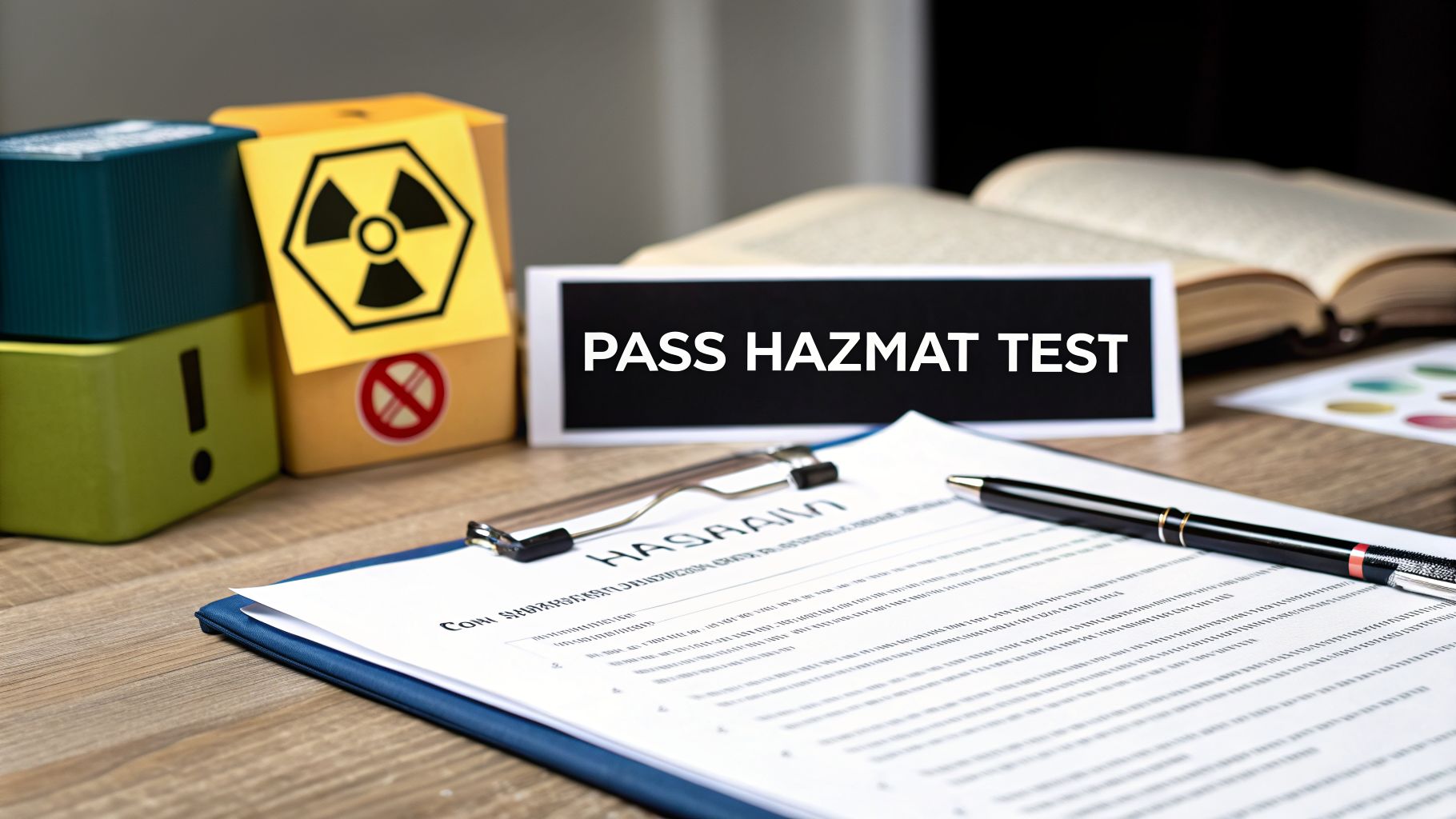
If you're looking to boost your paycheck and open up new career doors as a truck driver, getting your Hazmat Endorsement (H) is one of the smartest moves you can make. It's a federal qualification that proves you know how to transport sensitive materials safely, making you a much more valuable driver to any carrier. Nailing the hazmat endorsement test is your ticket to getting it.
What Is a Hazmat Endorsement and Why You Need It
Think of your standard CDL as a pass to drive on the main roads. The Hazmat Endorsement, or H endorsement, is the special key that unlocks the gates to better jobs and higher pay. It’s a federally recognized credential that shows you’re certified to legally and safely haul materials classified as hazardous—everything from everyday stuff like gasoline and cleaning supplies to industrial chemicals and compressed gases.
Because these loads come with a lot more responsibility, earning the endorsement is a bigger deal than adding other qualifications to your CDL. It tells employers you’re a professional they can trust with complex safety rules and regulations. In an industry where dependability is currency, the H endorsement puts you at the top of the list.
The Real-World Importance for Drivers
This is more than just another stamp on your license; the H endorsement directly shapes your career path. Many of the most stable, high-paying gigs in trucking, like hauling fuel or chemicals, are completely off-limits to drivers without it. Carriers also love drivers with multiple endorsements because it gives them the flexibility to assign you to a wider variety of loads.
At its heart, the hazmat endorsement test is all about one thing: public safety. By making sure every certified driver understands the complex rules, the test acts as a critical line of defense, preventing serious accidents that could harm the public or the environment.
Put simply, getting your Hazmat endorsement is a career multiplier. It doesn't just expand the list of jobs you can take on—it significantly increases how much you can earn. Companies are more than willing to pay a premium for drivers with this specialized knowledge, making the effort to pass the hazmat endorsement test a fantastic investment in your future.
Connecting the Test to On-the-Job Duties
The hazmat endorsement test isn’t just a pop quiz with random facts. Every single question is built around the real-world challenges and responsibilities you’ll face on the road. The whole point of the exam is to confirm you're competent in the areas that matter most. If you're just starting out, it's a good idea to first get familiar with the basic steps for earning your license.
Here’s a quick look at what the test covers and how it applies to your daily work:
- Hazard Identification: You’ll need to know the different hazard classes and how to read placards and labels on a container. Think of it as learning a new language—the language of safety—that tells you exactly what you’re hauling and the specific risks involved.
- Regulations and Compliance: The exam digs into the federal rules for loading, unloading, and securing hazardous cargo. Knowing this inside and out keeps you legal, preventing costly fines or, worse, a dangerous mistake.
- Emergency Procedures: You have to know precisely what to do if there's a spill, leak, or accident. This training prepares you to act as a first responder, protecting yourself, the public, and the environment when seconds count.
- Shipping Papers: The test will make sure you can correctly read and understand shipping documents. These papers are the official record of your cargo, and getting them right is non-negotiable for both compliance and emergency response.
Clearing the TSA Security Threat Assessment
Before you even think about cracking open a study guide for the hazmat endorsement test, there’s a critical first hurdle: the Transportation Security Administration (TSA) Security Threat Assessment (STA). This is a mandatory federal background check, and frankly, nothing else matters until you’ve cleared it. You could ace the written test, but without the TSA's green light, you won't be getting that endorsement on your CDL.
This isn’t your typical employment background screening. It's a comprehensive security vetting process designed to keep hazardous materials out of the wrong hands. The TSA digs into your history to confirm your identity, check for any criminal records, and verify your legal status to work in the U.S. There are no exceptions and no way around it.
Starting the Application and Fingerprinting
Your first move is to fill out the online application. This is where you’ll provide all your personal details and give your official consent for the government to conduct the background check. Once that's submitted, you’ll be prompted to schedule a fingerprinting appointment.
This next part is simple enough. You find an authorized enrollment center near you, make an appointment, and a technician will capture your fingerprints electronically. From there, your prints are sent directly to the TSA and FBI, where they’re cross-referenced against national databases for any red flags.
What the TSA Looks For
The whole point of the STA is to identify and screen out individuals who might pose a security risk. The TSA has a very specific list of crimes that will get an applicant disqualified, either temporarily or for good.
Here's what they're scanning for:
- Permanent Disqualifiers: Certain convictions will permanently bar you from ever getting a hazmat endorsement. This includes major offenses like treason, espionage, murder, or any terrorism-related crime.
- Temporary Disqualifiers: Other serious felonies can lead to a temporary ban, which usually lasts seven years from the conviction date or five years from your release from prison. These include crimes like smuggling, robbery, arson, and some drug distribution charges.
- Immigration Status: You have to be a U.S. citizen or a lawful permanent resident. There's no wiggle room here.
This flowchart maps out the complete hazmat endorsement journey, from the initial security screenings to the career opportunities that follow.
As you can see, it all begins with these crucial security and safety checks. Only after you're cleared can you move forward professionally.
Plan for Potential Delays
One of the biggest mistakes drivers make is underestimating how long this takes. The STA is a notorious bottleneck. Even after you pass your written knowledge test, you cannot get the endorsement until your state DMV receives confirmation that you’ve passed the federal background check.
The waiting game for the TSA's approval is a real factor. We tell all our students to start the application process as soon as possible so they aren't stuck waiting around after they're otherwise ready to hit the road.
In a state like Pennsylvania, you should realistically budget up to 90 days for the whole ordeal—from application and fingerprinting to finally having the new CDL in your hand. Some states, like Illinois, New Mexico, and North Dakota, take it a step further and require you to have your background check results before you can even sit for the written test.
Because every state is a little different, the best advice is always the same: start your TSA application early. It’s the smartest move you can make to keep your career on track.
Mastering the Core Concepts of the Hazmat Exam

Passing the hazmat endorsement test isn't about memorizing a giant list of chemicals. It’s about understanding the system—learning to see the risks, read the signs, and know exactly what to do when a problem arises. Think of it as learning the language of safety that every professional driver, shipper, and first responder speaks.
This section will break down the key subjects you'll face on the exam. We're going to get past the dry rulebook language and focus on what these concepts actually mean for you out on the road.
Decoding the Library of Dangers
At its core, hauling hazmat safely starts with understanding the nine official hazard classes. Think of it like a universal warning system. Each class tells you the primary danger of the material you're dealing with, whether it's explosive, flammable, or corrosive.
The hazmat endorsement test will absolutely grill you on these. For instance, you’ll need to know that Class 1 materials are explosives, while Class 3 covers flammable liquids like gasoline or paint thinner. You don't have to be a chemist, but you must be able to instantly recognize the type of threat each class represents.
This isn't just for passing the test. This knowledge directly impacts how you load your trailer and what materials you can and can't put next to each other. Mistaking a Class 4 (Flammable Solid) for a Class 5 (Oxidizer) could lead to a disastrous fire if they mix.
Reading the Story of Your Cargo
If the hazard classes are the chapters, then the placards, labels, and markings are the headlines. They are visual cues designed to be understood in a split second by anyone who sees them.
- Placards: These are the big, diamond-shaped signs you'll put on all four sides of your trailer. They give everyone—from law enforcement to emergency crews—an immediate heads-up about the primary danger inside. A red placard with a "3" on it screams "flammable liquids on board."
- Labels and Markings: These are smaller signs and codes placed directly on the individual boxes, drums, or containers inside your trailer. They provide more specific details, like the UN/NA identification number that names the exact substance.
It's simple: the placard on the outside of the truck tells you the general danger, while the labels and markings on the packages inside tell you precisely what that danger is. It's a system built to keep everyone informed and safe.
Your placards and shipping papers must always be a perfect match. If a DOT officer finds a discrepancy, you're looking at serious fines and a major safety violation. It’s one of the first things they check.
To help you get familiar with these, here's a quick reference for some of the most common placards you'll see on the road.
Hazardous Materials Placard Quick Reference Guide
| Placard | Hazard Class | Example Material |
|---|---|---|
| Class 3 | Gasoline, Ethanol |
| Class 6.1 | Arsenic, Pesticides |
| Class 7 | Radioactive Waste |
| Class 8 | Sulfuric Acid, Batteries |
Remember, this is just a small sample. Your CDL manual will have the complete list you need to learn for the test.
The All-Important Shipping Papers
While placards provide the visual warning, your shipping papers tell the whole story. This document is arguably the single most important piece of paper in your cab during a hazmat run. If there's an emergency, first responders will ask for your shipping papers before they do anything else.
The test will check if you know where to find key information on these papers. Every hazmat shipment must have documentation listing:
- The material's proper shipping name and UN/NA identification number.
- The hazard class and its packing group (which indicates the degree of danger).
- The total quantity and type of packaging used.
- A 24/7 emergency contact number for the shipper.
The rules are strict: these papers must be within your reach while you're at the wheel and in a specific, visible location (like the driver's seat or door pouch) when you're out of the truck. This isn't for convenience; it's a critical safety protocol that saves lives.
Building a strong foundation in general trucking knowledge is a huge help here. If you're still studying for your initial permit, many concepts that overlap with hazmat safety are covered in the General Knowledge test.
Loading, Securing, and Emergency Response
Finally, the hazmat endorsement test gets practical. It’s not just about what you know, but what you can do. This part covers the hands-on procedures for handling dangerous goods. You’ll be tested on loading rules, especially segregation—which means knowing which types of hazmat can’t be loaded together.
You'll also need to prove you know how to properly secure the load. A shifting load is always bad news, but with hazardous materials, it can be catastrophic. The exam will ask about using braces, blocks, and straps to make sure nothing moves.
Most importantly, you have to know what to do when things go wrong. What's the first step if you discover a leak? How do you use the Emergency Response Guidebook (ERG)? When do you call for help? Answering these questions correctly shows you're not just a driver; you're a responsible professional entrusted with protecting yourself and the public.
How to Prepare for and Pass the Written Test

Knowing the hazmat regulations is one thing. Proving you know them under the pressure of a state-proctored exam is a completely different ballgame. Passing the HazMat endorsement test isn’t about last-minute cramming; it's about having a smart study strategy so you can walk into the DMV with confidence.
Let's look at the numbers. The national first-time pass rate for the CDL HazMat endorsement test is around 70-75%. That might sound high, but compare it to the general CDL knowledge test, where pass rates often dip to 50-60%. The takeaway? Drivers who study specifically for this endorsement have a much better shot at success.
Most states will give you an exam with about 30 multiple-choice questions. The magic number you're aiming for is an 80% score, which means you can only miss 6 questions (24 out of 30 correct). You'll usually have around 60 minutes, which is more than enough time if you're prepared.
Building Your Study Plan
Your number one resource is the official Federal Motor Carrier Safety Administration (FMCSA) Hazardous Materials Study Guide. This is usually part of your state’s CDL manual, and it's the source material for every single question on the test. Think of it as the ultimate cheat sheet.
But just reading the manual cover-to-cover won't cut it. You need to get active with the material.
- Zero in on the "Big Four": Spend most of your time on placards, hazard classes, shipping papers, and emergency response procedures. These topics make up the lion's share of the test.
- Take Practice Tests Relentlessly: This is the single best way to find out what you really know. Practice tests expose your weak spots and get you comfortable with the way questions are worded long before you sit for the real thing.
- Think "Why," Not Just "What": Don't just memorize rules. Understand the logic behind them. When you know why a certain material can't be loaded next to another, you’ll be able to answer tricky situational questions without breaking a sweat.
This focused approach is the same one we recommend for getting your initial CDL permit. Having a good strategy is key.
Smart Test-Taking Strategies
On test day, how you take the test can be just as critical as what you’ve studied. I've seen plenty of drivers fail who knew the material cold but got tripped up by the questions themselves.
The key to passing the HazMat endorsement test is not just knowing the information, but knowing how to interpret the questions. The test is designed to assess your judgment in real-world scenarios, so think like a driver, not just a student.
Use these field-tested techniques to give yourself an edge:
- Read Every Single Word: Test writers love to use keywords like "always," "never," or "except." These words can flip a question on its head. Slow down and make sure you understand exactly what’s being asked.
- Use Process of Elimination: Not sure about an answer? Start by getting rid of the options you know are dead wrong. This often leaves you with a 50/50 shot, which dramatically improves your odds.
- Never Leave a Question Blank: There’s no penalty for guessing. A blank answer is a guaranteed wrong answer. If you're completely stumped, make your best educated guess and move on.
- Review Your Answers: If you have time left at the end, use it. A quick review might help you catch a simple mistake you made when you were rushing. Combining a solid study plan with these simple tactics is the fastest way to turn test-day anxiety into a passing score.
Alright, the big day is almost here. You’ve studied the regulations, you know your placards, and you’re ready to prove it. But passing the hazmat endorsement test is about more than just acing the questions—it’s about navigating the process smoothly from start to finish.
Let's walk through what to expect at the DMV, what happens after you get that passing score, and how to bounce back if things don’t go your way on the first try.
Your Test Day Checklist
Don't let a simple paperwork mistake derail your test day. After all the studying you’ve done, the last thing you want is to be turned away at the counter. Before you even think about leaving for the DMV, run through this checklist.
Every state has its own specific requirements, so a quick visit to your local DMV’s website is always a smart move. That said, you can bet you’ll need these core items no matter where you test.
Essential Documents for Your Hazmat Test:
- A Valid Commercial Driver's License (CDL): This is non-negotiable. Make sure your current CDL is not expired. If you're testing with a Commercial Learner's Permit (CLP), confirm your state allows it for endorsement tests.
- Proof of TSA Security Threat Assessment: Have your application confirmation or fingerprinting receipt ready. Some states won’t even let you sit for the test until they see official TSA approval in their system, so check this beforehand.
- Your DOT Medical Card: Your Med Card must be current. Double-check the expiration date.
- Proof of Identity and Residency: Be prepared with secondary documents. This usually means your birth certificate, Social Security card, and a couple of recent utility bills or bank statements.
- Test Fees: Bring enough cash or a card to cover the fees for both the test and the endorsement itself. The exact amount will be on your state's DMV site.
Paperwork aside, the best things you can bring are a clear head and a good night’s sleep. Get to the testing center a little early. It gives you time to find parking, use the restroom, and just breathe before you start the exam.
What Happens After You Pass
Congratulations, you passed! That's a huge hurdle cleared, but you're not quite ready to roll with a hazmat load just yet. Getting that passing score kicks off the final steps to make it official.
While the process can vary a bit from one state to another, it generally follows the same path. The DMV now has your test score, but they still need the green light from the TSA. Once your passed background check is officially in the system, the state will issue a new CDL with the "H" endorsement printed right on it.
Depending on your state, you might get your new license printed on the spot, or it could arrive in the mail a few weeks later. And if you're looking to broaden your skillset even further, getting rid of an automatic transmission restriction is a great next step.
Don’t assume you can start hauling hazmat loads the second you pass the test. You are not legally certified until the "H" endorsement is physically on your CDL.
If You Don't Pass on the First Try
It happens. Seeing a failing score is frustrating, but it’s far from the end of the road. With a national first-time pass rate hovering around 70-75%, plenty of great drivers need a second attempt. The trick is to see it as a learning experience, not a failure.
Most states will let you retake the test, but you might have to wait a day or so and pay the fee again. Use that time productively. Before you leave the DMV, ask the clerk if they can give you any feedback on which sections gave you the most trouble. That information is pure gold.
Pinpoint your weak spots and hit the books again. Was it the placard rules? The shipping paper details? Or maybe the emergency response protocols? By focusing your efforts on what tripped you up, you can walk back in with confidence and turn that first attempt into a valuable lesson.
Answering Your Top Hazmat Endorsement Questions
As you get ready to tackle the hazmat endorsement test, you’re bound to have some questions. It's totally normal. Trying to figure out all the rules and steps can feel a bit like untangling a knotted rope, but getting solid answers will help you move forward with confidence.
Let's clear up some of the most common things drivers ask about when they're going for their H endorsement.
How Long Is the Hazmat Endorsement Good For?
This is a big one, and it's where a lot of confusion comes from. The short answer is that your hazmat endorsement is tied directly to your TSA Security Threat Assessment (STA). That federal background check is valid for a maximum of five years, which means your endorsement is, too.
But here’s the catch: your state might make you renew your CDL itself more often, maybe every four years. When it's time to renew your hazmat endorsement, you don’t just get it stamped again. You have to start the whole process from scratch.
That means you'll have to:
- Submit a completely new application for the TSA background check.
- Get fingerprinted all over again.
- Pass the Security Threat Assessment one more time.
On top of that, some states will require you to retake the written knowledge test at every renewal. The TSA’s approval can take a while, so plan ahead. You should start the renewal process at least 90 days before your current endorsement expires to make sure you don't have a gap where you can't haul hazmat.
Can I Get a Hazmat Endorsement with a Criminal Record?
The answer here is a firm "it depends." It all comes down to what the crime was. The TSA has a very specific list of offenses that can disqualify you, and they're broken down into two main groups.
The TSA doesn’t bend on its security standards. Some crimes will permanently bar you from getting a hazmat endorsement, while others lead to a temporary disqualification.
Here’s a simple breakdown of how the TSA looks at it:
- Permanent Disqualifying Offenses: These are the most serious crimes and mean you can never hold a hazmat endorsement. Think of major felonies like espionage, treason, murder, or anything related to terrorism.
- Temporary Disqualifying Offenses: This category includes other serious felonies that get you banned for a set period. You're typically disqualified for seven years from your conviction date or five years from your release date from prison, whichever is later. These include crimes like smuggling, arson, robbery, bribery, and some felony drug convictions.
Before spending any time or money on the application, I always tell drivers to check the official list of disqualifying criminal offenses on the TSA website. It'll tell you exactly where you stand.
What Is the Difference Between the H and X Endorsements?
Great question. This gets right to the heart of specializing in your trucking career. Both endorsements deal with hazardous materials, but they let you haul very different kinds of loads. Knowing the difference is crucial for targeting the right jobs.
It really boils down to the container the material is in.
- The 'H' Endorsement is for hauling hazardous materials that are packaged. This means things in boxes, drums, or cylinders—basically anything that’s been loaded onto a flatbed or into a dry van.
- The 'X' Endorsement is a combo endorsement. It combines the 'H' (Hazardous Materials) with the 'N' (Tank Vehicles). This is what you need to haul hazardous materials in a tank truck, like gasoline, liquid chemicals, or industrial gases.
So, to get that X endorsement, you have to pass both the Hazardous Materials knowledge test and the Tank Vehicle knowledge test. If your goal is to be a tanker driver hauling fuel or other bulk liquids, the X endorsement is your target.
How Much Does the Hazmat Endorsement Test Cost?
There isn’t a single price tag for the hazmat endorsement. The total cost is made up of a few different fees, and the final number will change a bit depending on your state. You can generally plan for three main expenses.
First, the biggest chunk is the TSA Security Threat Assessment fee. You'll pay this directly to the TSA's enrollment provider, and it's usually around $86.50, though that price can change.
Second, your state’s DMV will have its own fee for taking the written hazmat endorsement test. This is often pretty small, somewhere in the $10 to $50 range.
Finally, after you've passed the test and cleared the background check, there's usually a small administrative fee to add the endorsement to your CDL and print you a new card. When you add it all up, you should probably budget between $100 and $200 for the whole thing. For the exact costs, your state DMV's website is always the best source.
Passing the hazmat endorsement test is a huge step toward a more lucrative trucking career. With the right preparation, you can walk in and pass it with no problem. Patriot CDL provides expert-led programs built to get you ready for every part of your CDL journey, including all endorsements.