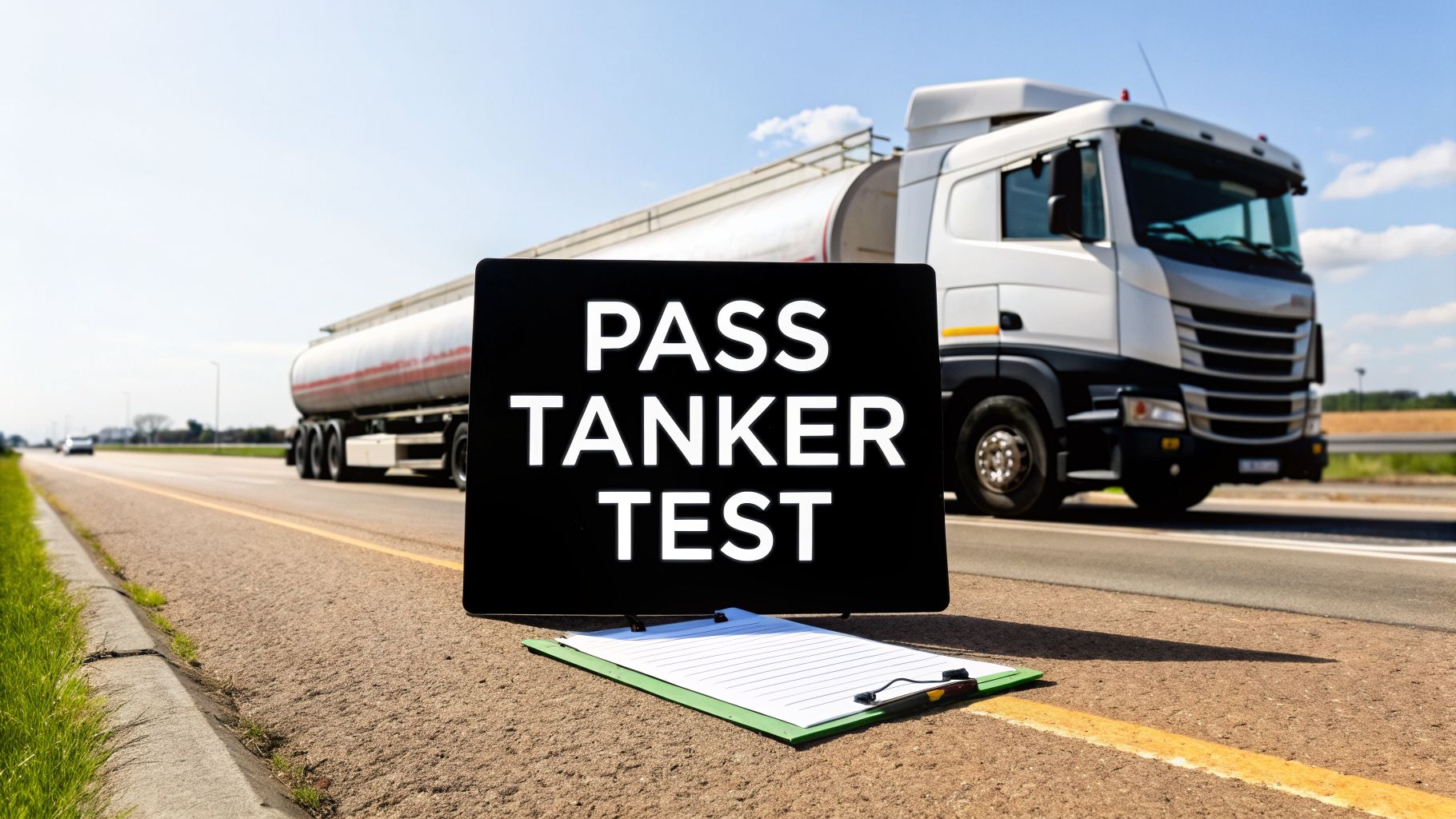
If you’re serious about building a long-term, profitable career in trucking, getting your tanker endorsement is one of the smartest moves you can make. It’s what’s known as the 'N' endorsement, a special credential on your CDL that proves you have the knowledge to safely haul bulk liquids and gases. This single letter on your license unlocks higher-paying jobs that many other drivers simply can't touch.
More Than Just a Letter on Your License
In a competitive field, specialization is what sets you apart. A standard Class A or B license is your ticket to the game, but endorsements like the tanker are what help you win. Adding the 'N' endorsement to your CDL immediately boosts your value to employers and your overall earning potential.
And it's not just for drivers hauling hazardous materials like gasoline or chemicals. You might be surprised by just how much freight falls under the tanker category.
It's Not Just About Hauling Fuel
A lot of drivers think the tanker world is all about the fuel industry. While hauling gasoline is certainly a big piece of the pie, the opportunities are far more diverse. Any company moving these products needs drivers with an N endorsement:
- Food-Grade Liquids: Think about it—milk, juice, corn syrup, and even vegetable oils all travel in tanker trucks. These are stable, year-round industries that don't slow down.
- Water: From potable drinking water to non-potable water for industrial and farm use, it's all hauled in bulk.
- Industrial Chemicals: Many non-hazardous chemicals used in manufacturing offer steady, often local, routes.
- Liquefied Gases: This includes materials like nitrogen and oxygen, which are essential for hospitals and industrial work.
Because of the unique skills needed to handle liquid loads—like dealing with surge and a high center of gravity—companies pay a premium for drivers who are properly endorsed. We're not talking about a small bump in your per-mile rate; this often adds up to thousands of dollars in extra income each year.
The Job Security That Comes with Specialized Skills
The trucking industry can be a rollercoaster, but the demand for liquid and gas transport stays remarkably consistent. People always need fuel, food, and water. By earning your tanker endorsement, you can better insulate your career from the market swings that affect general freight.
This kind of specialized skill makes you an essential asset. When general freight slows down, tanker drivers often find their services are still in high demand, giving them a level of job security that’s hard to find elsewhere.
This stability is a huge advantage. Plus, mastering the challenges of tanker driving makes you a safer, more skilled professional overall—a quality that the best carriers are always looking for. Getting comfortable with a CDL practice test tanker endorsement is how you start building that expertise before you ever hit the road.
Knowing the Rules of the Road
The need for this endorsement isn’t just a company policy; it’s the law. The Federal Motor Carrier Safety Administration (FMCSA) is very clear: you must have a tanker endorsement to operate any vehicle designed to haul 1,000 gallons or more of liquid or gas in bulk containers. It doesn't matter if the cargo is hazardous or not.
This federal rule is what makes the endorsement so valuable. The U.S. has a workforce of roughly 3.5 million professional truck drivers, but only a small fraction of them hold specialized credentials like the N endorsement. That scarcity is exactly what creates better pay and job security for those who are qualified. Investing in yourself with a solid training program is the most direct path to joining that elite group.
Before you start grinding through a cdl practice test tanker endorsement, we need to talk about the fundamentals. Passing the tanker test isn't about memorizing questions; it's about getting a real feel for the physics involved in hauling liquid. This is the stuff that separates the true professionals from the drivers who are a liability on the road.
Every question on that exam comes straight from real-world situations you'll face every day. Let's get into the nitty-gritty of what you absolutely have to know.
The High Center of Gravity Problem
First things first: a tanker is not a dry van. The biggest difference, and your biggest risk, is its high center of gravity. All that liquid sloshing around high up in the tank makes the whole rig incredibly top-heavy and much less stable than a truck with a solid, low-riding load.
This design flaw makes tankers prime candidates for rollovers. You’ll see this pop up constantly on any good practice test. Curves, on-ramps, and even quick swerves to avoid a hazard become ten times more dangerous. You have to understand, on a gut level, how your speed and steering affect the stability of that tank.
A corner you could cruise through at 45 mph in a reefer might be a rollover waiting to happen in a tanker. That outward pull on the liquid is no joke—it can and will tip you over if you don't respect it. This means thinking ahead, bleeding off speed long before you enter a turn, and always, always being mindful of how different your truck handles.
Taming the Beast: Liquid Surge
If there’s one concept that defines tanker driving, it’s liquid surge. When a tank isn't full to the brim, that liquid has room to move. That movement creates some serious forces that can push your truck right where you don't want it to go.
Think about hitting the brakes with a half-full tank. Thousands of pounds of liquid slam into the front of the tank, creating a powerful shove that can push you straight into an intersection. The opposite happens when you accelerate; the liquid rushes to the back, slowing you down and sometimes even making the steer tires feel light.
This constant push and pull is something you live with. The forward surge during braking is particularly nasty. It can feel like you’ve been rear-ended, and it has the potential to cause a jackknife or a complete loss of control.
To pass your endorsement test, you can't just know the definition of surge. You have to understand how it behaves in different situations—braking, accelerating, and turning. The table below breaks down the key topics you'll be tested on.
Key Knowledge Areas for the Tanker Endorsement Test
This table covers the critical concepts you must master. The test is designed to ensure you know not just the what, but the why behind every safety rule.
| Core Concept | Why It's Critical on the Test | Real-World Application Example |
|---|---|---|
| High Center of Gravity | Questions will focus on rollover risk and speed management, especially in curves. | Knowing to reduce speed significantly more than a dry van driver would on a curved highway off-ramp. |
| Liquid Surge | You must be able to describe how surge affects acceleration and braking. | When stopping for a red light, you apply brakes steadily, anticipating the forward surge that will push the truck just as you come to a stop. |
| Baffles vs. Bulkheads | The test will check if you know the difference and how each affects liquid movement. | You're assigned a baffled tanker, so you know that while surge is reduced, you still need to be extremely cautious with your speed in turns. |
| Outage and Weight | Expect questions about proper loading, ullage (outage), and weight distribution. | Leaving the right amount of empty space (outage) in the tank to allow for liquid expansion without overloading axles. |
| Specialized Driving | The test covers specific procedures for handling smooth bore (unbaffled) tanks. | Driving a smooth bore milk tanker requires exceptionally smooth braking and acceleration to prevent the intense surge from causing a loss of control. |
Mastering these areas is non-negotiable. They are the foundation of safe and professional tanker operation.
How Baffles and Bulkheads Work
Tanker designers didn't just leave us to deal with surge on our own. They came up with internal structures to help manage it, and you absolutely must know how they work.
- Baffles: Think of these as walls inside the tank with holes in them. They disrupt the liquid's front-to-back flow, slowing down the surge. While they definitely help, they don't stop it completely.
- Bulkheads: These are solid walls that divide the tank into smaller, separate compartments. A bulkheaded trailer is like hauling several small tanks instead of one big one. This design is much more effective at preventing long, powerful surges.
- Smooth Bore Tanks: The "danger zone." These tanks have nothing inside—just a smooth, open barrel. They're often used for food-grade products that need easy cleaning. They experience the most extreme surge and demand the highest level of driver skill.
The type of tank you’re pulling dictates everything. You need to know what you’re working with so you can adjust your driving on the fly.
The most important thing to remember is that baffles only slow down the forward and backward surge. They do nothing to stop the side-to-side slosh that causes rollovers. Your speed in a curve is always the number one safety factor.
Hauling a tanker isn't just another job—it's a step up in your career, bringing better pay and more job security.

This image really maps it out: gaining specialized endorsements like the tanker "N" directly contributes to a more stable and profitable future. These core tanker concepts build on the foundational knowledge every commercial driver needs. If you want to see how it all fits together, check out our guide on the CDL general knowledge test. Nailing down the basics is the first real step toward earning your endorsements and building the career you want.
Building Your Study Plan with Practice Tests
Getting your tanker endorsement isn't just about memorizing the CDL manual. It’s about having a game plan. The single best way to build that plan is with a good cdl practice test tanker endorsement, but you have to know how to use it. It's not about just running through questions; it's about strategically turning your weak spots into solid knowledge.
Think of practice tests as your guide. Instead of just flipping through the manual and hoping the right information sticks, you’ll use these tests to pinpoint exactly what you need to study. This approach makes your prep time way more effective.
Start with a Diagnostic Test
Before you even think about studying, you need to know where you stand. Take a full-length tanker endorsement practice test, cold. Don't stress about the score—the point is to get a real, honest baseline of what you know and, more importantly, what you don’t.
This first test will immediately shine a light on your knowledge gaps. You might find you're great with inspection procedures but get tripped up by the physics of liquid surge. Maybe you understand baffles perfectly but struggle with outage calculations.
Treat this first test like running diagnostics on your rig. You can't fix a problem until you know exactly where it is. That initial score gives you a clear, unbiased map of where to focus your efforts.
Once you get your results, take a hard look at the questions you missed. Were they mostly about safe driving rules? Vehicle inspection? Emergency protocols? Your answers here are the foundation for a smart study plan.
Focus Your Study Sessions
Now that you know your weak areas, you can stop studying aimlessly and start targeting them. If that first test showed you're shaky on the high center of gravity unique to tankers, your next study session should be dedicated entirely to that.
Go to that specific section in your state's CDL manual and really dig in. Find some videos that explain the concept. The key, though, is to use a cdl practice test tanker endorsement that lets you drill down on specific topics. Many online practice tests offer quizzes focused on single subjects.
This is so much more efficient than just reading the whole manual again. A good system looks something like this:
- Pinpoint a weak topic from your diagnostic test, like liquid surge.
- Study the material in the CDL manual that covers it.
- Take short practice quizzes on that one topic until you're consistently hitting 90% or higher.
- Move on to the next weak area and do it all over again.
This way, you're actively building knowledge and confidence one piece at a time, not just passively reading.
Simulate Real Test Conditions
After you've shored up your weak spots, it's time to put it all together. The last phase of your prep should be all about using full-length practice exams to get used to the real pressure of the DMV test.
This is what builds true test-day confidence. You need to get comfortable with the question format, the time ticking down, and the focus it takes to answer 20-30 questions without making simple mistakes.
Set aside some time in a quiet spot where you won’t be disturbed. Treat it just like you're at the DMV:
- Set a Timer. Most endorsement tests are timed. Practicing with that clock running helps you find a good pace so you don't feel rushed.
- Eliminate Distractions. Phone on silent and out of sight. Close all the other tabs on your computer. Create that test-center bubble.
- Review Everything. When you're done, don't just glance at the score. Go through every single question again—even the ones you got right. Make sure you understand why the correct answer is right and why the other choices are wrong.
This isn't just about memorization; it's about building the mental stamina to perform when it counts. Since most tankers have air brakes, it's also a great time to make sure that knowledge is sharp. You can dive deeper by checking out our guide on the CDL air brakes test to ensure all your bases are covered. When you walk into the DMV, you want to feel prepared, not panicked.
Getting Inside the Head of the Test-Makers
Reading the manual is one thing, but the real learning starts when you see how that knowledge is tested. To nail your tanker endorsement exam, you have to get comfortable with the way the DMV asks questions. Let's walk through a few realistic examples from a cdl practice test tanker endorsement so you can see how to break them down, sidestep the wrong answers, and lock in the right one.
The test isn’t trying to trick you, but it does demand that you think like a professional driver under pressure. Simply memorizing facts won't cut it; you need to understand the why behind every answer.
Dissecting a Classic Surge Question
Alright, let's start with a scenario you are almost guaranteed to face. This question gets right to the heart of liquid surge and its very real dangers.
Sample Question 1:
You are driving a tanker with smooth bore (unbaffled) tanks, and you need to make a stop. The most dangerous potential consequence of braking is:
- A) A side-to-side surge that could cause a rollover.
- B) A forward surge that can push the truck into the intersection.
- C) A backward surge that can cause the steering to feel light.
- D) Increased wear on the brake pads and drums.
All of these might seem possible at first glance. A, B, and C all describe liquid surge. And D is definitely a real-world result of braking. So, which one is the most dangerous outcome in this specific situation?
Thinking Through the Problem
The key is to focus on the words "smooth bore," "braking," and "most dangerous." Smooth bore tanks are wide open inside, meaning there’s nothing to slow down that sloshing liquid.
- Option A is wrong. That side-to-side slosh is a huge risk, but it’s mainly a problem when you’re taking a curve or a corner, not stopping in a straight line.
- Option C is also out. A backward surge happens when you accelerate, not when you hit the brakes.
- Option D is a maintenance issue. It’s important, but it’s not an immediate, life-threatening hazard like losing control of your rig.
- Option B is the correct answer. When you brake, all that liquid slams forward. In a smooth bore tank, that force is so powerful it can literally shove your truck right past the stop line and into an intersection.
This is the kind of deep thinking you need. You have to connect the action (braking) with the equipment (smooth bore tank) to pinpoint the most severe and immediate danger.
To master this test, it's not enough to just know the facts. You have to apply them to real-world situations. The examiners want to see that you can make safe decisions on the fly, and that starts with understanding the physics of the massive liquid load behind you.
Another Common Question: Equipment Knowledge
Let's look at another one, this time focused on your equipment. The test will definitely check if you know the different types of tanks and how they change the way you drive.
Sample Question 2:
You are assigned a tanker with baffles. What is the primary function of these baffles?
- A) To separate different types of liquid cargo in the same tank.
- B) To prevent side-to-side liquid movement in curves.
- C) To slow down the forward and backward surge of the liquid.
- D) To strengthen the tank walls for carrying hazardous materials.
Spotting the "Almost-Right" Answers
Here, the wrong answers are cleverly designed to sound right by mixing up terms you’ve probably heard. Let's knock them out one by one.
- A is incorrect. Solid walls called bulkheads are what separate different liquids within the same tanker.
- B is incorrect. This is a common and dangerous myth. Baffles do very little to stop side-to-side movement. That’s why you still have to slow way down for curves, no matter what kind of tank you're pulling.
- D is incorrect. Tank walls are built to specific standards, but that isn't the job of a baffle.
- C is the correct answer. Baffles are walls with holes in them. They disrupt the flow of the liquid and reduce the power of that front-to-back surge when you brake or accelerate, making the truck more stable.
Knowing these differences is non-negotiable. Your pre-trip inspection is your first line of defense, and it’s not just about kicking tires—it’s about understanding the specific equipment you’re about to operate. For a full refresher on that process, our comprehensive guide on the pre-trip inspection is a great place to start.
By working through a cdl practice test tanker endorsement and breaking down each question this way, you’re training your brain to see the patterns. You'll learn to spot the critical safety detail they're testing you on, building the confidence you need to ace the exam.
Final Preparations for Test Day Success
The final 48 hours before your tanker endorsement test are absolutely crucial. You've already put in the work, grinding through practice tests and studying the manual. Now is not the time for last-minute cramming; it's time to shift gears and focus on being mentally sharp and ready for the real thing. Think of it as a cool-down lap before the main event, ensuring all your effort pays off when you’re sitting in that testing chair.
Your final review should be light. Don't try to learn anything new. Instead, quickly scan your notes on the big topics—liquid surge, outage, and especially rollover prevention. I'd recommend running through one more practice test, but not to chase a high score. The goal here is just to keep the question format and pacing fresh in your mind.
Honestly, the most important thing you can do at this point is rest. A well-rested brain is your best asset for recalling specific details under the pressure of a DMV exam.
The Night Before and Morning Of
The evening before your test, put the books away. Seriously. Give your brain a break and do something relaxing. Eat a good meal, lay out your clothes for the morning, and get all of your documents together in one spot so you're not scrambling.
Getting a full night's sleep is non-negotiable. It's the single best thing you can do for your mental performance.
On test day, wake up with plenty of time to spare. Nothing creates anxiety like rushing. Have a decent breakfast, but don't go too heavy or overdo it on the coffee—you don't want to be jittery. The goal is to walk into the testing center feeling calm, prepared, and confident.
Test Day Strategy and Mindset
Once you're seated and the test begins, just take a deep breath. You've got this. Your main strategy is to manage your time and read every single question carefully. Don't rush it.
Here’s a practical approach I tell all my students to use:
- Read the Full Question: Read the question and all the answer choices before you even think about picking one. The DMV is notorious for writing distractors that look right at first glance but are designed to trip you up.
- Spot the Keywords: Zero in on critical terms like "smooth bore," "baffles," "most," or "least." These words can completely change the meaning of a question.
- Use Process of Elimination: Before you select the answer you think is right, actively look for the ones you know are wrong. Crossing those off mentally makes your chances of picking the correct one much better.
- Keep Your Cool: If you hit a tough question and feel yourself getting stressed, just pause. Close your eyes for a second and take a slow breath. Remind yourself that you've prepared for this. One tricky question won't sink your score.
Remember, confidence comes from preparation. You've used the CDL practice test tanker endorsement to build your knowledge. Trust that work. A calm, methodical approach is your best tool now.
Your DMV Checklist
Showing up to the DMV without the right paperwork is a surefire way to get turned away, and that's the last thing you want. Before you head out the door, run through this checklist. Requirements can vary a bit by state, but these are the universal essentials.
Make sure you bring:
- Your Valid Commercial Driver's License (CDL): You can't get an endorsement without your current CDL.
- Proof of Identity and Residency: Check your state's DMV website for the exact documents, but this typically includes a U.S. passport or other proof of legal residency.
- Required Fees: Have payment ready for the test and endorsement fees. I always suggest bringing a little extra, just in case.
Don't forget the basic eligibility rules, either. To get a tanker endorsement, you must be at least 18 years old and already hold a valid CDL. The FMCSA requires this endorsement for anyone operating a vehicle designed to transport liquid or gaseous materials in tanks larger than 119 gallons each, or with a combined total capacity of 1,000 gallons or more. If you're new to the industry, our guide on how to get your CDL permit can walk you through some of those foundational steps.
Your Tanker Endorsement Questions, Answered
As you gear up for your tanker test, a few questions always seem to pop up. Getting straight answers is just as important as studying the manual—it builds the confidence you need to walk into the DMV and ace the test.
Let's clear up a few of the most common things drivers ask.
How Many Questions Are on the Tanker Test?
While the exact test can vary a bit depending on your state, everyone follows the same federal standards. You can plan on seeing a 20-question multiple-choice exam.
The catch? Most states require you to score at least 80%, which means you can’t miss more than four questions. With only 20 questions total, every single one counts. This is why drilling those weak spots with a CDL practice test tanker endorsement is so crucial.
An 80% passing score doesn't leave much room for error. Consistent practice is the only way to make sure you can comfortably pass and avoid the headache of a retest.
Do I Need an N Endorsement for IBC Totes?
This one trips a lot of people up, but the answer is almost always yes. The regulations don't care about the size of one container; they care about the total volume of liquid you're hauling.
Here's the rule of thumb: if the aggregate capacity of all the containers on your truck adds up to 1,000 gallons or more, you need the N endorsement. A typical Intermediate Bulk Container (IBC) holds 275 or 330 gallons. Just four 330-gallon totes puts you at 1,320 gallons, so you absolutely need the endorsement.
What Is the Difference Between N and X Endorsements?
Knowing the difference between the 'N' and 'X' endorsements is key to mapping out your career. Each one opens up different job opportunities.
The 'N' Endorsement: This is your ticket to operating a standard tanker carrying non-hazardous liquids. Think milk, juice, water, or industrial fluids that aren't classified as hazmat.
The 'X' Endorsement: Think of this as the combo meal. It combines the tanker (N) and hazardous materials (H) endorsements. If you want to haul liquids classified as hazardous—like gasoline, propane, or certain corrosive chemicals—you'll need the X endorsement.
Many drivers go straight for the X endorsement. It gives you the most flexibility and makes you a more attractive candidate for higher-paying gigs in the fuel and chemical industries.
Ready to take the next step in your professional driving career? Patriot CDL provides expert, hands-on training to help you earn your CDL and endorsements quickly and affordably. Our experienced instructors will guide you through every part of the process, ensuring you have the skills and confidence for test day and beyond. Visit us to learn more about our programs and get on the road to a better future.