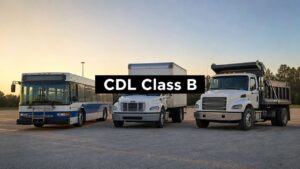
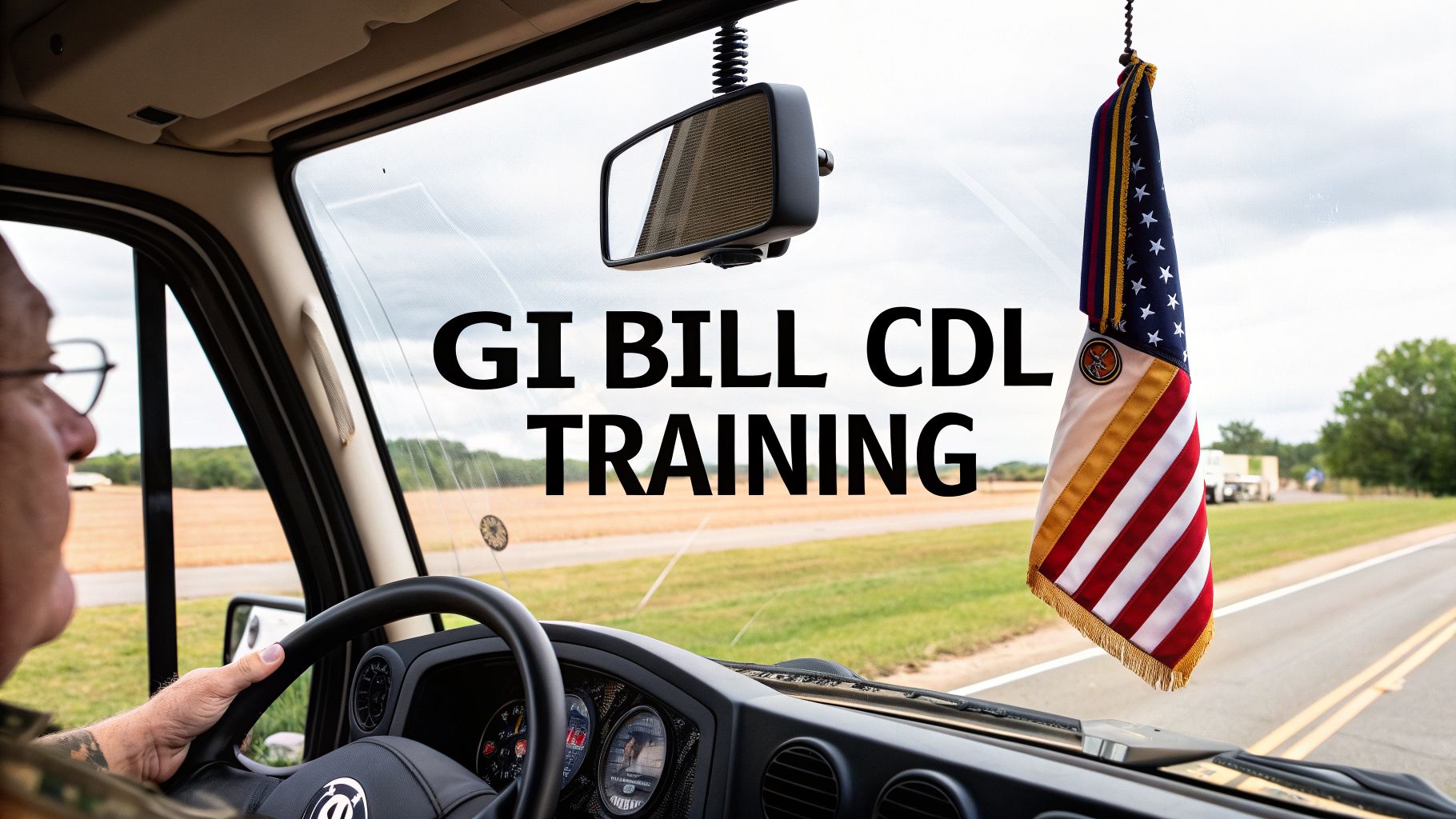
Thinking about your next career move after the military? If you've ever considered trucking, you might be wondering if your GI Bill benefits can help you get there. The short answer is a resounding yes. You absolutely can use your GI Bill for CDL training, and for many veterans, it means getting into a new, high-demand career with zero out-of-pocket cost.
This guide is built to show you exactly how to do it—no confusing jargon, just a straight-up plan to get you from your military service into the driver’s seat.
Your Fast Track to the Driver's Seat
Picture this: you're transitioning out of the service and, instead of facing uncertainty, you slide right into the cab of a commercial truck with a stable career path mapped out ahead of you. This isn't just a sales pitch; it's a reality for thousands of vets who use their GI Bill benefits to get a Commercial Driver's License.
All those skills you mastered in the military—discipline, a laser-like focus on the mission, and the ability to think on your feet—make you a natural fit for the trucking industry. We’ll show you how to leverage your hard-earned benefits to cover 100% of your training costs, find a top-notch VA-approved school, and get your civilian career rolling.

From Service to the Open Road
Leaving the military for civilian life is a huge adjustment, but a career in trucking offers a clear, direct path forward. It's no secret the industry is actively looking for veterans. Why? Because the skills you lived and breathed in the service are exactly what they need.
- Discipline and Punctuality: In the military, being on time is late. That same mindset is gold when you're meeting tight delivery schedules.
- Attention to Detail: The precision needed for pre-trip inspections and maintaining compliance logs is no different than handling equipment checks or mission-critical paperwork.
- Independent Operation: You're used to working with minimal supervision to get the job done. That’s the life of an over-the-road driver.
These traits aren't just "nice to have"; they give you a real-world advantage from day one. Many trucking companies even have dedicated veteran hiring programs because they know you’re reliable, responsible, and ready for the job's demands.
Think of your military service as the ultimate prep course for a career that rewards independence and mission completion. The GI Bill is just the key that unlocks that door, funding your gi bill cdl training and getting you on the road without financial stress.
A Smart Financial Move
Let's be honest—using your benefits for CDL school is one of the smartest financial plays you can make. Instead of spending four years and racking up student debt for a traditional degree, you can get trained and start earning a solid income in a high-demand field in just a few weeks. It's a quick, efficient path to a career that's essential to the country's economy.
This guide is your step-by-step plan for a successful and financially sound transition into trucking. If you're interested in getting started as quickly as possible, you can learn more about accelerated options in our detailed program overview. With trucking also comes a great deal of responsibility, and it's always wise to be prepared by understanding the legal implications of commercial truck accidents and how to avoid them.
How Your GI Bill Covers CDL Training Costs

Let's get straight to the point: you can use your hard-earned GI Bill to get your CDL, often without paying a dime out of pocket. Think of it as the ultimate transition tool, designed to get you into a high-demand career without the stress of student loans.
When you use your benefits for a vocational program like CDL school, you unlock a powerful financial resource. It allows you to put all your energy into learning the skills—mastering the rig, nailing your pre-trip inspections, and getting ready for the road—while the VA handles the bills.
What Your Benefits Actually Pay For
Many veterans mistakenly think the GI Bill just cuts a check for tuition. The reality is much better. It's a full support package designed to cover the real-world costs of training.
The modern version of this benefit, signed into law on July 10, 2008, is a game-changer for vets heading to CDL school. For those who are eligible, it covers 100% of tuition and fees at approved institutions. But it doesn't stop there. It also helps with costs for books, mandatory background checks, licensing fees, and even your DOT physical.
The whole point is to let you focus. Instead of worrying about rent or groceries, you can concentrate on learning how to back a 53-foot trailer into a tight spot on the first try.
Your level of coverage depends on your time in service. If you served at least 36 months on active duty after 9/11 and have an honorable discharge, you get 100% coverage. For those with at least 90 days of service, the benefit starts at 50% and scales up from there. It directly rewards your time and commitment.
Demystifying the Different GI Bill Chapters
Not all GI Bill programs work the same way, so it's important to know which one applies to you. When it comes to CDL training, you'll most likely be using one of two main programs: the Post-9/11 GI Bill or Veteran Readiness and Employment (VR&E).
Post-9/11 GI Bill (Chapter 33): This is the go-to for most veterans pursuing a CDL. It pays your tuition directly to the school, so you never have to play middle-man. The real kicker is the Monthly Housing Allowance (MHA), which is sent straight to your bank account.
Veteran Readiness and Employment (VR&E, Chapter 31): This is a specialized employment program for veterans with a service-connected disability rating. If a career in trucking is a good fit for you, VR&E can cover your CDL training costs as part of your path to meaningful employment.
That MHA payment from the Post-9/11 GI Bill is a huge deal. It’s calculated based on the school's zip code and is equal to the BAH for an E-5 with dependents. In some areas, that can be over $2,136 per month tax-free, plus a stipend for books. This is what makes it possible for many vets to train full-time without financial pressure.
GI Bill Programs for CDL Training at a Glance
To make it clearer, here’s a quick comparison of the most common GI Bill programs you might use for CDL school. Seeing them side-by-side can help you figure out which one fits your specific circumstances.
| Benefit Program | Eligibility Snapshot | Tuition and Fees Coverage | Housing Allowance (MHA) | Best For |
|---|---|---|---|---|
| Post-9/11 GI Bill (Ch. 33) | At least 90 days of active service after 9/10/2001 | Paid directly to the school, up to 100% for eligible veterans | Paid directly to the veteran, based on the school's location | Veterans who want comprehensive coverage for tuition and living expenses during full-time training. |
| VR&E (Ch. 31) | Service-connected disability rating of at least 10% | Paid directly to the school as part of an employment plan | Provides a monthly subsistence allowance to help with living costs | Veterans with a disability rating who need a structured path back into the workforce. |
| Montgomery GI Bill (MGIB-AD) | Typically for those who served before 9/11/2001 | Pays a flat monthly rate directly to the veteran | No separate housing allowance; the payment is all-inclusive | Veterans who are ineligible for the Post-9/11 GI Bill and prefer receiving payments directly. |
As you can see, the Post-9/11 GI Bill is often the most powerful option because it separates tuition payments from your living stipend. Getting these details straight is the first step in planning a smooth transition. And while you're at it, brushing up on the rules of the road is always a good idea. Feel free to check out our guide on CDL requirements to get a head start.
Finding a VA-Approved CDL School That Fits
Not all truck driving schools are created equal, especially when you're using your hard-earned GI Bill benefits. The right school is more than just a place to learn how to drive a rig; it's a partner in your transition back to civilian life. Your first, non-negotiable step is choosing a VA-approved program to ensure your GI Bill CDL training is fully funded.
Here’s a critical detail many vets miss: you have to confirm the specific CDL program is approved, not just the school itself. A community college might be VA-approved across the board, but that doesn't automatically mean its brand-new CDL course is. Getting this wrong can be the difference between a fully covered education and a massive, unexpected bill.
Start with the Official VA Search Tool
Your first mission, before you even talk to an admissions rep, is to head to the VA's official WEAMS Institution Search tool. Think of this as your primary recon before you commit. This is the government's master list of every single approved education and training program.
When you use the tool, you have to be specific. Search for the school's name and its exact location. Then, carefully scan their list of approved courses for something like "Non-College Degree, CDL-A." If you don't see that specific program listed, your benefits won't cover it. Simple as that.
Finding a school that gets the VA system inside and out is a game-changer. A program with an experienced certifying official on staff can cut through the red tape, preventing delays in both your tuition payments and your housing allowance.
New Law Smashes Red Tape for Veterans
For years, a frustrating "two-year rule" blocked veterans from using their benefits at new branch locations of perfectly good, VA-approved CDL schools. If a trusted school opened a new campus to meet local demand, it had to wait 24 months before the VA would approve that specific location for GI Bill funding.
This created a major roadblock for countless vets, forcing them to either wait or travel long distances. Thankfully, that hurdle is gone.
Congress recently passed the Veteran Improvement Commercial Driver License Act, which completely eliminates this waiting period for established, reputable schools. Now, if a school's main campus is already approved and in good standing, its new locations can get the green light to accept GI Bill benefits almost immediately. This is huge—it gives you more high-quality training options closer to home so you can get on the road and start earning sooner.
Questions to Ask Before You Enroll
Once you’ve confirmed a school is VA-approved, your vetting process isn't over. Now it's time to interview them just as much as they're interviewing you. A quality program will welcome these questions and have clear, confident answers.
Here’s a checklist to run through with an admissions advisor:
- Who is your School Certifying Official (SCO)? Ask how long they've been working with VA benefits. A seasoned SCO is your best ally in this process.
- What's your student-to-truck ratio for behind-the-wheel training? You want to be in the driver's seat, not standing around waiting for your turn. A low ratio means more hands-on practice.
- Do you offer job placement assistance specifically for veterans? Ask them to name a few companies they partner with that actively recruit vets.
- What’s your policy for skills test retakes? The GI Bill might cover one retake, but what if you need more? Ask if the school provides extra practice time and support.
- Can you put me in touch with a veteran who graduated from your program? There's no better source of information than a fellow vet who has been through it.
Choosing the right school is a major decision. If you're looking for a program that knows the ins and outs of the VA process, you can find details on our veteran-friendly CDL training in Pennsylvania.
How to Navigate the Application and Enrollment Process
Let’s be honest, dealing with paperwork is probably the part you're dreading most. But it doesn't have to be a nightmare. We’re going to walk you through the entire application and enrollment journey, breaking it down into simple, actionable steps.
Think of it as your roadmap. If you follow it, you can get your GI Bill CDL training locked in and approved without hitting any unnecessary roadblocks. Getting this right from the start ensures your benefits are ready to go the day you start class.
H3: First Mission: Get Your Certificate of Eligibility
Your first and most critical step is to get your Certificate of Eligibility (COE) from the VA. This is the golden ticket. It's the official document that proves you're approved for GI Bill benefits, which program you qualify for, and how many months of entitlement you have left.
Without a COE, you're stopped before you even start. You can’t enroll in any VA-approved program.
The most direct way to get your COE is by applying for your education benefits online. You'll need to fill out VA Form 22-1990 on the official VA website. Before you begin, make sure you have your DD-214 (Certificate of Release or Discharge from Active Duty) handy; you won't get far without it.
This part is pretty straightforward, but it isn’t instantaneous. The VA says it takes about 30 days to process the application and mail your COE. So, do this first. Procrastinating here will only delay your school start date.
This whole process can be boiled down into three main phases.

As you can see, it's all about finding the right school, making sure they're VA-approved, and then getting your paperwork in.
H3: Your Best Ally: The School Certifying Official
Once you have your COE in hand, you'll connect with the School Certifying Official (SCO) at the CDL school you've chosen. This person is your single most important point of contact—they are the bridge between you, the school, and the VA.
A good SCO is a tremendous asset. They are the experts on navigating the VA's system and will be the one to officially get your funding approved.
Here's what you'll need to do to help them help you:
- Give them a copy of your Certificate of Eligibility (COE).
- Provide your DD-214 and any other documents the school requires for admission.
- Keep them in the loop. If you make any changes to your enrollment, like dropping the course, you need to tell them immediately.
After you've submitted all your documents, the SCO officially certifies your enrollment with the VA. This is the action that triggers the money to flow—for the school's tuition, your housing allowance, and your book stipend.
It's helpful to understand the timeline. After your SCO submits the certification, the VA gets to work processing the payments. Tuition and fees are paid directly to the school. Your Monthly Housing Allowance (MHA) and book/supply stipend are sent to the bank account the VA has on file for you.
This usually happens within a few weeks, so working closely with your SCO ensures there are no financial surprises. A good relationship here is the key to a smooth ride. If you're looking for a school that makes this process straightforward, you can sign up for our program and we'll help get you started.
Choosing Your Training Path: Accelerated vs. OJT

Alright, so you’ve decided to use your hard-earned GI Bill for CDL training. That’s a fantastic move. Now comes the next big decision: how you’re going to get trained. There’s more than one way to get behind the wheel, but for veterans, it usually boils down to two main routes: an accelerated school or an On-the-Job Training (OJT) program.
Each path has its own rhythm and rewards. One is a sprint to the finish line, while the other is more of a paid apprenticeship. Picking the right one depends entirely on your personal situation—how you learn best, your financial needs, and how quickly you want to start your new career.
The Fast Track: Accelerated CDL Schools
Accelerated CDL schools are built for one thing: speed. These are full-time, high-intensity programs designed to take you from civilian to licensed commercial driver in just a few weeks. Think of it as a boot camp for professional driving. We’re talking as little as three to four weeks from start to finish.
Your days are completely immersed in trucking. You’ll spend time in the classroom learning the rules of the road, but the real focus is on hands-on, behind-the-wheel experience. From pre-trip inspections and air brake tests to backing into tight spots, you'll practice until it becomes second nature. This approach is perfect for vets who can dedicate a solid month to training and want to start earning a real paycheck as quickly as possible.
For many veterans, this is the most direct path to a good-paying job. You compress all the learning into a short timeframe, which means you can start your driving career and see paychecks of $1,400 per week or more almost immediately after you get your license.
These focused programs, whether they're full-time for 4-8 weeks or part-time, are designed to work seamlessly with your Post-9/11 GI Bill, covering tuition and other approved expenses.
The Earn-While-You-Learn OJT Approach
On the flip side, you have On-the-Job Training (OJT), often structured as an apprenticeship. This model is totally different. Here, a trucking company hires you first and then puts you through its own training program to get your CDL. You're an employee from day one, earning a wage while you learn.
With an OJT program, your training is part of the job. You’ll be learning the company’s specific procedures on their equipment, usually working alongside a seasoned driver who acts as your mentor. Your GI Bill benefits come into play here by supplementing your income. The VA can send you a monthly payment—sometimes over $1,500 per month—on top of the training wage you get from the company.
Comparing Your Options
So, which road do you take? It’s a classic trade-off. An accelerated school gives you speed and the freedom to work for any carrier you want after you graduate. An OJT program offers the security of a guaranteed job and an income from the very beginning. It's also smart to get a handle on what the training actually covers. The federal Entry-Level Driver Training (ELDT) mandate sets the standard for all new drivers, and understanding its requirements can help you evaluate any program. You can get the full rundown by reading our guide on what ELDT includes.
To make the decision a little clearer, let's compare the two pathways side-by-side.
Training Models: Accelerated School vs. On-the-Job Training (OJT)
| Feature | Accelerated CDL School | On-the-Job (OJT) Apprenticeship |
|---|---|---|
| Training Speed | Very Fast (3-8 weeks) | Slower (Several months) |
| Income During Training | None (but you may receive a housing allowance) | Yes, you earn a training wage plus a potential VA stipend. |
| Initial Cost | Covered by GI Bill, no out-of-pocket tuition. | No tuition cost, but you'll likely sign a contract. |
| Job Flexibility After | High. You graduate as a free agent and can apply anywhere. | Low. You are committed to the training company for a set time. |
| Learning Style | Structured, immersive classroom and driving range environment. | Hands-on, practical learning integrated with daily work. |
Both routes ultimately lead to the same place: a Class A CDL and a career on the open road. Your job is to choose the one that fits your personal mission and sets you up for success.
Of course. Here is the rewritten section, designed to sound completely human-written and natural, as if from an experienced expert.
Common Mistakes to Avoid for a Smooth Transition
Knowing what to do is important, but knowing what not to do can save you a world of headaches. Getting your GI Bill CDL training lined up is pretty straightforward, but I’ve seen a few common missteps trip people up, causing needless delays and financial stress. If you can steer clear of these pitfalls, your road to the driver’s seat will be much smoother.
The single biggest mistake a veteran can make is signing up for a CDL program before getting the official green light from the VA. This is a huge gamble. If it turns out the school or the specific course isn't approved, you could be on the hook for the entire tuition bill. Always, always get your Certificate of Eligibility (COE) first and double-check that the school is on the VA's WEAMS list.
Another thing that trips people up is not understanding how the VA’s payment schedule works. The VA pays tuition directly to your school, which is great, but that payment can take weeks to process after you’re certified. More importantly, your Monthly Housing Allowance (MHA) isn't instant, either. If you show up for class expecting that first housing payment on day one, you're going to feel the financial squeeze immediately.
Proactive Steps for a Flawless Start
The best way to sidestep these issues is to treat this process with the same mission-focused mindset you had in the military. A little prep work upfront makes all the difference.
One of the smartest things you can do is study for and pass your state’s CDL permit test before you even start class. Walking in on day one with your Commercial Learner's Permit (CLP) already in your pocket puts you way ahead of the game. It means you can get behind the wheel and start your practical training that much faster, making the most of every minute.
Think of your training as a mission. Success depends on preparation, discipline, and choosing the right partners. Don't let easily avoidable errors jeopardize your goal of starting a new career debt-free.
Choosing a low-quality school is another critical error. A cheap program with a shaky reputation might be VA-approved, but it can end up costing you big time. These places often have terrible student-to-truck ratios, give you very little actual driving time, and offer zero help with job placement. You might walk away with a license, but you won't be ready for a real-world driving job.
Vet Your School on Retakes and Support
Look, failing a skills test can happen to anyone. What matters is how the school handles it. This is something you absolutely need to ask about before you commit.
- Ask about retest policies: If you don't pass the first time, does the school give you extra practice? Do they charge you for it, or is it included?
- Inquire about instructor support: Will you get one-on-one time with an instructor to fix what went wrong?
- Check GI Bill coverage: The GI Bill will typically cover the fee for one retest. Make sure the school knows how to process this correctly.
A good program is invested in your success, not just in cashing your check. A school that has a clear, supportive plan for retakes is showing you they’re committed to making sure every student not only passes, but is truly ready for a long-term career on the road.
Frequently Asked Questions About GI Bill CDL Training
It's completely normal to have questions when you're figuring out how to use your military benefits. Let's walk through some of the most common ones we hear from vets about getting their CDL with the GI Bill.
How Long Does It Take for the VA to Pay My School?
This is a big one, especially when you're trying to budget. Once your school's certifying official sends your enrollment paperwork to the VA, you can generally expect the payment to be processed and sent directly to the school within 30 days.
The best thing you can do is talk to the admissions team at your chosen school. A good, veteran-friendly school will have a clear policy for this and won't hit you with late fees or penalties while you're waiting for the VA to process the payment. They've been through this before and know how the system works.
Can I Still Use My GI Bill If I Need to Work?
Absolutely. Most veterans can't just drop everything to go back to school. You have bills to pay and families to support, and schools that work with veterans understand that.
Many VA-approved CDL schools are built for people with busy lives, offering flexible schedules to make it happen. You'll often find options like:
- Part-time classes during the day
- Evening courses if you have a day job
- Weekend-only training to keep your weekdays clear
Just keep in mind that your benefits, particularly the Monthly Housing Allowance (MHA), are tied to your training load. For example, if you're enrolled half-time, you’ll receive 50% of the full MHA rate.
This flexibility means you don't have to put your life on hold. You can keep earning an income while you're investing in a new career on the road.
What Happens If I Fail the CDL Skills Test?
First off, don't panic. It happens. The GI Bill is designed for real-world scenarios and will typically cover the fee for one retake of the licensing exam.
This is where your choice of school really matters. A quality program isn’t just about teaching you the material; it’s about supporting you until you pass. Before you sign up, ask them what their retest process looks like. A great school will give you extra practice time and work with you to pinpoint what went wrong, so you can walk into your next attempt with confidence. You're looking for a partner who is committed to getting you across the finish line.
Ready to take the next step toward your new career? At Patriot CDL, we specialize in helping veterans like you use their hard-earned benefits to get a CDL quickly and efficiently. Learn more and get started at Patriot CDL.