Starting CDL training is exciting right up until you stand next to a tractor-trailer for the first time. Then the size of the truck gets very real. New students usually worry about the same things. Will I miss a mirror check? Will I grind gears? Will I freeze when I have to back into a tight space with an instructor watching?
That’s where driver simulator training fits in. It gives students a place to make early mistakes without traffic, damage, or panic getting in the way. Used correctly, it doesn’t replace real truck time. It prepares you for it, so the first drive feels familiar instead of overwhelming.
For students who want to finish training fast, pass the skills exam, and get to work, that matters. A simulator lets instructors build habits before those habits become expensive problems on the range or road.
Your First Day Behind the Wheel Without Leaving the Classroom
A lot of students walk in with book knowledge but no real sense of how a combination vehicle moves. They may have studied air brakes, weight shifts, and turning space, yet still feel stuck when they picture themselves in the driver’s seat. That gap between knowing and doing is where many beginners lose confidence.
A simulator closes part of that gap on day one.
You sit down, adjust the seat, look at the mirrors, put your hands on the wheel, and start learning the routine in order. You can practice scanning, lane position, stopping distance, turns, and backing logic before you ever roll an actual truck into a live training yard. That first exposure matters because anxiety drops when the cab layout and control flow stop feeling new.
Why the first session matters
The first challenge in CDL school usually isn’t intelligence. It’s overload. Students are processing vehicle size, mirror use, instructor commands, gear patterns, traffic signs, and nerves all at once.
A simulator lets an instructor slow that down.
- Cab familiarity: You learn where to look and what to touch before road pressure kicks in.
- Repeatable basics: If you miss a step, the instructor resets the scenario and you do it again.
- Controlled stress: Students can practice hard situations without worrying about clipping a cone or holding up traffic.
Practical rule: Confidence doesn’t come from hype. It comes from repetition in the right order.
Some learners also do better when classroom teaching includes digital tools. If you want a broader picture of how structured online instruction works, this MEDIAL guide to virtual classrooms gives useful context for how technology supports step-by-step learning.
Before any driving starts, students still need the written side handled. Studying for the permit is part of the process, and a solid general knowledge test prep resource helps build that foundation so simulator sessions make more sense.
What Is Modern Driver Simulator Training
Modern driver simulator training gives CDL students a place to build driving habits before every mistake carries a real cost in the truck, the yard, or traffic. In a strong program, the simulator is used to teach what beginners usually struggle to organize at first: where to look, when to react, how to sequence each step, and how to stay calm when several tasks hit at once.
A good comparison is a flight simulator for pilots. The goal is not to replace the aircraft. The goal is to make the first hours in the aircraft more productive. CDL training works the same way. If a student has already practiced scanning mirrors, setting up a turn, responding to a hazard, or working through a backing sequence in a simulator, the first live repetitions usually go faster and make more sense.
That matters for ROI. Students are not paying for entertainment. They are paying to graduate quickly, pass the CDL exam on the first try, and start earning sooner.

The parts that make it work
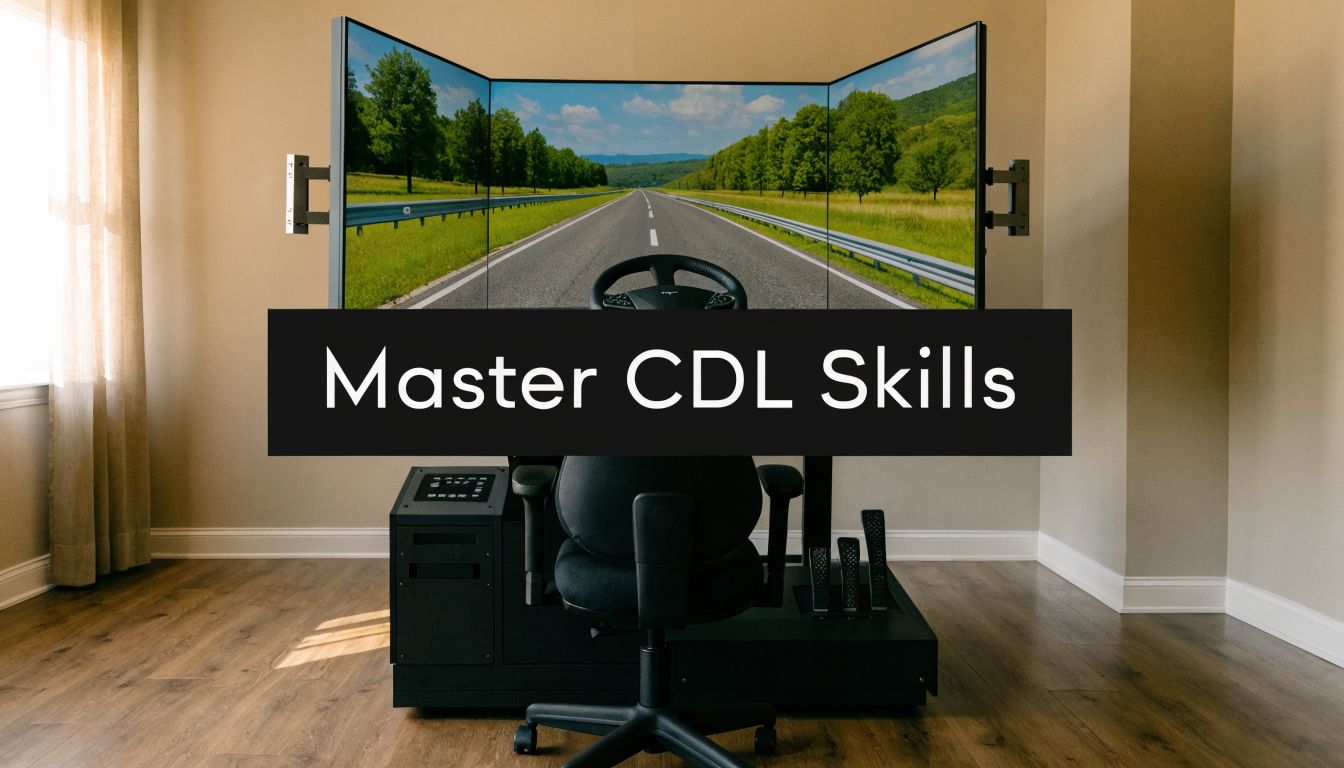
A modern simulator is a training station made of several pieces that support each other:
- Wide visual display: Students need enough road view to judge lane position, turning space, mirror timing, and traffic movement.
- Truck-style controls: Steering, pedals, and shifting inputs should feel close enough to truck operation that timing practice carries over.
- Scenario software: Instructors can load intersections, weather, traffic, hazards, backing drills, and skill-specific exercises on demand.
- Recorded feedback: The system captures lane position, braking, speed control, missed checks, and other actions so the instructor can coach specific mistakes.
This structure helps students answer a basic question: “What exactly did I do wrong?” In a truck, beginners often know a run felt messy but cannot identify the missed mirror check or the late steering correction that caused the problem. A simulator makes those errors easier to isolate and repeat until the sequence becomes consistent.
Why fidelity matters
The most important difference between a serious training simulator and a basic desktop setup is fidelity. Fidelity means how closely the simulator matches the actual driving task.
For CDL students, that includes the field of view, mirror behavior, steering response, pedal timing, and the way the road scene develops. If those pieces are too far from real truck operation, the practice becomes less useful. Analysts at the University of Iowa’s National Advanced Driving Simulator found that higher-fidelity systems produced better training outcomes than low-fidelity setups in commercial driver training, as described in this commercial driver simulator study from the University of Iowa.
Here is the simple version. A narrow screen can teach rules. It usually cannot teach spatial judgment well enough for trailer tracking, turn setup, or mirror-dependent maneuvers. Truck students need both.
What simulators do well, and what they do not
A simulator is strongest when the lesson depends on sequence, timing, attention, and repetition. It can help students build the habit of checking mirrors before a lane change, recognizing a hazard early, or setting up a backing move in the right order. Those are the same habits that affect road-test performance and first weeks on the job.
A simulator does not replace seat time in an actual truck. Students still need real vehicle feel, real yard reference points, and real road experience with an instructor beside them. Schools that use simulators well treat them as a multiplier for hands-on training, not a substitute for it.
That approach also helps returning students. Someone coming back after time away from trucking may benefit from a CDL refresher course with simulator-supported practice before jumping back into full on-road sessions. It shortens the relearning curve and helps rusty habits show up early, while corrections are easy to make.
At Patriot CDL-style programs, that is the practical value of modern simulator training. It organizes early skill-building, cuts down wasted repetitions, and helps students reach live truck training better prepared to pass their exams and get to work.
The Real Benefits and Limitations for CDL Students
You sit down for a simulator session on Monday morning. By lunch, you have already worked through a missed downshift, a bad backing setup, a sudden lane closure, and a wet-road stop. In a real truck, those same repetitions would take far more scheduling, yard time, and reset time. That difference matters to CDL students because faster correction early often means faster progress later.

A good simulator helps you compress the learning curve. It works like a flight trainer for the first stage of skill-building. You can repeat the same setup until the sequence starts to feel familiar, then carry that familiarity into the yard and onto the road. For students at schools like Patriot CDL, that can improve return on tuition and time. You spend fewer early truck sessions figuring out basic order and more time refining the parts that affect your exam score.
That is the first real benefit. Simulators save live truck time for skills that need live truck feel.
Where students usually gain the most
CDL students tend to improve fastest in areas where mistakes come from timing, order, or attention rather than raw vehicle feel.
- Backing setup: You learn where to place the truck before the move starts, which is often the difference between a clean attempt and a messy one.
- Hazard response: Instructors can trigger a cut-off vehicle, poor visibility, or a fast-developing problem without putting anyone at risk.
- Shifting sequence: You can practice the pattern and rhythm before adding the stress of a real drivetrain.
- Mirror discipline: Repetition helps students stop staring forward and start scanning like a professional driver.
This is one reason students often feel more confident by the time they reach the on-road exam. The first time they see a situation in the truck is not always the first time they have thought through it.
For drivers returning after time away, a refresher CDL course with simulator-supported practice can shorten the re-entry period and expose weak habits before they show up in a live vehicle.
What simulators cannot teach by themselves
A simulator can teach judgment and sequence. It cannot fully reproduce weight transfer, suspension movement, clutch feel, brake feel, or the pressure that comes from managing a full-size truck in real traffic.
Students sometimes get confused here, so it helps to separate two kinds of learning. The simulator teaches the map. The truck teaches the terrain. If you only study the map, you are not ready. If you enter the terrain with no map, progress is slower and more stressful.
That is why strong CDL programs use a blended approach. Students build recognition and repeatable habits in the simulator, then confirm those habits in the truck with an instructor.
A simulator lets students correct mistakes early. The truck teaches what those corrections feel like under real conditions.
This short video gives a helpful visual sense of how simulated driver training environments work in practice:
A balanced way to judge the value
Some students hear "simulator" and assume it is either a shortcut or a gimmick. Neither view is accurate. A simulator is a training tool. Its value depends on how well the school connects it to yard practice, road practice, and test preparation.
Even outside CDL training, organizations use simulation to show how quickly attention failures can turn into costly mistakes. A public-facing example is a corporate event interactive driving experience built around distraction awareness. CDL programs apply the same core idea in a more career-focused way. They give students repeated exposure to situations that would be harder, slower, or less safe to recreate on demand in a truck.
| Training area | Simulator strength | Limitation |
|---|---|---|
| Backing logic | Repeatable visual practice | Limited physical feel |
| Hazard drills | Safe exposure to dangerous events | No actual roadway pressure |
| Shifting sequence | Fast repetition of steps and timing | Different from the exact feel of every real transmission |
| Mirror habits | Immediate correction of scanning errors | Real traffic adds more variables |
For a CDL student, the practical takeaway is simple. Simulator training can help you graduate better prepared, reduce wasted live-truck repetitions, and build confidence before the road test. It cannot replace the truck. Used well, it helps you get more out of the truck time you pay for.
How Simulators Enhance Hands-On CDL Training
A good simulator session should make your first live truck lesson feel familiar, not overwhelming. The goal is simple. Students should spend less time figuring out what the instructor means and more time doing the skill correctly.
That matters because truck time is expensive and limited. If a student already understands trailer movement, mirror sequence, hazard response order, and inspection flow before climbing into the cab, the live lesson usually moves faster and with fewer wasted repetitions. In a program focused on getting students licensed and job-ready sooner, that kind of preparation has a clear return.
Backing is a good example. In the yard, a beginner often struggles with two things at once: understanding trailer geometry and handling nerves. A simulator separates those problems. It lets the instructor slow the lesson down, show what the trailer is doing, and repeat the same setup until the student starts to recognize patterns. Small steering inputs, early mirror checks, and proper setup stop feeling random.
Pre-trip and backing practice
Pre-trip training benefits for a similar reason. Many CDL students can memorize parts of the inspection but still lose their place once an examiner is watching. A simulator gives them a controlled place to rehearse the order again and again until the sequence feels more like a routine than a speech. A detailed pre-trip inspection guide supports that same habit-building outside the simulator.

Instructors can also isolate one skill at a time so students are not trying to fix everything in one attempt:
- Straight-line backing: Students practice patience, reference points, and steady mirror use.
- Offset backing: They learn that the setup often decides whether the maneuver works.
- Alley dock work: They can repeat angle control and correction timing before yard pressure makes them rush.
Eye tracking and correction
Some modern systems add another coaching tool. They show where the student is looking during a maneuver.
That helps because many beginners believe they checked their mirrors when they only gave a quick glance, checked too late, or stayed locked on one side too long. With eye-tracking, the instructor can point to a specific missed check and correct it on the next repetition. The feedback becomes concrete, which usually helps students improve faster than general reminders.
Instructor note: “Use your mirrors” is too broad for most beginners. “Check your right mirror before you start the correction” gives the student something clear to do on the next attempt.
Defensive habits before road pressure
Simulators also let instructors run traffic problems on purpose. A pedestrian steps out. A car cuts in. Rain reduces visibility. A lane closes with little warning. In a real truck, those situations show up when they show up. In a simulator, the instructor can call them up on demand and coach the response sequence until the student stays calmer and more organized.
That is one reason simulator time can improve a student's return on tuition. Students who have already practiced these decisions indoors often need less explanation once they reach the road portion, and that can support faster progress toward graduation and stronger confidence for the exam.
If you want a simple outside example of how interactive driving experiences can teach attention and response, this corporate event interactive driving experience shows the broader concept in public training, even though CDL instruction goes much deeper.
The simulator builds the mental pattern. The truck confirms it under real conditions.
Simulator Training and Your CDL Requirements
You start CDL school on Monday. By Friday, you want to know one thing. Will simulator hours help you get licensed sooner, or are they just extra classroom time?
They help when they are used the right way.
Simulator training can count as part of a legal training program, but it does not replace all behind-the-wheel instruction. CDL students still need real truck time to build control, judgment, and test-ready performance under live conditions. The exact mix depends on the school’s training design and on state and federal rules, so the smart question is not “Does a simulator replace driving?” The smart question is “Which parts of training can I learn faster in the simulator so my truck time is used better?”
That distinction matters for your return on tuition.
A simulator is good for repeatable practice. You can run the same backing setup, hazard response, or pre-trip sequence several times in a row and fix the same mistake before it becomes a habit. A real truck is where you confirm those skills under actual road conditions, with real space, timing, traffic, and vehicle movement.
What students often get wrong
Some students hear that simulators are approved in training programs and assume that means they can complete the whole CDL path indoors. That is not how the licensing process works.
A better way to view it is this. The simulator is the flight trainer. The truck is the actual aircraft. A pilot would not skip real flying, but no serious pilot wants to waste expensive flight time learning the basics from scratch. CDL training works much the same way.
Used properly, simulator sessions help students build:
- Order and routine, such as pre-trip flow and response steps
- Visual discipline, such as mirror checks and scanning patterns
- Consistency, because the same task can be repeated until it becomes more natural
The truck portion still carries the weight of real-world execution. That includes managing vehicle feel, live traffic interaction, braking judgment, lane position, and the pressure of performing while an examiner watches.
Why this can shorten the path to your CDL
Students do not graduate faster because they skip practice. They graduate faster because the practice is organized in the right order.
If a student learns inspection flow, mirror timing, and basic maneuver setup in the simulator first, the first truck sessions can focus more on correction and less on basic orientation. That usually means fewer wasted reps and steadier progress toward the road test. For many students, that also means better confidence on exam day, which can improve the odds of passing on the first attempt and getting to work sooner.
If you want to review how simulator-supported instruction fits inside the required training path, Patriot CDL’s ELDT training overview is a useful place to start.
The schools that get the best results do not treat simulators as a shortcut. They use them as a way to make every hour in the truck count more.
What to Expect from Simulator Training at Patriot CDL
Your first simulator session usually feels a lot like your first lab in a skilled trade. You are in a controlled setting, but the work is still real. The instructor sets up the exercise, explains what skill you are practicing, and watches how you respond before stepping in with corrections.

At Patriot CDL, that first run gives the instructor a baseline. Can you keep your eyes moving? Do you check mirrors early or after the problem has already developed? Do you set up a backing maneuver with a plan, or do you start correcting too late? Those details matter because they often explain why one student needs ten truck reps to learn a pattern and another needs four.
Then the session becomes much more specific.
Instead of broad feedback, you get corrections tied to moments you can see and remember. An instructor may stop the review at the exact point where your lane position drifted, where you missed a mirror check, or where your backing angle got away from you. That shortens the learning loop. You make the mistake, understand it, and try again while the sequence is still fresh.
A common progression looks like this:
- First attempt: You oversteer, rush the setup, or forget part of your scan pattern.
- Instructor review: The instructor shows what happened, why it happened, and what to change on the next run.
- Second attempt: Your steering gets calmer, your checks happen earlier, and the maneuver starts to look more organized.
- Repeat and stabilize: The goal is not one lucky run. The goal is a habit you can repeat on command during the CDL exam.
That matters for your return on training time. Students do not save time because training gets easier. They save time because weak spots show up sooner, which lets instructors correct them before truck hours are spent on preventable mistakes. For a student trying to graduate quickly, pass on the first attempt, and get to work sooner, that is the essential value.
If you want to see how simulator work fits into the full schedule of classroom, range, and road instruction, the Patriot CDL training program overview shows how those pieces are organized.
Students also learn that simulator training is not one-size-fits-all. One student may need extra work on backing sequence and reference points. Another may be comfortable with maneuvers but weak on mirror rhythm and hazard recognition in traffic. The simulator helps instructors diagnose that early, so your practice plan matches the skill that needs attention most.
By the time you move back into the truck, you should not be guessing about the order of the task. You should be using truck time to refine it under real conditions. That is how simulator training helps Patriot CDL students build confidence, protect their training hours, and reach the road test better prepared.
Frequently Asked Questions About Driver Simulators
Students usually don’t need more hype by the end of the conversation. They need clear answers.
Common questions
| Question | Brief Answer |
|---|---|
| Is a driver simulator just a video game? | No. A training simulator is built to teach driving habits, decision-making, and procedural skills with instructor oversight. |
| Can simulator time replace all truck driving time? | No. Simulators support training, but they don’t fully replace required behind-the-wheel instruction. |
| Will simulator training help with the CDL test? | Yes, especially for backing logic, hazard awareness, and control sequence before live practice. |
| Are simulators good for nervous beginners? | Yes. They reduce first-day stress because students can learn the cab routine and skill sequence in a controlled setting. |
| Do experienced drivers benefit too? | Yes. They can use simulator sessions to fix habits, refresh rusted skills, or practice specific maneuvers. |
Short answers to the concerns students bring up most
Some students worry that simulator practice won’t feel real enough to matter. It won’t feel identical, but that’s not the standard. The question is whether it helps you arrive at truck training with better habits, and in many cases it does.
Others ask if simulators are mostly for weak students. They aren’t. Strong students use them to sharpen timing and reduce wasted attempts. Nervous students use them to slow things down and get comfortable.
The best students don’t avoid repetition. They look for the safest way to get more of it.
One last question comes up often. Can simulator practice make you overconfident? It can, if a school treats simulation as a complete substitute for real driving. Good instruction prevents that by connecting every indoor lesson to actual yard and road performance.
Patriot CDL helps students move from permit prep to hands-on CDL training with a practical, accelerated approach built for real job entry. If you want a faster path into trucking with structured support for the written test, skills practice, and road exam prep, visit Patriot CDL.