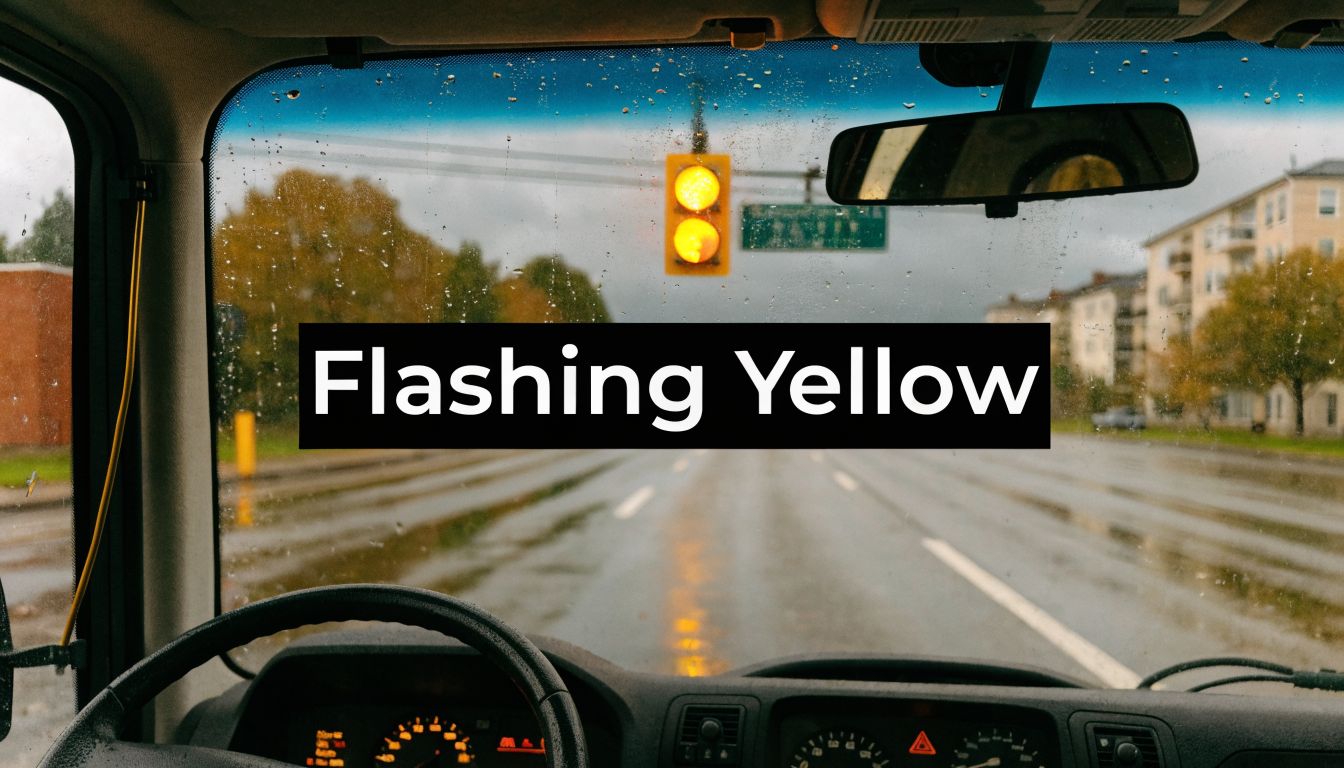
You’re rolling toward an intersection in a loaded truck. Rain is on the windshield, traffic is moving fast, and the signal ahead starts a yellow light flashing pattern. A car driver might treat that as a quick caution and move on. In a commercial vehicle, it’s a judgment call with more weight behind it.
You have more mass, more blind spots, more off-tracking, and less room for error. You also have to think like a test-ready professional. The examiner isn’t just watching whether you move. They’re watching whether you recognize risk, yield correctly, and control the truck with patience.
Your First Test Before the Official Test
A new CDL student usually reaches this lesson before they realize how often it shows up in real driving. You can know backing, shifting, and lane control, then still get into trouble at an intersection because a flashing yellow looks simple when it isn’t.
When you see a yellow light flashing, you’re being asked to make a decision, not follow an automatic command. That matters in a truck. If you guess wrong, you may stop too late, turn too wide, or force another driver to brake.

A good student handles this the same way they handle a full pre-trip inspection routine. They slow down, read the situation, and act on purpose. That mindset keeps you safe and helps you pass the exam.
What makes this harder in a truck
A flashing yellow for a sedan often means minor adjustment. For a tractor-trailer, it can mean:
- Longer decision space because you need more room to slow smoothly
- Bigger turning path because the trailer doesn’t follow the tractor exactly
- More scanning because mirrors, crosswalks, and opposing lanes all matter at once
- Higher legal risk because failure to yield is easy for an examiner to spot
Practical rule: If the signal gives you permission to continue only with caution, your first move is to reduce speed and gather information, not commit to the maneuver.
What you need to know before test day
You need to separate three different ideas that many beginners blend together:
- A flashing yellow traffic signal means caution, not a free pass.
- A flashing yellow arrow usually means a permitted turn after yielding.
- Your truck’s own flashing yellow or hazard lighting serves as a warning to others, not a substitute for safe driving decisions.
That distinction is where a lot of test mistakes begin. Students memorize one short phrase, then apply it everywhere. The examiner wants more than that. They want to see that you know who has the right-of-way, when to wait, and how truck size changes the decision.
Decoding Flashing Yellow Traffic Signals
The most common confusion starts with shape. A circular flashing yellow and a flashing yellow arrow are not the same signal, even though both require caution.

Circular flashing yellow
A circular flashing yellow usually means you may continue with caution. It does not automatically require a full stop, but it does require you to slow, scan, and be ready to stop if conditions demand it.
For a CDL student, that means your eyes should move in a pattern:
- Ahead first for traffic entering or slowing unexpectedly
- Left and right for cross traffic or late movers
- Crosswalk areas for pedestrians
- Mirrors if you may need to slow abruptly
If the intersection is crowded, wet, poorly lit, or visually messy, caution becomes more than a word. It becomes a slower approach and a delayed commitment.
Flashing yellow arrow
A flashing yellow arrow is most often used for a left turn. It means you may turn left, but only after yielding to oncoming traffic and pedestrians. It is a permitted turn, not a protected one.
That matters because some students see the arrow and think the signal is favoring them. It isn’t. It’s allowing the turn when the path is clear.
On a road test, a calm wait is almost always better than a rushed left turn.
The reason traffic engineers like this signal is that it has produced measurable safety benefits. The flashing yellow arrow can reduce total left-turn crashes by up to 39% and has shown benefit-cost ratios as high as 144:1 according to the FHWA-related summary on flashing yellow arrows and yellow trap history.
Who you yield to
At a flashing yellow arrow, new drivers often ask one question wrong. They ask, “Can I go?” The better question is, “Who still has priority over me?”
Use this quick reference:
| Signal | What it means | Who you yield to |
|---|---|---|
| Circular flashing yellow | Proceed carefully if safe | Anyone already creating a hazard, including pedestrians |
| Flashing yellow arrow | Left turn is permitted if safe | Oncoming traffic going straight, pedestrians, and others lawfully in the intersection |
Why examiners care
Your road examiner isn’t grading your bravery. They’re grading your judgment. If you creep into the intersection too aggressively, cut off oncoming traffic, or fail to check for a pedestrian, that tells the examiner you don’t understand a basic right-of-way rule.
For written prep, it helps to review signal questions in a focused way, especially in the general knowledge test practice area. The wording on test questions changes, but the rule stays steady. Flashing yellow means caution. Flashing yellow arrow means yield, then turn only when clear.
Using Your Vehicle's Flashing Yellow Lights
There’s a second kind of yellow light flashing every CDL student needs to understand. This one is on the vehicle, not above the road.

When your truck uses warning lights, you are communicating hazard, reduced normal movement, or temporary danger to other road users. That could happen on the shoulder, during a breakdown, near a work area, or in another situation where you need extra visibility.
Why these lights matter
Commercial warning beacons are built to be seen. MUTCD-compliant 12-inch solar LED beacons, often used on commercial vehicles, flash at 50 times per minute with a 7,000 mcd luminous intensity, ensuring visibility up to 1,640 feet even in low-power situations as described in the technical product specifications for these yellow beacons.
You don’t need to memorize every technical detail for the CDL test. You do need to understand the practical point. These lights are designed so other drivers notice you early.
When to use them
Think of your warning lights as a message to traffic behind and around you. Common situations include:
- Stopped in a hazardous location where approaching drivers need extra notice
- Disabled or limited mobility when your vehicle can’t move normally
- Temporary roadside exposure during a situation that increases collision risk
- Slow or unusual operation when your truck is creating an unexpected traffic condition
What you should not do is treat warning lights like permission to block lanes, stop carelessly, or continue driving without a plan. They support safety. They don’t replace it.
A short legal explainer can also help when you want to understand how fault gets argued after an intersection event. Mattiacci Law on yellow light fault is useful because it shows how right-of-way and driver judgment become central after a crash.
Make your warning visible and credible
Drivers trust warning lights when the rest of your behavior matches the signal. If your flashers are on, your positioning, speed, and lane use should all make sense.
This demonstration is a helpful visual reference:
Your lights say, “Notice me.” Your vehicle control has to say, “I know what I’m doing.”
Truck-Specific Actions at a Flashing Yellow
A passenger car can often recover from a late decision with a quick brake or a quick turn. A combination vehicle can’t. That’s why a professional response to yellow light flashing has to account for truck physics, not just traffic law.
Stopping distance changes the whole decision
A beginner in a semi often arrives at a flashing signal carrying too much speed for the amount of information available. That creates pressure. You feel like you have to decide now.
You don’t.
NHTSA data from 2025 reports an 18% higher intersection crash rate for Commercial Motor Vehicles at flashing signals, tied in part to longer stopping distances and trailer swing, according to the CMV flashing-signal summary cited here. Even if you don’t use that number on test day, the lesson behind it is critical. Trucks need earlier decisions.

How to handle a flashing yellow left turn in a tractor-trailer
When you’re turning left on a flashing yellow arrow, don’t judge the gap like a car driver would. Your truck accelerates slower, occupies more space, and stays exposed longer.
Use a truck-focused process:
- Reduce speed early. Don’t roll in hot and hope the gap appears.
- Square the approach. Set up the tractor so you can see oncoming traffic clearly.
- Watch the crosswalk before the gap. A pedestrian can cancel a good traffic gap.
- Commit only when the trailer can clear. Don’t think only about the tractor nose.
- Finish the turn without cutting it tight. Protect the trailer path.
Trailer swing and off-tracking
The trailer is the part students forget when they get nervous. They focus on the front bumper, then turn too soon. That can drag the trailer over a curb, into a lane line, or toward a vehicle beside you.
Here’s the safer mental cue: wait a little longer, then turn a little cleaner.
A good left turn in a combination vehicle starts with patience, not steering input.
If you’re practicing articulated-vehicle control, targeted review in a combination vehicles practice test can reinforce how pivot point, tracking, and rear swing affect intersection maneuvers.
A simple decision filter
When the signal is flashing yellow, ask yourself these three questions in order:
| Question | Why it matters in a truck |
|---|---|
| Can I slow smoothly and still observe? | Prevents rushed entries |
| Is the full path clear, not just the front half? | Protects trailer and lane space |
| Can I complete the move without forcing others to react? | Shows professional right-of-way judgment |
That last question is the one examiners notice most. If another driver has to brake hard because you entered on a marginal gap, you were not “cautious,” even if you made it through.
Navigating Different State Rules and Work Zones
A CDL driver may cross multiple states in a short stretch of work, and that’s where yellow light flashing can become a rule problem instead of just a driving problem. The basic message stays close to the same, but the wording and emphasis can change enough to trip up a new commercial driver.
One source used in CDL-related discussions notes that an estimated 15% of interstate CMV violations involve intersection errors, often tied to confusion about state-specific rules and efforts to harmonize standards, as referenced in this discussion of interstate CMV signal-rule confusion.
State wording can shape driver behavior
Most states treat a flashing yellow as caution and a flashing yellow arrow as a yield condition. What changes is the emphasis. Some states stress pedestrians in the intersection. Others focus more directly on right-of-way or collision avoidance.
That difference matters when you’re tired, in unfamiliar traffic, and trying to make a left turn with a long trailer.
Flashing Yellow Arrow Rules in Key States
| State | Primary Rule | Specific Emphasis / Nuance |
|---|---|---|
| Florida | Proceed with caution after yielding | Pay close attention to pedestrians and vehicles already in the intersection |
| California | Turn is permitted only when safe | Driver responsibility is strongly tied to avoiding collision |
| Texas | Yield before proceeding | Right-of-way language is central to the decision |
| Michigan | Yield to oncoming traffic and pedestrians | More uniform phrasing around the flashing yellow arrow |
This isn’t a substitute for reading the current state manual. It’s a reminder that “I thought it meant the same thing everywhere” isn’t a strong defense.
If you’re preparing for routes or testing in the West, the California CDL guide section here can help you stay oriented on state-specific training expectations.
Work zones use flashing yellow differently
In a work zone, yellow lights often guide movement rather than regulate right-of-way in the same way an intersection signal does. That’s where pattern matters.
A random flash can warn you that something is ahead. A coordinated flash can help show you where to go.
The best response from a truck driver is deliberate lane guidance scanning:
- Read the light pattern early so you don’t make a late lane change
- Look beyond the first barrel or sign because the path may bend
- Leave extra room around workers and equipment even if traffic is flowing
- Keep your steering smooth because abrupt correction is harder in a long vehicle
Why sequential flashing matters
In work zones, the arrangement of the warning lights affects how well drivers understand the path. A sequential flash pattern for warning lights is preferred by drivers and is more effective for conveying directional information at night when paired with a temporal peak luminous intensity of 25 cd, according to the CDC-backed work-zone lighting study.
That helps explain why some temporary traffic control setups feel easier to read than others. The lights aren’t only there to say “danger.” They may also be telling you “move this direction.”
In a work zone, don’t fixate on the nearest flashing lamp. Read the whole channel the devices are forming.
Where new drivers get caught
The biggest mistake isn’t ignorance of one rule. It’s carrying the wrong rule into the wrong setting.
A student may:
- treat a flashing yellow arrow like a protected turn
- treat a work-zone flasher like a normal intersection signal
- assume every state words yielding obligations the same way
- focus on the tractor path and forget where the trailer will track
Those aren’t small errors in a commercial vehicle. They’re the kind that create curb strikes, lane encroachment, and test deductions fast.
Passing Your CDL Test with Flashing Yellows
By test day, you don’t need a speech about flashing yellow lights. You need a clean mental routine.
The written exam checks whether you know the rule. The road test checks whether you can apply it calmly in real time. Those are related skills, but they’re not identical.
What to say and do on the road test
An examiner likes to hear clear thinking. You don’t need to narrate every breath, but a short verbal check can help show awareness.
A strong approach sounds like this:
I see the flashing yellow. I’m slowing, checking cross traffic and pedestrians, yielding as needed, and proceeding only when my path is clear.
That kind of verbalization helps because it proves you recognized the signal and made an intentional right-of-way decision.
A simple exam-day checklist
Use this when approaching any yellow light flashing condition:
- Identify the signal type. Circular or arrow.
- Come off the speed. Give yourself time to read the scene.
- Scan full width. Lanes, crosswalks, mirrors, and escape space.
- Yield first. Especially on a left-turn arrow.
- Finish smoothly. No panic brake, no rushed steering, no forcing the gap.
Likely written test ideas
You may see the exact wording vary, but the questions usually target the same weak spots.
Meaning question
A flashing yellow means proceed with caution, not automatic stop and not full right-of-way.Arrow question
A flashing yellow arrow permits a left turn only after yielding to oncoming traffic and pedestrians.Work zone question
Flashing yellow warning devices in work zones are there to increase awareness and guide drivers through a temporary path.Commercial vehicle judgment question
In a truck, caution means adjusting for size, slower acceleration, larger blind spots, and trailer movement.
If you ever get cited while building your driving career, practical overviews like Ticket Shield's Florida CDL ticket insights can help you understand how traffic violations can affect a CDL holder beyond the initial stop.
Build the habit before the examiner sees it
The best students don’t wait to “perform safety” on test day. They repeat the same routine in training until it becomes automatic. That’s especially true if you’ve had time away from driving or need to rebuild confidence before the exam. A structured CDL refresher course can sharpen signal recognition, intersection judgment, and verbal road-test habits.
One final point often gets missed. Work-zone lighting isn’t trivia. If you recognize that sequential flashing helps guide direction at night, you’ll read temporary traffic control more accurately and react with less hesitation.
Passing the CDL test at a flashing yellow is rarely about doing something dramatic. It’s about showing the examiner you can slow down, sort out right-of-way, and move a large vehicle without gambling.
If you want hands-on help turning rules like yellow light flashing into road-test habits, Patriot CDL offers practical CDL training built around real vehicle control, inspection skills, and exam preparation. It’s a strong next step if you’re ready to train with instructors who understand how new drivers learn.