Your Guide to a CDL Class B License in 2026

You're probably seeing these vehicles every day without giving them much thought. A straight truck making local deliveries. A school bus on its morning route. A dump truck headed to a jobsite. Then one day, usually during a job search or a rough commute, the question pops up: could I do that for a living?

For a lot of adults, that question starts a practical career pivot. You want work that's hands-on, steady, and tied to something real. You may not want a four-year degree, and you may be done with jobs that feel like they go nowhere. A CDL Class B can fit that moment well because it leads to driving jobs that keep cities, schools, construction crews, and local businesses moving.

The problem is that many guides still make the process sound simpler than it is, or more confusing than it needs to be. They often skip the part that matters most today: training rules changed, and the path now depends on current federal standards plus the way your state runs testing.

That's why it helps to treat this like a roadmap instead of a pile of forms. If you understand what Class B means, what vehicles it covers, what the updated training rules require, and how schools and state testing fit together, the process gets a lot less intimidating.

Your Starting Line for a New Career Path

A student will often tell me the same story in different words. They were stuck in traffic, looked over, and saw someone driving a large delivery truck, city bus, or construction vehicle. That driver looked focused, skilled, and employed in a job that clearly mattered. For someone thinking about a career change, that can hit hard.

A CDL Class B is often the first serious step into commercial driving for people who want local or community-based work. You're not automatically signing up for long-haul life. In many Class B roles, the work is tied to a route, a city, a school district, a utility company, or a construction schedule.

Why this path appeals to career changers

Some students come from warehouses. Some come from retail. Some are fresh out of school and want a trade path that leads to work faster than a traditional degree route. What they usually have in common is this: they want a skill they can build, a license that means something, and a job with a clear purpose.

Class B work tends to feel concrete. You deliver materials. You move passengers. You support a crew. You keep schedules running. That matters.

Practical rule: If you like the idea of driving larger vehicles but want work that often stays closer to home, Class B is usually where the conversation starts.

What makes the process feel confusing

Individuals don't get stuck because the steps are impossible. They get stuck because the terms sound official and scattered.

Common points of confusion include:

  • License class: People mix up Class A and Class B.
  • Training rules: Older advice may ignore the post-2022 ELDT requirement.
  • State testing: The broad structure is familiar, but the exact testing setup can differ by state.
  • Job fit: Many people don't know which vehicles and careers fall under Class B.

Once those pieces are organized, the path becomes manageable. You're not trying to learn everything at once. You're moving through a sequence.

What a CDL Class B Actually Means

The simplest way to think about a CDL Class B is this: it's the license for large single vehicles, not the big tractor-trailer combinations that come to mind when hearing “truck driving.”

A Class B CDL is defined by a weight threshold of 26,001 pounds GVWR or more for a single vehicle, with any trailer generally limited to under 10,000 pounds GVWR, and that's the line commonly used to separate it from Class A vehicles like tractor-trailers, according to this Class B CDL overview.

A diagram illustrating the three different classes of Commercial Driver's Licenses, including their specific vehicle weight requirements.

Think single unit, not combination rig

If you're trying to picture the difference, use this mental shortcut.

  • Class A: Truck plus a heavy trailer.
  • Class B: One heavy vehicle doing the work itself.

That's why Class B often covers vehicles people already recognize from everyday life. You see them in neighborhoods, school zones, industrial parks, and city streets.

Common examples include:

  • School buses
  • City or transit buses
  • Dump trucks
  • Refuse trucks
  • Large delivery trucks

If you want a broader look at qualification basics, Patriot's guide to CDL requirements is a useful reference point.

Where people get mixed up

A lot of beginners focus only on what the vehicle looks like. That can lead to wrong guesses.

A boxy vehicle isn't automatically Class B. A truck with a trailer isn't automatically Class A. The legal category comes from the vehicle setup and weight rating, not just appearance. That matters because your training and testing need to match the license you're seeking.

You don't choose a CDL class by the job title alone. You choose it by the vehicle you're legally expected to operate.

Endorsements can shape your path

Many new drivers find extra opportunity. Your base Class B license may be enough for some roles, but certain jobs require additional endorsements.

You'll often hear about:

  • Passenger endorsement
  • School bus endorsement
  • Hazardous materials endorsement

The right endorsement depends on what you plan to drive and who or what you plan to carry. If your goal is bus driving, for example, the conversation is different from someone aiming for construction or municipal fleet work.

Navigating State Permit and Testing Requirements

The licensing path is federal in structure but handled through your state. That's why two students in different places can be following the same broad rules while still dealing with different offices, scheduling systems, and testing details.

A typical Class B applicant usually needs to clear a DOT medical exam, get a commercial learner's permit, and pass a three-part CDL skills test made up of a vehicle inspection, basic controls or backing, and a road test, as outlined in this Class B complete guide.

The permit stage comes before the wheel time that counts

This is one of the first points where people rush and create problems for themselves. They want to think about road driving right away, but the process starts with being medically qualified and permit-ready.

That usually means handling the early paperwork in order:

  1. Get the DOT medical exam
  2. Prepare for the written knowledge testing
  3. Obtain the commercial learner's permit
  4. Move into approved training
  5. Schedule the state skills test when eligible

If you're still sorting out the permit side, Patriot's commercial learner's permit guide can help clarify that stage.

The post-2022 change many old guides miss

This is the part that changed the game for first-time applicants.

Federal rules require new CDL applicants to complete Entry-Level Driver Training, or ELDT, before taking the CDL skills test, and that rule took effect on February 7, 2022. The training must be completed through a provider listed on the FMCSA Training Provider Registry, according to the FMCSA CDL information page.

That means you can't rely on the old approach of piecing things together informally and then showing up for the final exam. Your training record now matters in a formal way.

Important: ELDT isn't just helpful preparation. It's a gate you must clear before many applicants can move on to skills testing.

Why state details matter more now

The broad test categories are familiar, but the exact experience can still vary. A school that knows your state's current setup can save you a lot of wasted time and bad practice habits.

What students should verify early:

  • Testing location: Some states test at state sites, others work more closely with third-party setups.
  • Scheduling process: Wait times and booking methods differ.
  • Vehicle type for exam: You want training in a vehicle that matches your testing plan.
  • Maneuver expectations: Backing patterns and scoring emphasis may not look exactly the same everywhere.

That's why current, local preparation matters more than generic internet advice.

Your Step by Step Path to Certification

Most students do better when they stop treating the CDL process like a mystery and start treating it like a sequence. You're not trying to become an expert all at once. You're building one layer at a time.

The first decision is usually the most practical one: where will you train? Some people choose a community college format. Others want a shorter, more concentrated path through a private CDL school. Neither choice is automatically right for everyone. The better fit depends on your schedule, budget, learning style, and how quickly you want to move.

A five-step infographic showing the certification path for obtaining a CDL Class B professional driving license.

Step one is choosing the training setup

Some students need a slower pace because they're balancing work or family obligations. Others want an intensive format with more repetition over a shorter span. What matters is whether the school is set up to train for your license class and current compliance requirements.

When comparing providers, ask practical questions:

  • Are they listed properly for ELDT purposes?
  • Do they train specifically for Class B vehicles?
  • Will you practice pre-trip, backing, and road driving in the same kind of vehicle you'll test in?
  • Do they understand your state's current testing patterns?

Patriot's CDL training program options are one example of the kind of structured school path many students compare with longer community-based programs.

Step two is getting permit-ready

Before the road portion becomes real, you need enough theory knowledge to move through the permit process. That means learning rules, safety concepts, inspection basics, and any extra material tied to the type of work you want later.

This stage feels dry to some students, but it matters. A driver who understands the “why” behind the rules usually learns faster once they step into the vehicle.

A short training video can help you connect the process to real practice:

Step three is where confidence gets built

This is the part most students look forward to. It's also where they usually realize commercial driving is a skill, not just a bigger version of driving a car.

You'll spend time working on:

  • Pre-trip inspection routines
  • Basic control and backing
  • Turning, lane use, and mirror discipline
  • Road driving under instructor supervision

At first, students often feel overloaded by the number of checks, references, and vehicle dimensions. That's normal. Repetition fixes a lot of that. Good training breaks the work into manageable drills so you can improve without feeling buried.

Slow, clean practice beats rushed practice. Commercial driving rewards control, awareness, and consistency.

Step four is taking the skills exam

By the time you test, nothing on the exam should feel unfamiliar. Stress is normal, but surprises are what hurt people. A solid training path aims to remove surprises.

The usual testing flow includes the inspection portion, the basic control portion, and the road drive. The exam doesn't just ask whether you can move the vehicle. It asks whether you can handle it safely, communicate awareness, and operate within the standard your state expects.

Step five is transitioning into work

Once licensed, the next move is matching the license to the right first job. That could mean local delivery, bus work, municipal fleets, construction support, or another route tied to single-unit commercial vehicles. The strongest first job isn't always the flashiest one. It's the one that lets you keep building skill.

Costs and Career Opportunities with a Class B License

The money question matters, but it helps to frame it the right way. Don't just ask what training costs. Ask what kind of work the license prepares you to do, how quickly you can move into that work, and whether the day-to-day schedule fits your life.

Because pricing varies by school, location, vehicle type, endorsements, and state fees, the smartest approach is to compare complete training packages rather than chasing the cheapest sticker price. A lower quote doesn't always include the support, documentation help, or test-focused preparation that saves time later.

What you're really paying for

With Class B training, students are paying for more than truck time. They're paying for guided preparation through a regulated process.

That often includes:

  • Compliance support: Help staying aligned with permit and training requirements.
  • Instructional time: Classroom or theory work plus hands-on vehicle training.
  • Test preparation: Focused practice on inspection, maneuvers, and road performance.
  • Vehicle access: Use of the proper vehicle for training and often for testing logistics.

If you're interested in construction-related driving paths, this highway construction job guide gives helpful context on the kinds of jobs and work settings that often connect well with Class B vehicle experience.

The kinds of jobs a Class B can open

One reason people choose Class B is the range of local or regional work tied to it. The jobs differ, but many share something attractive: they support industries people rely on every day.

Job TitleWork EnvironmentEstimated Salary Range (2026)
Local delivery driverCity routes, warehouses, retail delivery networksVaries by employer, route, and vehicle type
Dump truck driverConstruction sites, paving crews, material haulingVaries by project type and region
School bus driverSchool districts, contracted student transportationVaries by district and endorsement needs
Transit or shuttle driverMunicipal routes, passenger transport, local servicesVaries by agency and schedule
Refuse truck driverResidential streets, sanitation routes, municipal workVaries by municipality or contractor
Concrete mixer driverConstruction supply yards and jobsitesVaries by market and seasonal demand

Matching the job to your lifestyle

This is where career decisions get personal. Some drivers want a route with familiar streets and predictable timing. Others prefer physically active jobs around crews and jobsites. Some want passenger work because they like routine and community contact.

A Class B path can make sense if your priorities include:

  • Being home more consistently
  • Working in your local area
  • Building a trade skill without a long academic runway
  • Entering transportation through a practical first step

The right first job is the one that matches both your license and your life.

Common Exam Pitfalls and Retest Strategies

A lot of students think the biggest reason people fail is nerves. Nerves matter, but they're usually not the root problem. The core issue is often a mismatch between what the student practiced and what the state tested.

The current environment makes that more important. Post-ELDT requirements and state-specific test changes mean applicants need preparation for exact, current standards, and some states, including Texas, explicitly updated their CDL maneuver set in September 2024, as noted by Santa Fe College's ELDT Class B overview.

A woman with curly hair inspecting the engine of a commercial truck during a maintenance check.

The pre-trip is where many students leak points

Beginners often try to memorize the inspection like a speech. That usually falls apart under pressure. The stronger approach is to understand the system you're checking and then describe it clearly.

A good pre-trip performance comes from knowing:

  • What the part is
  • What condition it should be in
  • What defect would make it unsafe

If you need a more focused breakdown, Patriot's pre-trip inspection guide is a practical place to study the structure of that portion.

Backing mistakes usually come from rushing

Students tend to over-correct. They chase the trailer or body position too aggressively, then create a bigger problem than the one they started with. In most backing drills, calm adjustments work better than dramatic steering.

The best backing correction is usually the small one you make early, not the big one you make late.

If you've ever looked at driving test prep from other license systems, the pattern is similar. Resources like pass your G2 with G1ready.ca show the same basic truth: clean habits and exact test awareness beat last-minute cramming.

What to do if you don't pass the first time

Failing a portion of the test feels bad, but it doesn't mean you're not cut out for commercial driving. It usually means you need a more specific correction plan.

A useful retest strategy looks like this:

  1. Identify the exact failure point
    Was it inspection language, a backing boundary, traffic observation, or control on the road?

  2. Practice the weak skill in isolation
    Don't repeat the whole day casually. Drill the actual problem.

  3. Confirm current state expectations
    Make sure your practice matches the format you'll see next time.

  4. Retest with a calmer routine
    Rest, arrive early, and use the same mental sequence you practiced.

Students improve fastest when they stop calling it “failing the whole test” and start calling it “missing a specific standard.”

How Accelerated Programs Support Your Success

Some people do well in long, spread-out training schedules. Others lose momentum when the process drags. If you need structure, repetition, and a fast move into the workforce, an accelerated program can make the path feel much more doable.

The main advantage isn't just speed. It's concentration. You stay close to the material, practice more consistently, and keep the permit, ELDT, inspection, backing, and road-driving pieces connected in your head instead of stretching them out over a long timeline.

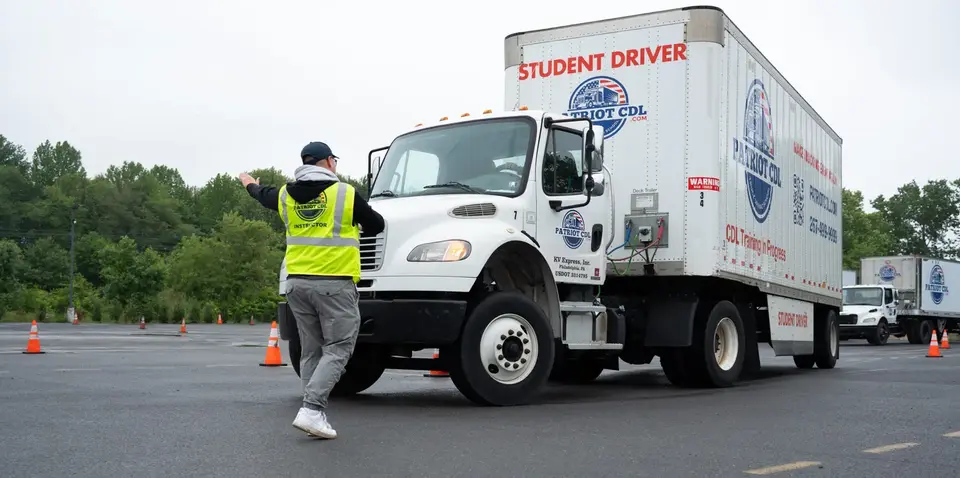
An experienced instructor observing a trainee driving a large commercial truck during a CDL class B training session.

Why focused training helps many beginners

Class B students usually need three things from a school: current compliance awareness, practical repetition, and correction from someone who knows what examiners expect. A shorter, intensive format can support that well because the skill-building stays active day after day.

That's also where refresher support can matter. For drivers who need to rebuild confidence on specific maneuvers or test items, Patriot's refresher CDL course shows the type of supplemental training some students use when they need targeted help rather than a full restart.

What a good accelerated path should provide

Look for a program that keeps the process organized and current.

A useful accelerated setup should help with:

  • Permit and documentation flow
  • ELDT-aligned training completion
  • Hands-on work in the correct vehicle type
  • Practice on pre-trip, maneuvers, and road driving tied to current testing
  • Clear coaching after mistakes

For a student who's motivated and ready to work, that structure can turn a complicated licensing path into a manageable routine.


If you're ready to move from “I've been thinking about it” to starting, Patriot CDL is worth a look. They offer Class A and Class B training, guide students through permit and training requirements, and focus on the practical skills that matter on test day and on the job.

Application Submitted!

Your application has been sent. Our team will get in touch with you as soon as possible.

Thank you for your interest.