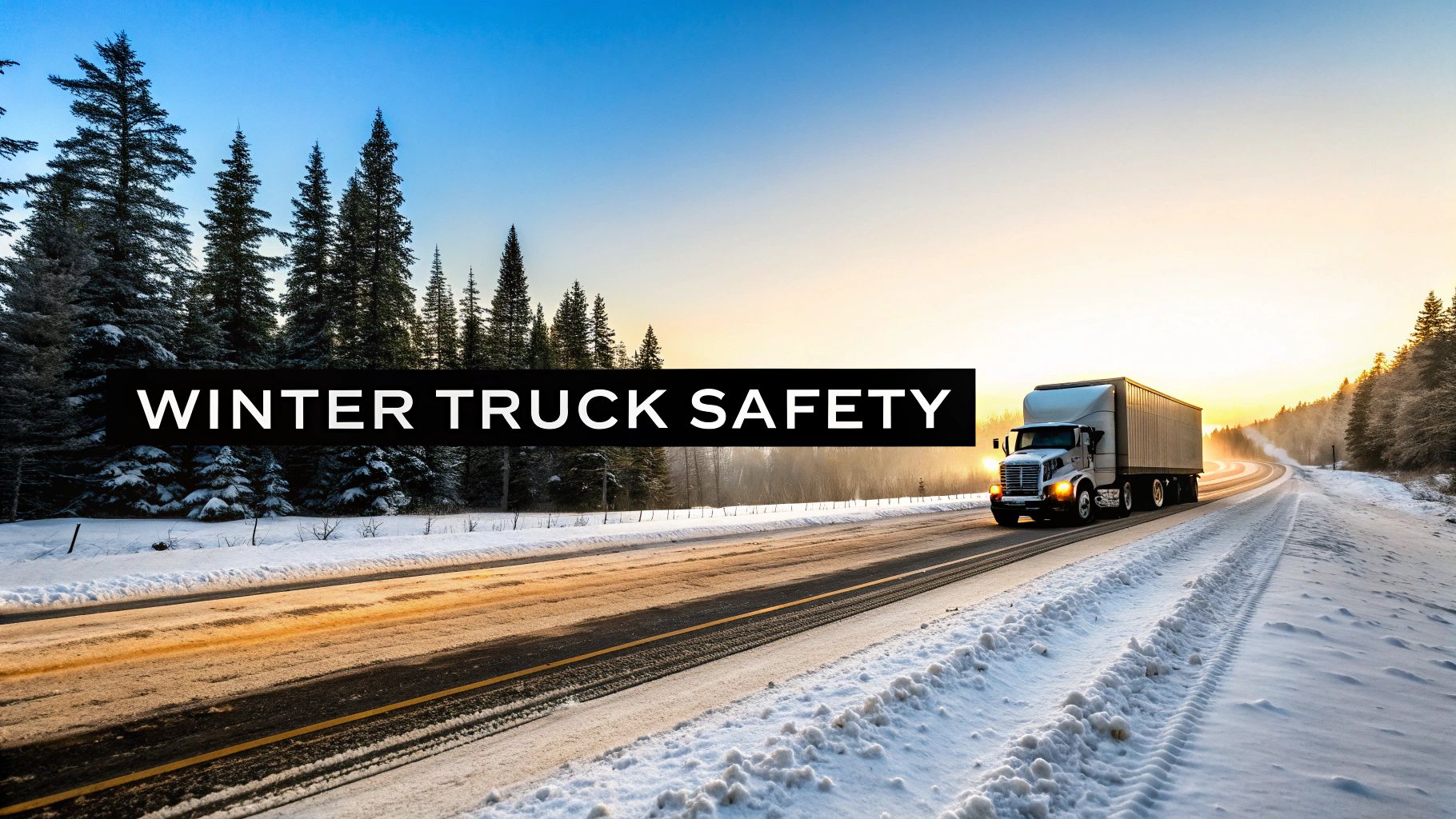
Winter presents the ultimate test for commercial drivers. The open road, usually a symbol of freedom, transforms into a landscape of slick ice, blinding snow, and unpredictable hazards. Posted speed limits become mere suggestions, and stopping distances can triple in an instant. For professional truck drivers, mastering these conditions isn't just about getting from Point A to Point B; it is about protecting your rig, your cargo, and your livelihood. This guide moves beyond the obvious "slow down" advice.
We are diving deep into actionable, expert-level winter driving safety tips that separate the amateurs from the seasoned professionals. This is not surface-level information. Instead, we provide a comprehensive roundup of the critical skills and preparation methods essential for operating a commercial vehicle in severe weather.
You will learn specific techniques for:
- Prepping your vehicle for the harshest conditions.
- Mastering advanced braking and skid recovery.
- Managing speed and following distances on compromised surfaces.
- Maintaining total visibility when snow and ice hit.
These strategies will equip you with the skills and confidence needed to navigate the harshest winter weather safely and effectively. Let's explore the essential techniques for staying in control when the temperature drops.
1. Winterize Your Vehicle
Proactive vehicle preparation, or "winterization," is the cornerstone of any effective winter driving safety plan. This process involves a comprehensive, pre-season inspection and servicing of your truck's key systems to ensure they can withstand the harsh demands of cold temperatures, ice, and snow. It's not just about adding antifreeze; it's a systematic approach to prevent common cold-weather failures before you hit the road.
By addressing potential issues in the controlled environment of a garage or maintenance bay, you significantly reduce the risk of a dangerous and costly breakdown in freezing conditions. Think of it as setting your vehicle up for success. This preventative maintenance is a non-negotiable first step for any professional driver operating in regions with severe winters.
Why Winterization is Critical
The logic is simple: mechanical components behave differently in the cold. Fluids thicken, batteries lose power, and rubber becomes brittle. A comprehensive winterization checklist directly counters these effects. For instance, testing your battery is crucial because its cranking power can drop by as much as 50% in freezing temperatures. Likewise, ensuring your fuel tank is at least half full helps prevent condensation from freezing in the fuel lines, a common cause of winter stalls.
The data below highlights the proven benefits of a thorough pre-season vehicle check.
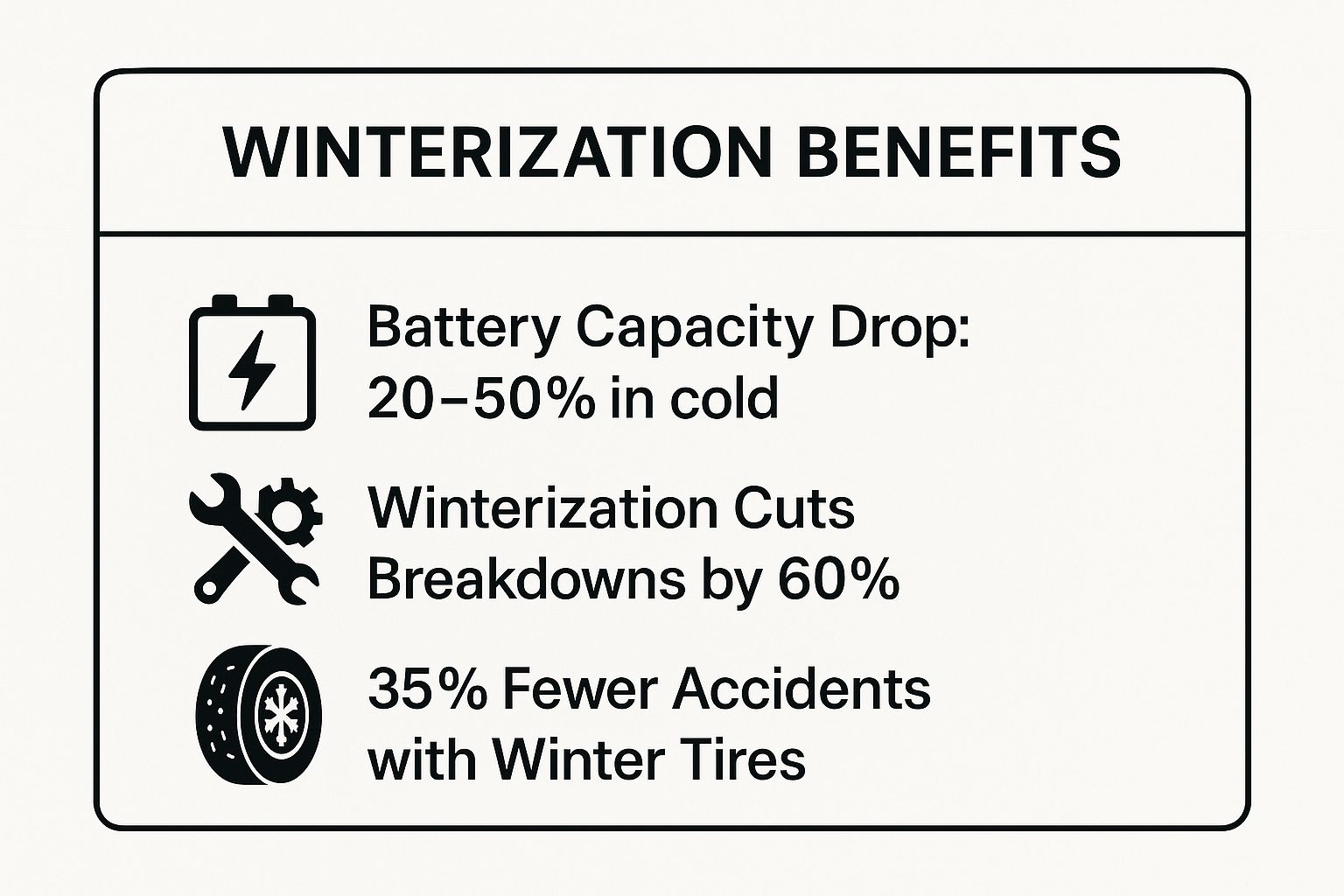
These statistics clearly show a direct correlation between proactive vehicle preparation and improved safety outcomes, from preventing breakdowns to reducing accidents.
Your Winterization Checklist
Begin your winterization process in early fall, well before the first freeze. This gives you ample time to order parts and perform necessary services without rushing.
- Fluids and Fuel: Check and top off all essential fluids, especially windshield washer fluid with a freeze-resistant formula. Keep your fuel tank at least half full at all times.
- Battery Health: Use a voltmeter to test your battery. A healthy, fully charged battery should read above 12.6 volts; readings below 12.4 volts indicate it may need replacement. Clean any corrosion from the terminals.
- Tire Inspection: Proper tires are one of the most vital winter driving safety tips. Check your tread depth using the penny test; if you can see all of Lincoln's head, your tires are worn and need replacing. Ensure tire pressure is set to the manufacturer's recommendation, as pressure drops in cold weather.
- Emergency Kit: Assemble or restock a winter emergency kit designed for at least 72 hours of self-sufficiency. Include high-calorie food, water, extra blankets, warm clothing, a flashlight, and a portable battery bank.
2. Master the 3-Second Rule and Increase Following Distance
Maintaining a safe following distance is a fundamental principle of defensive driving, but its importance is magnified exponentially by winter conditions. The standard "3-second rule" taught for dry roads is dangerously inadequate when ice and snow reduce your truck's traction. Adapting this rule is one of the most critical winter driving safety tips a professional driver can implement to prevent accidents.
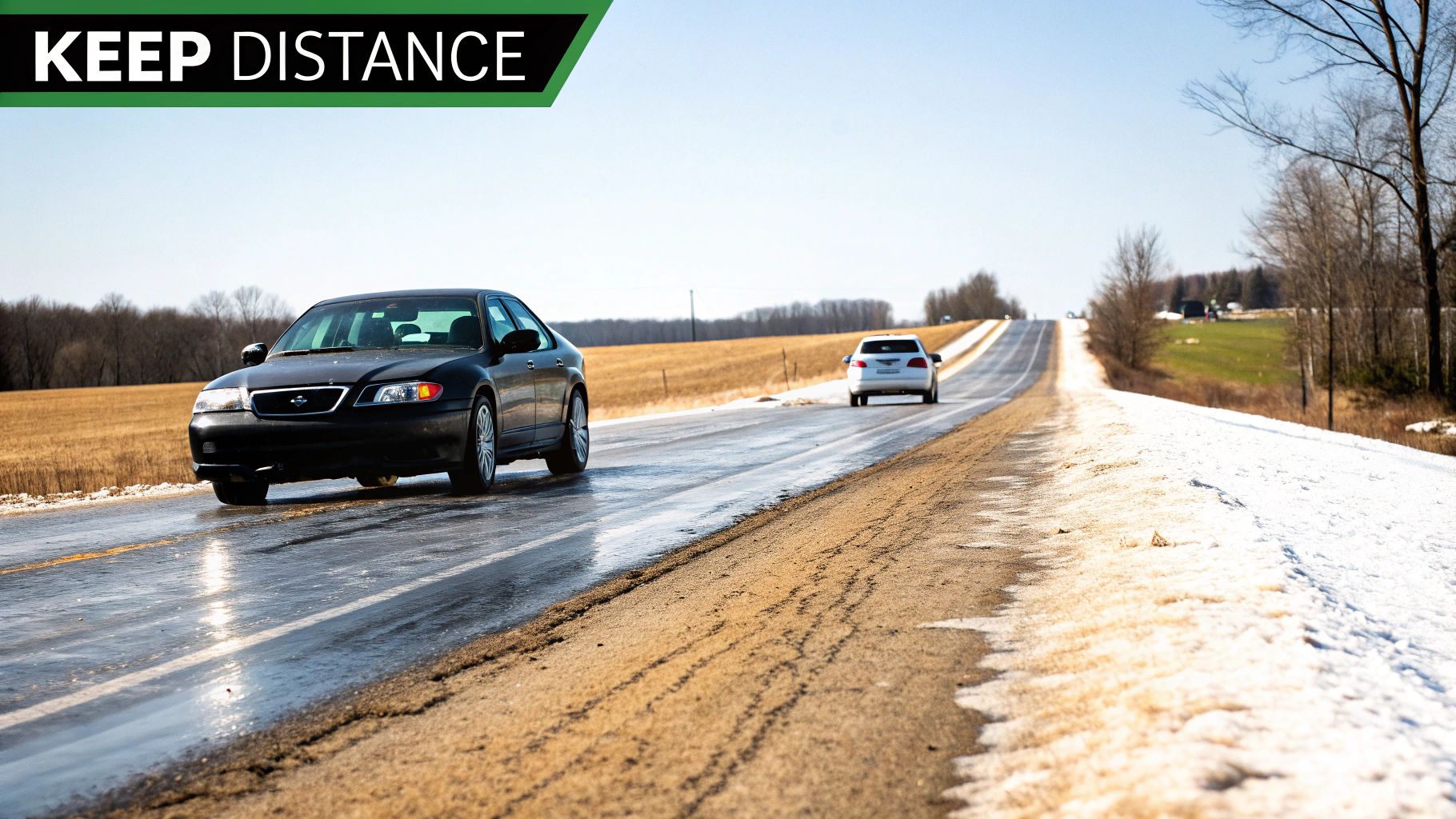
The concept is to create a buffer of space and time that allows you to react and bring your heavy vehicle to a complete stop without collision, even on a low-friction surface. On slick roads, your stopping distance can increase by up to ten times. Therefore, extending your following distance to 8-10 seconds is not overly cautious; it's a necessary adjustment to account for physics. This extra space is your biggest safety asset in unpredictable winter traffic.
Why Extending Your Following Distance is Critical
The logic is rooted in stopping distance. In ideal conditions, it takes a fully loaded commercial truck the length of a football field to stop. Add a layer of ice or packed snow, and that distance grows dramatically. By increasing your following distance, you are giving yourself the two things you need most in an emergency: time to perceive a hazard and space to safely execute a maneuver.
The effectiveness of this technique is well-documented. For example, some commercial trucking fleets that mandate extended following distances in winter report up to 30% fewer winter-related accidents. Similarly, Sweden's advanced driver education, which emphasizes a 6 to 10-second rule in adverse conditions, is a contributing factor to the country's remarkably low traffic fatality rates. It’s a proven strategy for mitigating the inherent risks of winter roads.
Your Increased Following Distance Checklist
Make a conscious effort to measure and maintain your space cushion every time you drive in winter. It should become an ingrained habit, not an afterthought.
- Practice Your Count: To measure your following distance, watch the vehicle ahead of you pass a fixed object like a sign or overpass. Then, begin counting: "one-thousand-one, one-thousand-two…" until your truck’s front bumper reaches the same object.
- Adjust for Conditions: Your baseline should be at least 8-10 seconds on snowy or icy roads. Increase this distance even more during active snowfall, in fog, or when dealing with freezing rain, as visibility and traction are further compromised.
- Anticipate Intrusions: Be aware that other drivers in smaller vehicles may see your large gap as an invitation to cut in front of you. When this happens, don't get frustrated; simply ease off the accelerator and re-establish your safe following distance behind the new vehicle.
- Use Visual Cues: Use landmarks to help you visualize the space. In a 55 mph zone, an 8-second following distance is over 640 feet. Look for reference points far ahead to help maintain that gap.
3. Learn Proper Braking Techniques
Mastering how to slow and stop your commercial vehicle on compromised surfaces is a non-negotiable skill. Proper braking technique in winter is fundamentally different from driving on dry pavement; it requires precision, anticipation, and a clear understanding of your truck's braking system. Applying the brakes too hard or too late is a primary cause of jackknifes, skids, and loss of control.
This is about more than just pressing a pedal. It’s about feeling how the truck responds to your inputs and adjusting your technique for ice, packed snow, or slush. By learning and practicing methods like threshold braking and proper ABS usage, you can maintain control in situations where others might panic, turning a potential disaster into a controlled stop. This is one of the most critical winter driving safety tips for any professional driver.
Why Braking Technique is Critical
The core principle is to avoid locking up the wheels, which immediately causes a loss of steering control and dramatically increases stopping distance on slick surfaces. An anti-lock braking system (ABS) is designed to prevent this, but the driver must know how to work with the system, not against it. For vehicles without ABS, manual techniques are required to mimic this effect.
The difference in outcomes is significant. The National Safety Council's defensive driving programs emphasize that proper braking can improve stopping performance by over 20% in emergency scenarios. For a heavy truck, that 20% can be the difference between a safe stop and a serious collision. Understanding how to use your brakes effectively is a hallmark of a true professional.
Your Braking Technique Checklist
Integrate these braking strategies into your driving habits, and practice them in a safe, empty area before you need them in an emergency.
- Understand Your System: Know if your truck and trailer are equipped with ABS. With ABS, apply firm, steady pressure to the brake pedal and hold it. You will feel a pulsing or vibrating sensation as the system activates; do not pump the brakes, as this defeats the system.
- Manual Braking (No ABS): If you do not have ABS, you must prevent wheel lockup manually. Use cadence braking: press the brakes to the point just before they lock, then release slightly and repeat. This "pumping" action helps maintain steering control.
- Anticipate and Increase Following Distance: The most effective braking technique is using the brakes as little as possible. Increase your following distance to at least 8-10 seconds behind the vehicle in front of you. This gives you ample time to slow down gradually by simply easing off the accelerator.
- Use Engine and Jake Brakes Wisely: Use your engine's natural resistance (engine brake) or your Jake Brake to help slow the vehicle, but be extremely cautious. On very icy surfaces, the abrupt slowing from a Jake Brake can cause the drive wheels to lose traction. Use it on the lowest setting and only when you have good grip.
4. Understand and Recover from Skids
Losing traction and entering a skid is one of the most hazardous situations a driver can face in winter. Understanding the mechanics of a skid, how to prevent one, and how to react correctly is a critical skill. This isn't about panic; it's about muscle memory and a calm, deliberate response that can turn a potential disaster into a controlled recovery.
For a professional driver, mastering skid control is non-negotiable. It’s the difference between maintaining control of an 80,000-pound vehicle and causing a multi-lane pileup. This knowledge transforms you from a passenger in a slide to a pilot actively guiding your vehicle back to safety. It’s a fundamental component of advanced winter driving safety tips.
Why Skid Control is Critical
The physics of a skid are unforgiving, but they are predictable. Whether it’s understeer (front-wheel skid) or oversteer (rear-wheel skid), the cause is the same: the tires have exceeded their limit of grip. Learning to manage this situation is a proven lifesaver. For example, in Finland, where advanced skid-pan training is mandatory for all drivers, winter road fatality rates are significantly lower than in many other cold-weather countries.
Professional drivers, from rally champions to stunt performers, use these precise techniques to control vehicles at high speeds on slick surfaces. The principles they use are directly applicable to a commercial driver managing a jackknife skid on black ice.
This video from the Bridgestone Winter Driving School clearly demonstrates the proper techniques for handling both understeer and oversteer, showing the immediate effect of correct driver inputs.
Your Skid Recovery Checklist
The key to skid recovery is to react smoothly and without panic. Your goal is to help the tires regain traction, which cannot be done with abrupt steering, braking, or acceleration.
- Look and Steer Where You Want to Go: Your hands will instinctively follow your eyes. Do not stare at the obstacle or the ditch you're sliding toward. Look down the road to your intended path and gently steer the vehicle in that direction.
- Manage Your Feet: For most skids, especially oversteer (when the rear slides out), ease your foot off the accelerator. Do not slam on the brakes, as this will lock the wheels and worsen the skid.
- Avoid Overcorrection: A common mistake is yanking the steering wheel too far, which can snap the vehicle back the other way, causing a secondary and often more violent skid. Make your steering inputs smooth and measured.
- Practice in a Safe Environment: The best way to build muscle memory is to practice. Find a large, empty, and snowy parking lot (with permission) to feel how your vehicle responds when it loses traction at low speeds. This practice is invaluable.
5. Adjust Speed for Conditions
Simply adhering to the posted speed limit is insufficient during winter; the most fundamental skill is dynamically adjusting your speed to match the real-time conditions. This practice involves a constant, conscious assessment of weather, visibility, traffic flow, and road surface integrity. It’s about driving at a speed that is reasonable and prudent for the circumstances, which is often significantly lower than the legal maximum.
For professional drivers, mastering speed management is a core competency that directly translates to safety and control. It acknowledges the physical reality that stopping distances increase dramatically on slick surfaces. By proactively reducing speed, you grant yourself the two most critical resources in an emergency: time to react and distance to stop. This is a non-negotiable principle of professional winter driving.
Why Speed Adjustment is Critical
The relationship between speed and safety in winter is governed by physics. A vehicle's momentum and the friction between its tires and the road dictate how it behaves. Introducing ice or snow drastically reduces this friction, making a speed that is safe on dry pavement incredibly dangerous. For example, a commercial truck that can stop in 300 feet on a dry road may need over 1,000 feet to stop on ice at the same speed.
Evidence from various safety organizations underscores the life-saving impact of this simple adjustment. Montana Highway Patrol data shows that a significant reduction in speed directly correlates with a 45% decrease in winter-related accidents. This highlights that managing your velocity is one of the most effective winter driving safety tips a driver can employ.
Your Speed Adjustment Checklist
Integrate these speed management tactics into every winter trip, making them second nature before you encounter hazardous conditions. This proactive approach ensures you maintain control when it matters most.
- Follow the Visibility Rule: Never out-drive your headlights or the visible distance ahead. You must be able to come to a complete, safe stop within the space you can clearly see.
- Implement Percentage Reductions: As a general guideline, reduce your normal highway speed by at least 25% on wet roads and by 50% or more on snow-covered roads. On icy patches, your speed should be at a crawl.
- Use Cruise Control Sparingly: Never use cruise control on slippery, wet, or icy surfaces. It can cause the vehicle to accelerate unexpectedly when regaining traction, leading to a loss of control.
- Anticipate Icy Spots: Be especially cautious on bridges, overpasses, and shaded areas, as they freeze first and stay frozen longer than the main roadway. Reduce speed before you reach these potential black ice zones.
6. Plan Routes and Check Weather Conditions
Effective pre-trip planning is one of the most powerful, yet often overlooked, winter driving safety tips. This goes beyond simply entering a destination into a GPS. It's a proactive strategy that involves meticulously monitoring weather forecasts, selecting the safest possible routes, and developing contingency plans before your wheels ever start turning. This discipline transforms a reactive journey into a controlled and predictable operation.
By anticipating potential hazards like snow squalls, icy patches, or road closures, you can make informed decisions to avoid them entirely. This might mean adjusting your departure time, choosing an alternate route, or even delaying the trip if conditions are too severe. This level of foresight is a hallmark of a professional driver and is fundamental to navigating winter's unpredictable nature safely and efficiently.
Why Pre-Trip Planning is Critical
The core principle here is risk mitigation. Winter weather is a dynamic variable that can render a normally safe route treacherous in a matter of hours. By integrating weather and road condition analysis into your planning, you actively steer clear of the most dangerous situations. For example, state Department of Transportation (DOT) 511 systems offer real-time updates on road conditions, closures, and incidents, allowing you to adapt your plan on the fly.
This proactive approach has proven benefits. Studies show that professional trucking fleets using dedicated weather routing services can reduce winter-related incidents by a significant margin. This highlights a clear link between thorough planning and tangible safety improvements. It’s about taking control of the factors you can, so you are better prepared for the ones you can't.
Your Route Planning Checklist
Integrate this checklist into your routine at least 24 hours before any winter trip, with a final check just before you depart. This systematic process ensures no critical detail is missed.
- Monitor Weather Diligently: Use multiple, reliable sources for forecasts. Check the National Weather Service, local news channels, and your company's preferred weather provider. Look at the forecast for your entire route, not just your start and end points.
- Leverage DOT Systems: Before departing, check the 511 system for every state on your route. These services provide the most current information on road closures, construction, and active incidents.
- Plan Safe Havens: Identify several safe and accessible truck stops or rest areas along your route. Note which ones are open 24/7 and have amenities that would be useful if you need to shut down for an extended period to wait out a storm.
- Communicate Your Plan: Always share your intended route, schedule, and expected arrival time with your dispatcher and a family member. If you deviate from the plan due to weather, provide an immediate update.
7. Maintain Optimal Visibility
Maintaining clear and unobstructed visibility is a non-negotiable aspect of safe winter driving. It's about more than just clearing a small patch on your windshield; it encompasses a complete system of pre-trip preparation and on-road awareness to see and be seen. In conditions of blowing snow, heavy fog, or low light, your ability to make split-second decisions depends entirely on what you can see.
Failing to fully clear your vehicle or maintain your visibility systems can have severe consequences, from obscuring pedestrians and other vehicles to creating road hazards for those behind you. A comprehensive approach ensures you have a complete, 360-degree view of your surroundings, which is one of the most effective winter driving safety tips for preventing accidents.
Why Optimal Visibility is Critical
Reduced visibility is a direct cause of countless winter collisions. Snow and ice accumulation on your vehicle, especially on the roof and hood, can fly off at speed, blinding drivers behind you or causing them to swerve dangerously. For instance, safety campaigns like New Hampshire's 'Operation Clear View' demonstrated a significant reduction in visibility-related crashes by enforcing complete vehicle clearing.
Furthermore, professional drivers who make a habit of fully clearing their equipment, including lights, mirrors, and trailer tops, are involved in far fewer accidents. When you can see potential hazards sooner and other drivers can clearly see your signals and intentions, reaction times improve for everyone on the road, dramatically increasing overall safety.
Your Visibility Checklist
Integrate these steps into your daily pre-trip inspection routine throughout the winter months. A few extra minutes spent before you depart can prevent hours of delay or a serious incident.
- Clear ALL Snow and Ice: Do not just clear a peephole. Use a quality snow brush and ice scraper to remove all accumulation from every surface: windshield, windows, mirrors, roof, hood, trunk, and all lights and reflectors. This prevents dangerous "snow bombs" from flying off your vehicle.
- Manage Washer Fluid: Keep your windshield washer fluid reservoir full with a winter-grade formula that resists freezing. It's wise to carry a spare jug in your truck, as you will use it much more frequently to clear road salt and grime.
- Clean Interior Glass: Fog and haze on the inside of your windows can be just as dangerous as snow on the outside. Regularly wipe down interior glass with a clean microfiber cloth and a dedicated glass cleaner to prevent fogging and reduce glare.
- Use Your Headlights: Turn on your headlights, even during daytime hours in overcast or snowy conditions. This simple action makes your truck significantly more visible to other motorists from a distance, giving them more time to react to your presence.
8. Practice Smooth and Gradual Vehicle Control
The fundamental law of driving on low-grip surfaces is smoothness. Every input you give the vehicle, from steering and braking to accelerating, must be deliberate, gentle, and progressive. This technique is about preventing the sudden shifts in weight and traction that overwhelm your tires' grip on ice and snow, which is the primary cause of skids, spins, and jackknifes.
This method, championed by everyone from Formula 1 legends like Jackie Stewart to advanced driving schools, is not about being slow; it's about being efficient with the limited traction available. By avoiding abrupt actions, you keep the truck's chassis stable and predictable, allowing you to maintain control even when the road surface offers minimal grip. This is one of the most crucial winter driving safety tips for any professional driver.
Why Smooth Control is Critical
Abrupt inputs are the enemy of traction. A sudden jerk of the steering wheel, a stomp on the brakes, or a jab at the accelerator can instantly break the tires' fragile connection to an icy road. Smooth, gradual control keeps the vehicle’s weight balanced, maximizing the grip at all four corners. This principle is why advanced driving schools report significantly fewer student incidents when this technique is emphasized.
Think of your available grip as a finite resource. Any single action, like turning or braking, uses up some of that grip. If you try to do too much at once, or do it too quickly, you exceed the limit and lose control. Practicing smooth inputs ensures you stay well within the vehicle's limits, significantly reducing the risk of a loss-of-control accident.
Your Smooth Control Checklist
Integrate these mental cues and physical practices into your driving until they become second nature, especially before and during winter weather.
- The Egg and Coffee Trick: Drive as if you have an egg under your accelerator and brake pedals that you don't want to break. At the same time, imagine a full, hot cup of coffee resting on your dashboard that you don’t want to spill. This visualization forces you to be gentle with every input.
- Plan Ahead: Begin all actions, especially braking and turning, much earlier than you would on dry pavement. This gives you the time and space needed to execute them gradually without unsettling the truck and trailer.
- Feather the Throttle: Instead of on-or-off throttle application, practice "feathering" the pedal. This means making tiny, smooth adjustments to maintain momentum without spinning the drive wheels.
- Steer Like a Captain: Turn the steering wheel with slow, consistent hand-over-hand movements, as if you are piloting a large ship. Avoid sharp, reactive movements; look far ahead to anticipate turns well in advance.
8-Key Winter Driving Safety Tips Comparison
| Item | Implementation Complexity 🔄 | Resource Requirements ⚡ | Expected Outcomes 📊 | Ideal Use Cases 💡 | Key Advantages ⭐ |
|---|---|---|---|---|---|
| Winterize Your Vehicle | Medium – multiple seasonal tasks, some technical checks | High – winter tires, fluids, battery, emergency kit | Greatly reduces breakdowns and accidents in winter | Vehicle prep before cold season travel | Improves safety, performance, and peace of mind |
| Master the 3-Second Rule and Increase Following Distance | Low – behavioral adjustment during driving | Low – only driver attention and focus required | Reduces rear-end collisions by up to 40% | Driving in slippery or low-visibility winter conditions | Increases reaction time, lowers collision risk |
| Learn Proper Braking Techniques | Medium – practice needed, varies by vehicle | Low to medium – requires training and practice | Reduces stopping distance and prevents skids | Emergency stops and normal winter driving | Maintains control, optimizes vehicle safety systems |
| Understand and Recover from Skids | High – requires skill development and calm reactions | Low – training and safe practice spaces | Prevents accidents during loss of traction | Handling skids on ice/snow, emergency recovery | Builds confidence, reduces accident severity |
| Adjust Speed for Conditions | Low to medium – requires judgment and vigilance | None to low – no special resources needed | Reduces accidents by up to 60% per studies | Driving in variable winter weather and road conditions | Enhances safety and fuel efficiency |
| Plan Routes and Check Weather Conditions | Medium – requires pre-trip research and planning | Low – access to weather info and route tools | Avoids hazardous conditions and reduces stress | Pre-trip planning for long or complex winter journeys | Improves preparedness, reduces exposure to dangers |
| Maintain Optimal Visibility | Medium – manual clearing and equipment check required | Medium – ice scrapers, washer fluid, lighting | Reduces visibility-related crashes by ~30% | Before and during winter driving trips | Prevents accidents and legal issues, reduces fatigue |
| Practice Smooth and Gradual Vehicle Control | Medium – requires conscious driving adjustments | None – skill-based, no extra equipment needed | Improves traction, comfort, and vehicle control | All winter driving situations | Reduces accidents, vehicle wear, and discomfort |
Drive Your Career Forward, No Matter the Weather
Navigating the unpredictable challenges of winter is a defining aspect of a professional truck driving career. It's a true test of skill, foresight, and discipline. The journey through this article wasn't just about listing winter driving safety tips; it was about building a comprehensive framework for proactive safety and professional excellence. We've moved beyond generic advice, diving deep into the actionable strategies that separate seasoned professionals from the rest.
From the non-negotiable process of winterizing your rig to the critical art of adjusting your following distance, each tip is a building block toward total vehicle command. Mastering smooth, gradual inputs for acceleration and steering isn't just a technique; it's a mindset. Understanding how to prevent, and if necessary, recover from a skid is a skill that can make the difference between a close call and a catastrophic event. These principles, when practiced consistently, become second nature.
From Theory to Mastery on the Road
The core takeaway is that winter safety isn't a checklist you complete once; it's an ongoing commitment. It's about developing a deep respect for the power of weather and the physics of your vehicle. The most important insights from our discussion are:
- Proactive Planning is Paramount: Your safety on an icy road begins hours or even days earlier, with meticulous route planning, diligent weather monitoring, and a thorough pre-trip inspection.
- Space is Your Greatest Asset: Increasing your following distance provides the time and space needed to react to sudden hazards, a buffer that is absolutely essential on low-traction surfaces.
- Smoothness Prevents Chaos: Abrupt braking, steering, or acceleration can easily break traction and initiate a skid. Deliberate, smooth control is the key to maintaining grip and stability.
Ultimately, mastering these advanced winter driving safety tips elevates your career. It transforms you from someone who simply operates a truck into a true professional who commands their vehicle with confidence, ensuring the safe and timely delivery of every load, regardless of the season. This level of expertise not only protects you, your cargo, and others on the road but also makes you an invaluable asset to any logistics operation. True proficiency is built on a foundation of exceptional training, where these life-saving habits are ingrained from the very beginning.
Ready to build a career on the bedrock of safety and skill? Patriot CDL instills these core principles, providing the hands-on experience needed to handle any condition the road throws at you. Take the first step toward becoming a true road professional, prepared for all seasons, by exploring our comprehensive training programs.