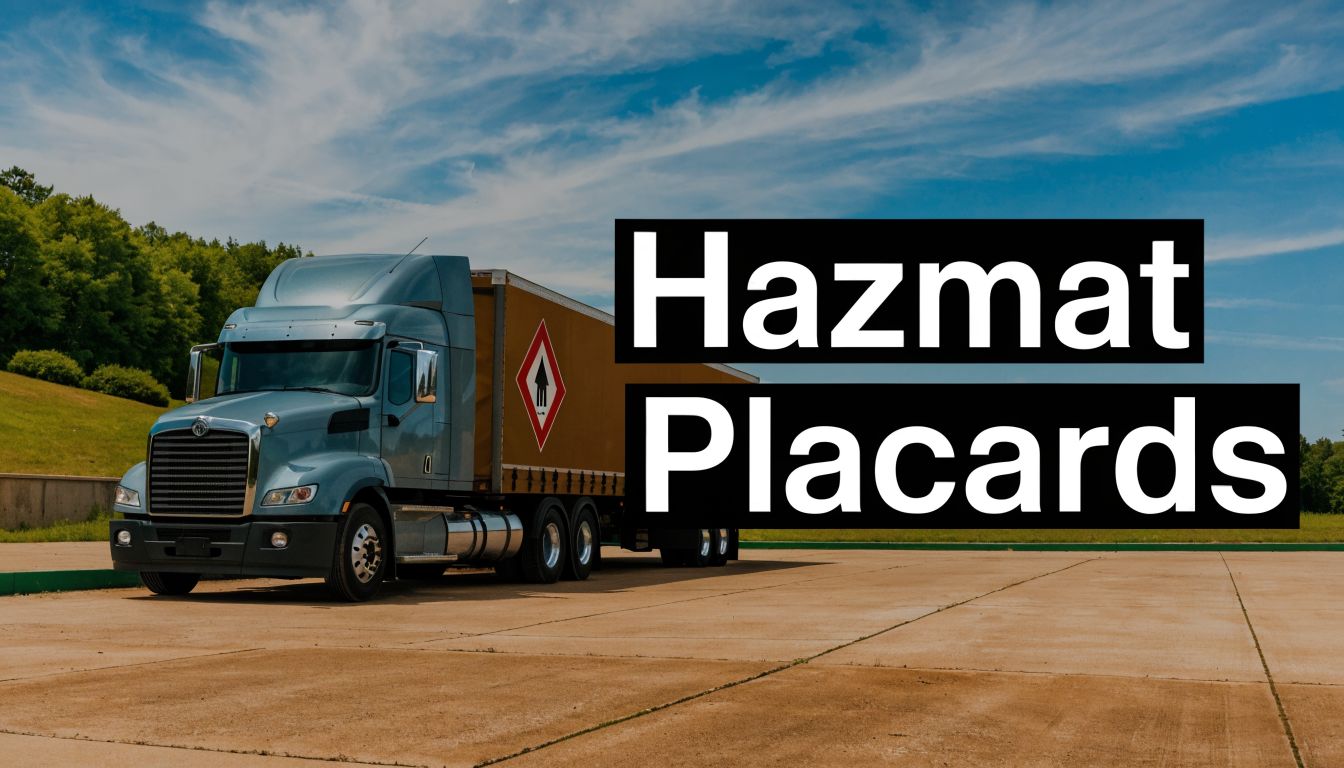
A hazardous materials placard is a standardized diamond-shaped sign required by the DOT for vehicles transporting dangerous goods, and it must measure at least 250 mm (9.84 inches) on all sides. It tells drivers, inspectors, and first responders what kind of danger is on the vehicle by using specific colors, symbols, and hazard class numbers 1 through 9.
If you're new to CDL training, you've probably seen those diamond signs on tankers, trailers, and containers and wondered what they really mean. They aren't decoration, and they aren't optional. They're the road's hazard language, built so a driver in traffic, a scale-house officer, or a firefighter pulling up to a crash can recognize danger fast.
A good driver doesn't just notice a placard. A good driver knows what it says, when it has to be there, and when it has to come off. That's what keeps people safe and keeps your record clean.
The Diamond Signs on the Highway
You merge onto the highway, settle into your lane, and spot a tanker ahead with a bright diamond sign on the rear. That's the moment most new drivers start asking the same question: what is a hazardous materials placard and why does it matter so much?
It's a universal warning sign for transportation. The DOT requires these diamond-shaped placards under 49 CFR Part 172, Subpart F so the hazard is visible outside the vehicle, not buried in paperwork. That matters when seconds count.

Why drivers need to care
Think of a placard like the cover page on a dangerous load. It doesn't tell the whole story by itself, but it gives the first warning fast enough for people to act. If there's a spill, fire, leak, or inspection, that sign is one of the first things anyone looks at.
The larger idea is simple. Safety signs work because they communicate danger quickly and consistently. If you want a broader refresher on the purpose of safety signs, that helps frame why hazmat placards are treated so seriously in transportation.
Practical rule: If a sign on your truck changes how emergency crews approach an accident scene, you need to understand it before you roll.
What it means in the real world
For a new CDL driver, this isn't just a hazmat test topic. It's part of your daily responsibility. During your walk-around, placards belong in the same mental category as brakes, lights, tires, and securement. If your inspection habits need work, a solid pre-trip inspection routine will help you build the discipline placarded loads demand.
A professional driver treats placards as active safety equipment. If one is missing, covered, backwards, or damaged, that isn't a small cosmetic problem. It's a compliance problem and a safety problem at the same time.
Decoding the Diamond The 9 DOT Hazard Classes
The DOT groups hazardous materials into 9 hazard classes, and those classes appear on placards as numbers and symbols. The placards themselves are standardized diamond-shaped signs, at least 250 mm (9.84 inches) on all sides, and they use specific colors, pictograms, and class numbers to identify the type of danger on the vehicle, as outlined in DOT placard design basics.
When you learn the classes, you stop seeing random signs and start seeing a pattern.

The nine classes in plain language
| Class | Name | Common example | Primary risk |
|---|---|---|---|
| 1 | Explosives | Fireworks or blasting materials | Can detonate or rapidly explode |
| 2 | Gases | Propane or compressed gas cylinders | Pressure, fire, or inhalation danger |
| 3 | Flammable liquids | Gasoline | Ignites easily |
| 4 | Flammable solids | Reactive solids or materials dangerous when wet | Can catch fire or react during transport |
| 5 | Oxidizers and organic peroxides | Oxidizing chemicals | Can intensify fire |
| 6 | Toxic and infectious substances | Poison materials or infectious samples | Can cause serious injury, illness, or death |
| 7 | Radioactive material | Radioactive cargo | Radiation exposure |
| 8 | Corrosives | Battery acid | Burns skin and corrodes metal |
| 9 | Miscellaneous hazardous materials | Materials that don't fit the other classes | Transportation hazard that still needs control |
How to remember them
Don't memorize the list like a speech. Group them by the kind of harm they can cause.
- Things that burn or feed fire: Class 3, 4, and 5
- Things that poison or injure people directly: Class 2, 6, and 8
- Things that create severe special hazards: Class 1, 7, and 9
That approach helps on test day and on the road.
If Class 3 tells you "fire risk" and Class 8 tells you "chemical burn risk," you've already made the jump from memorizing to understanding.
A few that drivers often mix up
Class 2 and Class 3 get confused because both can involve flammable products. The difference is form. Class 2 is gas under pressure. Class 3 is liquid that ignites easily.
Class 4 and Class 5 also trip people up. Class 4 is about combustible or reactive solids. Class 5 is about chemicals that can make other materials burn harder.
Class 6 and Class 8 aren't the same either. A toxic substance can harm you through exposure. A corrosive can burn tissue or eat through metal.
If you're preparing for the written side of CDL training, reviewing the general knowledge test material alongside hazmat concepts helps because inspections, safe driving, and cargo awareness all connect.
When to Placard The 1001 Pound Rule and Its Exceptions
Many new drivers often get tangled up. They hear "1,001 pounds" and assume that's the whole rule. It isn't.
Placarding rules follow two different tracks under §172.504. According to PHMSA placarding requirements, Table 1 materials require placards for any quantity because of their hazard level, while Table 2 materials require placards at 454 kg (1,001 lbs) aggregate gross weight for non-bulk packages.
Think of it as red-alert versus threshold-based
Table 1 materials are the red-alert category. If the material falls there, quantity doesn't save you. The risk is serious enough that the placard is required even for a small amount.
Table 2 works differently. That's where the well-known 1,001-pound rule applies for many non-bulk shipments. Here, the load has to cross a weight threshold before placarding is required.
A simple decision guide
- Table 1 material: Placard it for any quantity.
- Table 2 material in non-bulk packages: Placard it when the aggregate gross weight reaches 1,001 pounds.
- Bulk packaging: Requirements can trigger regardless of that non-bulk threshold.
That last point matters. A driver can get burned by thinking only about weight and ignoring packaging type.
The mistake I see most is this: a new driver remembers one number but forgets to ask two questions. "What table is it in?" and "Is it bulk or non-bulk?"
Where the DANGEROUS placard fits
The DANGEROUS placard is one of the biggest confusion points for beginners. It's a limited exception for certain mixed non-bulk Table 2 loads. In some domestic situations, it can stand in for multiple hazard classes on the same vehicle. But it does not apply when a Table 1 material is present, and it does not solve every mixed-load problem.
That means you can't use it like a shortcut because you're in a hurry. If the conditions don't fit, the generic placard is the wrong placard.
A good example of why details matter is battery freight. Drivers often assume "it's just batteries" without checking how the shipment is classified, packaged, and documented. If you want to see how specific one category can get, this breakdown of lithium battery shipping requirements is useful because it shows how fast hazmat rules become detail-heavy.
What to do if you're unsure
When you're not sure, stop guessing. Check the shipping paper, verify the hazard class, confirm whether the material falls under Table 1 or Table 2, and look at the total aggregate gross weight for non-bulk packages.
If your fundamentals feel rusty, a CDL refresher course can help rebuild the habit of slowing down and verifying before the wheels move. That's how you avoid the classic rookie error of repeating a rule you half-remember.
How to Read a Specific Placard
A placard works like a short warning sentence. You read it in parts, and each part tells you something different.

The four parts to read
Start with the color. Color gives you a fast clue about the type of danger. A flammable placard, for example, uses a design associated with fire risk.
Then look at the symbol. The pictogram helps even if you only catch a quick glance. Flame, skull, gas cylinder, and trefoil symbols all point you toward the hazard family.
Next comes the class number at the bottom. That number ties the sign to one of the DOT hazard classes.
Finally, if present, read the four-digit UN or NA number. That number identifies the specific material and lets responders cross-reference it in the ERG. According to PHMSA Chart 17 guidance, placard numerals must be at least 41 mm high for readability, and the UN/NA number is used for ERG lookup. The same guidance notes that Placard 3 (Flammable) corresponds to a 150-foot initial isolation zone for a fire.
A working example
Take a Class 3 Flammable placard with a UN number shown in the center. A driver or responder can read that in layers:
- Flame symbol: fire hazard
- Class 3: flammable liquid
- UN/NA number: exact product identification through the ERG
That's why placards need to stay legible and durable. They aren't there to satisfy paperwork. They're there so people can make the right first move when something goes wrong.
This short video gives a useful visual walkthrough of the process:
Why the number matters
A lot of new drivers focus on the color and stop there. That's only half-reading the sign. The class tells you the general danger. The UN or NA number points to the exact material.
Read the placard the same way you'd read a warning light on the dash. First identify the system, then identify the specific problem.
Placards vs Labels Whats the Difference
New drivers mix these up all the time because placards and labels often use similar colors and symbols. But they aren't the same thing, and using the wrong term can lead to real mistakes.
The easiest way to think about it is this. Placards are for the truck. Labels are for the packages inside the truck. Placards show the outside world what broad hazard is being transported. Labels help handlers identify individual packages, drums, or boxes.
Side-by-side difference
| Feature | Placard | Label |
|---|---|---|
| Where it goes | Outside of the vehicle or bulk package | On the individual package |
| What it warns about | The hazard on the transport unit | The hazard on that specific package |
| Who relies on it first | Drivers, inspectors, first responders, public | Loaders, handlers, warehouse staff |
| How new drivers misuse it | Thinking a package label replaces a vehicle placard | Assuming a vehicle placard covers every package detail |
This confusion matters because new CDL drivers often misunderstand placarding thresholds and exemptions. That misunderstanding can lead to violations, and USDA hazmat guidance discussing FMCSA penalties notes fines can reach $91,427 per violation.
The practical analogy
Think of a truck like a building. The placard is the warning sign on the building's front door. The label is the warning sign on a specific room inside.
If a driver confuses those two roles, they can leave with a vehicle that's improperly marked even though the freight itself is labeled correctly. That's exactly the kind of avoidable mistake that turns a routine inspection into a bad day.
A Practical Guide for New CDL Drivers
When you're hauling hazmat, your job isn't just to drive smoothly. Your job is to notice problems before an inspector or emergency responder notices them for you.

What to check before rolling
For placarded vehicles, your walk-around needs to include the signs themselves. Make sure the placards are present where required, mounted correctly, visible, and readable from a normal inspection distance.
Use this checklist mindset:
- Presence: Is the required placard on the unit?
- Placement: Is it displayed where it should be, not hidden by grime, straps, or equipment?
- Condition: Is it torn, faded, folded, or damaged?
- Match: Does it agree with the shipping papers and what you're hauling?
A clean truck with the wrong placard is still wrong. A correct placard that's unreadable is still wrong.
How professionals think about placards
A rookie often sees placards as a regulation issue. An experienced driver sees them as part of risk control. If something happens on the road, that sign shapes how other people respond to your truck.
That means placard discipline protects more than your CDL. It protects your time, your reputation, your employer, and everyone working around your vehicle.
Don't treat placards like stickers. Treat them like emergency information mounted on the truck.
Why endorsements and route awareness matter
If you're moving regulated hazardous materials, the hazmat endorsement isn't just another box to check. It signals that you've been tested on the rules that keep these loads under control.
That becomes even more important if you're running cross-border freight. For drivers on Canada or Mexico routes, this overview of placard differences in cross-border shipping notes that DOT and UN systems align on symbols, but some international systems such as the EU's ADR may require orange plates, and NAFTA trade hazmat shipments saw a 12% rise. The takeaway for a new driver is straightforward: don't assume every market uses the exact same display rules, even when the hazard symbols look familiar.
If you're still building toward your license or endorsements, reviewing the CDL requirements helps connect the permit, testing, and endorsement steps to the kind of work you want to do.
The instructor's advice
Build one habit now. Before you move the truck, pause and ask, "If this load leaks, burns, or gets inspected in the next hour, would the placards help or confuse the people responding?"
If the answer isn't clear, you aren't ready to pull out yet.
Frequently Asked Questions About Hazmat Placards
What should I do if a placard is lost or damaged during a trip
Stop treating it like a minor cosmetic issue. A missing or unreadable placard affects safety and compliance right away. Follow company procedure, secure the correct replacement, and don't keep rolling as if nothing happened.
When can placards come off the truck
Placards should come off when they no longer apply to the load and the vehicle is no longer required to display them. Leaving incorrect placards on a unit can mislead responders and inspectors, which creates a different kind of hazard.
Do placards tell me everything about the load
No. A placard gives a fast outside warning, not the full shipment story. You still need the shipping papers and, when needed, the ERG to identify the exact material and proper response.
What if I'm not sure whether the load needs placards
Don't guess and don't let the dock rush you. Verify the hazard class, the quantity, the packaging type, and the paperwork before departure. If you're still in the permit stage, getting your basics solid through CDL permit preparation makes these decisions easier because you'll understand the language before you're under dispatch pressure.
Is this mostly an inspection issue or a safety issue
It's both. Placards help inspectors enforce the rules, but their real value shows up when something goes wrong on the road. In that moment, the right sign can guide the first safe response.
If you're ready to turn classroom knowledge into real CDL skills, Patriot CDL offers hands-on training that helps new drivers prepare for permits, inspections, road tests, and the responsibilities that come with professional trucking.