Before you even think about putting the truck in reverse, the real work begins. The old hands in this business will tell you that a perfect back is 90% setup and only 10% execution. If you rush the prep work, you're setting yourself up for a world of frustration and, worse, a preventable accident.
It all starts with a simple, non-negotiable rule we all live by: G.O.A.L.
Setting the Stage: The G.O.A.L. Mindset
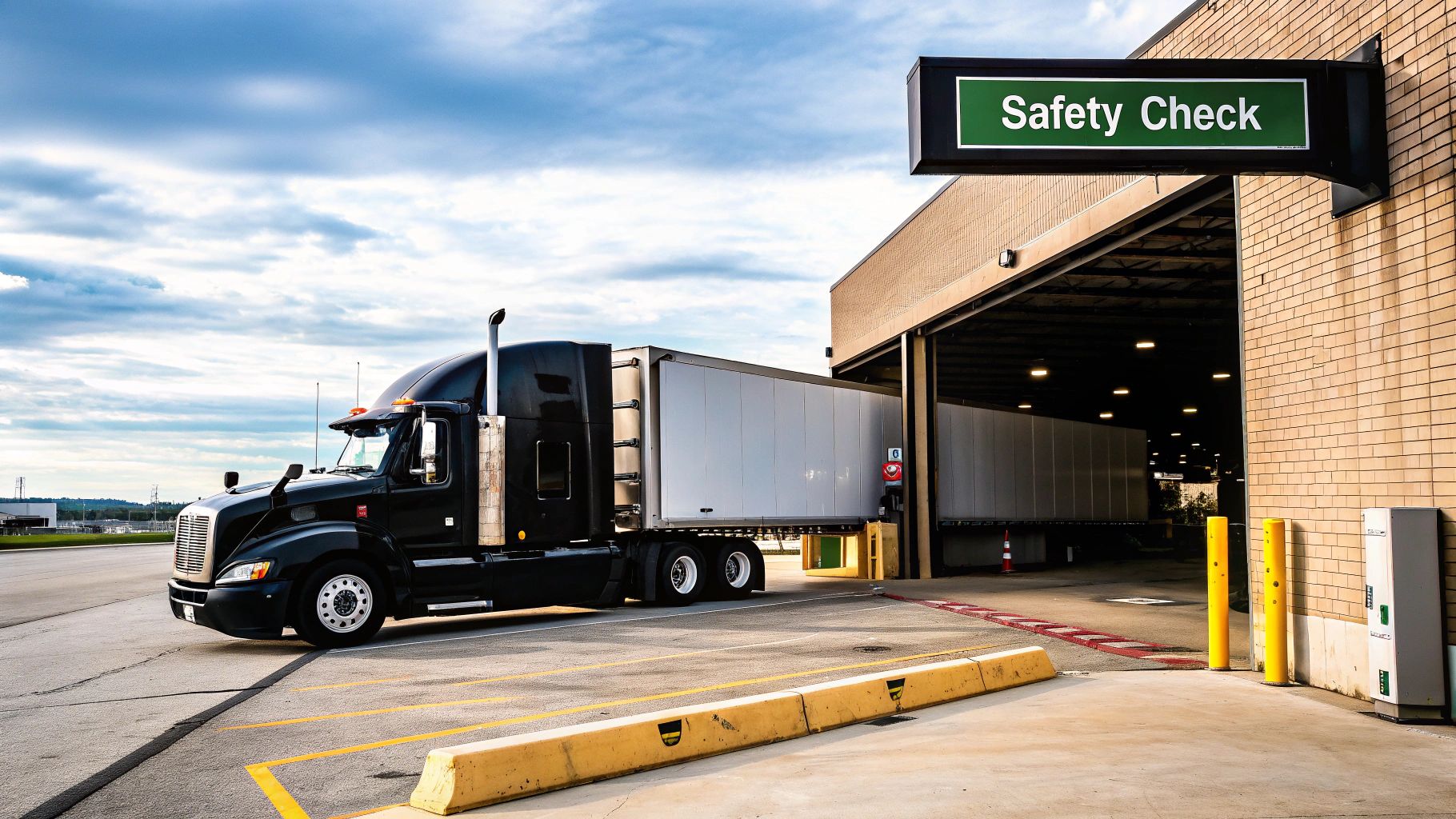
G.O.A.L. stands for Get Out And Look. This isn’t just a quick peek in your mirrors. It means turning off the engine, setting the brake, and physically walking around your entire rig and the space you're about to back into. Your mirrors only show you part of the picture; your own two feet will show you the rest.
What You're Really Looking For
Getting out of the cab is your chance to spot all the little things that can turn a routine dock into a disaster. You're looking for hidden dangers—low-hanging branches, sneaky poles hiding just below your mirror line, potholes, or patches of soft ground that could sink a tire.
But you're not just looking for obstacles. You're planning your attack.
Visualize the entire path of your trailer. See the line it needs to take to hit the dock squarely. Mentally trace the arc of the trailer's rear tires and think about where they need to be at every stage of the turn. This mental walkthrough is what separates the pros from the rookies.
While you're out there, get specific:
- Scan for hidden hazards: Is there debris, an oil spill, or a patch of ice that could cause you to lose traction?
- Check your overheads: Don't forget to look up. Are there any signs, low-hanging wires, or awnings in your path?
- Inspect the dock itself: Is the dock bumper in one piece? Is the dock plate level and clear? Catching a problem now is better than after you've hit it.
- Pinpoint your target: Know exactly where your trailer tandems need to end up for a clean, safe dock.
This walk-around is as fundamental to a driver's daily routine as a formal vehicle inspection. In fact, the mindset is the same. For a refresher on those critical checks, our guide on the pre-trip inspection covers everything you need to know.
The Physics of the Pivot
Everything in backing hinges on one point: the fifth wheel. This is the pivot point where your tractor and trailer connect, and every move you make with the steering wheel is a conversation with it. Turn the tractor's wheel to the left, and the rear of the trailer swings to the right. It's a dance.
Your job isn't to muscle the trailer into the spot. It's to guide it. Think of it less like pushing a stubborn mule and more like leading a partner in a dance. Small, deliberate steering inputs are your best friend. Big, jerky movements will just get you into trouble. By the time you climb back into the cab, your mind should be clear on the path you visualized.
Before you begin any backing maneuver, running through a mental or physical checklist based on your G.O.A.L. walk-around is a critical safety habit. It ensures you haven't overlooked any details that could compromise the safety of the maneuver.
Pre-Backing Safety Checklist (G.O.A.L.)
| Check Area | Key Focus Points | Reason for Check |
|---|---|---|
| Ground Level | Potholes, debris, spills (oil, water, ice), soft ground, curbs. | Prevents tire damage, loss of traction, and unexpected trailer shifts. |
| Overhead | Tree limbs, power lines, building awnings, signs, clearance bars. | Avoids catastrophic damage to the trailer roof and equipment. |
| Path of Travel | Other vehicles (parked or moving), pedestrians, shopping carts, pallets. | Ensures a clear and safe path, preventing collisions with property or people. |
| Dock/Spot | Condition of dock bumpers, levelness, door clearance, dock lock status. | Guarantees a secure and damage-free connection to the loading dock. |
| Blind Spots | Areas not visible in mirrors (especially behind the trailer's rear corners). | Identifies "hidden" obstacles that are a primary cause of backing accidents. |
This systematic approach transforms G.O.A.L. from a simple look into a comprehensive safety procedure, drastically reducing the risk of an incident.
Backing a semi is a high-stakes skill. Shockingly, over 50% of heavy truck collisions related to maneuvering happen during backing. That single statistic tells you everything you need to know about how challenging this everyday task really is.
There's a reason backing exercises make up a huge chunk—around 25-30%—of the practical CDL driving test. They are the ultimate test of a driver's patience, spatial awareness, and ability to stay calm and in control. Mastering these foundational skills isn't just about passing a test; it's about ensuring a long, safe career on the road.
The Secret to Counter-Intuitive Steering Control
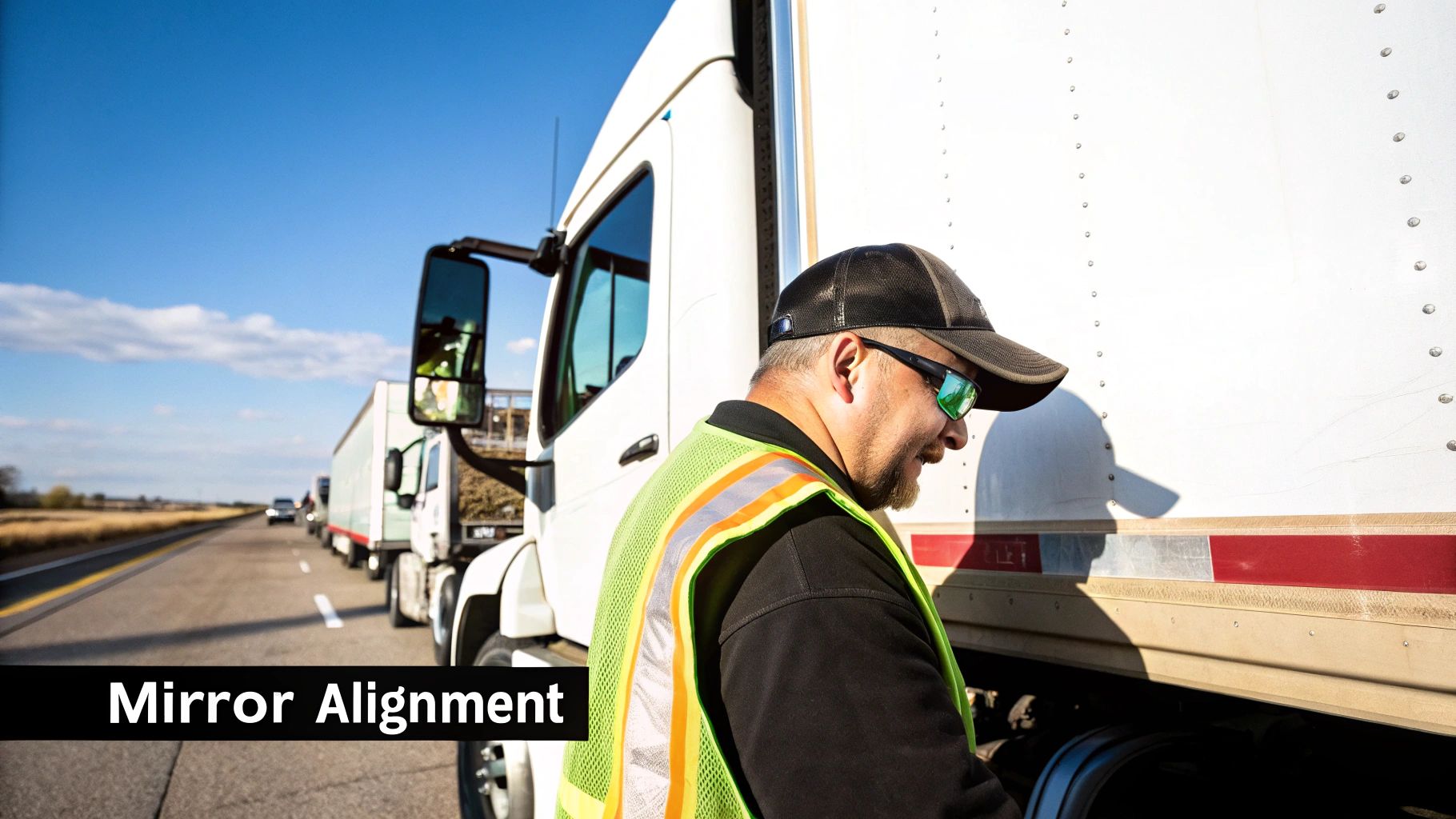
The very first thing you need to do when learning to back a semi is to forget everything you know about reversing a car. Your instincts are your worst enemy here. The steering feels completely backward, and the biggest hurdle for any new driver is fighting that feeling.
It all boils down to one simple, but totally counter-intuitive, idea. You don't steer with the top of the wheel. You steer with the bottom.
Master the Bottom of the Wheel
Put your hand at the six o'clock position on the steering wheel. From now on, when you're in reverse, this is your command center. The rule is absolute: whichever direction you move the bottom of the wheel, that’s where the tail of the trailer will go.
Need the back of the trailer to swing left, toward your driver's side? Push the bottom of the wheel to the left. Need it to go right, toward the passenger's side? Push the bottom of the wheel to the right. Getting this one concept locked in your brain changes everything.
This trick does more than just simplify the direction; it forces you to use small, deliberate movements. Over-steering is the number one rookie mistake, and it's what leads to frustration and dangerous jackknifes. A small, controlled nudge on the bottom of the wheel is all it takes to get things started.
It’s a lot like pushing a shopping cart from the front. You give one corner a gentle nudge to get it turning, then you immediately adjust to follow its path. You don't just give it a hard shove and hope for the best.
This mental image is a great way to avoid the aggressive, jerky steering that gets so many drivers into trouble. It reminds you that you're guiding the trailer, not wrestling it into submission.
Chasing the Trailer the Right Way
Once the trailer starts heading where you want it, your next job is to "chase" it with the tractor. This is where the counter-steering comes in. After you've nudged the bottom of the wheel to start the turn, you have to turn the wheel the other way to get the tractor to follow the trailer into the spot.
Let's say you pushed the bottom of the wheel left, and now the trailer is angling perfectly toward the dock on your driver's side. To finish the maneuver, you need to steer the tractor to the left to line up with it. That means turning the top of the steering wheel to the right (or pushing the bottom of the wheel to the right) to bring the tractor around.
This constant back-and-forth of tiny adjustments is the real rhythm of backing. It’s a subtle dance:
- Initiate: A small push on the bottom of the wheel to direct the trailer.
- Observe: Glance at your mirrors. See how the trailer is reacting.
- Follow: Steer the opposite way to bring the tractor back in line behind it.
The secret is making these corrections early and often. Don't wait until the trailer is way off course before you react. It's the tiny, constant adjustments that keep the whole rig under your control.
The Power of Going Slow
Every instinct you have might be screaming at you to hurry up, especially when you're in a busy yard with other drivers watching. Ignore that impulse. Speed is your enemy when backing a trailer. Moving at a crawl isn't a sign of weakness—it's the mark of a pro who understands the physics of their rig.
Going slow gives you the one thing you need most: time.
Time gives you a chance to see how your steering inputs are affecting the trailer's path. It gives you the space to make a small correction before a tiny mistake turns into a big problem. The slowest drivers are often the most efficient because they nail it on the first try.
Rushing forces you into making bigger, more aggressive steering corrections. This kicks off a vicious cycle of over-correcting, where you're just "chasing your tail" and whipping the wheel back and forth. That chaotic approach almost always ends with you having to pull up and start all over again, which wastes way more time than just backing slowly and carefully from the get-go.
Putting It All in Motion: The 3 Essential Backing Maneuvers
Alright, you've got the basics down—the feel of the steering, the importance of setup. Now it’s time to put that knowledge to work with the three core backing maneuvers you’ll use every single day. Getting these right will give you the confidence to handle pretty much any tight spot, from a crowded distribution center to a tricky city dock.
We'll start with the simplest and build from there. The truth is, the thought process is the same for all of them: find your fixed points, live in your mirrors, and make small, early corrections. It's a constant dance of observation and adjustment.
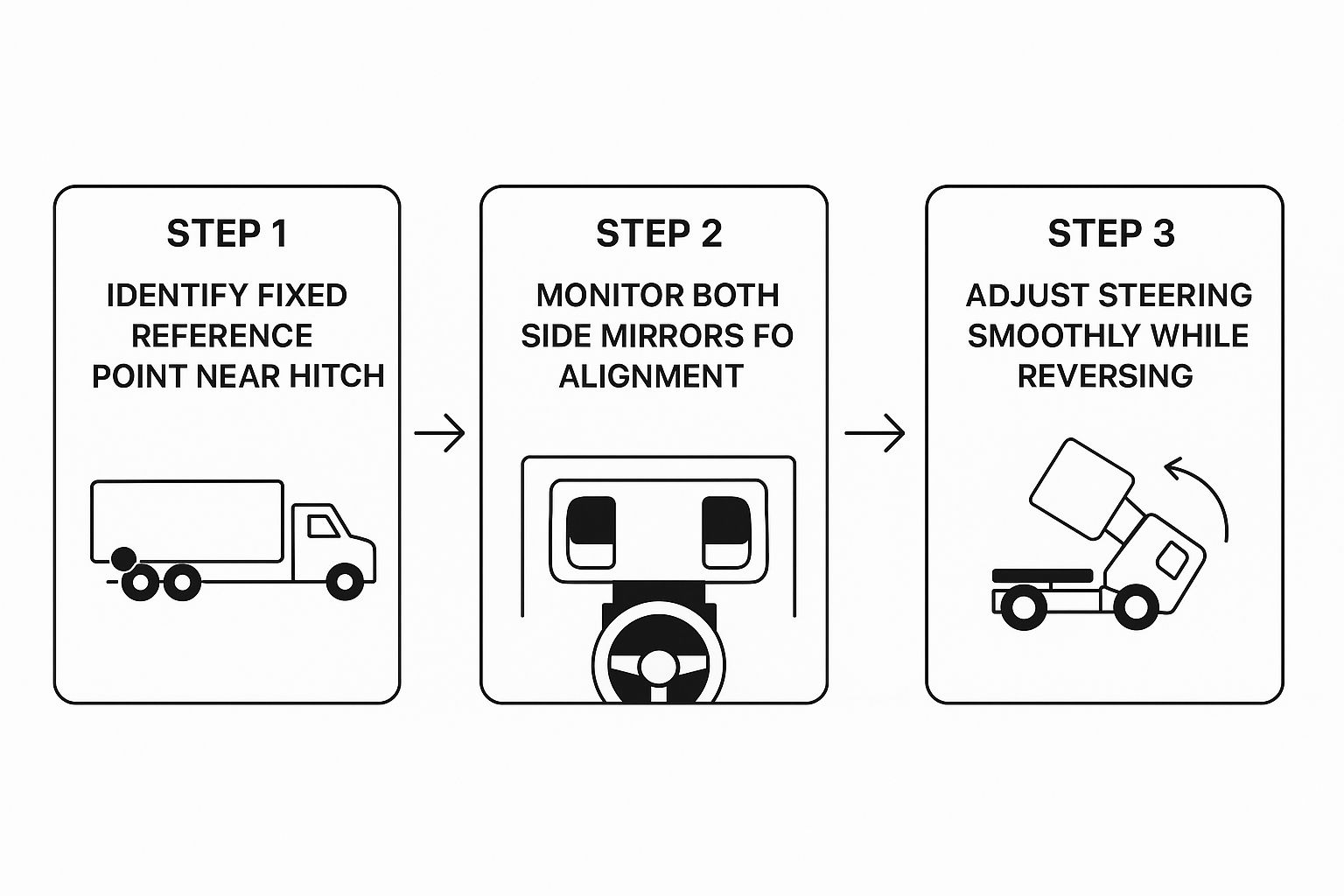
As you can see, a good back is never one single, sweeping move. It’s a constant loop of watching your target and tweaking your steering to stay on course.
The Straight-Line Back
This is the foundation for everything else. It sounds dead simple, but keeping a 53-foot trailer tracking perfectly straight requires a surprisingly delicate touch. The goal isn't to avoid steering; it's to make your steering inputs so tiny they’re almost invisible.
As you roll backward, fix your eyes on your mirrors. Watch the gap between the trailer and the painted lines. The instant you see the trailer drift, make a tiny steering correction with the bottom of the wheel in the opposite direction. You have to catch that drift the moment it starts.
Think of it like balancing a broomstick on your hand. You don't wait for it to start toppling over; you're making dozens of tiny, constant adjustments to keep it centered. That’s exactly what a perfect straight-line back feels like.
Practice this in an empty lot. Your goal is to go several hundred feet without any major side-to-side wobble. This is where you build the muscle memory and patience for the tough stuff.
The Alley Dock (90-Degree Back)
This is the classic, the one you’ll do most often. You’re putting the trailer into a dock or a parking spot at a 90-degree angle, usually between two other rigs. I can't stress this enough: your setup is everything. A sloppy setup guarantees a frustrating back and forces you to pull up and start over.
- The Setup: Pull past the spot until your cab is completely clear of it. A great rule of thumb is to drive forward until your shoulder is aligned with the center of the bay you're aiming for.
- The Turn: From there, cut the wheel hard away from the dock. If you're doing a driver-side back, you'll turn the wheel to the right. This kicks the rear of the trailer over toward the opening.
- The Follow-Through: Keep your eyes glued to that driver-side mirror. You're waiting for the moment your trailer tandems (the rear wheels) enter the "box." As soon as they cross that line, you have to start "chasing" the trailer by turning the wheel the other way. This gets the tractor to follow the trailer into the spot.
It's a smooth, fluid motion of turning, watching, and counter-steering until you're straight. One pro-tip I learned early on: use the trailer's landing gear as a visual cue. When it lines up with the edge of the trailer next to you, you're usually on the right track.
The Offset Back
An offset back is when you need to move the trailer from one lane to an adjacent one without pulling completely forward—a common move in a crowded truck stop or yard. This maneuver really tests your feel for the trailer's pivot point and how much it swings.
To start, make a shallow turn into the direction you want the trailer to go. So, for an offset to the left, you'll make a small right turn to get the trailer moving left. As soon as it starts to enter the new lane, you have to quickly counter-steer to the left to straighten everything out. The steering inputs are much smaller than an alley dock, but your reactions have to be quicker.
To give you some perspective, the logistics industry is exploding worldwide. The Asia-Pacific region, for instance, now makes up over 37% of the global semi-trailer market. That boom means more trucks are navigating incredibly crowded ports and terminals, making efficient backing a non-negotiable skill. In China alone, driver training programs focusing on these maneuvers have reportedly increased by as much as 40% in recent years just to keep up.
Before we wrap up, it’s helpful to see these maneuvers side-by-side to understand where they fit in.
Comparison of Backing Maneuvers
Each primary backing type has its place. This table breaks down their common uses and what makes each one uniquely challenging.
| Maneuver Type | Primary Use Case | Difficulty Level | Key Challenge |
|---|---|---|---|
| Straight-Line Back | Long, straight approaches to docks or parking | Beginner | Maintaining perfect alignment with tiny, constant steering corrections. |
| Alley Dock (90-Degree) | Standard dock loading/unloading; parking in tight rows | Intermediate | Nailing the initial setup and timing the follow-through correctly. |
| Offset Back | Shifting lanes in a confined yard or truck stop | Advanced | Quick, shallow steering inputs and rapid counter-steering. |
Mastering these maneuvers on paper is one thing, but getting behind the wheel is where the real learning happens. They are fundamental skills that show up in various combinations on the CDL exam. For more review, you can explore practice questions on combination vehicles that will help you prepare.
How to Correct Common Backing Mistakes on the Fly
Even the most seasoned pros get into a jam now and then. The real difference between a veteran and a rookie isn't that the old-timers never make mistakes; it's that they know how to fix them quickly and safely without breaking a sweat. This is your playbook for troubleshooting those common backing errors right when they happen.

Don't think of these corrections as failures. They're essential tools in your driver's toolkit. Learning to spot a bad angle and fix it is just as crucial as setting up a perfect approach from the start. The secret is catching the problem early and reacting with a cool head.
Recognizing the Dreaded Jackknife
The jackknife is every driver’s worst nightmare, but it rarely happens out of the blue. It almost always starts with a turn that’s just a little too aggressive. You’ll know you’re entering the danger zone when your tractor and trailer start forming a sharp 'V' shape.
In your mirrors, you'll suddenly see way more of the trailer's side than its rear. It will look like the trailer is closing in on your cab at an alarming speed. This is your cue to act, and act fast.
The second you feel the turn is too tight or you're losing the back, stop immediately. Never try to power through it or correct by cranking the wheel harder. The only safe escape from a potential jackknife is to pull forward, straighten out your rig, and start the maneuver over.
Trying to force a back from a bad angle is a recipe for disaster. It puts a ton of stress on your fifth wheel and can cause serious damage to your equipment or anything around you. A pull-up isn’t a sign of failure; it’s the mark of a smart, safe professional.
When Your Trailer Disappears from a Mirror
It's a common and disorienting mistake: you're backing up, and suddenly the trailer vanishes from one of your mirrors. If you're backing to the driver's side and you can no longer see the trailer in your passenger-side mirror, you've turned too sharply. Your rig is no longer properly aligned.
The fix is simple: stop backing. You need to steer back toward the side where the trailer disappeared. This will "chase" the trailer back into view and let you see your full alignment again.
Here’s a quick mental checklist for that scenario:
- Problem: Trailer is gone from the passenger-side (blind-side) mirror while backing to the driver's side.
- What it means: Your angle is too aggressive; you've steered too hard to the left.
- The fix: Steer to the right to bring the trailer back into that mirror. You might need to pull forward a few feet to really lessen the angle.
This is a classic case of over-steering. Always remember, small, deliberate steering inputs are your best friend.
Escaping the Correction Trap
Ever been there? You find yourself "chasing your tail," whipping the steering wheel back and forth with endless little corrections but getting absolutely nowhere. This happens when you overcorrect one mistake, which then forces another overcorrection in the other direction. You get stuck in a frustrating cycle that just makes your alignment worse.
The best way out of this trap is often the simplest one: pull up.
Seriously. Just stop what you're doing, take a breath, and pull your rig straight forward 15-20 feet. This gives you a complete reset on your approach. Trying to salvage a back that has gone completely sideways is a waste of time, fuel, and patience. A clean restart from a better position will get you docked faster and with a lot less stress than fighting a losing battle.
It’s also a good moment to mentally re-evaluate your approach, much like you do when checking your equipment during a pre-trip inspection. Knowing your systems is key, and you can always stay sharp by reviewing resources like the air brakes test to stay sharp.
Every single driver, no matter how many millions of miles they've run, uses the pull-up. It's the ultimate reset button. Learning when to hit it is a massive step toward mastering the art of backing a semi.
A Few Tricks of the Trade from a Pro
Once you get the hang of the basics, you'll start to see the little things that separate the rookies from the veterans. It's not about one big secret; it's about a thousand small adjustments learned over millions of miles. These are the tricks that keep you safe, save you time, and make the job a whole lot less stressful.
The first and most important habit to build is setting yourself up for success. Whenever you have the choice, always set up for a driver-side back. It's a game-changer. Why? Because your target, your trailer, and any nasty surprises are right there in plain sight through your driver-side window.
A blind-side back, on the other hand, is just asking for trouble. You're trying to hit a target you can't see, with a massive blind spot that could be hiding anything from a concrete post to another rig. I don't care if it takes you an extra two minutes to circle the lot—do it. Get the angle that lets you see what you're doing.
Learn to Read the Pavement
Experienced drivers don't just see an empty space; they see a roadmap. You need to train your eyes to use landmarks—a crack in the asphalt, a faded yellow line, even a dark oil stain—as your personal guideposts.
For example, you might figure out that once your trailer tandems hit a specific seam in the concrete, it's the perfect moment to cut the wheel for your final turn into the dock. This turns a high-stress guessing game into a simple, repeatable process. You're not winging it anymore; you're following a plan.
"A good back isn't one giant, sweeping motion. It's a series of small, confident corrections. You're using reference points you trust to walk that trailer exactly where you want it to go."
This kind of precision is what saves you from doing the "dance of a thousand pull-ups" in a crowded truck stop. Finding a good spot to safely practice this can be tough, which is why having good resources is key. If you need help, our guide on locating secure truck parking can point you toward places where you can safely get some reps in.
How to Handle Tough Conditions
Backing on a perfect, sunny day is one thing. But the real world throws curveballs. You have to know how to adjust when things get nasty.
- At Night: Your vision is shot. Flip on your four-ways and any work lights you've got. Slow everything down to a crawl. If you feel unsure, get out and look. There's no shame in it.
- In Rain or Snow: The ground is slick, and your tires can slide when you least expect it. Every move you make—steering, braking, accelerating—needs to be ten times smoother. Jerky movements are your enemy here.
- On a Slope: Gravity becomes a huge factor. If you're backing downhill, the trailer will want to run away from you. Backing uphill, it'll feel like you're pushing a mountain. Be ready on the brakes and anticipate how that slope is going to affect your trailer's momentum.
Don't Forget About Trailer Swing-Out
This is the one that gets so many drivers in trouble. Trailer swing-out is a classic "rookie mistake" that can cause some serious damage.
Here's the deal: when you turn your wheel to back the trailer to the left, the front right corner of your trailer is going to swing out wide to the right. It's a simple law of physics, but it's incredibly easy to forget when you're laser-focused on your tandems.
I've seen it a hundred times: a driver is so worried about the back of the trailer that they clip a parked truck or a light pole with the front. Before you make any sharp turn, take a half-second to glance in your opposite mirror. That quick check can be the difference between a perfect back and a very bad day.
Frequently Asked Questions About Backing a Semi
Even after you've gone through training, getting the hang of how to back a semi trailer in the real world brings up a lot of questions. Let's tackle a few of the most common ones I hear from new drivers out on the road.
What's the One Thing I Absolutely Have to Remember?
If you forget everything else, remember this: small moves make big differences. You steer the trailer's tail by nudging the bottom of the steering wheel in the direction you want it to go. That’s the golden rule.
Over-steering is the classic rookie mistake. It’s what causes you to chase the trailer back and forth, and it's the fastest way to end up in a jackknife. There's a reason old-timers say, "slow is smooth, and smooth is fast." Trying to rush it will just force you to pull up and start over, which wastes more time than just taking it slow in the first place.
How Do I Know if I'm About to Jackknife?
You’re heading for a jackknife when you see the angle between your tractor and trailer getting way too sharp—forming a tight "V" shape. A dead giveaway is looking in your mirrors and seeing way more of the trailer's side than its rear.
The second you feel that angle getting too aggressive or like you're losing control, stop. Just stop.
The only way out of a potential jackknife is to pull forward. Don't try to fight it or force it back from a bad angle. Pulling up straightens the rig out, giving you a clean slate to restart the back from a much safer position.
Driver-Side vs. Blind-Side Backing: Which One and Why?
Given the choice, always, always set up for a driver-side back. No exceptions. It's worlds safer because your target and the entire path of the trailer are right there, visible in your driver-side window and mirror. You can see everything that matters.
A blind-side back is exactly what it sounds like—you’re trying to maneuver around a giant blind spot on your passenger side. It’s a high-risk move that should be avoided whenever possible. Take the extra minute it takes to circle the lot and line up for a driver-side back. A long, successful career is built on consistently making the smart, low-risk choice. Honing these skills isn't just for the road; it's crucial for your exams, and you can always sharpen your knowledge with a general knowledge test to keep the fundamentals fresh.
Ready to turn these skills into a career? At Patriot CDL, we provide the expert, hands-on training you need to get on the road with confidence. Learn more and start your journey at https://patriotcdl.com.