You’re probably in one of three spots right now. You’re tired of dead-end work and want a career that pays without requiring a degree. You’re already driving for a living and need a real upgrade, not another low-skill local job. Or you’re staring at the New York DMV process and realizing fast that getting a cdl in new york isn’t hard because the steps are mysterious. It’s hard because people waste time on the wrong training, the wrong study habits, and the wrong assumptions.
I’ve watched that happen over and over. The students who move quickly don’t treat this like a paperwork errand. They treat it like job prep from day one. That means choosing legal, state-compliant training, showing up ready for the medical exam, studying the permit material with a plan, and practicing the skills test the way the examiner scores it.
If you want the shortest path to a usable CDL, keep it simple. Get your documents right. Get medically cleared. Pass the permit tests without dragging it out. Pick training based on seat time and instructor access, not flashy promises. Then drill pre-trip, backing, and road skills until the truck feels boring. Boring passes.
Your First Mile New York CDL Requirements and Medical Exam
The first mistake people make is thinking they can “just go sign up” and figure the rest out later. That’s backwards. Before you touch training, you need to make sure you qualify.

What you need before anything else
To start the process for a Class A CDL in New York, you need to:
- Hold a valid Class D license: You need a standard New York driver license before moving into commercial licensing.
- Meet the age rule: You can drive intrastate at 18, but you need to be 21 for interstate driving and hazmat work, according to this New York CDL requirements guide.
- Provide core documents: Bring proof of identity, Social Security number, and New York residency.
- Get a DOT medical card: This is not optional. A certified medical examiner has to clear you for commercial driving.
The age rule matters more than people think. If you’re 18, 19, or 20, you can still build experience, but your job options are narrower because interstate freight and hazmat aren’t open to you yet. If you’re 21 or older, your options expand immediately.
The DOT medical exam trips up unprepared applicants
A lot of applicants get nervous about the physical because they’ve heard rumors. Most of the fear comes from not knowing what the examiner is checking.
You need to schedule the exam with a provider listed on the National Registry. Bring your ID, be honest about medications and history, and don’t show up guessing about your own health. If you use corrective lenses, wear them. If you have a condition you manage, bring the paperwork that shows it’s managed.
Practical rule: Don’t treat the DOT medical exam like a school nurse visit. Treat it like a job requirement, because that’s exactly what it is.
What I tell students is simple. Get the medical card before you build the rest of your timeline around training dates. If there’s an issue, you want to know early, not after you’ve paid deposits and booked time off work.
Why legitimacy matters more now
This is also where you need to stay away from shortcuts and shady operators. A 2025 federal audit by the FMCSA found that 53% of 200 sampled non-domiciled CDL records in New York were issued improperly, the highest failure rate among states, which led to mandates tied to $73 million in federal highway funding, according to Inbound Logistics coverage of the New York CDL audit.
That should tell you everything you need to know. Paperwork errors aren’t harmless. Bad licensing practices create problems for drivers, employers, and everyone on the road. Work with people who follow the rules, document the process correctly, and prepare you for a valid license that holds up under scrutiny.
What to bring to the DMV
Don’t make two trips because you got casual with paperwork. Bring your license, your residency proof, your Social Security documentation, and your medical certification details if required at that stage of filing. Keep originals organized in one folder.
A clean process starts with clean documents. That sounds basic because it is. But the applicants who move fastest are usually the ones who stop making avoidable mistakes.
From Study Guide to Commercial Learner's Permit
Many individuals overcomplicate the permit. Then they fail because they studied everything equally instead of studying what’s tested.
For a Class A permit, the usual core written tests are General Knowledge, Air Brakes, and Combination Vehicles. For many Class B applicants, the mix is different based on vehicle type and endorsements, but the principle stays the same. Study what applies to the license you want, not the license someone else mentioned in a Facebook group.
How to study without wasting a week
Read the New York Commercial Driver’s Manual like a mechanic, not like a tourist. You’re looking for systems, definitions, safety rules, and procedure. Don’t just highlight pages and call it studying.
Use this approach:
- Read one section at a time: General Knowledge first. Air Brakes second. Combination Vehicles third if you’re going for Class A.
- Turn weak spots into notes: If air brake components blur together in your head, write them out by hand.
- Take practice tests after each section: Not before. Practice tests measure retention. They don’t replace learning.
- Circle repeat-miss topics: If you keep missing stopping distance, brake lag, or coupling questions, that’s your signal to slow down.
A lot of applicants rush the manual because they think the actual test will be easier than the book. It won’t. The manual is the map.
Where people usually stumble
The permit test rewards specific reading. It punishes lazy guessing.
Common trouble areas include:
- Air brake logic: Students memorize terms but don’t understand what each component does.
- Combination vehicle safety: They know the parts, but not how the system behaves under stress.
- Inspection concepts: If you don’t understand what you’re checking and why, the answer choices start looking identical.
Don’t chase memorization alone. If you understand the truck, the written test gets easier and the road training gets easier later too.
That’s why I’d rather see a student spend an extra evening thoroughly learning air brakes than trying to brute-force ten random practice quizzes.
Taking the tests at DMV
When you’re ready, go to the DMV and take the required knowledge exams for your license path. If you miss one, each retake costs $5, as explained in this New York permit and CDL process overview. That isn’t a huge fee, but repeated retakes usually signal a bad study method, not bad luck.
Once you pass, you’ll get your Commercial Learner’s Permit, or CLP. That permit lets you practice in a commercial vehicle under proper supervision. It does not make you job-ready. It doesn’t mean you can skip formal training. It means you’ve earned the right to start the main part.
What the CLP actually means
Your permit is permission to practice, not proof of skill. That’s a big difference.
While holding the CLP, your job is to start building habits the examiner will score later:
- Pre-trip routine
- Vehicle control
- Backing accuracy
- Safe road habits
- Calm, repeatable decision-making
The strongest students don’t celebrate the permit too hard. They use that momentum and move straight into skills training.
Choosing Your Path to a Class A or B License
Here, people either save time and money or burn both.
The training route you choose matters more than most applicants realize. New York has demand for drivers, but demand doesn’t rescue poor training. In Upstate New York, 1,699 new CDL licenses are awarded each year while 2,193 drivers leave the sector, according to Page Training Center’s Upstate market comparison. There’s opportunity here. But opportunity only helps you if you can pass and show up job-ready.

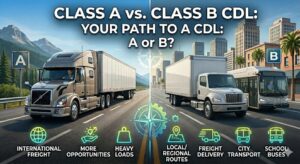
First choose Class A or Class B
Don’t choose based on what sounds impressive. Choose based on the work you want.
| License | What it covers | Best fit |
|---|---|---|
| Class A | Combination vehicles with a GCWR exceeding 26,001 pounds where the towed unit is over 10,000 pounds | Tractor-trailers, freight, tanker pathways, broader job options |
| Class B | Single vehicles with a GVWR of 26,001 pounds or more, or towing a lighter unit | Straight trucks, buses, dump trucks, many local routes |
If you want the widest range of freight jobs, get Class A. If you know you want bus, local delivery, or certain construction roles, Class B may fit better and get you working faster.
Then choose the training model
Here’s the honest breakdown.
| Training path | What you get | Tradeoff |
|---|---|---|
| Accelerated private school | Fast timeline, focused CDL prep, more direct skills repetition if the school runs well | Quality varies a lot, so you must vet the program carefully |
| Community college program | Structured classroom environment, often lower tuition than some private options | Usually slower and less flexible for people who want to start working quickly |
| Company-sponsored training | Low upfront cost or no tuition in some cases | You’re often tied to an employment contract and lose flexibility |
The right answer depends on your budget, your schedule, and how much freedom you want after licensing.
What separates good training from weak training
Ignore the lobby. Ignore the brochure. Ask these questions instead:
- How much hands-on truck time do I get?
- What’s the instructor-to-student ratio?
- How much time is spent on pre-trip and backing, not just road driving?
- Do you train specifically for New York test standards?
- What happens if I struggle with one skill?
Those answers matter because quality varies sharply. In the same Upstate comparison, top schools report pass rates over 90% with 1:4 instructor ratios, while average private schools in cities like Syracuse and Rochester are closer to 40% with 1:8 ratios and tuition up to $10,000. That gap tells you exactly what to look for. More access to the instructor usually means more correction, more repetition, and fewer bad habits.
If a school can’t clearly explain how students practice pre-trip, backing, and road work, keep looking.
My opinion on the three paths
If you need speed and want control over where you work after graduation, an accelerated school is often the smartest option. But only if it’s truly hands-on. A rushed program with too many students around one truck is just an expensive delay.
Community college can make sense if you want a more traditional environment and a slower pace. It’s a reasonable route for some adults, especially if they need a measured schedule.
Company-sponsored training is fine for people who need the lowest possible upfront cost and are comfortable with commitment. Just read every contract carefully. Free training isn’t free if you lose job flexibility.
One example of the accelerated model is Patriot CDL’s Class A and Class B training approach, which focuses on permit guidance, hands-on skills work, and flexible scheduling. That type of structure fits students who want direct CDL prep rather than a longer academic-style program.
The choice I recommend most often
If you’re changing careers and want the strongest return on your time, choose the school that gives you the most supervised truck practice and the most instructor attention. Not the school with the loudest marketing. Not the one with the prettiest website. Not the one your cousin picked because it was nearby.
A CDL school should train you to pass the test and survive week one on the job. If it can’t do both, it’s not the right school.
Mastering the Behind-the-Wheel Skills Test
You can spot the unprepared applicant before the truck leaves the lot. He memorized a few phrases, rushed the setup, and hoped confidence would carry him through. That strategy fails in New York. The skills test rewards routine, control, and clean habits. If you want to pass on the first try, train each part separately and drill it until it feels boring.

The test has three parts. Pre-trip inspection. Basic control. Road test. Students get into trouble when they treat it like one long event. It is not. Each part asks for a different skill, and strong schools train them that way.
Pre-trip inspection wins or loses momentum fast
A weak pre-trip puts you behind immediately. Examiners want to hear an inspection that follows a clear order and uses correct terms. Random talking is not enough. If your school taught you to memorize scraps instead of a system, fix that before test day.
Use zones. Keep the same route every time. Say what you are checking and what condition it must be in.
- Front of vehicle: lights, reflectors, windshield, leaks
- Engine area: belts, hoses, fluids, wiring, mounting
- Driver side and coupling: frame, suspension, brakes, air lines, fifth wheel
- Trailer section: tires, lights, doors, landing gear
- In-cab and air brake check: warning devices, pressure build, leak test, parking brakes
If you need a clean practice sequence, use a New York CDL pre-trip inspection guide.
The air brake check deserves extra reps. A lot of failures start there because applicants rush, skip steps, or say the order wrong. Practice it until you can do it under pressure without searching for the next step.
Coach’s note: Pre-trip is a procedure test. Sound organized and deliberate.
Basic control exposes sloppy training
Backing tells me two things fast. First, whether the student was taught a repeatable setup. Second, whether the student knows how to stay calm after a small mistake.
Aggressive steering ruins more maneuvers than bad luck. Straight-line backing needs small corrections early. Offset backing and alley dock need patience, visual reference points, and the discipline to stop before the trailer gets too far away from the line you wanted.
Use this routine every rep:
- Set up the same way every time
- Back slowly enough to catch the drift early
- Make one correction at a time
- Stop and reset before the angle gets worse
That is how first-time passes happen. Not with bravado. With repetition.
A quick visual can help if you’re trying to understand what examiners are looking for in real testing conditions.
The road test measures whether you drive like a hireable professional
By the road portion, the examiner already knows if you were trained well. Your job is to confirm it.
The common failures are ordinary mistakes. Late lane position. Poor mirror checks. Rolling through observation points. Turning too fast. Letting the truck drift on exit. None of that looks dramatic, but it tells the examiner you are not in command of the vehicle.
Drive smooth and make your habits visible. Check mirrors with purpose. Set up early for turns. Control speed before the corner, not during it. At intersections, show clear left-right-left scanning. Give the examiner a safe, predictable ride.
One sentence to remember. Slow is acceptable. Uncertain is expensive.
How to practice in the final days before the test
Do not spend the last two days hopping between random videos and half-remembered tips from friends. Tighten your routine instead. Run your pre-trip out loud. Walk through your backing setup in order. Review the road mistakes your instructor had to correct more than once.
If your school offers extra lot time before the exam, take it. If it does not, that tells you something about the program you chose.
One more practical move helps after you pass. Start to search for available CDL jobs before your test date so you know which employers want manual transmission experience, endorsements, or specific route types. That keeps you from earning a license and then realizing your training narrowed your options.
On test day, arrive early, keep your sequence simple, and drive the way you practiced. The students who pass first are usually the ones who stopped improvising and started repeating the right habits.
After the Test Endorsements and Your First Job
Passing the test gets you the license. It doesn’t finish the career setup.
The next smart move is deciding whether you should add endorsements now or later. Some drivers wait too long and narrow their own job options. Others collect endorsements they don’t need. Be intentional.

Which endorsements matter most
A few endorsements open doors quickly in New York depending on the work you want:
- Hazmat endorsement: Valuable if you want specialized freight, but it comes with tighter federal requirements and usually makes the most sense for drivers planning a specific freight path.
- Passenger endorsement: Necessary for bus-related work.
- Double and triple trailers endorsement: Useful in certain freight lanes and terminal-based operations.
Don’t chase every endorsement just because it exists. Match the endorsement to the jobs you’re targeting.
There’s also another issue many drivers ignore at first. If you trained or tested in an automatic and want to qualify for more jobs later, you may need to remove the automatic transmission restriction. If that applies to you, look into an E restriction removal course in New York before a recruiter tells you your license doesn’t fit the fleet.
How to look for the right first job
Your first CDL job doesn’t need to be perfect. It needs to be safe, legal, and useful. You’re building your work history.
Start with a short, direct resume. Include your license class, endorsements, permit-to-license timeline if recent, any prior driving or equipment experience, and anything that signals reliability. Military service, construction work, delivery work, warehouse work, and shift-based jobs all matter because they show discipline and schedule tolerance.
If you want a broad snapshot of openings, use job boards built around commercial driving and logistics. A practical place to start is to search for available CDL jobs and sort for entry-level roles, local routes, and companies that hire recent graduates.
Questions to ask before you accept an offer
New drivers get in trouble when they only ask about pay. Ask these instead:
| Question | Why it matters |
|---|---|
| What kind of freight or vehicle will I handle? | It tells you what your daily stress actually looks like. |
| Is this local, regional, or over-the-road? | Home time changes the job more than the paycheck does. |
| How is new-driver training handled? | You want structure, not “figure it out with another driver.” |
| Are there contract obligations or repayment terms? | You need to know what happens if you leave. |
| What restrictions on my CDL affect this role? | This keeps you from finding out too late that your license doesn’t match the equipment. |
Your first employer should make you safer and more employable. If the company sounds disorganized during hiring, expect worse after onboarding.
What I tell every new graduate
Take the cleanest first step, not the flashiest one. A stable local or regional job with solid training can be a better launch than a bigger promise from a company that throws new drivers into chaos.
Your first year matters because it shapes your habits and your record. Protect both.
Common Questions About the New York CDL Process
You are close to the finish line, a stage where people make avoidable mistakes. They assume the last few steps are simple, skip details, and end up delaying their license, retesting, or accepting a job their CDL does not support.
Can I transfer an out-of-state CDL to New York
Yes, if your record is clean and your paperwork matches. Bring your current CDL, proof of identity, proof of New York residency, and your medical certification information. Check for name mismatches, expired documents, or license class issues before you go to the DMV. Small paperwork problems waste full days.
What happens if I fail one part of the skills test
You retest on the failed portion based on the rules at your testing site. Get the examiner feedback, then drill that exact weakness. If you missed points in backing, practice setup, pull-ups, and sight-side control. If you failed pre-trip, fix your inspection routine and your wording. Targeted correction gets people through faster than repeating the whole test blindly.
Is color blindness an automatic disqualifier
No. The medical examiner decides whether you can safely identify traffic signals and meet the required standard. Stop guessing based on forum posts. Get the medical exam and deal with the actual answer, not internet noise.
How long do I need to hold the CLP before the road test
You must hold your Commercial Learner's Permit for the required waiting period before taking the skills test, as noted earlier in this article. Use that time well. Do not just wait for your test date. Study, practice inspection flow, and tighten up the weak areas that usually cost first-time applicants points.
How often do I renew a CDL in New York
New York CDLs renew on a regular cycle, and your medical certification has to stay current with it. Watch the medical card date closely. Drivers get themselves into trouble by focusing on the license expiration and forgetting the medical side.
What should I study if I keep failing the written test
Stop rereading the whole manual. Study by category.
Focus on the sections tied to the questions you missed. For many applicants, that means general knowledge, air brakes, combination vehicles, and inspection rules. If your issue is test format and recall under pressure, use a general knowledge test study guide for New York CDL applicants and quiz yourself in short sessions until the patterns become automatic.
Do I need Entry-Level Driver Training for a CDL in New York
If you are a first-time Class A or Class B applicant, yes. ELDT must be completed through an approved provider before you can finish the licensing process. Ask the school one direct question before you hand over any money: are you listed properly and are your training records submitted on time. If the answer sounds vague, leave.
If you want a fast, practical route to a cdl in new york, talk to Patriot CDL. They provide Class A and Class B training, permit guidance, hands-on instruction, and scheduling options built for adults who want to get licensed and get to work without wasting months.