

Passing your air brakes CDL test isn't just another box to check. It's the key that unlocks the door to operating the vast majority of commercial vehicles on the road today. If you fail, you get a license restriction that can slam the brakes on your career before it even gets rolling.
Why Mastering the Air Brakes Test Is Your Career Gateway
Let's get straight to it: passing the air brakes endorsement is about opening up your future in trucking. This one test is what stands between you and the driver's seat of most heavy-duty trucks and buses, making it a non-negotiable step for any serious commercial driver. A solid grasp of how these systems work is the bedrock of safety and the absolute standard for big rigs.
This knowledge does more than just get you a passing grade. It builds the real-world confidence you need to safely handle a multi-ton vehicle. When you're out on the highway, knowing exactly how your brakes will respond isn't just theory—it's the critical skill that protects you, your load, and everyone else sharing the road.
The Career Impact of the Air Brakes Endorsement
The CDL Air Brakes Test is a major hurdle in getting your license, and for good reason. The stakes are incredibly high, especially when you consider that around 90% of all large commercial vehicles in North America use air brake systems.
Failing this test leads to an "L" restriction on your CDL. That little letter legally prohibits you from operating any of those trucks, which pretty much wipes out most of your job opportunities. Think of the air brakes endorsement as the essential prerequisite for landing the best driving jobs out there.
Building a Foundation for On-the-Road Confidence
Studying for this test is about more than just passing an exam; it's about preparing you for the reality of the road. You’ll learn to recognize the specific sounds of a healthy air system, spot potential trouble during your pre-trip inspection, and truly respect the physics involved in stopping an 80,000-pound machine.
This isn't just about memorizing facts and figures for a test. It's about developing the practical wisdom to anticipate problems, react correctly in emergencies, and maintain your equipment for maximum safety and efficiency.
In the end, mastering the concepts behind the air brakes test makes you a more competent, reliable, and hirable driver from day one. This guide is your roadmap to not just passing the exam, but truly excelling in your new career. If you're just getting started, a great first step is to get a handle on the entire CDL permit process.
A Look Inside Your Air Brake System
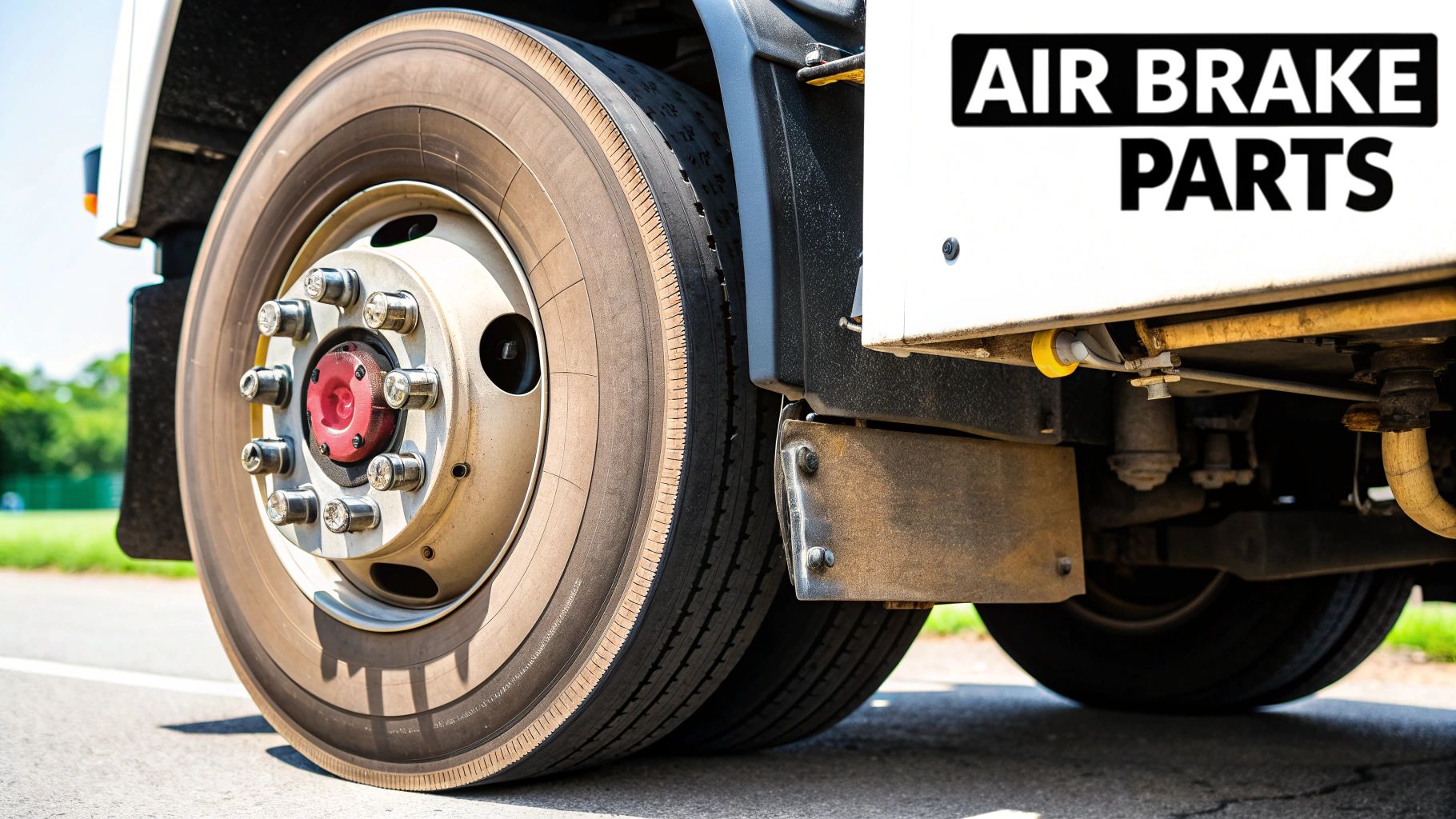
To really nail the air brakes test, you have to do more than just memorize a list of parts. You need to understand how they all work together. Think of it like a team where every player has a crucial role—knowing how they interact is what helps you answer those tricky situational questions and, more importantly, keep your rig safe on the road.
Let's follow the air from the moment it's created to the second it stops your wheels. This isn't just about passing a test; it's the real-world knowledge you'll rely on every single day.
The Heart of the System: The Air Compressor and Governor
It all begins with the Air Compressor. This is the powerhouse, usually driven by the engine, that pumps air into the system and pressurizes it. Without the compressor, you've got no brakes. Simple as that.
Right alongside it works the Governor. Its job is to be the system's "thermostat." It tells the compressor when to start and stop pumping. Once the air tanks hit their max pressure—usually around 125 PSI—the governor cuts the compressor off. When you use the brakes and the pressure drops to about 100 PSI, it tells the compressor to kick back on.
This "cut-in" and "cut-out" cycle is a fundamental concept. It ensures you always have enough air pressure to stop but prevents the system from being over-pressurized, which could blow a line. You can bet you'll see questions about this on your exam.
Where the Power is Stored: The Air Tanks
So, where does all that compressed air go? It's stored in Air Storage Tanks, or reservoirs. A typical truck has several tanks, and they act as a backup for each other. If one part of the system has a leak, you still have air for the other parts.
Think of them like a battery, holding onto that stopping power until you need it.
One of the most critical daily habits for any driver is draining the air tanks. The compressor sucks in air from the outside, which means moisture and even a little oil can get in. If you don't drain this gunk out, it can freeze in cold weather and cause your brakes to fail completely.
This is a non-negotiable part of your pre-trip inspection. It’s a huge safety point on both the written test and the skills test.
Making it Happen: The Foot Valve and Brake Chambers
When you step on the brake pedal, you're actually controlling the Brake Valve (you'll hear it called the foot valve or treadle valve). This valve releases that stored air from the tanks and sends it rushing through the lines to the wheels. The harder you press, the more air you send, and the harder the truck brakes.
That burst of air travels to the Brake Chambers at each wheel. Inside, the air pressure pushes against a diaphragm, which moves a pushrod. This is the first step in the mechanical process of actually applying the brakes.
The Final Push: Slack Adjusters and Brake Drums
That pushrod coming out of the brake chamber is connected to a Slack Adjuster. This is basically a lever that turns the linear push of the rod into the rotational force needed to apply the brakes.
The slack adjuster rotates what's called an S-cam. The S-cam then forces the brake shoes apart and presses them against the inside of the Brake Drum. It’s the friction between those shoes and the spinning drum that slows the wheel down and brings your massive rig to a halt.
Keeping those slack adjusters in perfect adjustment is critical. If there's too much "slack" or play, your brakes will be delayed and weak when you need them most.
Mastering the Pre-Trip Air Brake Inspection
The pre-trip air brake inspection is way more than just running down a checklist. It’s a methodical routine, and honestly, it’s what separates the drivers who walk into their CDL exam with confidence from the ones who stumble. The test will hit you from two angles: the written questions and the hands-on skills test. Both will hammer your ability to perform these checks correctly and in the right order.
Getting this part wrong is one of the fastest ways to fail. Trust me on this.
This isn’t about just glancing at gauges and kicking tires. Examiners are trained to look for a precise, step-by-step demonstration. They need to see that you actually understand why you're doing what you're doing. Memorizing the steps is a start, but performing them smoothly when you've got an examiner staring at you? That's the real test.
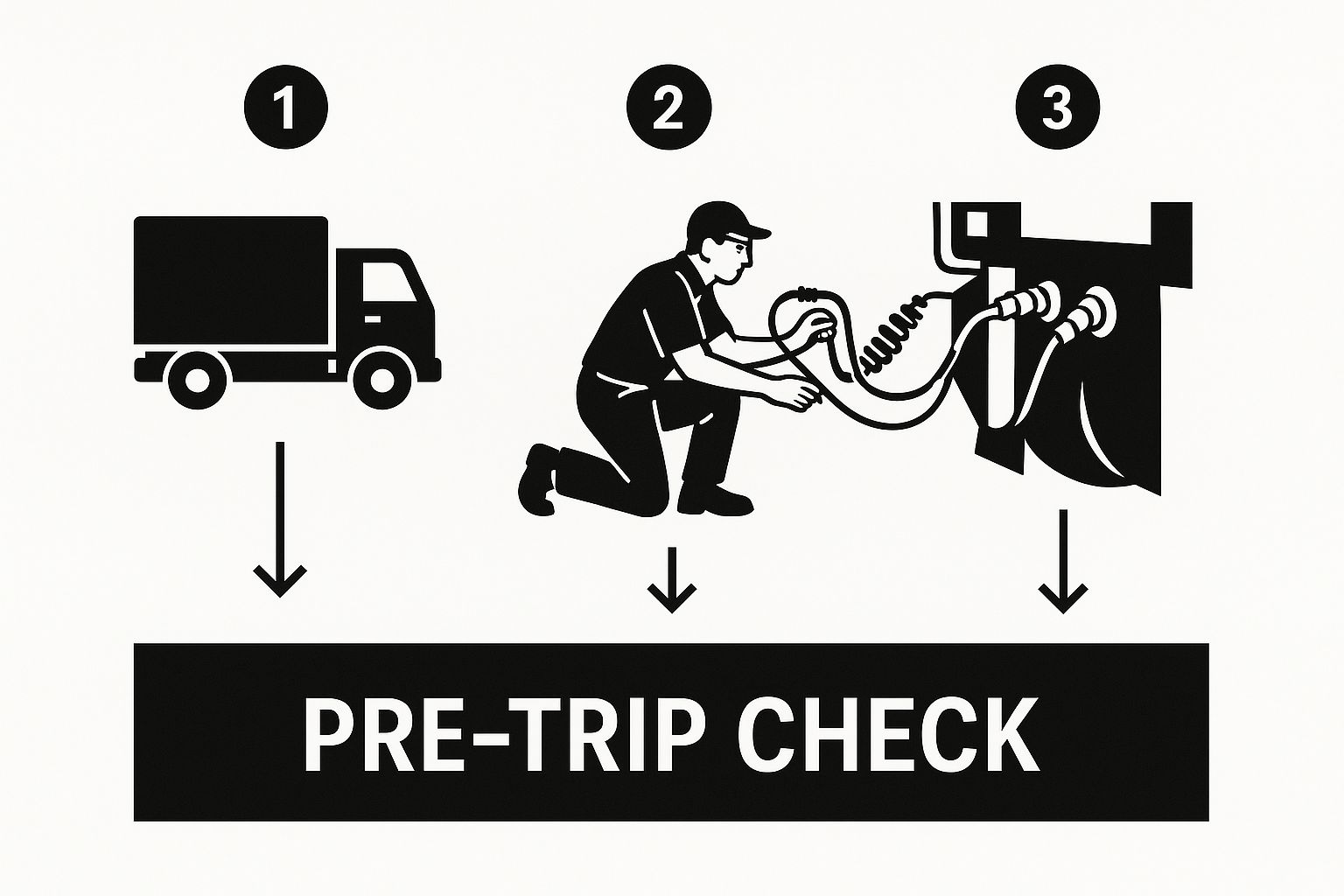
A proper inspection is a combination of what you do inside the cab and what you see on your walk-around. Every single part of that air brake system needs to be checked to make sure it's safe and ready to go.
The In-Cab Inspection Sequence
Think of your in-cab air brake test as a performance. It has to be done in a specific order, and you have to hit certain key pressure points and time limits. This is the exact sequence that examiners expect to see.
First up, you'll need to check the governor cut-out and cut-in pressures. With the engine running, let the system build air pressure until you hear it "cut out." That should happen somewhere around 125 PSI. Then, you'll start pumping the brake pedal to bleed off air until the governor "cuts in" and the compressor kicks back on. This needs to happen no lower than 100 PSI.
This test proves you know the healthy operating range of your air system. If a governor cuts out too high, you risk damaging the system. If it cuts in too low, you might not build pressure fast enough when you really need it.
Right after that, you'll move into the static and applied air leak tests. These are both timed and demand precision. I’ve seen more nervous test-takers mess this up by rushing than anything else. For a full breakdown of the entire inspection process, check out our complete guide to the pre-trip inspection.
Timed Air Leak Tests
The timed air leak tests are a huge deal. This is where a lot of students drop points on the practical portion of the air brakes CDL test. You absolutely have to know the pressure loss limits by heart.
Here’s exactly what you need to do:
- Static Leak Test: First, shut the engine off but leave the key on so you can see the gauges. Release the brakes. You can't lose more than 2 PSI in one minute for a straight truck or 3 PSI for a combination vehicle.
- Applied Leak Test: Right after the static test, push down on the foot brake and hold it with firm pressure. Now, you can't lose more than 3 PSI in one minute for a straight truck or 4 PSI for a combination vehicle.
A quick tip: announce each step clearly to the examiner. Tell them what you're testing so there's no confusion about what they're seeing.
Low Air Warning and Spring Brake Checks
The final two pieces of the in-cab inspection are all about testing the system’s emergency features. These are the fail-safes designed to stop the truck if you have a major air system failure.
First, you'll test the low air pressure warning alarm. With the key still on, keep pumping the brakes to bleed down the air. That alarm—usually a light and a buzzer—has to come on at or before the pressure drops to 60 PSI.
As soon as you hear that alarm, keep going. You’re now testing the spring brakes. Continue fanning the brakes, and the parking brake valve should pop out automatically when the pressure drops to somewhere between 20 and 45 PSI. That pop tells you the spring brakes have engaged on their own, just like they're supposed to.
Nailing the Most Common Test Questions
Let's be clear: passing the air brakes CDL test isn't about rote memorization. It’s about understanding the why behind the questions. The exam is built to test how you'd think on your feet, throwing real-world scenarios at you where you have to read gauges, spot a failing part, or pick the right emergency action.
Think about a question on brake lag. They aren't just checking if you know the definition. They want to see if you grasp the concept—that physical delay between hitting the pedal and the brakes engaging. It’s the time it takes for air to hustle through the lines, and knowing that is crucial for keeping a safe following distance. When you understand the "why," you can answer any version of that question they throw at you.
Interpreting Pressure Readings and Warnings
A huge chunk of the test revolves around situational puzzles based on your air gauges. You'll get a scenario and be asked to diagnose the problem based on what the needles are telling you or what warnings are going off. This stuff is pulled directly from the pre-trip inspection you have to master anyway.
You'll definitely see questions structured like this:
- Scenario: The low air pressure warning light and buzzer kick on. What's your immediate move? The only correct answer is to get off the road and stop as safely and quickly as possible.
- Question: At what PSI will the spring brakes automatically engage? You have to know this cold: between 20 and 45 PSI.
- Question: Your air pressure isn't building up. What are the two most likely culprits? They're looking for answers like a slipping V-belt on the compressor or a serious air leak somewhere in the system.
The numbers are absolute. You have to know the specific PSI values for the governor cut-in and cut-out, the low-pressure alarm, and when the spring brakes pop. There’s no wiggle room on these critical safety figures.
Drilling these numbers turns tough questions into easy points. This is also core material for the general knowledge test, so you can see how it all ties together.
Understanding Dual Air Brake Systems
I've seen a lot of students get tripped up on questions about the dual air brake system. It’s simple, really. Modern rigs have two independent systems for safety—a primary and a secondary. Each one handles a different set of brakes. Think of it as a built-in backup.
A classic test question will paint a picture of one system failing and losing all its air. You need to know that you still have brakes from the other system. The critical part to remember is that your stopping distance is going to be a lot longer. You can still stop, but you have to be incredibly careful about it.
Emergency Procedures and System Failures
You can bet the test will grill you on what to do when things go sideways. These questions are all about ensuring you can react safely when a real emergency hits.
For instance, they love to ask about brake failure on a steep downgrade. The correct procedure involves a few key steps: get into a lower gear to use the engine to help slow you down, look for an escape ramp, and use controlled, firm brake applications ("stabbing") with whatever air you have left. The one thing you never do is try to coast it out. Knowing how to handle an emergency is what makes you a professional, not just a driver.
Proven Study Strategies for Test Day Success
Knowing the theory behind air brakes is one thing. Being able to recall it cold under the pressure of the air brakes CDL test is something else entirely. It’s not about how long you study; it’s about how you study. The right preparation strategy will turn those abstract concepts into second-nature knowledge you can pull up on demand.
The first thing I tell every new driver is to get out of the manual and into the diagrams. Stop just reading words on a page. Instead, trace the path of air from the compressor all the way to the brake chambers until you can see the entire system in your head. This builds a mental map that’s far more durable than just trying to memorize facts.
Active Recall and Practice Testing
When it comes to the hard numbers, flashcards are your best friend. But don’t just write a term on one side and a definition on the other. Get specific. Make cards just for those critical pressure values you absolutely must know for your pre-trip inspection.
- Governor Cut-Out: What’s the ballpark PSI? (Around 125 PSI)
- Low Air Alarm: At or below what pressure does it have to come on? (At or below 60 PSI)
- Spring Brake Activation: What’s the pressure range where they pop out? (20-45 PSI)
Doing it this way forces your brain to actively recall the information, which is what really locks it in. Then, you have to hit the practice tests. This is non-negotiable. It builds your mental stamina for the real exam and gets you used to how the questions are worded. If you want to see where you stand, work through our Air Brakes Test 1 questions.
The whole point of practice testing isn't just to get a good score. It's to find your weak spots. That way, you know exactly what to study before you're sitting in that testing center.
Smart Test-Taking Tactics
When test day finally arrives, take a breath and slow down. Read every single question carefully. Be on the lookout for sneaky keywords like "always," "never," or "except"—they can flip the entire meaning of a question.
If a question stumps you, don’t panic. Use the process of elimination. Cross out the answers you know for a fact are wrong, and you’ll immediately improve your odds. This isn't just a "nice-to-have" skill; it's critical. Data shows that a surprising 15-20% of applicants fail the air brakes test on their first try, which tells you it’s no cakewalk. A failure means delays and frustration, so walking in with a smart strategy is essential.
Your Air Brakes Test Questions Answered
Alright, we've gone through the nuts and bolts of the air brake system and how to study for the test. But I know from experience that even with all that knowledge, you probably still have some practical questions about what to expect on test day.
Let's tackle those common, last-minute concerns. Getting these details straight will help you walk into the testing center feeling prepared and confident, with no surprises waiting for you.
How Many Questions Are on the Test?
This is usually the first thing people want to know. While it can vary a bit depending on your state, you can generally expect the air brakes endorsement exam to have around 25 to 35 multiple-choice questions.
The bar for passing is pretty standard across the board: you’ll almost certainly need to score at least an 80%. I can't stress this enough, though—always double-check your state's official CDL manual for the exact numbers.
What Happens If I Fail the Test?
Failing the air brakes test isn't the end of the world, but it does have a major catch. If you pass your other CDL tests but not this one, you can still get a CDL, but it will come with an "L" restriction.
An 'L' restriction means you are legally barred from driving any commercial vehicle with an air brake system. This is a huge career-limiter, since the vast majority of Class A and Class B trucks use them.
The good news is you can retake the test. Just keep in mind that your state might have a mandatory waiting period before you can try again, and there will likely be retesting fees. If you want a feel for the real thing, take a run through our air brakes practice test questions to see where you stand.
Is This Endorsement Needed for a Class C CDL?
This one trips people up sometimes. The need for the endorsement isn't tied to the license class itself, but to the actual vehicle you'll be driving. For Class A and Class B, it's pretty much a given that you'll need it.
For a Class C license, it depends. If the specific Class C vehicle you'll be operating is equipped with air brakes—like some large passenger vans, shuttle buses, or other specialized trucks—then yes, you absolutely must have the air brakes endorsement. The golden rule is simple: your endorsements have to match the equipment you operate.
At Patriot CDL, we ensure you're fully prepared for every part of your CDL journey, from the written permit exam to the hands-on skills test. Find out more about our accelerated programs and launch your trucking career with confidence at https://patriotcdl.com.