


If there's one make-or-break moment in your CDL exam, it's the air brake test. Getting your airbrake test practice down to a science isn't just about passing; it's the first real step you take toward becoming a safe, competent professional driver. This isn't just about memorizing steps—it's about building the hands-on, muscle memory that’ll keep you safe on the road.
Why Your Airbrake Test Practice Matters More Than You Think

Let's be real: passing the CDL test is about proving you can operate a massive vehicle without endangering anyone. The air brake inspection is a huge part of that proof. Many students get tunnel vision, focusing only on the pass-fail outcome, but what you're really doing is building the foundation for your entire career.
Your examiner isn’t just looking for you to recite a script. They’re watching to see if you have the practical know-how to spot a serious problem before it turns into a catastrophe. A slow leak or a sticky governor isn't just a minor detail on test day—out on the highway, it's a disaster waiting to happen.
From Jitters to Total Confidence
The more you practice the air brake sequence, the more it becomes second nature. And that’s the whole point. You want to get to where you can run through the entire check flawlessly, even with an examiner staring over your shoulder.
Consistent, hands-on practice helps you:
- Shake Off Test-Day Nerves: When you’ve done it a hundred times, you’re not thinking, you’re just doing. Muscle memory takes over.
- Look Like a Pro: A smooth, confident inspection tells the examiner you’re serious about safety and came prepared.
- Build Lifelong Safety Habits: The routine you perfect now is the same one that will protect you, your load, and everyone else on the road for years.
The air brake test is often called the toughest part of the entire pre-trip inspection. And the numbers back it up. Some CDL testing studies show that a staggering 80% of pre-trip inspection failures happen because of mistakes made during the air brake check.
It's More Than Just Passing a Test
At the end of the day, that in-cab air brake inspection is your first line of defense. Mastering it is a core skill, not just another box to check. Before you dive into practice, make sure you're clear on all the basic CDL requirements that set the stage for your training. Think of this guide as your roadmap—not just to pass the test, but to walk away feeling like a competent, confident operator from day one.
Understanding the Air Brake System Before You Test It
Trying to jump into an airbrake test practice session without knowing what the parts do is a recipe for disaster. It’s like a mechanic trying to fix an engine without knowing where the spark plugs are. To really nail this test, you need a solid mental map of how everything works together.
Forget the dense engineering manuals for a minute. Let's break this down into what you actually need to know for your CDL test and, more importantly, for your life on the road.
Think of the air brake system as the lungs of your truck. The air compressor is what does the breathing, pulling in outside air and pressurizing it. It's almost always driven by the engine, constantly working to build up the pressure needed to stop a fully loaded rig.
Of course, that compressor can't just run nonstop. That's where the air compressor governor comes in. It's the brain of the operation, telling the compressor when to kick on and when to take a break. It's programmed to start pumping air around 100 PSI (the "cut-in" pressure) and to stop once it hits about 125 PSI (the "cut-out" pressure). This cycle keeps the system safely charged and ready to go.
Where the Power Is Stored
Once the compressor has done its job, all that pressurized air needs a place to hang out until you need it. That's the role of the air storage tanks. Your truck has a few of them, often called primary and secondary, or sometimes "wet" and "dry" tanks.
The first tank the air hits is the wet tank. It’s designed to catch most of the moisture and oil that naturally comes from the compressor. Draining this tank daily is non-negotiable. From there, the cleaner, drier air moves on to the other tanks, just waiting for you to hit the brakes. This stored energy is what gives you the incredible stopping power needed for a heavy vehicle.
Putting the Air to Work
When you step on that brake pedal—the foot valve—you're not directly forcing fluid through lines like in your car. You’re actually opening a valve that unleashes a powerful blast of air from the storage tanks.
This air rushes through the lines to the brake chambers mounted at each wheel. A brake chamber is basically a tough, round can with a flexible diaphragm inside. As air floods the chamber, it pushes that diaphragm, which shoves a steel pushrod out with incredible force.
That pushrod is connected to a slack adjuster, which is essentially a lever. When the pushrod moves, it forces the slack adjuster to turn an S-cam. The S-cam then pushes the brake shoes out against the inside of the brake drum, and that friction is what brings you to a stop. It sounds like a lot of steps, but it all happens in the blink of an eye.
Key Takeaway: It's a simple chain of events. The compressor creates pressure, the governor regulates it, the tanks store it, and the chambers and slack adjusters apply it. If you understand this flow, you understand the 'why' behind every single step of your pre-trip inspection.
Remember, a safe truck is more than just good brakes. The overall reliability of your rig depends on quality heavy-duty truck parts that can stand up to the daily grind and pass those tough inspections.
This isn't just trivia; the examiners want to see that you get it. Your knowledge is tested directly on the written exams, where you'll see a set number of questions with a firm passing score. For example, many state CDL air brake tests have around 50 questions and require you to get an 80% to pass. Major training platforms also stick to that 75% to 80% threshold because it reflects what the DOT expects.
Knowing the "why" will help you nail those questions. When you're ready to put your knowledge to the test, our air brakes test practice module has a full set of questions to get you sharp.
The In-Cab Air Brake Inspection From Start to Finish
This is where all your airbrake test practice really comes into focus. The in-cab inspection is the heart and soul of the air brake test, a specific script you need to perform from memory right in front of the CDL examiner. You have to be both the actor and the narrator, clearly explaining every single step and what you expect to happen.
The entire check follows a logical path, starting with static safety checks and then moving into dynamic tests of the system's most important safety features. Once you master this sequence, what feels like a stressful exam becomes just another simple, repeatable routine. Let's walk through it, phase by phase, so you know exactly what to do, what to say, and what to look for.
A quick look at this diagram shows you the basic journey air takes in your system—from the compressor where it's made, to the tanks where it's stored, and finally to the brakes where it does its job.
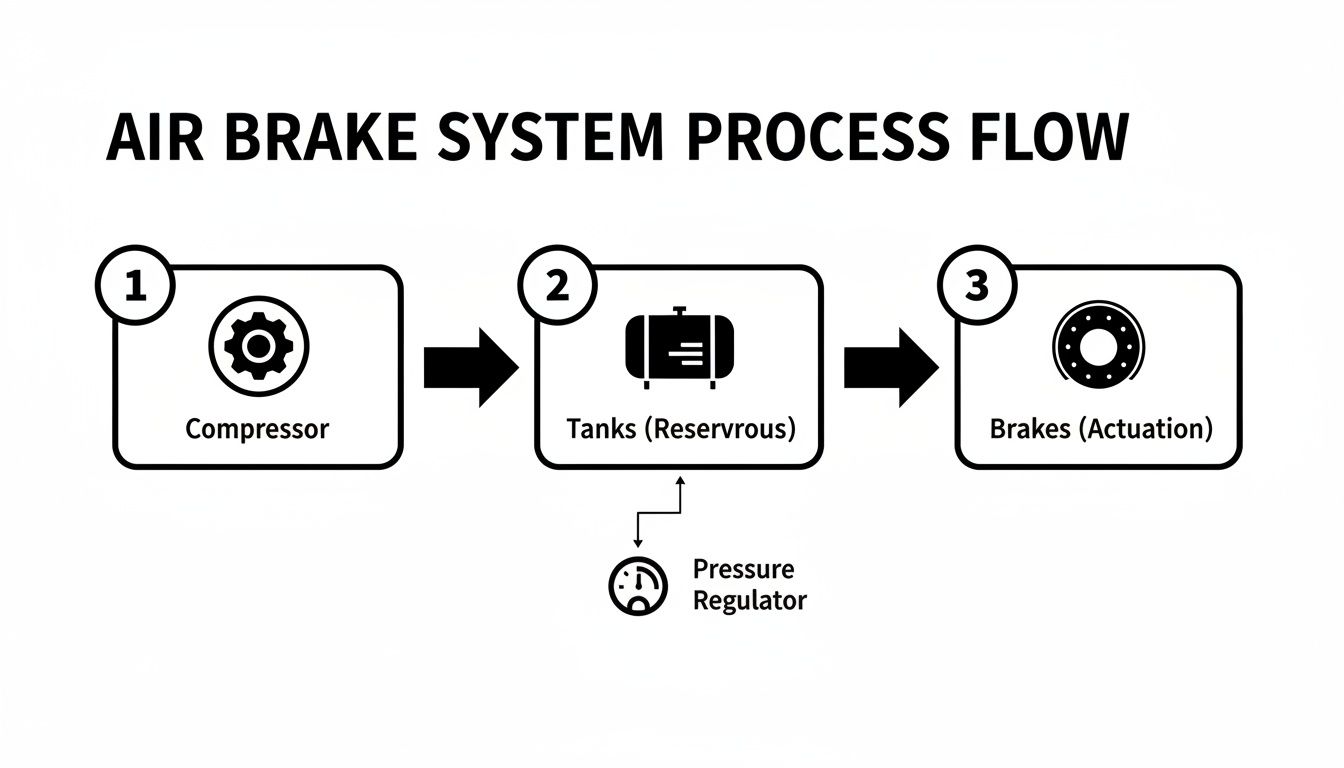
Understanding this flow helps make sense of why the in-cab inspection is done in such a specific order.
Phase One: The Initial Static Checks
Before you even think about starting the engine, the inspection has already begun. The goal here is simple: make sure the air system is solid and doesn't have any leaks when the compressor isn't running.
First thing's first: secure the vehicle. You absolutely have to chock the wheels, especially if you’re parked on even a slight slope. With the truck secured, turn the key to the "on" position, but don't start the engine. This brings your gauges and warning lights to life.
Assuming your system is already aired up (you want it between 100-125 PSI), you’re ready to perform two vital leak-down tests. This part is all about the numbers, and you have to know them and say them out loud.
-
Static Leakage Test: Release the parking brakes and get ready to time the air pressure drop for one minute. You must talk the examiner through it. For instance: "My system is fully charged. I'm now releasing the parking brake and will time it for one minute. I should not lose more than 3 PSI for my straight truck" (or "4 PSI for a combination vehicle").
-
Applied Leakage Test: Right after the static test, push down firmly on the service brake pedal and hold it for one full minute. Again, narrate what you're doing: "I am now applying firm pressure to the service brake and will hold it for one minute. For my combination vehicle, I should not lose more than 4 PSI."
These numbers aren't random; they're rooted in federal safety standards. An examiner will fail you on the spot for mixing up the PSI limits because it signals a major gap in your safety knowledge.
Phase Two: Verifying Safety Alarms and Brakes
Once you've confirmed the system can hold air, it's time to test the emergency warnings and the automatic spring brake application. To do this, you’ll slowly bleed the air out of the tanks and watch to see that the safety features engage exactly when they're supposed to.
Start fanning the service brake pedal to bring the system's air pressure down. As you do this, keep your eyes glued to the gauges and your ears open, calling out each event as it happens.
-
Low Air Warning Test: Keep fanning the brake. You must state that the low air warning light and/or buzzer needs to come on at or just before the pressure hits 60 PSI. When it does, announce it with confidence: "My low air warning light and buzzer have just activated at approximately 70 PSI, which is safely above the 60 PSI minimum."
-
Spring Brake Pop-Out Test: Continue fanning the brakes down. The parking brake knob—that yellow, diamond-shaped one—should pop out on its own somewhere between 20 and 45 PSI. Call that out, too: "My parking brake knob just popped out at 30 PSI, which tells me the spring brakes have automatically applied."
This sequence proves that if your truck ever suffered a major air loss on the road, the alarms would give you enough warning, and the spring brakes would eventually engage to bring the vehicle to a safe stop.
Phase Three: System Build-Up and Governor Test
The last piece of the puzzle is testing the air compressor and governor. You need to show they can build air pressure quickly and maintain it properly, proving the system can recover after you've been using the brakes.
Now, you can safely start the engine. With the engine running, your job is to watch the air pressure gauges and narrate the build-up.
You need to verbalize the timing. A good example would be: "I am now watching my air pressure build. The pressure must climb from 85 PSI to 100 PSI within 45 seconds." This confirms your compressor is working efficiently.
The final step is to check the governor's cut-out and cut-in pressures.
-
Governor Cut-Out: Let the pressure build until the compressor shuts off. You’ll know it happens when you hear the air dryer purge with a loud "pssshhh" sound. Announce the pressure reading: "My governor cut out at 125 PSI, which is within the correct operating range."
-
Governor Cut-In: Start fanning the brakes again to lower the pressure. Watch the needle like a hawk and note when it stops dropping and begins to climb again. That's your cut-in point. Announce it: "My governor cut back in at approximately 100 PSI."
To make this easier to remember on test day, here's a quick cheat sheet summarizing the whole process.
CDL Air Brake Test At-A-Glance Checklist
This table breaks down the entire in-cab inspection into a quick-reference format. Use it to quiz yourself until each step becomes second nature.
| Test Phase | Key Action Required | What to Monitor (Audible/Visual) | Passing Criteria |
|---|---|---|---|
| Static Leak Test | Release parking brake & time for 1 minute. | Air pressure gauge. | Don't lose more than 3 PSI (straight truck) or 4 PSI (combo). |
| Applied Leak Test | Hold service brake & time for 1 minute. | Air pressure gauge. | Don't lose more than 4 PSI (combo vehicle). |
| Low Air Warning | Fan service brake to lower pressure. | Warning light/buzzer & air gauge. | Alarms must activate at or above 60 PSI. |
| Spring Brake Pop-Out | Continue fanning brake to lower pressure. | Parking brake knob & air gauge. | Knob must pop out between 20-45 PSI. |
| Air Build-Up | With engine running, time pressure build. | Air gauge & a watch/timer. | Must build from 85 PSI to 100 PSI in 45 seconds or less. |
| Governor Cut-Out | Let pressure build to maximum. | Air gauge & sound of air dryer purge. | Compressor must shut off between 120-140 PSI. |
| Governor Cut-In | Fan brake to lower pressure slightly. | Air gauge needle stops dropping/starts rising. | Compressor must turn on around 100 PSI. |
Nailing this complete sequence demonstrates to the examiner that you know the system inside and out. It's a critical part of the overall vehicle evaluation, which we cover in much more detail in our complete guide to the pre-trip inspection.
Remember, those specific PSI limits for leakage aren't just for the test; they are pass/fail criteria directly tied to Federal Motor Carrier Safety Administration (FMCSA) standards. Examiners focus on them heavily because they are a non-negotiable measure of a vehicle's safety.
Common Failure Points and How to Avoid Them
Even students who know the air brake test inside and out can get tripped up by simple mistakes when the pressure is on. Knowing where these common tripwires are is half the battle. Think of this as a look at the real-world blunders that happen every day, both during airbrake test practice and on the actual exam.
By getting familiar with these common errors now, you can build a mental checklist that keeps you steady when the nerves kick in. This is your cheat sheet for a smooth, confident, and successful inspection.
The Forgotten Chocks Scenario
Picture this: you climb into the cab, feeling good. You turn the key to power up the gauges, but before you can even announce your first step, the examiner says, "We're done here." What just happened? You forgot to chock the wheels.
It’s an instant failure and a tough pill to swallow, but it's a fundamental safety violation. An examiner sees this as a huge red flag—a sign that you might cut corners on the road when no one is watching.
How to Avoid It: Make chocking the wheels the very first thing you do before you even think about starting the in-cab portion of the test. Build a rock-solid habit: park the truck, set the brakes, get out, grab the chocks, and secure the wheels. Only then should you get back in the cab to begin.
Misstating the PSI Loss Limits
You're in the middle of the applied leakage test, holding steady pressure on the brake pedal. The examiner asks, "What's the maximum allowable air loss for this vehicle?" Feeling confident, you say, "Three PSI in one minute." The examiner makes a note, and you've just failed that part of the test.
The problem? You were testing a combination vehicle, which has a 4 PSI limit for the applied test. Stating the wrong number is just as bad as having a real leak because it reveals a critical gap in your safety knowledge.
How to Avoid It: You need to burn the "Rule of 3s and 4s" into your brain until it's automatic.
- Straight Truck: 3 PSI static loss / 3 PSI applied loss.
- Combination Vehicle: 4 PSI static loss / 4 PSI applied loss.
Drill this difference every single time you practice. Say the correct numbers out loud for the vehicle you're in. This is core-level information, just like the material covered in the General Knowledge test you took for your permit.
Rushing the Governor Tests
You've aced the leakage and alarm tests and now it's time for the governor. You fire up the engine and let the pressure build. The moment you hear the air dryer purge, you immediately jump on the brakes to fan them down for the cut-in test.
The examiner might stop you and ask, "What was the exact cut-out pressure?" If you were rushing, you might not have been watching the needle closely enough to give an accurate answer. You have to state the specific PSI where the compressor stopped building air.
Examiner Insight: A vague answer like "it cut out around 125" won't fly. They need to hear a precise, confident statement: "My governor cut out at exactly 126 PSI, which is within the safe operating range."
How to Avoid It: Slow down. Treat the governor cut-out and cut-in as two totally separate steps. Don't blend them together.
- Cut-Out: Let the pressure build. Watch the needle like a hawk until it stops, and listen for the purge. Announce the exact PSI.
- Cut-In: Then, and only then, begin fanning the brakes. Watch the needle fall, then stop and start to climb again. Announce that exact PSI.
This methodical pace shows the examiner you're in full control and are actually observing the system, not just racing through a memorized script. It's a small change in your approach that makes a huge difference in how your performance is perceived.
Setting Up a Winning Air Brake Practice Schedule

Let's be real—you can't cram for the air brake inspection. This isn't about memorizing facts for a multiple-choice test; it's about building muscle memory and deep familiarity. A solid practice plan is what separates a nervous, fumbling attempt from a smooth, confident performance that impresses the examiner.
The key is consistency over intensity. Short, daily practice sessions are way more effective than one long, exhausting cram session on the weekend. You want the entire sequence to become automatic, freeing up your mental energy to focus on what the gauges are telling you.
Here’s a practical, four-week progression I've seen work time and time again.
Week 1: Master the Script (No Truck Needed)
Before you even climb into the cab, your first week is all about memorizing the script. You need to know the entire in-cab inspection cold—every step, every PSI value, and every verbal cue for the examiner.
- Your Action Plan: Grab some index cards and write down each step of the inspection, one step per card. Run through the stack multiple times a day until you can recite the whole thing, word-for-word, from memory.
- The Goal: By the end of the week, you should be able to recite the full in-cab script aloud, twice in a row, without a single mistake.
Think of this as building your foundation. It’s no different than following any other detailed procedure, like a comprehensive maintenance checklist for an RV; the process must be ingrained before you can execute it flawlessly.
Week 2: Connect Words to Actions (In the Cab)
Alright, time to get in the truck. This week is all about linking the script you just memorized to the actual physical actions. Sit in the driver's seat and start performing the test, saying your lines aloud as you do each step.
Forget about being perfect. The goal here is to build the muscle memory of flipping switches, pressing pedals, and watching the right gauges at the right time. Pull out your phone and record yourself. You'd be amazed at the small hesitations and mistakes you'll catch on video that you completely miss in the moment.
Expert Insight: Don't just go through the motions. Actually watch the air gauges. See the needles drop during the applied leak test. Watch them climb during the governor cutout test. Connecting the visual feedback to your script makes it stick.
Weeks 3 & 4: Full Integration and Polish
Now that the in-cab portion is becoming second nature, it's time to put it all together. For the last two weeks, your airbrake test practice should focus on running the entire pre-trip inspection, flowing seamlessly from your walk-around right into the in-cab air brake checks.
This is critical because it mimics the real test. You need the stamina and focus to perform the air brake test perfectly, even after you've already spent 20-30 minutes inspecting the outside of the vehicle. Keep recording yourself and, if you can, have an instructor watch you. They'll spot the little things that can make all the difference.
By the time test day rolls around, this won't feel like a test anymore. It’ll just be a professional safety inspection you've done a hundred times.
To help you stay on track, here's a structured plan that breaks down the weekly progression.
4-Week Air Brake Practice Progression Plan
| Week | Primary Goal | Key Practice Activities | Success Metric |
|---|---|---|---|
| 1 | Memorization | Study the script. Use flashcards. Recite aloud daily. | Recite the entire in-cab script from memory without errors. |
| 2 | Hands-On Application | Practice in the cab. Match physical actions to the script. Record and review your performance. | Perform the in-cab test while verbalizing each step, no longer needing a script. |
| 3 | Integration | Perform the full pre-trip inspection, flowing directly into the air brake test. | Complete the entire pre-trip and air brake sequence in one continuous flow. |
| 4 | Refinement & Timing | Practice the full sequence under timed conditions. Get feedback from an instructor. | Consistently perform a smooth, confident, and accurate full inspection within a reasonable time. |
Following a plan like this removes the guesswork. It builds your knowledge, your skills, and most importantly, your confidence for test day.
Answering Your Top Air Brake Test Questions
Even after hours of practice, a few nagging questions can pop up right before test day. Let's tackle some of the most common ones I hear from students, so you can walk in feeling prepared and confident.
What if My Air Pressure Builds Too Slowly During the Test?
So you're in the middle of the test, and you notice the needle climbing way slower than the required 85 to 100 PSI within 45 seconds. This is a classic sign of a real-world problem, maybe a slipping compressor belt or a sneaky air leak.
Don't panic. The key here is to talk the examiner through what you're seeing. Say something like, "I'm observing the pressure is building slower than it should. On the road, this would signal a problem with the compressor that needs immediate inspection."
This simple act shows the examiner you know what you're doing and what to look for. It's not necessarily an instant fail, especially if the system eventually hits the governor cut-out. What's more important is demonstrating that you understand how a healthy system operates and can spot a potential safety issue.
Can I Bring a Written Checklist to My CDL Air Brake Test?
The short answer is no. During the official skills test, you generally can't use checklists, notes, or any other kind of cheat sheet. The air brake inspection is all about demonstrating you have the procedure committed to memory.
This is exactly why we drill it over and over in practice. The goal is to make the sequence second nature, so you can perform it smoothly even with test-day jitters. Use checklists all you want while you're learning, but the ultimate goal is to leave them in the truck on exam day.
What’s the Single Biggest Reason People Fail This Test?
From what I've seen over the years, a massive stumbling block is simply getting the air pressure loss limits wrong. You have to state the exact PSI-per-minute limit for your vehicle, like "less than 4 PSI for a combination vehicle." Messing that up is a huge red flag for the examiner.
Another common pitfall is rushing and either mixing up the steps or forgetting one entirely. It's easy to blank on the low-air warning alarm test or miss the spring brake pop-out when you're nervous. This is why mastering the sequence from the start is so critical. Plenty of drivers have had to take an e-restriction removal course down the line because they didn't nail every detail of the air brake system initially.
A Pro Tip from the Examiner's Seat: If you make a small mistake, don't let it throw you. Correcting yourself calmly and professionally can actually work in your favor. It shows you know the material well enough to catch your own error and proves you can keep your cool under pressure.
How Do I Recover if I Realize I've Made a Mistake?
The best thing you can do is just own it and fix it. If you skip a step or say the wrong number, simply say, "Correction," and then state the right information or perform the correct step.
For example, if you misspeak, you could say, "My air loss is 2 PSI. Correction, my air loss is 1 PSI, which is well within the acceptable limit." Examiners are looking for competent, safe drivers, not robots. Acknowledging a minor slip-up and immediately correcting it shows confidence and a true understanding of the procedure.
At Patriot CDL, we know that solid preparation is the foundation of a long, successful career on the road. Our experienced instructors offer the hands-on training and in-depth knowledge you need to ace the air brake test and the rest of your CDL exam. Get started on the right foot by checking out our programs.