
So, you're wondering what a truck driver really makes. It’s a common question, and the numbers can feel all over the map. The simple answer is that the national median pay for heavy and tractor-trailer truck drivers hovers around $53,560 per year, which breaks down to about $25.75 per hour.
But that number is just the starting line on a long road of earning potential.
What Truck Drivers Really Earn
That national average gives you a decent baseline, but it hardly tells the whole story. Think of that median salary as the 50-yard line on a football field—half of all drivers earn more, and the other half earn less. Your actual paycheck is shaped by the specific job you do, the miles you cover, and the experience you rack up.
A lot of different things can move your pay up or down, turning that one average figure into a huge range of possibilities. The Bureau of Labor Statistics provides that median as a general guide, but what you take home can look very different. The first step to landing on the higher end of that scale is getting the right training, and a solid CDL program is designed to get you there from day one.
Salary Potential by Role and Experience
To really get a handle on what you could earn, it helps to look at salaries based on common career paths in the trucking world. A driver who is brand new and running local routes is going to have a totally different pay structure than a seasoned veteran hauling specialized cargo clear across the country.
Your career in trucking isn't just a job; it's a journey of building skills. Each year of experience and every new endorsement you earn acts as a stepping stone to a higher income bracket.
To give you a clearer picture, here’s a quick breakdown of what you might expect to see based on different roles and experience levels.
Truck Driver Salary Snapshot by Role and Experience
This table provides a quick overview of potential earnings based on job type and years in the industry.
| Driver Profile | Typical Annual Salary Range |
|---|---|
| Entry-Level Local Driver (0-1 year) | $45,000 – $60,000 |
| Experienced Regional Driver (3-5 years) | $65,000 – $80,000 |
| Veteran OTR Driver (5+ years) | $75,000 – $95,000+ |
As you can see, there's a clear upward trend. The more time you spend behind the wheel and the more challenging the routes you take on, the more your value—and your salary—grows. In the sections ahead, we’ll dig into exactly how things like your location and special endorsements can unlock that higher pay.
How Your Location Impacts Your Paycheck
When it comes to a truck driver's salary, one of the biggest factors is something you might not expect: your home address. Just like a gallon of milk costs more in one city than another, your potential earnings can swing dramatically depending on the state you call home. It all boils down to local economics—a mix of supply and demand, cost of living, and the amount of freight that needs moving.
A driver living near major shipping ports, huge manufacturing centers, or busy freight corridors will almost always have better-paying gigs at their fingertips. These hotspots create a constant demand for drivers to keep goods flowing, which naturally pushes wages higher. Simply put, where you park your rig for the night can add or subtract thousands of dollars from your yearly income.
Why Some States Pay More
Picture a state’s economy as the engine powering truck driver pay. Regions with powerful industries—think energy, agriculture, or tech—are constantly generating tons of freight that has to get from Point A to Point B. States with bustling ports, like California, are a perfect example. Goods flood in from overseas and need to be trucked across the nation, creating a steady stream of valuable work.
A driver in a farming state, for instance, might cash in on high-paying loads during harvest season. Meanwhile, someone based in a manufacturing hub like Ohio could have consistent, well-paying work all year long. Knowing what makes the local economy tick is a huge advantage.
The difference in pay isn't just about the miles you run. It's about the value of what’s in your trailer and how badly the local market needs it moved. A driver in a high-demand area often earns way more for the exact same amount of work.
It's also true that states with a higher cost of living usually offer bigger paychecks to help drivers keep up with expenses. That’s why you’ll often find more competitive salaries on the coasts compared to the Midwest or the South. If you're serious about maximizing your pay, learning about the CDL requirements and job market in California is a great starting point to understand one of the country's top-paying markets.
Top Paying Regions for Truck Drivers
While the numbers are always shifting, some parts of the country consistently pay drivers better than others. This usually happens when high freight demand collides with a regional shortage of qualified drivers.
Here’s what typically creates these high-paying pockets:
- Major Freight Corridors: States that are crossroads for major national shipping routes always have more freight than they know what to do with.
- Dominant Local Industries: Areas with booming energy or manufacturing sectors need specialized hauling, which often comes with a bigger paycheck.
- Driver Shortages: In some regions, there just aren't enough drivers to go around. This forces companies to sweeten the deal with better pay and bonuses to get talent behind the wheel.
At the end of the day, deciding where to live and work is one of the biggest financial decisions you'll make in your trucking career. By strategically picking a region with a strong freight market, you set yourself up to earn significantly more than the national average.
Unlocking Higher Pay With Experience and Specializations
While your location definitely sets a baseline for your earning potential, your personal skills and on-the-road experience are what really write your paycheck. Think about it: a brand-new driver and a 20-year veteran might cover the exact same mileage in a week, but their pay stubs will tell two very different stories.
The path from a starting salary to a six-figure income is paved with experience, a clean driving record, and special qualifications known as endorsements.
Think of your standard Commercial Driver's License (CDL) as your general admission ticket. It gets you in the door. Endorsements, on the other hand, are the VIP passes that unlock the higher-paying, more specialized jobs. Every endorsement you add to your license makes you a more valuable asset, allowing you to haul freight that other drivers simply can't touch.
The Power of CDL Endorsements
An endorsement is a special certification on your CDL that proves you have the skills and knowledge to handle specific types of cargo or vehicles. For example, hauling hazardous materials requires a serious understanding of safety protocols and comes with a lot more responsibility—so it naturally pays better.
The more complex or demanding the load, the bigger the reward. These qualifications directly boost your average truck driver salary because they open the door to more profitable freight.
Some of the most valuable endorsements include:
- H Endorsement (Hazmat): This lets you transport hazardous materials, anything from industrial chemicals to gasoline. The extra training and risk involved almost always translate to a significant pay bump.
- T Endorsement (Tanker): This is for hauling liquids like milk, fuel, or chemicals in tanker trucks. It takes a unique skill set to manage the "slosh" of liquid cargo while driving.
- X Endorsement (Tanker/Hazmat Combo): This is the heavy hitter. It combines the H and T endorsements, qualifying you for some of the highest-paying jobs out there, like hauling gasoline.
- Doubles/Triples Endorsement: This certifies you to pull two or three trailers at once. It’s a common requirement for certain long-haul routes and dramatically increases how much freight you can move.
Your career growth in trucking is directly tied to your willingness to upskill. An investment in an endorsement is an investment in your future income, often paying for itself with just a few specialized loads.
From Experience to Expertise
Beyond specific endorsements, nothing beats time on the road. A long track record of safe, reliable driving builds a reputation that companies will gladly pay a premium for. An experienced driver with a spotless MVR is a low-risk, high-reward hire. They get trusted with the most expensive equipment and the highest-value cargo.
This is exactly why seasoned long-haul and specialized drivers regularly earn between $80,000 and $100,000 a year, with some in-demand roles pushing well beyond that. Let's not forget, the trucking industry is the backbone of the U.S. economy, moving over 90% of all consumer goods, raw materials, and food. That critical role means competitive pay is essential to keep the supply chain moving.
For drivers wanting to level up, even removing certain license restrictions can open up new opportunities. For instance, many new drivers get their CDL in an automatic truck, which puts an "E" restriction on their license. Learning to drive a manual transmission makes you a more versatile and attractive candidate for a wider range of companies. Investing in an E restriction removal course is a smart, practical step toward more job options and, ultimately, higher pay.
Your income isn't static. It’s a direct reflection of the expertise you bring to the driver's seat.
Company Driver vs. Owner Operator: Who Earns More?
One of the biggest crossroads a professional driver will face is the choice between being a company driver and becoming an owner-operator. This decision completely changes your financial picture, how you handle risk, and what your day-to-day life looks like. It's a classic trade-off between stability and high-stakes opportunity, and it has a massive impact on your average truck driver salary.
Think of it this way: a company driver is a skilled employee, while an owner-operator is a small business owner. Both can be successful, but they are fundamentally different paths.
The Stability of Company Driving
When you're a company driver, your world is pretty straightforward. The carrier owns the truck, pays for the fuel, covers the maintenance, and handles the insurance premiums. Your main job? Drive. That’s it.
Most company drivers are paid by the mile (CPM), by the hour (common for local gigs), or a percentage of the load's revenue. This structure gives you a predictable paycheck you can count on. You also get the perks of being a regular employee, like health insurance, a 401(k), and paid vacation—all without the headaches of running a business.
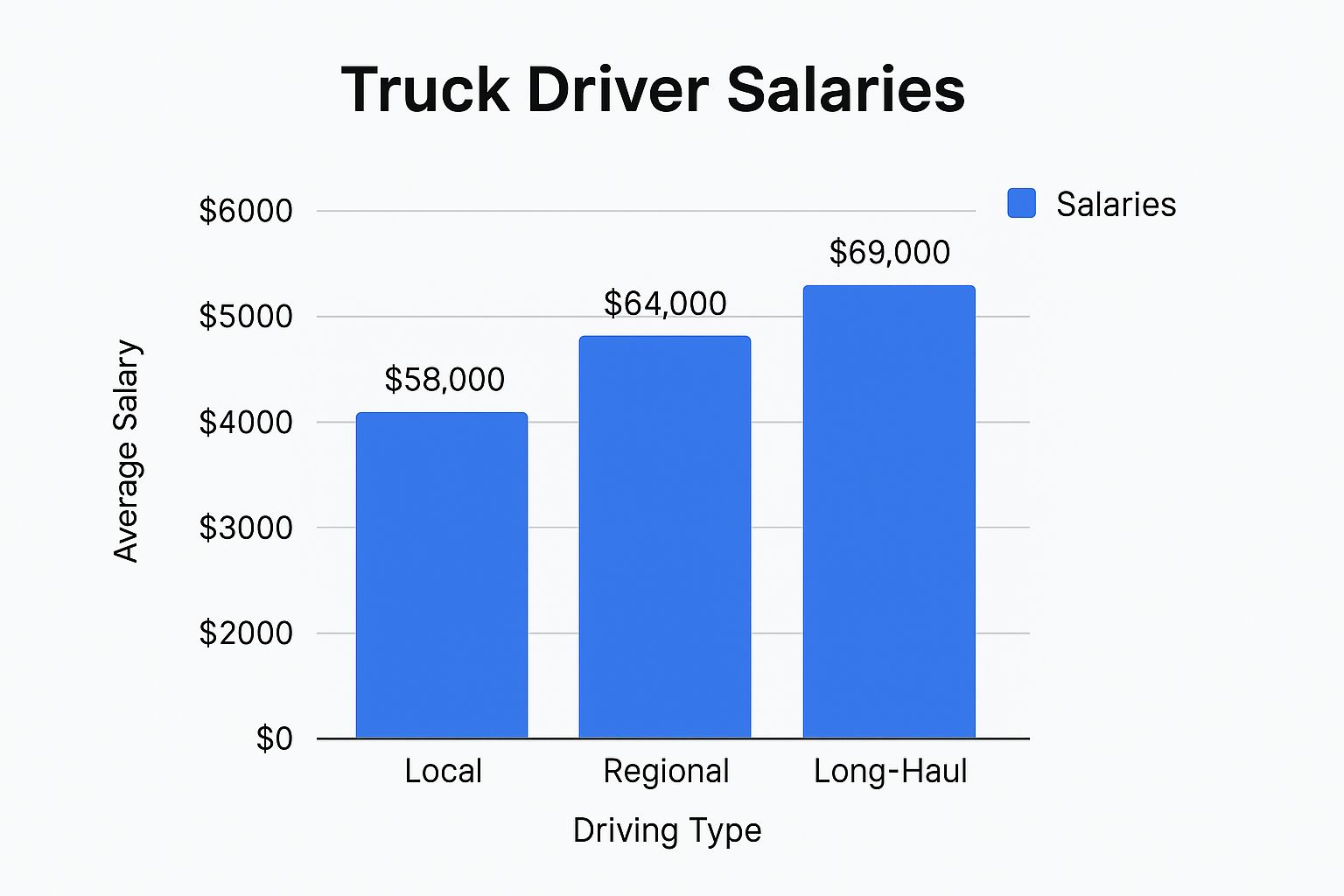
As you can see, the type of route you run plays a big role in your pay, with long-haul trucking often leading to the highest earnings for both company drivers and owner-operators.
The High Stakes of Being an Owner Operator
Stepping up to become an owner-operator is a whole different ballgame. You're not just a driver anymore; you're an entrepreneur. On paper, the earning potential is huge. It’s not uncommon to hear of owner-operators grossing over $200,000 a year. You're the boss, which means you pick your loads, set your own home time, and run your business your way.
But with great reward comes great responsibility. That impressive gross revenue isn't what you take home. You're running a business now, and every single cost comes directly out of your pocket.
"Being an owner-operator means you trade the security of a W-2 for the freedom of a 1099. Your ceiling for earnings is much higher, but your financial floor is gone. Every decision, from fuel stops to freight choice, directly impacts your bottom line."
So, what are you paying for? The list is long:
- Truck Payments: A new semi-truck can easily top $150,000.
- Fuel: This is your biggest and most volatile expense.
- Insurance: Commercial truck insurance isn't cheap, but it's non-negotiable.
- Maintenance & Repairs: A blown tire or engine trouble can wipe out a week's profit in an instant.
- Tires: A full set can run you several thousand dollars.
- Permits & Fees: Staying legal and compliant costs money.
To really see the difference, let's break down the financials side-by-side.
Company Driver vs Owner Operator: A Financial Overview
| Financial Aspect | Company Driver | Owner Operator |
|---|---|---|
| Gross Income | Lower, but more predictable (salary or per-mile) | Higher gross revenue potential |
| Primary Expenses | Minimal (personal items, food on the road) | All business costs (fuel, truck, insurance, repairs) |
| Equipment | Provided and maintained by the company | Purchased and maintained by the driver |
| Benefits | Typically includes health insurance, 401(k), paid time off | Responsible for own benefits and retirement savings |
| Risk & Liability | Low; the company assumes most risks | High; personally responsible for all business liabilities |
| Net (Take-Home) Pay | Lower, but stable and consistent | Higher potential, but can be highly variable |
Ultimately, what this table shows is a clear choice between risk and reward. One of the biggest logistical headaches for an owner-operator is managing downtime. Every minute you're not moving is a minute you're not earning. Finding reliable and secure truck parking solutions becomes a crucial skill to keep your operation running smoothly and profitably.
The decision boils down to your personal appetite for risk. Company driving offers a safe harbor with steady pay and benefits. Being an owner-operator offers the freedom of the open road and a shot at much higher earnings—if you have the business savvy to manage the costs and navigate the risks.
A Global Look at Truck Driver Salaries
It's one thing to know the average salary in the U.S., but it's another to see how that stacks up on the world stage. Taking a step back and looking at the global picture gives you a much better feel for the real value of your skills. The same forces that affect your paycheck here—driver shortages, freight demand, government rules—are playing out all over the world.
Think of it like this: the global trucking industry is a massive, interconnected highway system. A big traffic jam or a sudden surge in demand in one country can send ripples clear across the ocean, especially in tightly linked markets like North America.
How North America Compares
So, where do American drivers fit in? Globally, truck drivers in North America consistently pull in some of the highest paychecks in the business. A big part of that is driven by massive consumer demand and a stubborn, ongoing driver shortage that forces companies to open their wallets to attract and keep good drivers.
For instance, just look north of the border. Canada has been scrambling to find qualified drivers for a while now. Their high vacancy rate in the trucking sector has pushed wages up, creating a seriously competitive job market for anyone with a CDL.
It's not just about bragging rights; understanding these global trends shows just how valuable skilled, professional drivers are in the North American market. When you see neighboring countries dealing with their own severe shortages, it really drives home the critical role you play in keeping the supply chain moving.
Economic Forces Shaping Global Pay
Ever wonder why a driver in one country might earn way more or less than a driver somewhere else? It usually boils down to a few key economic pressures. These factors are pretty much universal, but they hit differently depending on the region.
- Driver Shortages: This is a big one. A lot of developed nations are dealing with an aging workforce and aren't seeing enough new blood coming into the industry. Countries with the worst shortages, like the United Kingdom and Canada, often have to raise wages to compete for the small pool of available talent.
- Freight Volume and Demand: It's simple supply and demand. Economies that produce a lot of goods—whether from manufacturing, farming, or imports—have more freight to move. High demand means more loads, which gives drivers more leverage for better pay.
- Government Regulations: The rulebook matters, too. Things like hours-of-service regulations, safety standards, and labor laws all play a part in what you can earn. Stricter rules might limit your driving time, but they can also lead to higher pay-per-mile or hourly rates to make up for it.
At the end of the day, this global perspective makes one thing crystal clear: professional truck drivers are essential everywhere. While the challenges and opportunities might look a little different from place to place, the value of a good driver is recognized worldwide.
Truck Driver Salary FAQs
Let's be honest, when you're looking at a career in trucking, one of the biggest questions is about the money. You want to know what you can expect to earn and, more importantly, how you can make more.
This is where we'll tackle the most common questions we hear about truck driver salaries. We'll break it down with straight-up answers, drawing from years of experience in the industry.
Which Truck Drivers Make the Most Money?
If you're chasing the highest paychecks, specialization is the name of the game. The drivers who earn the most are the ones who handle the loads others can't—or won't.
Think about ice road truckers. They're navigating some of the most dangerous roads on the planet, and their pay reflects that extreme risk. The same goes for drivers who haul oversized loads. Moving a massive wind turbine blade or a piece of industrial machinery takes incredible skill and special permits, so the compensation is at a premium.
Drivers with a hazmat endorsement also fall into this top-tier category because they're trusted to transport sensitive materials. And don't forget about private fleets. A company like Walmart, for instance, is well-known for paying its in-house drivers some of the best salaries and benefits in the business.
Do Local or OTR Truck Drivers Make More?
This is the classic debate, and the answer isn't as simple as one being better than the other.
Generally, over-the-road (OTR) drivers have a higher annual earning potential. It makes sense, right? They're paid by the mile and they spend weeks on the road racking up huge mileage totals. More miles equals more money.
But local driving jobs usually pay by the hour, which means your income is more predictable. You know what you're making week to week. While the absolute top-end salary might not reach OTR levels, you get the incredible perk of being home every single night. It really boils down to what you value more: maximizing your income or having more time at home.
The choice between OTR and local driving is a personal one. OTR offers a higher ceiling for your annual salary, but local routes give you a stable schedule and consistent home time.
How Can I Make More Money as a Truck Driver?
The great thing about a trucking career is that your starting salary is just that—a start. You have a ton of control over your income trajectory. If you're willing to put in the work, you can significantly increase your earnings.
Here are a few of the most effective ways to boost your pay:
- Build Experience: Time in the seat is money in the bank. A clean driving record and a few years of experience make you a top candidate for the best carriers and the highest-paying jobs.
- Get Endorsements: Adding tanker, hazmat, or doubles/triples endorsements to your CDL instantly makes you more versatile and qualified for higher-paying, specialized freight.
- Find Your Niche: Don't just haul general freight. Specialize in something like flatbed, car hauling, or refrigerated goods. These often come with better pay rates.
- Think About Ownership: The ultimate step for maximizing income is becoming an owner-operator. It’s a big move with the added responsibilities of running a business, but the earning potential is unmatched.
It all starts with a solid foundation. You have to ace the written exam to even get started, and a good guide on the CDL general knowledge test is the perfect place to begin. At the end of the day, the more you know and the more you can do, the more you'll earn.
Ready to get behind the wheel and start your high-paying career? Patriot CDL offers accelerated, hands-on training to get you on the road fast. Learn more and enroll today.