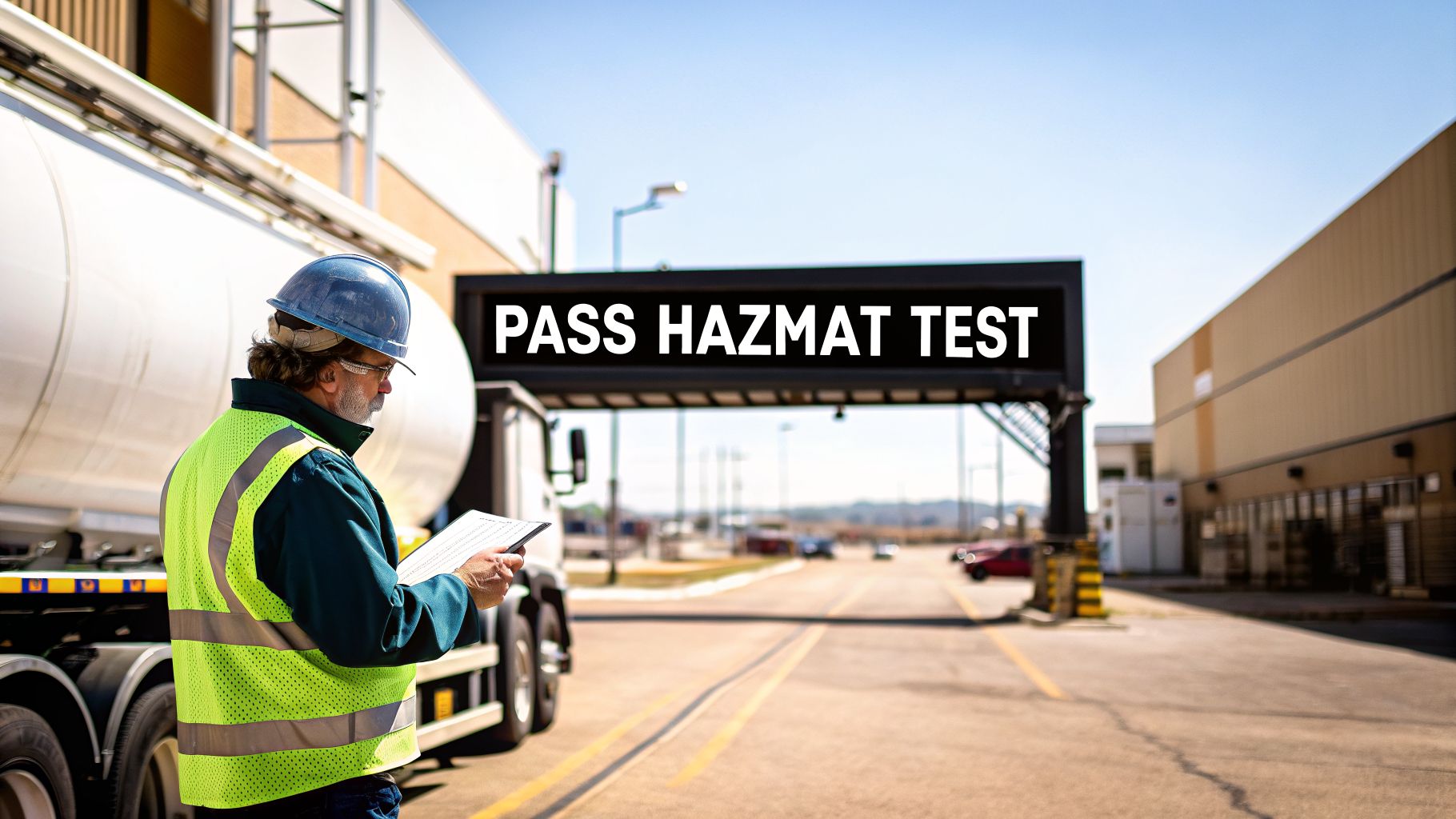
Earning your CDL Hazmat endorsement isn't just about passing another test—it's one of the smartest upgrades you can make to your trucking career. This credential qualifies you to haul the materials others can't touch, instantly making you a more valuable and sought-after driver.
Why a Hazmat Endorsement is a Smart Career Move
If you're weighing whether to get your hazmat endorsement, let me put it simply: it's one of the most powerful additions you can make to your CDL. Yes, passing the cdl hazmat endorsement test takes some serious study, but the return on that effort is huge and pays off almost immediately. It unlocks specialized, higher-paying jobs that are always in demand.
For most drivers, the biggest draw is the money. Being able to haul hazardous materials means you're going to earn more—it's that simple. Companies gladly pay a premium for drivers who have the qualifications and have cleared the tough TSA background check. We're not talking about just a few extra cents per mile; this can lead to a major boost in your annual income.
The Financial Upside of Hauling Hazmat
The numbers don't lie. While the cdl hazmat endorsement test is challenging because it digs deep into federal regulations, the career boost is undeniable. Industry data consistently shows that drivers with a hazmat endorsement earn 42.5% more on average. That's a base salary of around $66,555 compared to $46,673 for drivers without it.
The test itself was beefed up after the REAL ID Act of 2005 brought in mandatory, strict TSA security checks. Today, the system processes over 100,000 new applicants every year, a testament to how many drivers are chasing this advantage.
This isn't just a small pay bump. A 42.5% increase in your base salary can completely change your financial picture, giving you and your family more stability and opportunity. It’s what separates just having a driving job from building a profitable, long-term career.
Here's a quick look at why this endorsement is such a game-changer for your career.
Hazmat Endorsement at a Glance Key Benefits
| Benefit | Impact on Your Trucking Career |
|---|---|
| Higher Earning Potential | Earn 42.5% more on average. Access premium pay rates and specialized job bonuses. |
| Increased Job Security | Qualify for jobs in recession-proof sectors like fuel and chemical transport. |
| More Job Opportunities | Opens up an estimated 20% more job listings that are otherwise unavailable. |
| Preferred by Employers | 90% of employers prefer to hire drivers who already have their hazmat endorsement. |
In short, the financial and career benefits make the effort of getting the endorsement more than worth it.
More Than Just a Paycheck: Job Security and Opportunity
Beyond the bigger salary, a hazmat endorsement delivers something just as critical: job security. The trucking industry is already dealing with a massive driver shortage, but the need for specialized drivers is even greater.
These are just a few of the key sectors where hazmat-endorsed drivers are absolutely essential:
- Fuel Transport: Think about it—every single gas station in the country needs hazmat-certified drivers to deliver fuel. This creates a steady, recession-proof demand for your skills.
- Chemical Hauling: Industries from manufacturing and agriculture to healthcare rely on the safe transportation of chemicals, a job only endorsed professionals can do.
- Waste Management: Moving medical or industrial waste is another critical service that demands specialized training and certification.
These niches make up a huge slice of the freight market. For both new drivers and seasoned pros, the endorsement opens up roughly 20% more job opportunities. With hazmat haulers racking up over 20 billion miles each year, the career paths are stable and plentiful.
Plus, surveys show that a staggering 90% of employers prefer to hire drivers who already possess the hazmat endorsement. This puts you at the top of the list from day one. You can read more about how this endorsement complements the foundational CDL requirements.
Ultimately, earning this endorsement is a proactive move for career longevity. It establishes you as an essential part of critical supply chains, protecting you from market ups and downs and guaranteeing you'll always have access to the best jobs. It's a clear path to becoming a more respected and better-paid professional in the trucking world.
Navigating the TSA Background Check and Application
Before you can even think about taking the CDL HAZMAT endorsement test, you have to get through the Transportation Security Administration (TSA). They run a mandatory Security Threat Assessment on every single applicant, and it's not something you can rush.
It might sound a little intense, but it's a straightforward process once you know the steps. Let's break down exactly what you need to do to get the TSA's green light.
Core Eligibility Requirements
First things first, you have to meet the basic criteria. Think of these as the non-negotiables. Without them, your application is dead in the water.
- Age and Citizenship: You must be at least 21 years old. You also need to be a U.S. citizen, a lawful permanent resident, or a non-immigrant alien, asylee, or refugee with the proper lawful status.
- Valid CDL: You'll need a current Commercial Driver's License from your state.
- Medical Certification: A valid DOT medical card is a must. The TSA will check this, so make sure it's up to date.
My advice? Get all your documents together before you start the online application. Have your driver's license, proof of citizenship (like a birth certificate or passport), and your med card ready to go. It saves a lot of headaches later.
This chart shows you exactly where the HAZMAT endorsement fits into your career and why it's such a valuable step.

Getting your CDL is the starting line. But as you can see, adding the HAZMAT endorsement is what really opens the door to better pay and more specialized jobs.
The Application and Fingerprinting Process
Once you’ve confirmed you’re eligible, it’s time to start the official application on the TSA’s Hazardous Materials Endorsement Threat Assessment Program portal. You'll fill out your personal information online and then schedule an appointment for fingerprinting.
The single most important thing is accuracy. I've seen applications get delayed for weeks over a simple typo in a name or date of birth. Double-check everything before you hit submit.
After you apply online, you’ll head to a designated application center to get fingerprinted. These places are usually third-party contractors, not the DMV. A crucial tip: bring your original documents. They will not accept photocopies.
While the background check typically takes 1-3 weeks, don't be surprised if it stretches to a month or longer, especially if there are any hiccups. It’s always smart to start this process early. Over the years, the TSA has screened millions of drivers, and only about 2-5% are disqualified due to their criminal history.
If you're just getting started and need help with the first phase of your CDL journey, check out our guide to obtaining your permit.
Understanding Disqualifying Offenses
The TSA background check is no joke. They’re looking for specific convictions that could mark a driver as a security risk. You need to know what's on this list, because some offenses lead to a temporary ban, while others are permanent.
Common Disqualifying Offenses:
- Permanent Disqualifiers: Crimes like espionage, treason, murder, or certain terrorism-related offenses will permanently bar you from ever getting a HAZMAT endorsement. There's no appeal for these.
- Interim Disqualifiers: Other major felonies might get you a temporary disqualification. This includes things like extortion, smuggling, arson, and illegal possession of firearms. Usually, you have to wait seven years after a conviction or five years after being released from prison before you can re-apply.
If you have anything on your record, your best bet is to review the TSA's official list of disqualifying offenses yourself. And be honest on your application. Trying to hide something is a guaranteed denial and could bring on more penalties. The whole point of this screening is to keep dangerous materials in safe hands, and that process starts with a transparent application.
What You Actually Need to Know for the Hazmat Test
Passing the cdl hazmat endorsement test isn't about rote memorization. It’s about genuinely understanding the rules that keep you and the public safe when you're hauling dangerous goods. Let’s break down what you absolutely have to nail down, not just to pass the test, but to be a driver that shippers and carriers can trust.

The Federal Motor Carrier Safety Administration (FMCSA) lays out nine critical knowledge areas. Don't let the official jargon scare you. Think of them as the complete story of a hazmat load, from the moment you get the call to what you do if something goes wrong.
The Foundation: General Hazmat Knowledge
This is the big picture stuff—the "why" behind all the rules. It covers the purpose of the regulations, key definitions, and exactly what’s expected of you as the driver. You’ll need to know which officials can pull you over for an inspection and what your role is when they do.
A question here might be about your responsibility to double-check shipping papers or make sure your placards are right before you even think about putting the truck in gear. It’s the bedrock for everything else. If you’re looking for more study hacks, our guide for the general knowledge test has some great strategies that apply here, too.
Communication Is Everything: Shipping Papers and Placarding
This is a huge part of the exam, and for good reason. It’s all about how you communicate the danger you're hauling, both with the paperwork in your cab and the signs on your trailer.
Shipping Papers: You have to know a hazmat shipping paper when you see one. Can you find the emergency contact info? Does the shipper’s entry look correct? For example, you need to spot if the hazmat is listed first or highlighted, as required.
Placards: Get comfortable with the placarding tables. You need to know which placard to use based on the hazard class and weight, and just as importantly, when you don't need one.
A classic real-world scenario is hauling 1,500 lbs of a "Table 2" material, like a flammable liquid. You have to know that load requires you to display the flammable placard. This isn't just for the test; it's a daily part of the job that keeps everyone safe.
Pro Tip: The Hazmat Table (49 CFR 172.101) is your new best friend. Seriously. If you can master reading its columns—from shipping names to packing groups—you've mastered the single most important skill for passing this test and avoiding violations on the road.
On and Off the Truck: Loading and Unloading Rules
Getting hazardous materials on and off the truck safely is a massive responsibility. The test will hit you with questions about the rules that prevent things from going sideways during this critical time. For instance, you’ll need to know about "attendance" rules, which require you to stay within a specific distance of your truck when loading or unloading certain materials like explosives.
This section also covers securing the freight itself. Expect questions about bracing, chocking, and tying down packages to make sure nothing shifts or breaks open in transit. You absolutely have to know that you can't load Class 1 explosives next to a heat source, for example.
Don't Mix These: Segregation and Compatibility
Here’s where it gets a little more complicated. You can't just throw any two hazardous materials onto the same trailer. The regulations are incredibly strict about what can and cannot be transported together to prevent a dangerous chemical reaction.
Your go-to resource is the Segregation Table for Hazardous Materials. You must learn how to read this chart.
Let’s run a scenario:
You’ve got a corrosive material (Class 8) and another shipment that's dangerous when wet (Class 4.3). You check the segregation table and see a big "X" where those two classes meet. That "X" means they are forbidden on the same truck. Simple as that. Knowing this rule could literally prevent a catastrophe.
A huge part of this is also understanding very specific rules, like the lithium battery shipping requirements under 49 CFR, IATA, and IMDG. These are designed to prevent fires and are a hot topic for good reason.
Bulk vs. Non-Bulk Packaging
The test will also poke at your knowledge of the containers used for hazmat. You need to understand the fundamental difference between bulk packaging (like a massive cargo tank) and non-bulk packaging (like the drums or boxes you see every day).
This includes the basics of markings and labels. You should be able to look at a package and know what information, like the proper shipping name and UN number, is supposed to be there.
When Things Go Wrong: Emergency Response
And of course, you have to know what to do when the worst happens. This covers everything from spotting a leak to calling the right people. The test will ask about your immediate actions after an incident, what you need to tell first responders, and when you're required to file a formal report with the DOT. Being ready for this isn't just for the test—it's what makes you a true professional.
Creating Your Study Plan to Ace the Test
Knowing the material is half the battle for passing the cdl hazmat endorsement test. The other half? Having a rock-solid game plan for test day. A good study plan isn't just about cramming facts; it’s about building the confidence you need to walk into that testing center and succeed.

First things first, you need to know what you’re up against. The bar is set high: you must score at least 80% to pass, a standard that’s consistent across almost every state. In most cases, this means getting 24 out of 30 multiple-choice questions right.
Deconstructing the Test Format
The Hazmat test isn't just a random pile of questions. It’s designed to zero in on specific safety knowledge. While first-time pass rates hover around 65-70%, it's pretty common for drivers to need a second try. Knowing how the test is weighted helps you focus your study time where it counts.
Here's a typical breakdown of the topics you'll face:
- Hazmat Regulations: Roughly 22% of the test covers the big-picture rules.
- Safe Loading/Unloading & Emergency Response: Expect each of these to make up about 14% of your questions.
- Placards and Labels: This critical area accounts for around 12% of the exam.
- Documentation and Security: These topics each comprise about 10-12%.
Remember, failing means you have to go back and repeat the required ELDT theory training before you can retest. Building a smart study plan from the start is your best insurance policy. If you're new to this kind of prep, getting some general tips on how to prepare for a driving test can help build a strong foundation.
Using Practice Tests to Find Your Weak Spots
Practice tests are, without a doubt, your best friend here. But don't just take them to see a score. Use them like a mechanic uses a diagnostic tool to find the root of a problem.
Every time you finish a practice test, grab a notebook or open a spreadsheet. Log every single question you missed and, more importantly, figure out why you missed it.
Example Practice Test Log:
| Question Topic | My Answer | Correct Answer | Reason for Error | Study Action |
|---|---|---|---|---|
| Segregation Table | Class 4 & Class 8 | "X" – Do Not Load Together | I misread the chart under pressure. | Spend 20 minutes reviewing the Segregation Table. |
| Placarding Weight | No Placard Needed | Placard Required | I completely forgot the 1,001 lb rule. | Reread the entire chapter on Placarding. |
| Shipping Papers | B | C | I confused the shipper's job with the carrier's. | Make flashcards for shipping paper responsibilities. |
This turns passive studying into an active game plan. It forces you to spend time on your weak areas instead of just rereading the sections you already know well.
The real goal isn't to memorize the answers to practice questions. It's to understand the logic behind the rules so you can handle any question the real test throws at you.
Test Day Strategies and Time Management
Walking in prepared is about more than just knowing your stuff. You need a strategy to manage your time and avoid getting rattled by a tough question. With only 30 questions on the test, every single one is valuable.
On your first pass, answer all the questions you know instantly. This builds momentum and banks you easy points right away. If a question makes you pause, flag it and move on. Don't burn minutes on one tough problem when you could be answering three others.
Once you’ve answered the easy ones, circle back to your flagged questions. Use the process of elimination. You can almost always spot one or two answer choices that are obviously wrong. Eliminating those bad options can boost your odds of guessing correctly from 25% to 50%.
Finally, read every question carefully. The Hazmat test is known for tricky wording. A single word like "not" or "except" can flip the entire meaning of the question. Take a breath, read the full question and all the answers, and trust the work you put in.
Congratulations on passing your CDL HAZMAT endorsement test! That's a huge step, but getting the endorsement is only half the battle. Now, you’ve got to keep it. Think of it less like a one-and-done test and more like an ongoing responsibility that requires a little bit of upkeep to keep you on the road and earning.
Your HAZMAT endorsement is tied directly to your Commercial Driver's License, so when your CDL is up for renewal, your HME is too. But there’s an extra, critical piece to the puzzle that you can't afford to miss.
The Five-Year Security Threat Assessment Renewal
Every five years, you have to go through the TSA Security Threat Assessment all over again. There are no shortcuts here—if you miss this deadline, your HAZMAT endorsement is gone.
The process will feel familiar. You'll fill out a new application, head to an approved center to get fingerprinted, and wait for the TSA to run a full background check. They’re just making sure you still meet the security standards required to transport hazardous materials.
Here’s a pro-tip from years of experience: Don't wait until the last minute. I tell all my students to set a calendar reminder for 90 days before their endorsement expires. That gives you more than enough cushion to schedule your fingerprinting and handle any unexpected hiccups without risking a lapse.
What to Expect for Timeline and Costs
A little planning goes a long way in making sure your renewal is painless. While fees can vary a bit from state to state, the general framework is pretty consistent.
Here’s a realistic breakdown of what you'll be looking at for your five-year renewal:
- TSA Background Check Fee: Budget between $80 and $100. This covers the security assessment and the fingerprinting, and it's non-refundable, even if your renewal is denied for some reason.
- State Licensing Fee: Your state's DMV will have its own fee for issuing the updated CDL with the renewed endorsement.
- Timeline: The TSA usually turns these around in 30-45 days, but it can take longer if they’re backed up. That’s why starting early is your best defense.
Beyond the formal application, remember that you’re responsible for keeping a clean driving record. You’re also required to self-report any new criminal convictions to your state licensing agency right away, as certain offenses can trigger an immediate TSA security review.
It’s just like how you stay sharp on your pre-trip inspection; you have to be just as diligent with your HAZMAT renewal. Staying proactive and organized is what keeps you compliant, avoids downtime, and ensures you can keep taking those higher-paying HAZMAT jobs.
Your Hazmat Endorsement Questions, Answered
Going through all the steps to get your HAZMAT endorsement can still leave you with a few nagging questions. That’s perfectly normal. We get calls and emails about this all the time, so we’ve put together some quick, straightforward answers to the most common queries we hear from drivers.
Let's clear up any final confusion so you can walk into your test feeling confident.
How Long Is the Hazmat Endorsement Valid For?
Your hazmat endorsement is good for five years, but its validity is tied directly to your TSA Security Threat Assessment, not your CDL's expiration date.
Think of it like this: your state might issue you a CDL that's good for four or even eight years. But the federal government requires your security clearance to be renewed every five years. If you let that TSA clearance lapse, your HAZMAT endorsement becomes invalid on the spot, even if your plastic license is still good for another few years.
What Happens If I Fail the Test on My First Try?
Failing the test is a setback, but it’s not the end of the world. It happens more often than you'd think. However, federal rules have a specific requirement before you can try again. You must retake the Entry-Level Driver Training (ELDT) theory course from a provider listed on the Training Provider Registry.
Once you’ve completed that refresher course, the provider updates your record, clearing you to schedule another test. It’s a straightforward process, but it does add an extra step.
Use that first attempt as a diagnostic tool. Did you get tripped up on placarding? Were the segregation tables confusing? Pinpoint exactly where you struggled and focus your studying there. That's the surest way to nail it the second time around.
Can Someone With a Criminal Record Get a Hazmat Endorsement?
This is a big one, and the short answer is: it depends on the crime. The TSA maintains a strict list of disqualifying criminal offenses, which fall into two categories.
- Permanent Disqualifiers: Certain crimes, like treason, espionage, or terrorism-related offenses, will permanently bar you from getting a HAZMAT endorsement. There's no appeal for these.
- Interim Disqualifiers: Other serious felonies, such as arson, smuggling, or extortion, come with a temporary ban. You're typically ineligible if you were convicted within the last seven years or released from prison within the last five years, whichever is more recent.
Your best bet is to review the official TSA list of disqualifying offenses yourself. It's incredibly important to be 100% honest on your application—trying to hide a conviction is an automatic denial. For more answers to common questions in the trucking industry, check out our full blog.
What Is the Total Estimated Cost of the Endorsement?
The final bill for your HAZMAT endorsement will vary a bit depending on your state, but you can get a pretty good estimate by adding up three main costs. Budgeting for these upfront will save you from any surprises.
Here’s a realistic breakdown:
- TSA Security Threat Assessment: This is your biggest expense, covering the background check and fingerprinting. Expect it to be between $80 and $100.
- State Written Test Fee: The DMV or equivalent agency will charge a fee to take the knowledge test, which usually falls between $10 and $30.
- Endorsement and Licensing Fee: Once you pass, you'll pay a final fee to add the "H" endorsement to your physical CDL. This typically costs $20 to $50.
All told, you should plan to spend somewhere in the ballpark of $110 to $180 to get the endorsement, assuming you pass your test on the first go.
At Patriot CDL, our mission is to help you build a successful trucking career, whether you're just starting out or adding valuable endorsements like HAZMAT. Our instructors have the real-world experience to give you the training and test prep you need to get ahead.
Ready to boost your earning potential? Learn more about our CDL training programs at https://patriotcdl.com.