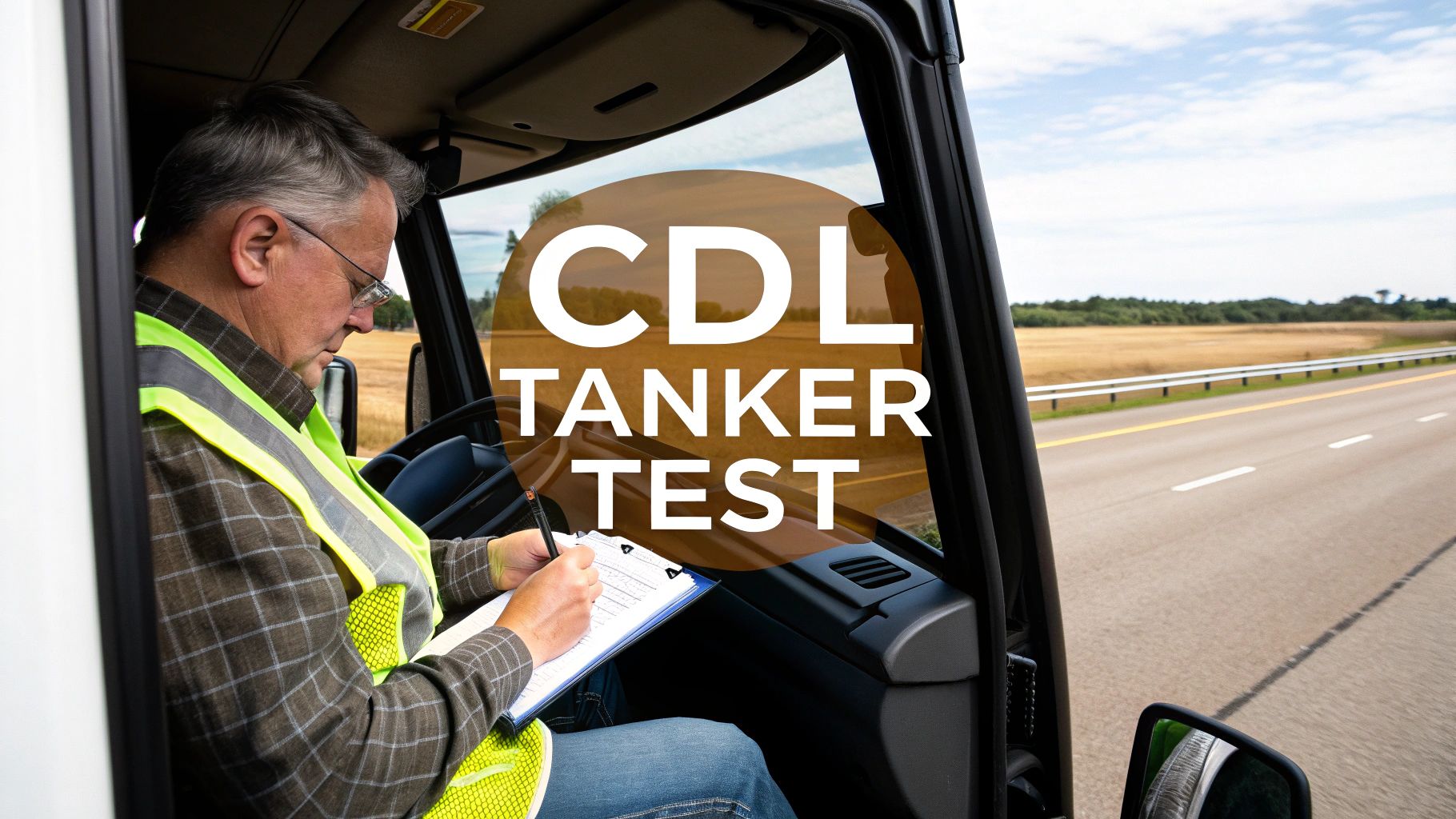
If you're a commercial driver looking to haul large amounts of liquid or gas, you'll need to pass the CDL tanker endorsement test. Getting this "N" endorsement on your CDL is the official green light, proving you have the specialized skills to handle the unique physics of liquid freight safely.
What Is The Tanker Endorsement and Why It Matters
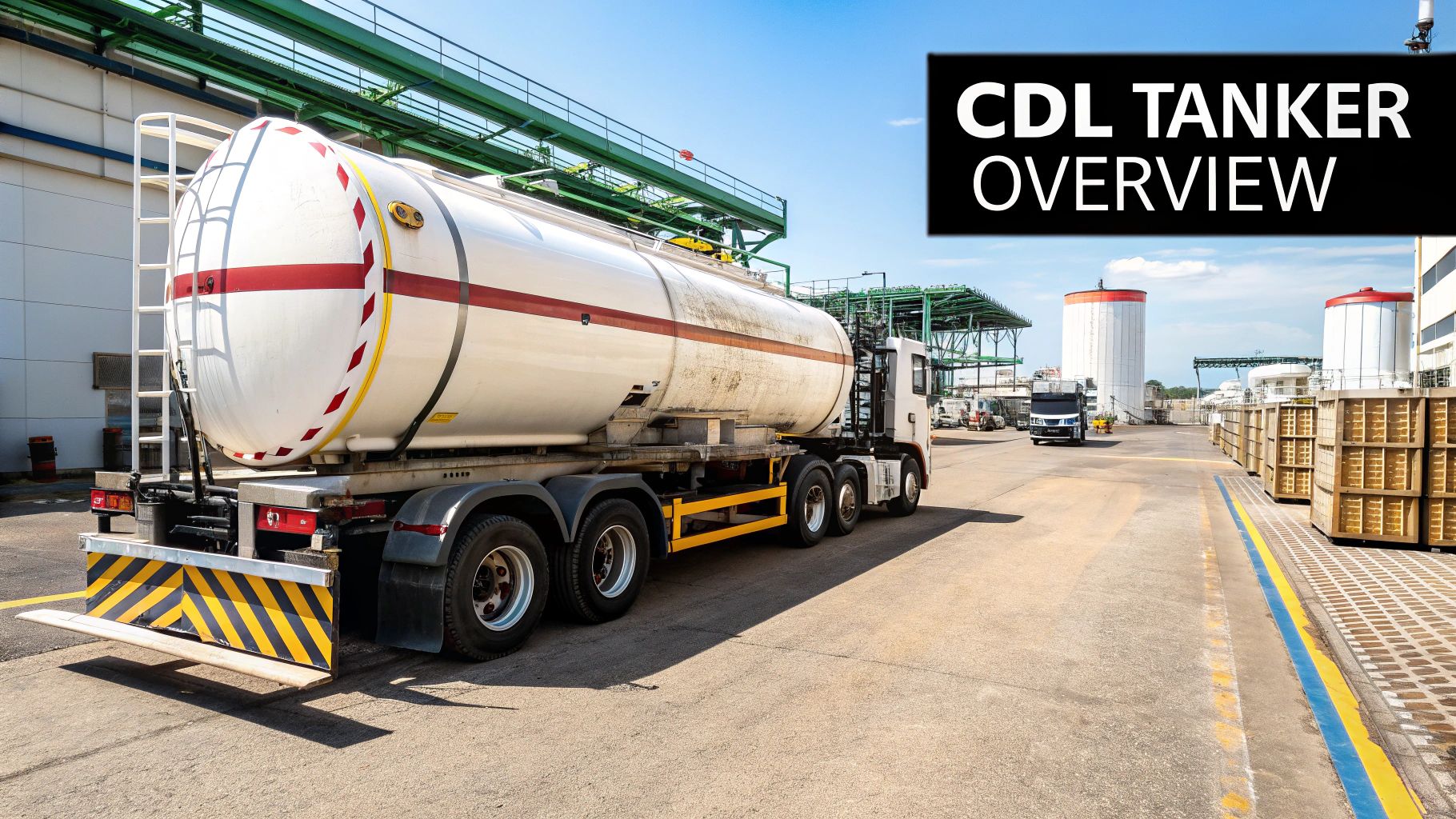
Think of the tanker endorsement as a special certification for a very demanding job. It’s far more than just a stamp on your license; it’s proof that you grasp the complex forces and safety rules that come with managing thousands of gallons of moving liquid. And it’s not just for the classic shiny, cylindrical tanker trucks you see on the highway. This rule applies to any commercial vehicle hauling liquid cargo over certain amounts.
To give you a quick rundown, here's a look at the essentials.
Tanker Endorsement (N) At a Glance
| Aspect | Key Detail |
|---|---|
| Official Name | N Endorsement |
| Why You Need It | Legally required to transport liquids or gasses in large quantities. |
| Governing Body | Federal Motor Carrier Safety Administration (FMCSA) |
| Threshold | Tanks with an individual capacity over 119 gallons and a combined total of 1,000 gallons or more. |
| Vehicle Types | Applies to traditional tankers, flatbeds, and even dry vans carrying portable tanks. |
| Key Skill | Safely managing liquid surge ("slosh") and a high center of gravity. |
This regulation has been around for a while. The Federal Motor Carrier Safety Administration (FMCSA) made the "N" endorsement mandatory back in 2011 to get everyone on the same page with safety. By July 2015, every state was on board, enforcing the rule for anyone hauling that 1,000+ gallon threshold.
The Unpredictable Nature of Liquid Cargo
Driving a truck loaded with solid, secured freight is one thing. The weight stays put. But liquid? It has a mind of its own. Two major dangers make hauling liquid freight a completely different ballgame.
- The "Slosh" Effect: Ever carried a bucket half-full of water and stopped suddenly? The water sloshes forward with surprising force. Now, imagine that force multiplied by 8,000 gallons of milk or fuel inside a tanker. That powerful wave, known in the industry as "slosh" or surge, can literally push your truck into an intersection when you brake or shove it sideways during a turn, often leading to a rollover.
- A High Center of Gravity: Tanker trucks are top-heavy by design. That classic cylindrical shape puts most of the weight high off the ground, raising the vehicle's center of gravity. This makes them much more likely to tip over, especially on sharp curves, highway on-ramps, or if you have to make a sudden evasive maneuver.
Why This Endorsement Is a Safety Must-Have
The whole point of the CDL tanker endorsement test is to make sure you know how to handle these risks. It's designed to confirm you can anticipate the forces of liquid surge and drive a top-heavy rig with the care and precision it demands. This knowledge is non-negotiable, whether you’re hauling something as common as juice or as volatile as fuel.
The 'N' endorsement is all about proactive safety. It trains you to think differently about braking, turning, and accelerating to stop incidents before they ever start, keeping you and everyone else on the road safe.
Ultimately, getting this endorsement is a critical step for breaking into the bulk transport industry. It tells potential employers that you're ready for the immense responsibility of hauling dynamic, and sometimes hazardous, loads. Of course, before you dive in, make sure you meet all the basic https://patriotcdl.com/cdl-requirements/ in your state first.
Meeting the Eligibility Requirements
Before you even crack open a study guide for the tanker endorsement test, you need to make sure you've got the basics covered. Think of it like a pre-trip inspection for your career—getting everything in order now will save you a ton of headaches down the road. The process itself is pretty straightforward, but you have to hit every step just right.
First things first: you must hold a valid Commercial Driver’s License (CDL). You can't add any endorsement without having the right license class for the truck you plan to drive, whether that’s a Class A or Class B. This is the foundation that proves you already know how to handle a big rig.
The Application and Paperwork
With your CDL in hand, your next stop is the DMV (or whatever your state's licensing agency is called). This is where you'll kick off the official application for the "N" endorsement. The exact steps can differ a bit from one state to another, but the paperwork you'll need is pretty standard.
Make sure you walk in with:
- Your current, valid CDL
- Proof of who you are and where you live (a birth certificate or utility bill usually works)
- The completed application form for the tanker endorsement
- Payment for the fees, which will vary depending on your state
It's also a smart move to double-check if your state has any extra medical requirements. Your standard DOT medical card is typically all you need, but it never hurts to confirm. Having all your ducks in a row before you get there makes the whole visit a lot less painful.
N Endorsement vs. X Endorsement
While you're at the DMV, you might see something called the X endorsement. It's really important to know the difference so you can pick the one that matches your career goals.
- N Endorsement: This is your standard tanker endorsement. It gives you the green light to haul non-hazardous bulk liquids or gasses—think things like milk, juice, or industrial water.
- X Endorsement: This one is a two-for-one deal. It combines the tanker (N) and hazardous materials (H) endorsements, clearing you to haul hazardous liquids like gasoline or certain chemicals.
If you know you want to haul fuel or other hazardous liquids, going straight for the X endorsement is the most efficient route. Just be ready for a more intense process that includes a full TSA background check.
To get a tanker endorsement, you have to pass a written knowledge test at your state licensing agency. The whole process usually takes a few weeks. It's not automatic—you need a CDL first, and there’s a fee for the test, but the exact costs and rules change from state to state.
The demand for qualified tanker drivers is always strong, so adding this endorsement is a great way to boost your value. To brush up on the core knowledge you'll need, check out our guide on how to prepare for your CDL permit test. Nailing those fundamentals builds the perfect base for specialized endorsements like this one.
Mastering the Core Exam Topics
To nail the CDL tanker endorsement test, you need to think differently. This isn't about memorizing rules from a book; it's about truly understanding the unique physics of hauling thousands of gallons of liquid. The test is designed to see if you can handle the real-world forces that make tanker driving a specialized skill. Getting a grip on these core concepts is your ticket to passing the test and, more importantly, staying safe on the road.
This exam zooms in on the specific handling and safety protocols for bulk liquids. Unlike a pallet of freight that stays put, liquid moves. It creates powerful, dynamic forces that can catch an unprepared driver completely off guard. The tanker endorsement (N) is one of several CDL specializations, but it's hyper-focused on the challenges of liquid dynamics and preventing rollovers.
The Physics of Liquid Surge
If there's one concept you need to burn into your brain, it's liquid surge. You might hear it called the "slosh effect," and it’s the single biggest factor in tanker driving.
Think about carrying a bucket half-full of water. If you stop suddenly, that water slams forward with a surprising amount of force. Now, imagine that same effect, but with 8,000 gallons of milk or gasoline. That massive wave of liquid can literally push your truck straight into an intersection when you brake. Take a turn too fast, and that same surge will slam to the side, dangerously increasing your risk of rolling over.
The test will absolutely grill you on how to manage this force. You'll need to know:
- Braking: Brake earlier and far more gently than you would with a standard dry van. No sudden moves.
- Accelerating: Smooth and steady is the name of the game. A jerky start sends a powerful wave sloshing backward.
- Turning: Slow down long before you enter a curve. You want that liquid to be as stable and centered as possible.
Understanding Your Vehicle's High Center of Gravity
Tanker trucks are notoriously top-heavy. It’s just their nature. That big, cylindrical tank places most of the weight high off the ground, creating a high center of gravity. This design makes them way less stable than other big rigs and much, much easier to tip over.
Expect questions about the most dangerous scenarios: highway on-ramps, sharp curves, and even just uneven road surfaces. You have to prove you understand the critical relationship between speed, curves, and the ever-present risk of a rollover.
The most dangerous combination a tanker driver faces is liquid surge and a high center of gravity. Driving smoothly isn't just a suggestion—it's what keeps the shiny side up.
This next image breaks down what you'll need to demonstrate to pass the test.
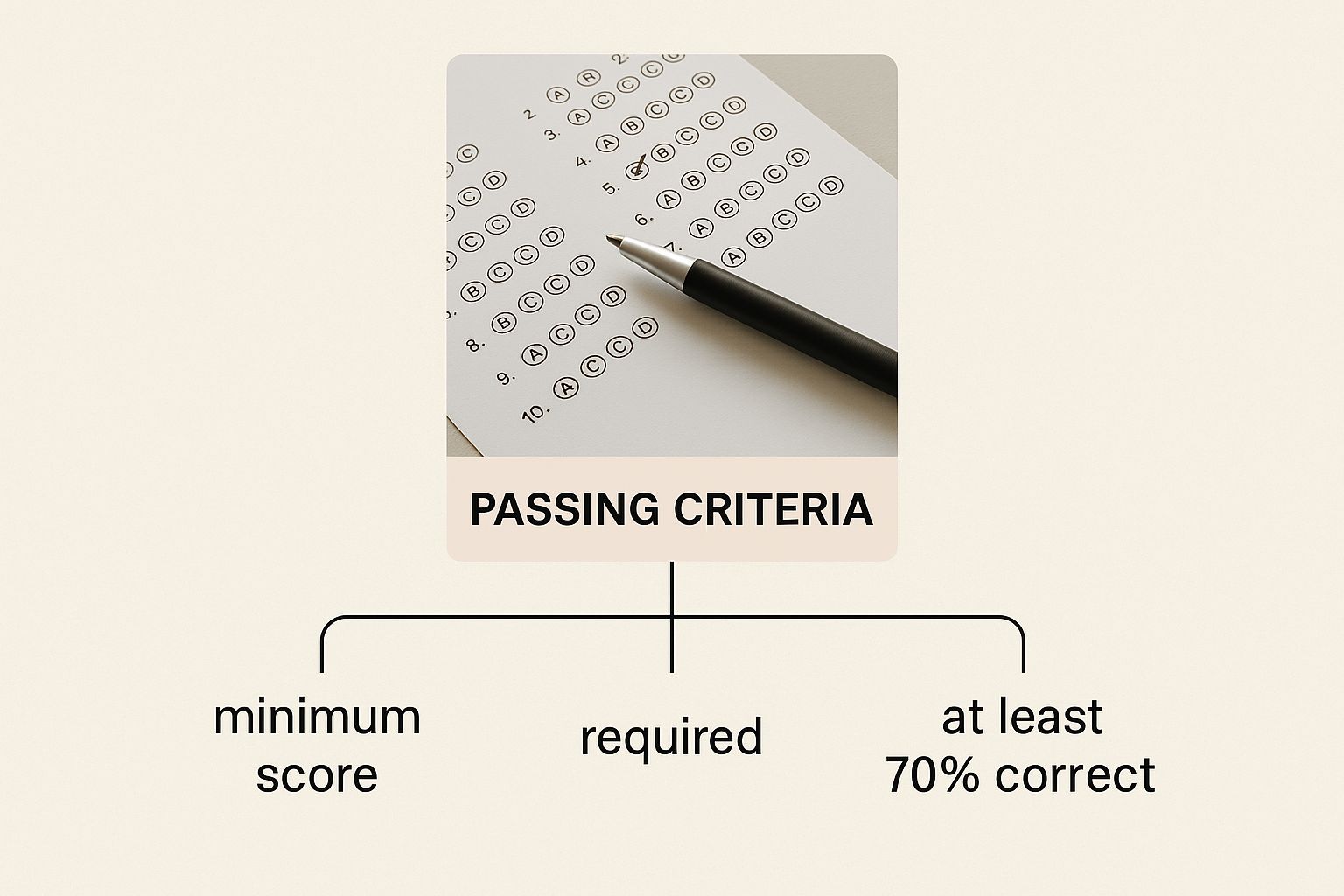
As you can see, the exam is a full-circle evaluation of your ability to handle these unique challenges safely and professionally.
Essential Terminology and Concepts
Beyond the physics, you have to know the lingo and the gear. The exam will test you on specific tanker parts and operational terms. It's not enough to have a vague idea; you need to know exactly what they do and why they're critical for safety.
To give you a head start, here’s a quick breakdown of the most critical topics you'll encounter on the tanker endorsement test. We'll cover what each concept is and, more importantly, why it's a non-negotiable for safe driving.
Key Study Topics for the Tanker Endorsement Test
| Knowledge Area | Core Concept | Why It Matters |
|---|---|---|
| Baffles | Partitions inside a tank with holes in them. They disrupt the front-to-back surge of the liquid. | They help you control the truck during braking and acceleration, but—and this is a key test point—they do nothing to stop side-to-side slosh in a turn. |
| Bulkheads | These are solid walls that divide a tanker into separate, smaller compartments. | A tanker with bulkheads basically acts like you're pulling several small tanks. This greatly reduces the surge effect in any single compartment. |
| Outage | The empty space intentionally left at the top of a tank after loading. | Liquids expand when they get hot. Outage gives the product room to grow without rupturing the tank. The test will cover the dangers of overfilling. |
| Center of Gravity | The high-up point where most of the tanker's weight is concentrated. | A high center of gravity makes the vehicle unstable and prone to rollovers, especially when combined with liquid surge on curves or ramps. |
Knowing these terms cold is a huge step toward passing. While these are specific to the N endorsement, a strong foundation is always a plus. You can brush up on the fundamentals by checking out our guide on the general knowledge test, since many of those core principles still apply.
Loading, Unloading, and Emergency Protocols
Finally, a big chunk of the test has nothing to do with driving. It's about what happens when you're parked. You have to be an expert in the safe procedures for loading and unloading, which includes everything from grounding the truck to prevent static electricity to double-checking that every valve and hatch is secure.
You'll also be tested on what to do when things go wrong. Emergency preparedness is huge. Be ready for questions on:
- Recognizing the early warning signs of a potential rollover.
- The proper steps to take if you have a liquid spill.
- Knowing your emergency equipment inside and out.
Focus on these key areas—surge, stability, equipment, and procedures—and you’ll be well on your way to adding that N endorsement to your CDL.
Your Proven Study Strategy for Success
Knowing what’s on the tanker test is one thing, but knowing how to study is what will actually get you that endorsement. This isn’t about cramming for hours on end. It’s about being smart and methodical, building the kind of real-world knowledge that gives you confidence when you walk into the DMV.
Your absolute best friend in this process is your state's official CDL manual. Seriously, don't waste your time with random third-party sites full of outdated or just plain wrong info. The test questions are pulled directly from that manual, so treat it like your bible.
Break It Down Into Manageable Sessions
Trying to swallow the entire tanker section of the manual in one sitting is a recipe for a headache. The trick is to break it up into smaller, more manageable pieces. Instead of trying to become an expert overnight, give yourself permission to focus on one topic at a time.
A simple schedule can make a world of difference:
- Day 1: Just focus on liquid surge and center of gravity. Nothing else.
- Day 2: Move on to the nuts and bolts of the tanker itself—baffles, bulkheads, and outage.
- Day 3: Cover the practical stuff: loading, unloading, and what to do in an emergency.
- Day 4: Put it all together. Do a full review and then take a practice test.
This approach keeps you from getting overwhelmed and helps the information actually sink in. Think about it—you wouldn't learn how to back a 53-foot trailer in a single afternoon. You'd break it down. Apply that same logic here. The structured approach in a quality CDL training program is a perfect model to follow for your own study plan.
Use Active Learning Techniques
Just reading the manual over and over again is a surefire way to get bored and forget everything. You need to get your brain involved. That means actively doing something with the information, not just letting your eyes glaze over the page.
Here are a few simple but powerful techniques:
- Create Flashcards: Grab some index cards and make flashcards for the key terms like "outage," "baffles," and "bulkheads." Write the word on one side and a simple definition—in your own words—on the other.
- Visualize Scenarios: When you read about a specific situation, like taking a sharp turn or needing to brake hard, close the book for a second. Actually picture it in your mind. Feel the surge. What would the liquid do? How should you react? This mental run-through is priceless.
- Explain It Out Loud: Find a friend, your spouse, or even just your dog, and try to explain a concept like liquid surge. If you can teach it to someone else, you'll know you’ve got it down cold.
The point of studying this way isn't just to pass a test. It's to build a deep, gut-level understanding of tanker physics that will keep you safe out on the road for your entire career.
The Power of Practice Tests
Finally, let’s talk about your secret weapon: practice tests. There is no better way to get ready for the real deal. Taking them does more than just quiz you; it gets you comfortable with the unique way the DMV phrases its questions, which can sometimes be tricky.
After you take one, don’t just glance at the score. Go back and dissect every single question you missed. Figure out why you got it wrong. Did you not understand the concept, or did you just read the question too fast? This is where the real learning happens, turning your mistakes into stepping stones.
When you put it all together—the official manual, active learning, and plenty of practice—you're not just studying harder, you're studying smarter. You’re building a solid foundation of knowledge that will let you walk into that test with the confidence of a seasoned pro.
Avoiding Common Test Day Mistakes
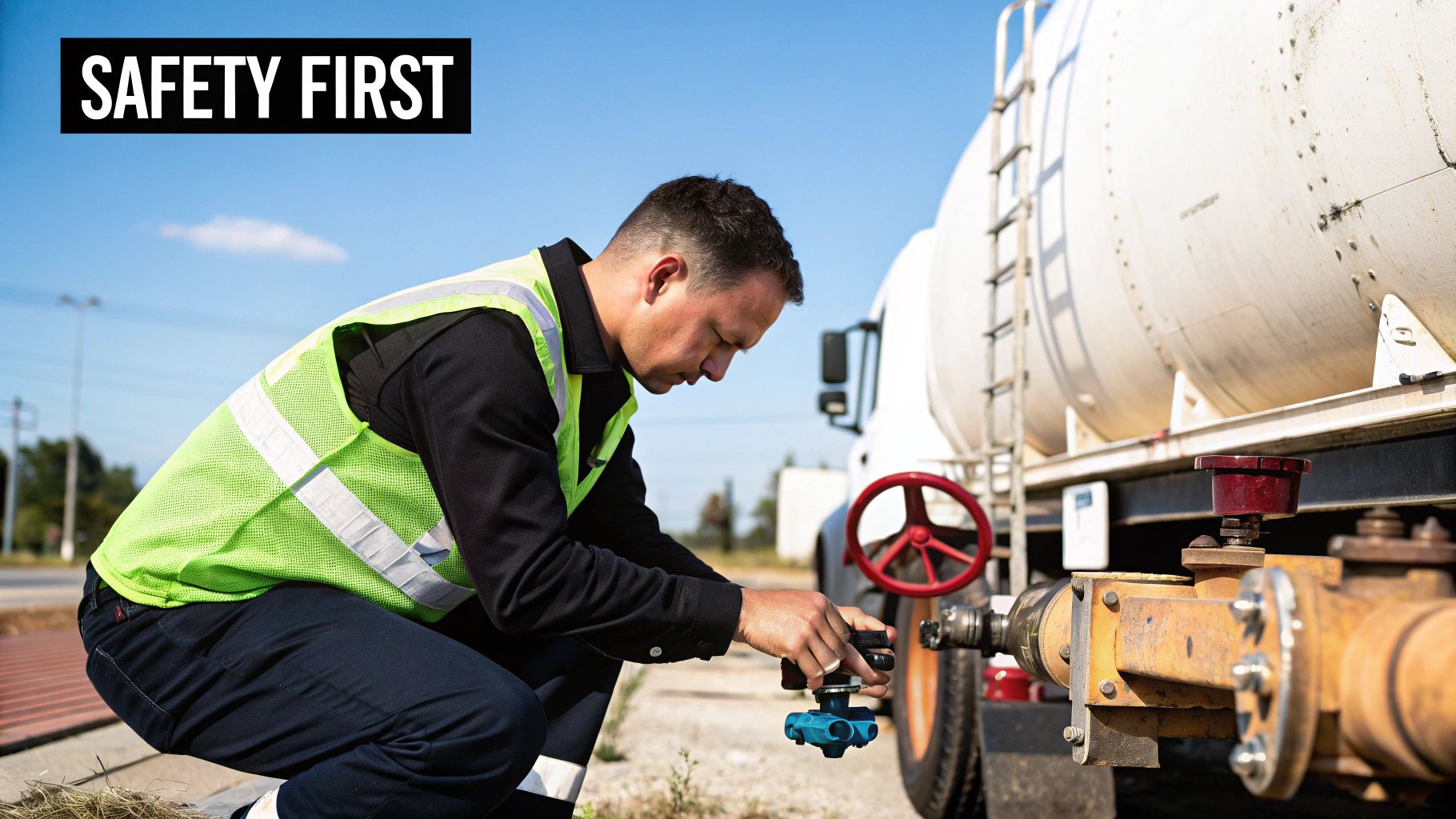
You’ve hit the books and run through the practice tests. Now comes the final boss: avoiding the simple, easy-to-make mistakes that catch even sharp drivers off guard. Passing the tanker endorsement test isn't just about memorizing facts; it's about staying cool under pressure and sidestepping the common traps.
A lot of drivers get tripped up on the core physics, especially the raw power of liquid surge. It's one thing to know it happens, but it's another to truly respect it. Underestimating that force leads to wrong answers about braking distances or how to take a corner. We're talking about the immense momentum of thousands of gallons of sloshing liquid—it's a force you can't afford to get wrong.
Another classic mistake is mixing up baffles and bulkheads. The test loves to throw this one at you. Remember, baffles only slow the front-to-back surge. They do absolutely nothing for the side-to-side slosh that can easily tip you over in a turn. Bulkheads are the real deal; they create separate, smaller tanks that control surge in every direction.
Reading Between the Lines
Let's be honest, the exam questions can be worded to trip you up. They aren't just checking if you've read the manual; they're testing if you can think through a real-world scenario like a pro.
One of the easiest ways to fail is by speed-reading. You fly through a question, miss one little word, and the whole meaning changes. You have to watch out for those absolute words—they're often the key to the right (or wrong) answer.
Keep an eye out for words like:
- Always: Is this statement true 100% of the time, with zero exceptions?
- Never: Is this something that is absolutely forbidden, no matter what?
- Best: This tells you there might be a few "okay" answers, but only one is the top choice.
- Except: This flips the whole question. You're looking for the one that doesn't fit.
When you see one of these, stop. Take a breath. Reread the question to make sure you know exactly what it's asking. That deliberate pace is just as crucial as knowing the material itself.
Overlooking the Details
Beyond the big ideas, it’s the small stuff that can sink your score. Forgetting specific safety rules is a common one. Drivers might blank on the exact steps for grounding a tanker to prevent a static spark or get fuzzy on what "outage" (ullage) is and why it’s so critical for preventing a tank from bursting as the liquid expands.
These aren't just trivia questions; they're life-and-death safety protocols. This focus on detail should carry over into everything you do, including your vehicle checks. Having a solid routine, like the one we cover in our guide to the CDL pre-trip inspection, gets you in the right headspace for the test.
The tanker test rewards precision. It’s not about having a general idea of the rules. It’s about knowing the specific procedure, the correct term, and the exact reason why you do it.
If you go in expecting these traps—from the physics questions to the sneaky wording—you can build a solid defensive strategy. Treat every question like it's trying to trick you, apply what you know with care, and you’ll sidestep those preventable errors standing between you and that N endorsement.
What Happens After You Pass the Test
Congratulations, you passed! Seeing that passing score pop up is an incredible feeling. You've cleared a major hurdle, but there are just a few quick steps left to make it official and start cashing in on your new qualification.
First things first, you'll head back to the DMV counter. Just hand over your passing test results, and the clerk will handle the paperwork to add the "N" endorsement to your CDL. It's a simple but crucial step that legally certifies you to haul bulk liquids.
Getting Your New License in Hand
With the paperwork done, you’ll usually have to pay a small fee to get your license reprinted with the new endorsement. The cost varies by state, but it’s typically pretty minor.
Once paid, you'll walk out with a temporary paper license that’s valid right away. Your new, updated plastic CDL—with that shiny "N" on it—will show up in your mailbox in a week or two, depending on how fast your state's DMV operates.
Think of this new endorsement as more than just a letter on your license. It's a direct investment in your career, signaling to every potential employer that you've mastered the specialized knowledge needed for one of the most respected jobs in trucking.
Opening Up New Career Doors
With your tanker endorsement locked in, a whole new world of driving jobs opens up. You’re no longer just a dry van hauler; you’re a specialist, and that makes you eligible for some of the best-paying gigs in the industry.
The demand for tanker drivers is always high, especially in sectors like:
- Fuel and Petroleum: The lifeblood of the country—hauling gasoline, diesel, and jet fuel.
- Food Grade: Transporting everyday liquids like milk, juice, corn syrup, and vegetable oils.
- Chemicals: Moving industrial chemicals (this often requires the HazMat or H endorsement, too).
- Waste Management: Transporting non-hazardous liquid waste.
These jobs often come with better pay and more consistent, predictable routes than general freight. By passing the CDL tanker endorsement test, you've seriously leveled up your value as a professional driver. You can start applying for those better jobs immediately and get on the road to a more stable and rewarding career.
Answering Your Top Questions
Getting any CDL endorsement brings up a lot of questions. Let's tackle some of the most common ones that drivers have when they're thinking about adding a tanker endorsement to their license.
How Many Questions Are on the Tanker Test?
You'll find that the exact number can change a bit depending on your state, but you can generally expect to see 20 to 30 multiple-choice questions.
Don't let that small number fool you, though. Most states require you to score at least an 80% to pass. That means you can’t just skim the material; you need to know it inside and out.
Is the Tanker Endorsement Test Hard?
This is probably the most common question we hear. "Hard" is relative, but here’s the consensus: it’s very passable with the right preparation. Most drivers agree it's less intense than the HazMat test, but it's not something you can just walk in and ace without studying.
The tricky part isn't memorizing a huge amount of information. It's about really understanding the unique physics of hauling liquids. If you can wrap your head around liquid surge and how a high center of gravity changes everything, you've won half the battle.
Here's a tip that makes all the difference: stop trying to just memorize facts. Instead, picture yourself behind the wheel in the scenarios described in your CDL manual. When you can visualize it, the knowledge really sticks.
Do I Need a Medical Card for the Tanker Endorsement?
Yes, but it's not an extra one. You need a valid DOT medical card to have a CDL in the first place, and that same card covers you for any endorsements you add, including the tanker (N) endorsement. There's no separate medical exam required just for tankers.
How Long Is a Tanker Endorsement Good For?
Great news here—your tanker endorsement doesn't have its own expiration date. It's linked directly to your CDL. As long as your main commercial license is valid, so is your N endorsement. You'll just renew them together.
What’s the Difference Between the N and X Endorsements?
This is a really important one because it can directly affect the jobs you qualify for. It's actually pretty simple:
- N Endorsement (Tanker): This is for hauling non-hazardous liquids or gasses in bulk. Think milk, water, juice, or cooking oil.
- X Endorsement (Tanker/HazMat Combo): This is the one you need for the hazardous stuff. If you want to transport gasoline, propane, or certain chemicals, you need the X endorsement, which combines your tanker and HazMat qualifications.
If hauling fuel is your goal, it makes the most sense to aim for the X endorsement right from the get-go.
Ready to take the first step toward a high-demand trucking career? At Patriot CDL, we provide the expert, hands-on training you need to pass your exams with confidence and get on the road fast. Learn more about our programs.