The first big hurdle on your journey to becoming a professional driver is the CDL General Knowledge test. It’s the foundational written exam that everyone has to pass.
Across the board, you can expect this core test to have 50 questions. To pass, you'll need to answer at least 40 of them correctly, which is a score of 80%. Getting this permit is your green light to start the hands-on, behind-the-wheel training.
Cracking the Code of the CDL Written Test
So, what exactly is on this test? It’s not just about memorizing facts; it’s about proving you have the essential knowledge to handle a large commercial vehicle safely. The questions cover everything from basic vehicle control and safety protocols to federal traffic laws and pre-trip inspections.
Think of it as the rulebook for the road. Passing it shows the DMV that you understand the immense responsibility that comes with operating an 80,000-pound rig.
The Foundation: Your General Knowledge Test
The General Knowledge test is the universal starting point for every aspiring truck driver in the country. This standard has been in place since the federal government established the CDL program back in 1989 to ensure all drivers meet the same minimum safety benchmarks.
While the main test is consistent, the total number of questions you’ll face can change. If you want to haul specific types of cargo, like hazardous materials or liquids in a tanker, you'll need to take additional "endorsement" tests. Each one adds another set of questions to your total.
Passing this first test is non-negotiable. It proves you've grasped the fundamental principles required before you can even think about specialized endorsements or on-road skills training.
Before you even worry about studying, make sure you meet all the prerequisites. You can review the complete list of CDL requirements to ensure you have all your ducks in a row for test day.
CDL General Knowledge Test at a Glance
To make it simple, here’s a quick breakdown of what to expect on the primary written exam.
| Test Component | Number of Questions | Required Passing Score | Correct Answers Needed |
|---|---|---|---|
| General Knowledge | 50 | 80% | 40 |
This table covers the big one—the test everyone takes. Remember, this is just the beginning. Additional endorsements will add more questions and require their own passing scores.
What’s Actually on the General Knowledge Test?
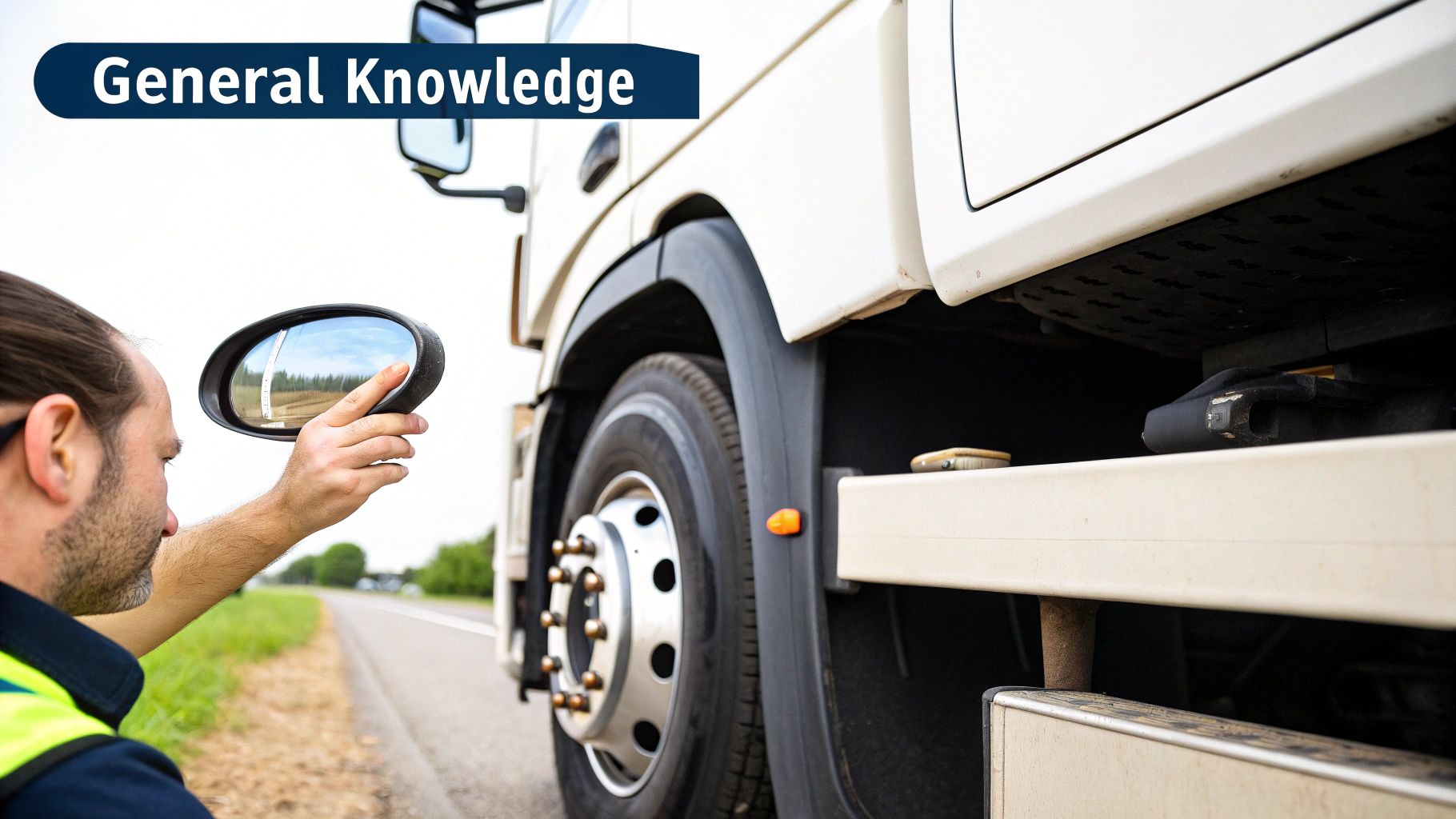
Those 50 questions on the CDL General Knowledge exam aren't just random trivia. They're a carefully crafted assessment designed to ensure you’ve got the foundational knowledge every professional driver needs. Think of it as the "why" behind the rules of the road—it confirms you understand the principles of handling a commercial vehicle safely before you even turn the key.
This isn't just about memorizing traffic laws you learned in driver's ed. The test dives much deeper, exploring the unique responsibilities that come with operating a rig that can weigh up to 80,000 pounds. When you understand the logic behind the questions, you're not just cramming for an exam; you're building the bedrock for a long, safe career.
Core Knowledge Areas You Must Master
The test can feel overwhelming, so it helps to break it down into a few key areas of focus. You’ll definitely need to be sharp on the following topics:
- Vehicle Inspection: This is a big one. You have to know the ins and outs of performing a pre-trip, en-route, and post-trip inspection. It’s all about spotting potential problems before they become dangerous.
- Basic Vehicle Control: This section covers the fundamentals of maneuvering a large truck, from accelerating and steering to stopping and backing up without incident.
- Shifting Gears: Forget what you know about driving a car. The test will ask about proper techniques for transmissions with up to 18 gears, emphasizing how to match engine RPMs to your speed.
- Communicating and Seeing: It's all about awareness. This means using your signals, horn, and lights correctly while also managing your mirrors and maintaining a safe visual lead to spot hazards early.
The General Knowledge test is your first major checkpoint. It’s designed to confirm you have the essential book smarts down cold before you ever get behind the wheel for your skills test.
Federal Rules and Safety Protocols
A huge chunk of the exam is dedicated to the federal regulations that are the law of the land for truckers. You'll be tested on things like hours-of-service rules, what different road signs mean for a commercial vehicle, and the correct procedures for everything from railroad crossings to managing your speed on a steep grade. These aren't suggestions; they're non-negotiable standards for every driver on the road.
The current test structure, with its 50 questions and 80% pass rate, is the result of decades of refinement aimed at making our roads safer. In fact, after testing standards were tightened back in 1989, the industry saw a drop in written test failures because applicants knew they had to take their preparation seriously.
When you master these topics, you're doing more than just studying for a test—you're preparing for the day-to-day realities of being a professional driver. To dig deeper, check out our complete breakdown of the General Knowledge test and see how each section contributes to your final score.
Navigating Endorsement Test Questions
Getting your CDL permit by passing the General Knowledge test is a huge first step. But if you want to drive specific types of rigs—like tankers or double trailers—you'll need to add endorsements to your license.
Think of it this way: your permit is like a high school diploma. It's the essential foundation. Endorsements are the specialized college courses that open doors to specific career paths.
Each endorsement requires you to pass its own written test. These tests are shorter than the General Knowledge exam, but don't let that fool you. They can be deceptively tricky. The 80% passing score requirement is still in effect, and with fewer questions on the test, your room for error gets razor-thin.
Why Fewer Questions Can Be Tougher
Endorsement exams dive deep into highly technical, focused subjects. For example, the Combination Vehicles test, which every Class A driver must pass, usually has about 20 questions. The Air Brakes test is a bit longer, with around 25 questions.
Let's do the math on that Air Brakes test. With 25 questions, you have to get at least 20 right to pass. That leaves you a buffer of only five incorrect answers. Every single question carries a lot more weight, making the pressure feel much higher.
The bottom line is simple: the more specialized the truck, the more specific and detailed the knowledge you need to operate it safely. These tests are designed to make sure you've truly mastered the unique procedures for that rig before you get behind the wheel.
A Look at Common Endorsement Test Requirements
While the exact number of questions can differ from one state to another, the table below gives you a solid idea of what to expect for the most common endorsements. Mastering these is key to building a flexible and successful trucking career.
| Endorsement | Typical Question Count | Passing Score | Correct Answers Needed (Example) |
|---|---|---|---|
| Combination Vehicles (T) | 20 questions | 80% | 16 out of 20 |
| Air Brakes | 25 questions | 80% | 20 out of 25 |
| Tanker (N) | 20 questions | 80% | 16 out of 20 |
| Hazardous Materials (H) | 30 questions | 80% | 24 out of 30 |
As you can see, the margin for error is consistently small. Each test is a focused challenge on a critical skill set.
Breaking Down What to Expect
Here’s a quick rundown of what each of these common tests covers:
Combination Vehicles (T Endorsement): Expect around 20 questions that are all about the physics of articulated vehicles. You’ll be tested on coupling and uncoupling procedures and how to prevent rollovers.
Air Brakes: This one usually has about 25 questions focused entirely on the air brake system. You'll need to know all the components, how to conduct a proper pre-trip inspection, and how to use them correctly on the road.
Tanker (N Endorsement): With about 20 questions, this test zeroes in on the unique challenges of hauling liquids. The big topics are managing liquid surge, understanding the high center of gravity, and special emergency procedures.
Hazardous Materials (H Endorsement): This is typically the longest endorsement exam, with around 30 questions. It covers a lot of ground, including placarding, loading/unloading rules, and federal safety regulations. If you're pursuing a hazardous material endorsement, you'll need to spend extra time studying the dense federal rulebook.
To truly prepare for these intense, focused exams, you need to go beyond just reading the manual. Getting hands-on practice with sample questions is crucial. For instance, you can sharpen your skills for the vital air brakes portion by taking a practice Air Brakes Test. It's that kind of dedicated preparation that makes all the difference on test day.
How State Variations Affect Test Questions
While the Federal Motor Carrier Safety Administration (FMCSA) sets the big-picture rules for the CDL, each state gets to put its own spin on the written tests. It's a bit like a recipe—the main ingredients are the same everywhere, but each chef adds a little something different.
This is why you'll see some slight but important differences from one state line to the next. For example, the Combination Vehicles test might be 20 questions long in Texas, but you could face 25 questions on the exact same topic just one state over. Knowing what your specific state requires is the key to focusing your study time effectively.
Why Your State Manual Is Your Best Friend
The single best way to know exactly what you're up against is to get your hands on your state's official CDL manual. Think of it as the ultimate cheat sheet, written specifically for the test you’ll be taking. Generic online guides can be helpful, but they're no substitute for the real deal from your local DMV.
Here’s a look at the typical breakdown for the core CDL knowledge tests.
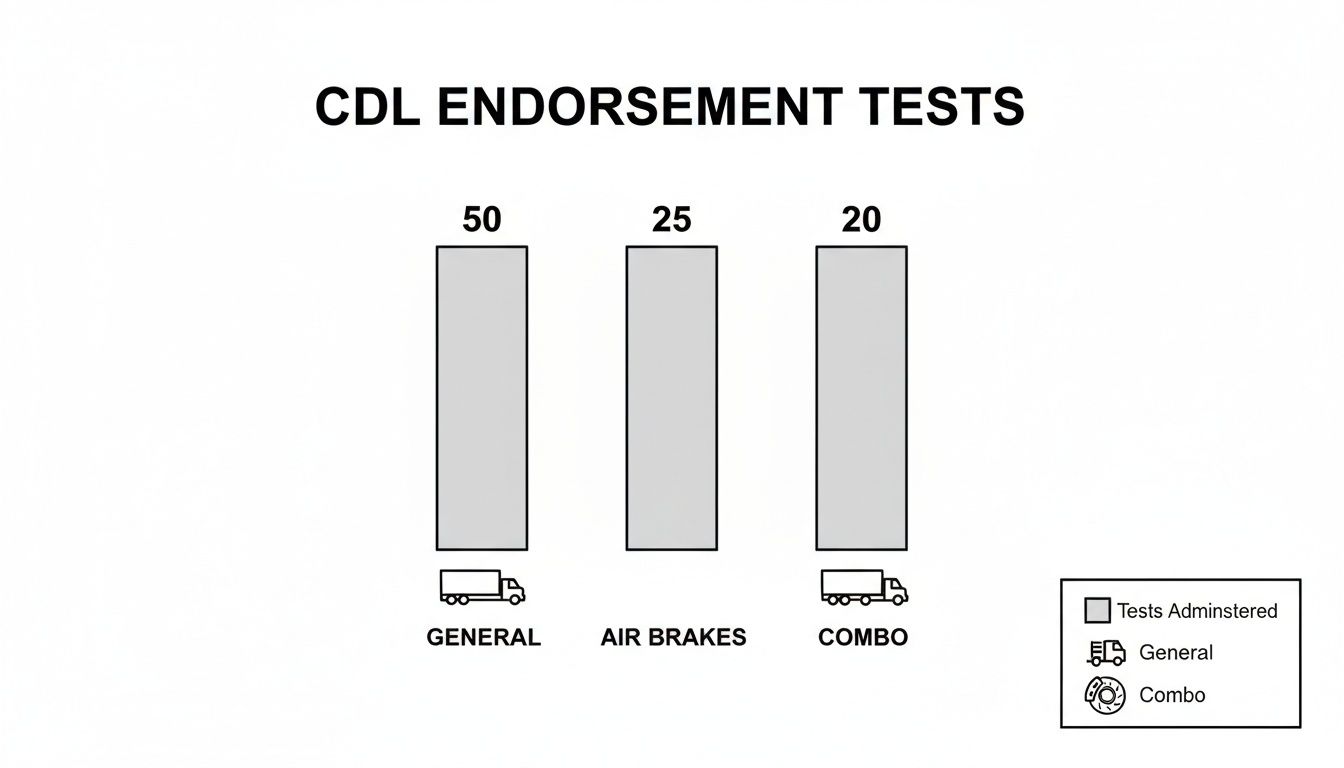
As you can see, the General Knowledge exam is the most comprehensive, while the Air Brakes and Combination Vehicles tests are shorter and more specialized.
A one-size-fits-all study plan can leave you unprepared. A driver in Florida might face slightly different questions than someone in Oregon, even though both are working toward the same federally recognized license.
This is why we always tell our students to dig into their local requirements. For example, anyone looking to drive professionally should check out the specific CDL test details for California, as they won't be identical to what you'd find in Arizona or Nevada. A little homework upfront means no nasty surprises on test day.
A Proven Strategy for Test Day Success

Knowing how many questions you'll face on the CDL test is one thing. Being ready to answer them all correctly is another game entirely. The key to walking out of the testing center with a passing score isn’t just about cramming facts—it’s about having a solid strategy.
True preparation means you don’t just know the rules; you understand why they exist. This is what separates the drivers who barely squeak by from those who walk in with the confidence to ace the exam. It’s about building a real foundation of knowledge.
Beyond Rote Memorization
It's a classic mistake we see all the time: drivers-in-training trying to memorize hundreds of practice questions. That approach is a house of cards. It might feel productive, but under the pressure of the real exam, it can all come crashing down.
A professional, structured training program takes a different path. Instead of just memorizing answers, a winning strategy focuses on:
- Real Understanding: You learn the nuts and bolts of air brake systems, vehicle dynamics, and federal regulations. This way, it doesn't matter how they word the question—you'll know the answer because you get the concept.
- Hands-On Connection: The classroom knowledge gets immediately linked to what you do behind the wheel. This makes the theory stick because you're actually applying it in real-world situations.
- Building Muscle Memory: You practice critical routines, like the pre-trip inspection, over and over until you can do them in your sleep. That kind of automatic recall is a lifesaver on both the written and skills tests.
A great driver doesn't just memorize the manual; they internalize the principles of safety and operation. That deeper level of understanding is what we aim to build.
Mastering the Pre-Trip Inspection
One of the biggest hurdles for many new drivers is the pre-trip inspection. This isn't just a checklist you memorize; it's a vital safety habit. A quality training program will break this monster task into small, logical chunks so you can perform it perfectly every single time.
When you nail the pre-trip, it has a ripple effect. It boosts your score on several parts of the written exam and gives you a massive head start for the hands-on skills test. You can get a feel for a rock-solid routine with this guide to the pre-trip inspection.
There are many proven strategies for your driving test that apply here. A structured approach turns book knowledge into instinct, which is exactly what you need to succeed.
Got Questions About the CDL Test? We’ve Got Answers.
It's completely normal to have a few questions buzzing around your head as you get closer to test day. Even with a solid study plan, a little uncertainty can creep in. Let's clear up some of the most common questions we hear from aspiring drivers.
What Happens If I Fail The CDL Permit Test?
First off, don't panic. Failing the permit test isn't a dead end—it's a bump in the road. Most states will let you retake the test, but you'll usually have to wait a bit, anywhere from one day to a full week. Some states might also cap the number of attempts you get in a certain period.
The best thing you can do is treat it as a learning opportunity. A good training program will help you pinpoint exactly where you struggled. Think of it as a diagnostic tool that shows you which areas need a little more focus before you go back in, fully prepared to ace it.
Are The CDL Test Questions The Same In Every State?
No, not entirely. While the Federal Motor Carrier Safety Administration (FMCSA) sets the standards for what you need to know, each state develops its own specific test questions. The General Knowledge test will always have 50 questions covering the same core topics, but the way those questions are worded can change depending on where you live.
This is exactly why your state’s official CDL manual is your new best friend. It’s the single most important study guide you have because it’s tailored to the exact test you’ll be taking at your local DMV.
While federal rules create a consistent foundation, your state's CDL manual is the ultimate playbook for test day. Stick to it, and you'll be studying the right material.
How Much Time Do I Get For The CDL Written Test?
Time limits can differ, but a good rule of thumb is to expect about one to two hours for the 50-question General Knowledge exam. For the shorter endorsement tests, you'll have less time—usually somewhere between 30 and 60 minutes.
It’s always smart to double-check the exact time limit with your local DMV ahead of time so there are no surprises. Quality training isn’t just about knowing the material; it’s about learning to work through the questions confidently and efficiently, so the clock never becomes an issue.
Ready to stop worrying about the test and start your career with confidence? The expert instructors at Patriot CDL provide the hands-on training and structured curriculum you need to pass your written and skills exams on the first try. Visit us to learn more at https://patriotcdl.com.