Getting your Class A CDL permit is the first real move you'll make toward a professional truck driving career. Think of it as a Commercial Learner's Permit (CLP)—a mandatory credential that lets you legally practice driving a Class A truck, but only with a licensed CDL holder riding shotgun. It's the essential first step before you can get behind the wheel for training and eventually take your final skills test.
Your First Step into a Trucking Career
Every trucking career starts with one critical piece of paper: the Class A CDL permit. This isn't just bureaucratic red tape; it's the key that unlocks the door to hands-on, behind-the-wheel training and, down the road, your full Commercial Driver's License. Nailing this permit proves you've cleared the initial federal and state requirements and passed the first round of knowledge tests.
You can think of the permit phase as the classroom portion of your education. Before you can get on a public road in a massive machine like a tractor-trailer, you have to show you have a solid grasp of its mechanics, safety rules, and the laws of the road. That foundational knowledge is what keeps you—and everyone around you—safe.
Why You Need a Class A License
A Class A license gives you the authority to operate the biggest and heaviest vehicles out there. It's the top of the food chain in the trucking world.
Specifically, it covers:
- Combination Vehicles: Any rig with a Gross Combination Weight Rating (GCWR) of 26,001 pounds or more, as long as the trailer you're towing weighs more than 10,000 pounds.
- Tractor-Trailers: The classic "18-wheelers" that are the lifeblood of the country's supply chain.
- Tanker Trucks: For hauling bulk liquids or gases.
- Flatbed Trucks: Used for moving oversized equipment, lumber, or other large materials.
The best part about a Class A license is its flexibility. It automatically qualifies you to operate most Class B and Class C vehicles, too. That versatility makes you a much more valuable driver in the eyes of any logistics company. The journey to get there is a clear, multi-stage process.
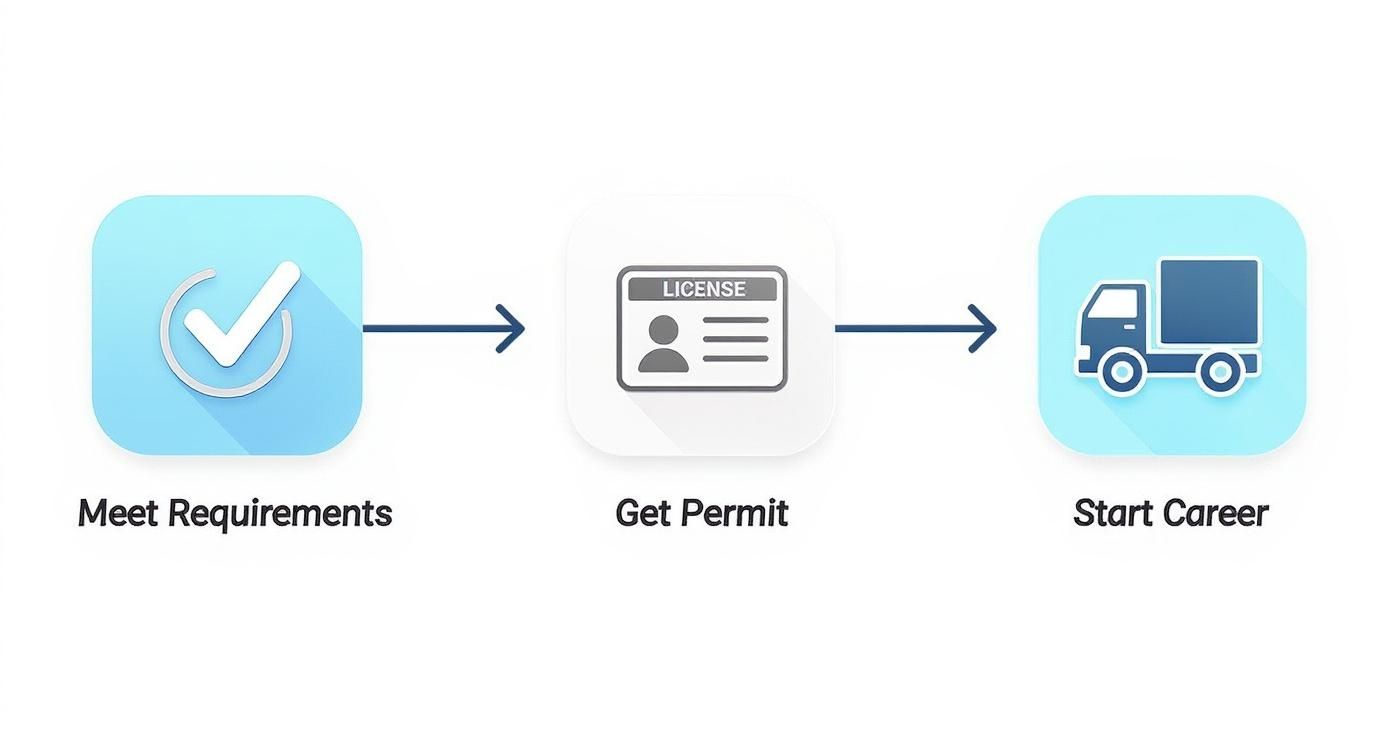
As the visual shows, your career truly begins once you’ve met the prerequisites and have that permit in hand.
Core Eligibility Requirements You Must Meet
Before you even crack open a study guide, you need to make sure you meet the non-negotiable requirements. These are set at both the federal and state levels, so you might see slight differences depending on where you live.
First up is age. The federal minimum age for driving a commercial truck across state lines (interstate) is 21. But things are starting to shift. In response to driver shortages, some states like New York lowered their minimum age to 18 in 2021, which aligns with a federal "safe driver apprenticeship pilot program."
Beyond age, you'll need a valid, standard driver's license from your home state. You'll have to prove you live there with documents like a utility bill or a rental agreement. And finally, your driving record needs to be clean. A history of serious violations like DUIs or reckless driving is a dealbreaker and can get you disqualified right from the start.
Your best asset when applying is a solid, clean driving history. It proves you're responsible and committed to safety—two of the most important traits in this industry.
Getting ready for your CDL journey is about more than just checking boxes. It’s about building a strong foundation for a long, successful career. Understanding the process and what's required from day one will make everything go a lot smoother. It helps to see how these initial steps fit into the bigger picture of a professional training program. You can learn more about a complete Class A CDL training program to get a clear roadmap of what to expect.
Assembling Your Paperwork and Passing the DOT Physical
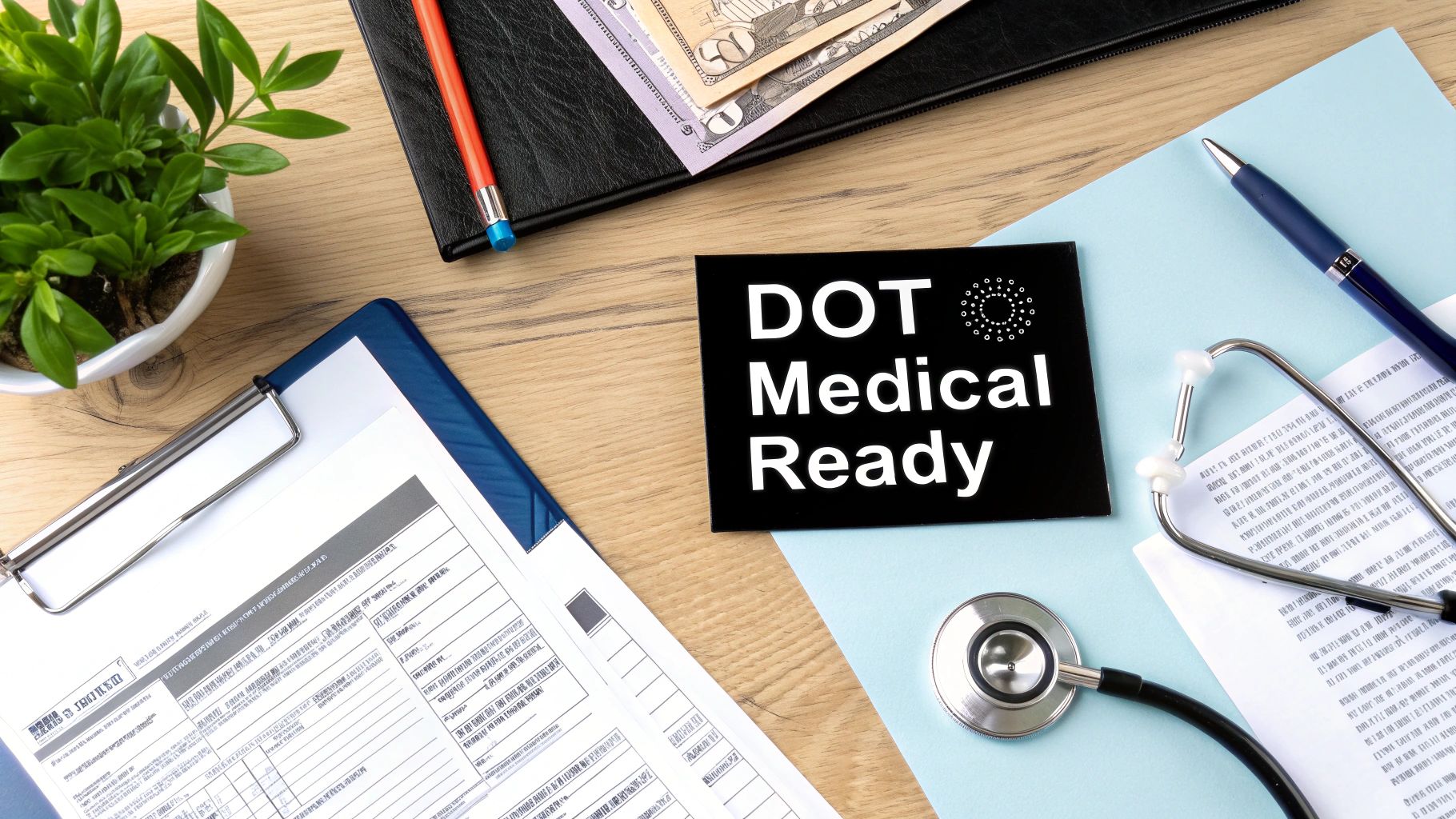
Before you even crack open a study guide for the written tests, there are two hurdles you absolutely must clear: gathering your paperwork and passing a DOT physical. I’ve seen countless aspiring drivers get sent home from the DMV, frustrated and delayed, simply because they overlooked these foundational steps.
Think of it like this: you wouldn't start a long haul without a thorough pre-trip inspection. This is your pre-application inspection. Get it right now, and the rest of the process will go much, much smoother.
Your Document Checklist
Every state DMV has its own quirks, but the core requirements are universal. They need to verify who you are, your Social Security number, and that you actually live in the state. Don't be the person holding up the line because you brought a photocopy when you needed an original.
To save you a headache, here’s a rundown of what you’ll almost certainly need to have in hand.
Required Documents for Your Class A CDL Permit Application
| Document Type | Accepted Examples | Key Tip |
|---|---|---|
| Proof of Identity | Your valid, unexpired U.S. Passport or state driver's license. | Your driver's license is your primary ID. Make sure the address is current before you even walk into the DMV. |
| U.S. Citizenship/Residency | An original U.S. birth certificate, Certificate of Naturalization, or a Permanent Resident Card. | Photocopies are almost never accepted for this. You need the real, certified document. No exceptions. |
| Social Security Verification | Your original Social Security card is best. A W-2 or 1099 with your full name and SSN might work in a pinch. | Don't assume a pay stub will cut it. The actual Social Security card is the gold standard. |
| Proof of State Residency | Two separate documents are usually required. Think utility bills, bank statements, or a signed lease agreement. | The name and address on these documents must match your driver's license exactly. Make sure they are recent (within the last 60 days). |
Walking into the DMV with this folder of documents ready to go is the first sign that you're serious about this career. It makes the clerk's job easier and gets you on your way faster.
Understanding the DOT Physical Exam
Next up is the DOT physical. This isn't your average annual check-up. It's a specific, federally required exam to make sure you're healthy enough to handle the demands of operating an 80,000-pound vehicle safely. It’s essentially a specialized pre-employment medical examination tailored for the trucking industry.
You can't just go to your family doctor, either. The exam must be done by a medical professional who is on the FMCSA National Registry of Certified Medical Examiners. These are the only people authorized to give you the green light.
Here's what they'll be looking at:
- Vision and Hearing: Can you see well enough (with or without glasses) to spot road hazards? Can you hear a "forced whisper" from a set distance? These are simple, non-negotiable tests.
- Blood Pressure: This is a big one. High blood pressure can be a deal-breaker if it’s not under control. If you're on medication, make sure you’re taking it consistently before your appointment.
- Urinalysis: They're checking for sugar and protein, which can indicate underlying issues like diabetes that might affect your ability to drive.
- Overall Health History: The examiner will go over your medical past, asking about any heart, lung, or neurological conditions that could compromise safety on the road.
Once you pass, you'll be issued a Medical Examiner's Certificate (MEC), which everyone just calls a DOT med card. This card is gold. You'll need it for your permit application, and you'll need to keep it current for your entire driving career.
A word of advice: if you have a known condition like sleep apnea, diabetes, or a past heart issue, don't hide it. Get it properly managed by your doctor and bring all your documentation—notes from your specialist, recent test results, a list of medications—to the examiner. Being upfront and prepared can be the difference between getting your card on the spot and getting bogged down in a mess of paperwork and follow-up appointments.
How to Master the CDL Written Knowledge Tests
Alright, you’ve got your paperwork and your DOT medical card. Now it's time for the next big hurdle: the written knowledge tests. Let me be straight with you—these exams are the real gatekeepers to getting your class a cdl permit. You can't just skim the manual the night before and hope for the best.
These tests are designed to make sure you truly grasp the safety principles, vehicle systems, and rules of the road that define a professional driver. Think of it as laying the foundation. Your future behind-the-wheel skills will be built on the knowledge you prove right here. For a Class A permit, that means passing three specific exams.
Breaking Down the Core Class A Tests
To get that permit, you have to prove you know your stuff in three distinct areas. Each test hits a different, critical aspect of handling a big rig.
- General Knowledge: This is the big one. It's the most comprehensive and covers the fundamentals of commercial driving.
- Combination Vehicles: This exam gets specific, zeroing in on the unique challenges of driving a tractor-trailer.
- Air Brakes: You have to prove you understand the complex air brake systems that all Class A trucks rely on.
Miss any one of these, and you'll be making a return trip to the DMV. That’s why a solid study plan isn't just a good idea; it’s absolutely essential if you want to get this done efficiently.
The General Knowledge Test Deep Dive
The General Knowledge test is by far the most extensive of the three. It’s like the final exam for the core concepts of being a safe, professional driver. You’ll see questions on everything from basic vehicle control and shifting to managing your speed and space in traffic. It covers how you communicate with other drivers, handle hazards like distracted drivers, and the real dangers of driving at night or in bad weather.
A huge chunk of this test is dedicated to vehicle inspections. You need to know the pre-trip, en-route, and post-trip inspection processes cold. For a really detailed breakdown of what’s on the exam, check out some guides on the CDL General Knowledge test. It’s a great way to structure your studying. This test confirms you have the base knowledge to start a safe career.
Mastering Combination Vehicles and Air Brakes
The Combination Vehicles test is where you get into the nitty-gritty of Class A rigs. You’ll need to understand concepts like the "crack-the-whip" effect when you make a turn, the exact procedures for coupling and uncoupling a trailer, and how to prevent rollovers—a huge risk with high-center-of-gravity loads. Knowing this material is what keeps you in control of a 53-foot trailer.
Finally, you have the Air Brakes test. This isn't just about memorizing parts; it's about understanding a complex mechanical system. You'll need to know:
- The names and jobs of all the main components, from the air compressor and governor to the storage tanks.
- The full procedure for a proper air brake system check, including testing for leaks and checking the low-pressure warning signals.
- The right way to use your brakes on long downgrades to avoid brake fade and potential failure.
Passing these tests isn't about memorizing answers. It’s about truly understanding the "why" behind the rules. Knowing why an air brake system can lag helps you adjust your following distance, and understanding rollover dynamics makes you a safer driver on curves.
Actionable Study Strategies for Success
Reading your state's CDL manual is non-negotiable, but just reading isn't really studying. You have to get active with it. A great way to start is by taking a practice test before you've even cracked the book. It’ll show you exactly where your weak spots are.
From there, focus your energy on those weaker areas. Make flashcards for things you have to memorize, like tire tread depths or legal axle weights. I’ve seen a lot of people find success by explaining the concepts out loud, as if they were teaching a friend. That simple act forces you to process the information on a much deeper level.
Keep taking practice tests. Get used to how the questions are worded and how to manage your time. This builds confidence and knocks down that test-day anxiety, putting you in the best possible position to earn your class a cdl permit on the very first try.
What to Expect at the DMV on Test Day
Alright, you’ve studied until your eyes are blurry and your documents are in perfect order. Now comes the moment of truth: heading to the DMV for your class a cdl permit test. This can feel like the final exam for a course you've been cramming for, but knowing exactly how the day will unfold can take a lot of that pressure off. It’s a pretty standard process, but a tiny mistake can send you home empty-handed.
Walking in prepared is about more than just having your paperwork straight; it’s about knowing the flow. You’re about to enter a huge and vital industry.
The Initial Application Process
Your first stop will be the application counter. This is where you hand over that folder you so carefully put together—your ID, proof of residency, Social Security card, and your fresh DOT medical card. The clerk is going to scrutinize every piece, making sure it all lines up with state and federal rules.
Once they give you the green light on your paperwork, you’ll fill out the official Commercial Learner's Permit (CLP) application and pay the fees. The cost is different everywhere, but you can usually expect to pay one fee for the application itself and then separate fees for each knowledge test you're taking. Pro-tip: find out what payment methods they accept beforehand. Some DMVs are still cash or check only.
Next up is the vision screening. It’s a quick check to make sure your eyesight, with or without glasses, meets the minimum federal standards for driving a commercial vehicle. It might seem like a small thing, but it’s a hard stop. If you can’t pass it, your day is done right there.
Taking the Computerized Knowledge Tests
This is the main event. You'll be led to a computer station to tackle the written tests. For a Class A permit, you have three hills to climb: General Knowledge, Combination Vehicles, and Air Brakes. You'll take them one by one.
The tests are almost always multiple-choice. You’ll see a question, a few possible answers, and you just have to pick the right one. Most states set the passing bar at 80% for each test. You have to pass all three to walk out with your permit.
The biggest mistake I see people make is rushing. They get in there, the clock is ticking, and they start flying through the questions. Slow down. Read every question twice. The wording can be intentionally tricky to make sure you actually understand the concepts, not just memorize answers.
Don't let the computer throw you off. The systems are usually pretty simple to navigate. Just focus, breathe, and trust the work you put in. And remember, this isn’t just about passing a test. The material you’re learning, especially for the General Knowledge exam, is the foundation for everything that comes next. It ties directly into doing a proper pre-trip inspection, which is one of the most critical skills you'll have to master for your final road test.
What Happens If You Don't Pass?
It happens to the best of us. Maybe the nerves got to you, or a couple of poorly-worded questions threw you for a loop. If you fail one of the tests, don't sweat it. It’s not the end of the line. The good news is you only have to retake the specific test you failed—your passing scores on the others are safe.
Most states will make you wait a bit before you can try again, anywhere from 24 hours to a full week. You will have to pay the test fee again, so be prepared for that. Use that waiting period to your advantage. Crack open that CDL manual and zero in on the sections that gave you trouble. Think of it as a small bump in the road, not a total dead end.
Life with Your New CLP and Finding the Right Training
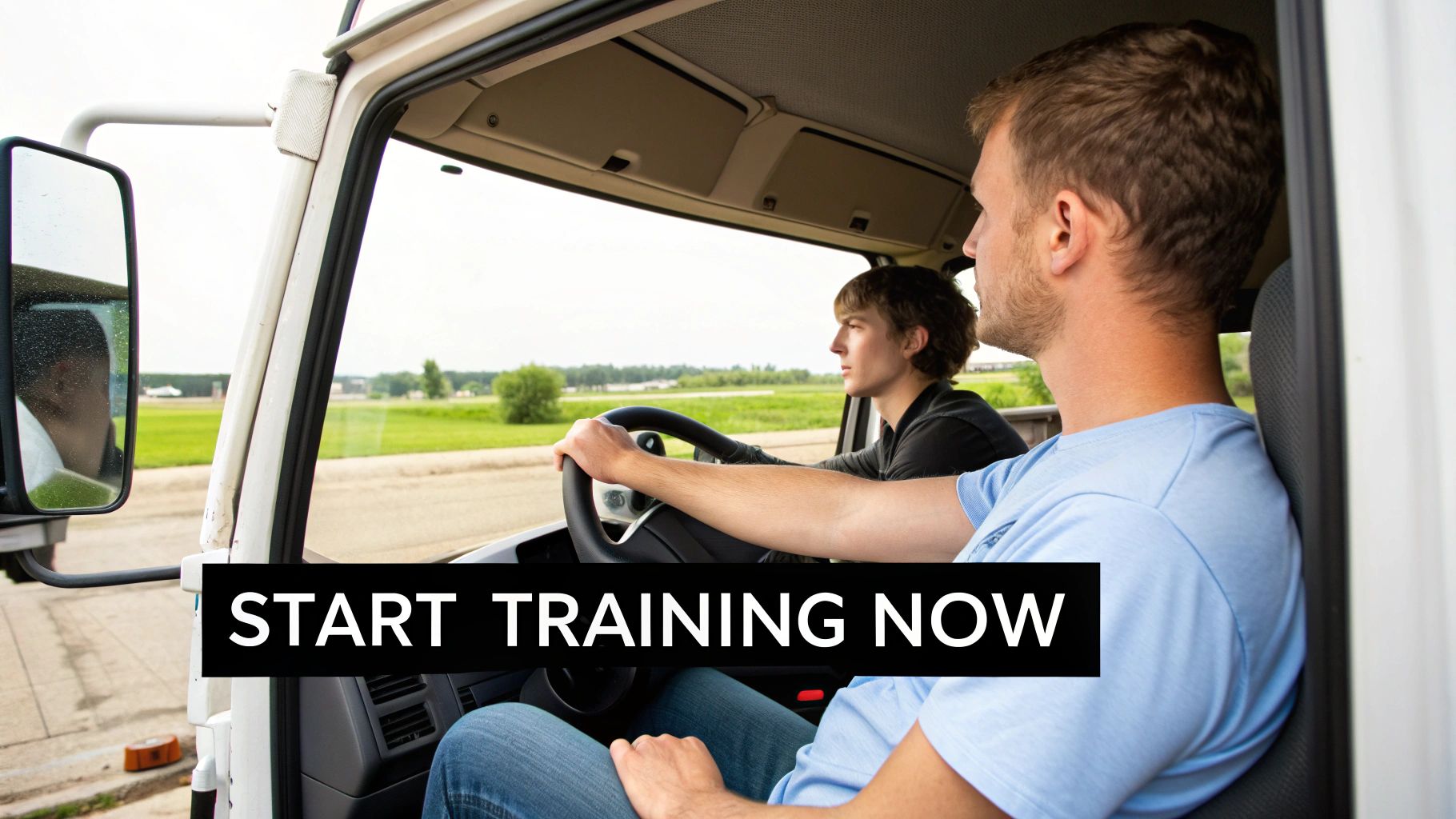
Getting that Class A CDL permit in your hand is a huge win. Seriously, take a moment to celebrate. But don't get too comfortable—this isn't the finish line. It’s the key that unlocks the single most important part of this journey: professional, behind-the-wheel training.
Your new Commercial Learner’s Permit (CLP) comes with some very strict rules. It's not a temporary license to drive solo. Federal law is crystal clear: you can only operate a Class A vehicle when a fully licensed CDL holder is right there in the passenger seat, supervising you.
This isn’t just a friendly suggestion; it's a hard-and-fast legal requirement. Think of that licensed driver as your mandatory co-pilot and mentor, there to guide you through the real-world skills you simply can't get from a manual. This supervised experience is the entire point of the permit.
Navigating the World of CDL Training
With your CLP ready to go, your immediate next move is enrolling in a reputable truck driving school. This step is no longer optional. A few years back, federal regulations changed, and now all new drivers must complete Entry-Level Driver Training (ELDT) from a certified provider before they’re even allowed to take the final CDL skills test.
This was done to make sure every new driver on the road has the same solid foundation of skills and knowledge.
Your choice of training school is one of the most important decisions you will make in your new career. A great school doesn’t just teach you how to pass the test; it teaches you how to be a safe, competent, and confident professional driver from day one.
A certified ELDT program is broken down into two main components:
- Theory Instruction: This is the classroom part. It picks up where your permit studies left off, diving deeper into complex safety protocols, regulations, and vehicle systems.
- Behind-the-Wheel (BTW) Training: This is where the rubber meets the road, literally. It includes time on a closed course or "range" to master skills like backing and parking, plus extensive training on public roads in actual traffic.
What to Look For in a Quality Training Program
Let's be blunt: not all CDL schools are the same. When you're shopping around, you need to know what to look for.
First, your non-negotiable starting point is to confirm the school is listed on the official FMCSA Training Provider Registry. If they aren't on that list, walk away. Period.
Next, get practical. Ask about their instructor-to-student ratio. How much one-on-one time will you actually get? What kind of trucks do they use for training? You want to learn on modern, well-maintained equipment, not something that’s barely holding together.
Finally, dig into the curriculum. A top-tier program will prepare you exhaustively for all three parts of the skills test: the pre-trip inspection, basic control skills, and the on-road driving exam. Some schools even show their commitment by offering specialized training, like an E-Restriction Removal Course for drivers who need to get certified on a manual transmission.
Finding a school that goes the extra mile is a sign that they’re dedicated to building truly skilled drivers. Your permit started the engine, but elite training is what puts your career in drive.
Answering Your Top Questions About the Class A CDL Permit
As you start down the road to getting your class a cdl permit, you’re bound to have some questions. It’s totally normal. Getting straight answers about the timeline, costs, and what you can actually do with the permit helps you map out your journey without hitting any unexpected roadblocks.
Let’s dive into some of the most common questions I hear from new drivers.
How Long Will It Take to Get My Permit?
This is probably the most-asked question, and the honest answer is: it depends. The two biggest variables are your own study discipline and how quickly your local DMV operates. Generally speaking, you should plan for the whole process to take anywhere from two to six weeks.
That window covers everything—rounding up your paperwork, getting the DOT medical exam done, hitting the books (your state’s CDL manual), and then heading to the DMV to knock out those written tests. If you can carve out dedicated study time every day, you’ll likely land on the shorter end of that estimate.
What’s the Real Cost of a Class A Permit?
The permit itself isn't terribly expensive, but there are a few required fees you'll need to cover before you get it in your hand. It's smart to budget for these from the start.
You'll need to plan for:
- Application Fees: States vary, but this is usually between $50 and $150.
- The DOT Physical: This will set you back somewhere in the $80 to $200 range.
- Written Test Fees: Some states charge a fee for each individual test you take.
All in, your total out-of-pocket cost for just the permit will likely be between $200 and $500. Keep in mind, this is just for the permit. The cost for a full CDL training program, which is your next big step, is a separate and much larger investment.
Can I Drive a Truck By Myself with a Permit?
I can't stress this enough: absolutely not. Your Commercial Learner’s Permit (CLP) is a permit to learn, not a temporary license to drive solo.
Federal law is crystal clear on this. When you're behind the wheel with a CLP, you must have a fully licensed CDL holder in the passenger seat next to you. They need to be licensed for the same type of truck you're driving and be ready to take over at a moment's notice.
Getting caught driving alone with only a permit is a serious violation. It leads to immediate disqualification and could kill your professional driving career before it even starts. The permit is your ticket to gain hands-on experience, but only with a qualified pro right beside you.
At Patriot CDL, we guide you through every stage of this process, from permit preparation to advanced on-road training. Learn how our expert instructors and accelerated programs can help you launch your trucking career. Get started with Patriot CDL today.