
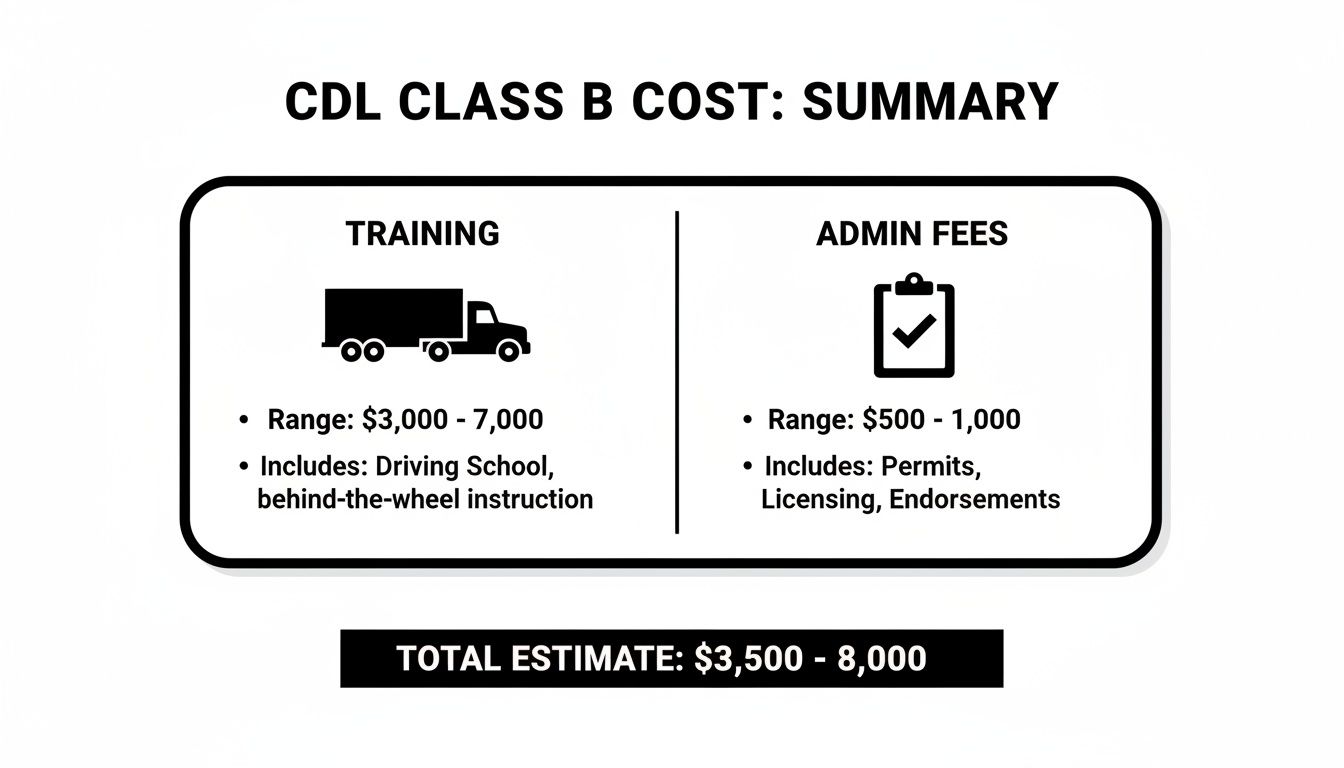
Thinking about a career on the road? The first question most people ask is, "What's this going to cost me?" When it comes to getting your CDL Class B license, you can generally expect the total investment to fall somewhere between $3,000 and $7,000.
Most high-quality, professional training programs land squarely in that range. But it's important to understand this isn't just some arbitrary fee—it's the direct cost of acquiring the real-world skills and official certifications you need to launch your career as a professional driver.
Your Quick Guide To CDL Class B Training Costs
Getting a clear picture of the cost of a CDL Class B license is the first real step on your journey. It helps to think of it less as an expense and more as an investment in a future with stability and high demand. That price tag covers the full spectrum of training, from learning the rules of the road in a classroom to getting crucial hours of practice behind the wheel.
Your initial investment is really a bundle of a few key things that all work together to get you road-ready. These typically include:
- Tuition Fees: This is the biggest piece of the pie. It pays for your instructors' expertise, all the curriculum materials, and the school's administrative support.
- Vehicle and Equipment Usage: You can't learn to drive a straight truck or a bus without one! This covers the cost of fuel, insurance, and maintenance for the professional-grade vehicles you'll be training on.
- ELDT Certification: Any legitimate school has to provide federally required Entry-Level Driver Training (ELDT). This isn't optional—it's a must-have for all new CDL applicants.
Breaking Down The Main Expenses
Here's the bottom line: for a comprehensive, professional training program in the United States, you're looking at a cost between $3,000 to $7,000. That price range covers tuition-based courses that get you everything you need—classroom theory, hands-on driving time, and the federally mandated ELDT compliance certificate from the Federal Motor Carrier Safety Administration (FMCSA).
Programs like the CDL training offered at Patriot CDL are designed to provide exactly this kind of all-in-one training to prepare you for the real world, efficiently.
It's a good rule of thumb to remember that a higher price tag often means you're getting more for your money. Think more hours of one-on-one driving instruction, smaller class sizes, and even direct help with job placement after you graduate.
To get a clearer sense of where your money goes, let’s look at a typical cost breakdown.
Estimated CDL Class B Cost Breakdown
The table below summarizes the key expenses you'll likely encounter on your way to earning a Class B license.
| Expense Category | Typical Cost Range |
|---|---|
| School Tuition & Fees | $3,000 – $7,000 |
| DOT Physical/Drug Test | $100 – $200 |
| Permit Application Fee | $50 – $150 |
| Skills Test Fee | $100 – $300 |
| License Issuance Fee | $75 – $150 |
As you can see, the overwhelming majority of your investment is in the training itself, which is exactly what prepares you for a successful career.
This quick overview should give you a solid foundation for understanding the costs. Now, we can start digging into the details of what influences that price and how you can manage the investment.
What's Actually Included in Your Tuition?
When you first look at the price for a CDL program, it’s natural to ask, "So, where does all that money go?" It's a fair question. The cost of getting your Class B license isn't just one lump sum; it's really divided into two main parts: the time you spend in the classroom and the crucial hours you spend behind the wheel.
Think of it this way: the classroom is where you get the blueprint. You learn the rules of the road, safety regulations, and all the essential theory. But the behind-the-wheel training? That's when you actually start building the house—applying everything you learned in a real-world setting. You absolutely need both to build a successful driving career.
Classroom Learning: Building Your Foundation
Every great driver starts with a solid base of knowledge, and that begins in the classroom. This isn't just about cramming for a test; it's about deeply understanding the principles that keep you and everyone else on the road safe. Part of your tuition goes directly to paying for expert instructors and a curriculum that’s built to make you succeed.
The topics are serious and required by federal law. We’re talking about things like:
- Federal Motor Carrier Safety Regulations (FMCSR): You'll get to know the complex rules that all professional drivers live by.
- Pre-Trip Inspection Procedures: Mastering the detailed, step-by-step process of checking your vehicle to make sure it's 100% safe before you even turn the key.
- Logbook and Hours-of-Service Rules: Learning how to legally track your time to avoid dangerous fatigue.
This foundational knowledge is non-negotiable. Before you can even think about driving, you have to meet all the essential criteria, which you can read more about in our detailed guide on CDL requirements.
Behind-the-Wheel Training: The Real-World Investment
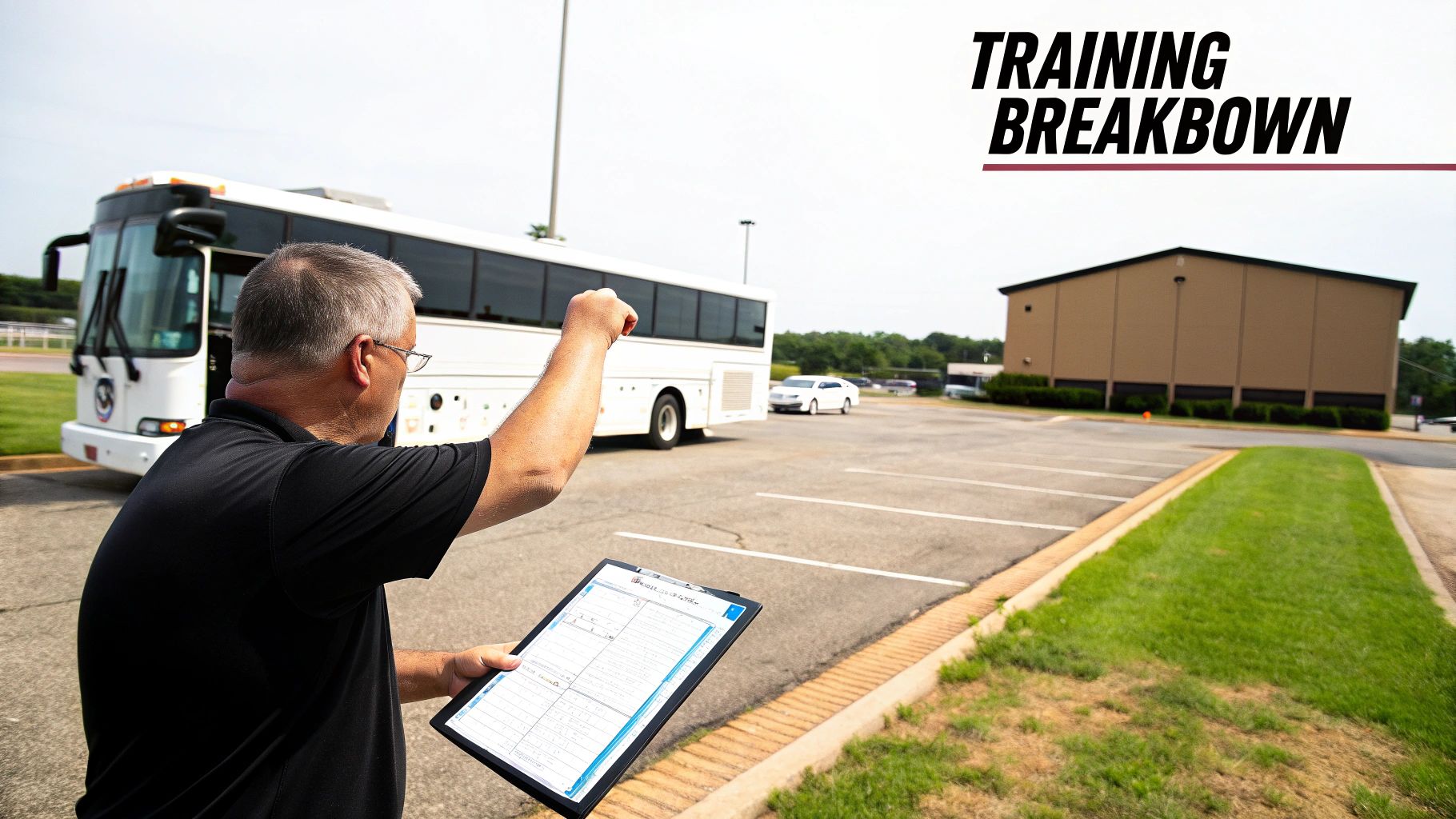
The second—and usually the largest—part of your training cost is the hands-on driving. This is where the rubber meets the road, literally. It’s also the most resource-heavy part of any CDL program, and a big chunk of your tuition is invested right here.
For starters, there are the vehicles themselves. It costs a lot to buy, fuel, maintain, and insure a fleet of straight trucks, dump trucks, or buses. These aren’t small expenses, but they're essential for giving you a safe and reliable environment to learn in.
A low student-to-instructor ratio is one of the biggest signs of a high-quality school. It might mean the program costs a bit more, but that one-on-one time with an experienced instructor is priceless when you’re learning to handle a massive vehicle.
At the end of the day, a higher tuition fee often means you're getting more hours behind the wheel, training in modern equipment, and receiving more personal instruction. This isn't just about getting you past the CDL exam; it’s about making sure you’re a safe, confident, and hirable driver the moment you get your license.
Uncovering the Hidden Fees Beyond Tuition
The tuition you pay for CDL school is the main event, but it's rarely the final number you'll end up paying. Think of it like buying a ticket to a concert—the ticket gets you in the door, but you still have to budget for parking, service charges, and maybe a t-shirt. Getting your CDL Class B is similar; the total investment includes several smaller, yet mandatory, fees that can definitely add up.
These aren't sneaky charges from the school. They’re standard costs required by state and federal agencies to legally get you on the road. Knowing what they are ahead of time is the key to creating a realistic budget and avoiding any last-minute financial surprises.
You can expect these regulatory and administrative fees to add another 15-25% to your total training cost. That often means an extra $500 to $1,000 on top of tuition. These costs are pretty standard across the country, thanks to federal mandates. Key expenses include the DOT physical, which runs about $100-$150, drug screens for $60-$150, and permit applications. For example, a North Carolina Class B permit costs $64 plus a $1.25 FMCSA query fee.
Common Administrative and Testing Costs
So you can get a clearer picture, let's break down the most common fees you'll run into. Each one plays a specific and important role in getting you licensed.
- DOT Physical and Drug Screen: Before you can even get a learner's permit, you have to pass a Department of Transportation physical exam and a drug test. This proves you're medically fit to operate a commercial vehicle safely.
- Commercial Learner’s Permit (CLP) Fee: This is what your state's DMV charges to apply for and issue your CLP, which is what allows you to start practicing behind the wheel with a licensed instructor.
- State Skills Testing Fee: Once you've finished your training, you'll pay a fee to the state or a third-party examiner to take your official road test. This simply covers the cost of administering the exam itself.
- License Issuance Fee: After you pass your skills test—congratulations!—there's one last fee to have the DMV print and issue your official CDL Class B license.
These fees are all part of the process and are tied directly to federal safety standards. That FMCSA query fee, for instance, helps maintain a national database that tracks driver violations to keep our roads safe. It's all part of the Entry-Level Driver Training (ELDT) framework that sets a uniform standard for all new drivers.
The single best way to avoid surprises is to ask for a complete, itemized cost sheet from any school you consider. A transparent school like Patriot CDL will gladly break down every single cost, so you know exactly what you’re paying for—both in tuition and in required fees.
Ultimately, knowing about these extra costs puts you in control. It allows you to plan your finances accurately, compare different schools on an apples-to-apples basis, and start your training with the confidence that comes from seeing the full financial picture.
Comparing CDL Class A and Class B Costs
When you're starting out, one of the first big decisions you'll face is whether to go for a Class A or a Class B license. It's a common fork in the road for new drivers. Both are great tickets to a solid career, but they come with different price tags, time commitments, and ultimately, lead to different kinds of jobs.
Figuring out which path is right for you means looking at your own budget, your career goals, and what you want your day-to-day life to look like.
Why Is Class A Training More Expensive?
It really just boils down to the complexity of the vehicle.
Think of it this way: a Class B truck, like a dump truck or a city bus, is one solid piece of machinery. It’s big, but it’s a single unit. A Class A vehicle, on the other hand, is a combination rig—a tractor pulling a separate trailer. It literally bends in the middle. Learning to control that "bend" when you're backing up, turning corners, or navigating tight spaces is a whole different ballgame.
It simply takes a lot more time behind the wheel with an instructor to master the skills needed to safely handle a big rig.
Training Time and Intensity
The extra skill required for a Class A license translates directly into more training hours. Most Class A programs involve 160 hours or more of intensive instruction, often spread out over four to six weeks. You’ll spend a significant portion of that time learning challenging backing maneuvers and getting a feel for the pivot point between the tractor and trailer.
Class B programs are much more streamlined because they're focused on single-unit vehicles. The training is less complicated, so you can usually wrap it up in about three weeks, requiring roughly 80 hours of instruction. That faster timeline is a huge factor in why the cost of cdl class b is lower. For many students looking at California CDL programs, this quicker path to getting on the road and earning is a major plus.
A Class A license is an investment in versatility, allowing you to drive almost any commercial vehicle. However, a Class B license offers a faster, more affordable entry into the professional driving world, with a strong focus on local jobs that get you home every night.
CDL Class A vs. Class B At a Glance
So, let's put it all side-by-side. This table breaks down the key differences to help you see the whole picture, from the initial cost to the kind of work you can expect.
| Factor | CDL Class B | CDL Class A |
|---|---|---|
| Typical Training Cost | $3,000 – $7,000 | $7,000 – $10,000+ |
| Average Training Time | 2-4 Weeks | 4-8 Weeks |
| Common Job Roles | Dump truck driver, bus driver, local delivery driver | OTR trucker, regional hauler, line haul driver |
| Typical Work Schedule | Local routes, home daily | Long-haul, regional, often away for days/weeks |
| Average Starting Salary | $55,000 – $70,000 | $75,000 – $90,000+ |
When you look at the numbers, the choice becomes a lot clearer.
It really comes down to your priorities. If you want to get into a new career quickly, with a smaller upfront investment, and you like the idea of local routes that have you home for dinner, then the Class B CDL is an absolutely fantastic choice.
How to Fund Your CDL Training
For a lot of folks looking to get behind the wheel, that initial training cost can feel like a pretty big hurdle. But the good news is, you've got options. Thinking through how you'll pay for school is the first real step toward managing the investment and getting your career on the road.
The most straightforward route, of course, is using personal savings. If you’ve managed to put some cash away, you can pay for training without taking on any debt. If you're just getting started on that front, learning how to start saving money without the stress can give you a solid game plan for building up your training fund.
Exploring Company-Sponsored Programs
You've probably seen ads for this. Many of the big trucking companies are hungry for new drivers, so they offer to sponsor your training or reimburse your tuition. This path often means you pay little to nothing upfront because the company foots the bill for your school.
So, what's the catch? There's usually a trade-off. You'll likely need to sign a contract to work for that company for a specific period, often one to two years. It’s a fantastic way to get started with no money out of your own pocket, but just make sure you read the fine print and understand the commitment before you sign on.
Other Powerful Funding Avenues
If you'd rather not be tied to one company right out of the gate, there are plenty of other ways to cover the cost of your Class B training. These options give you the freedom to choose your own employer after you graduate.
- Private School Financing: Most reputable CDL schools, Patriot CDL included, have their own financing plans. This is a popular choice because it breaks your tuition down into much more manageable monthly payments.
- WIOA Grants: The Workforce Innovation and Opportunity Act (WIOA) is a federal program designed to help people get trained for jobs in high-demand fields—and trucking is definitely one of them. It’s worth checking with your local career center to see if you qualify for these grants.
- Veterans' Benefits: If you're a veteran or an eligible family member, don't forget about your GI Bill® benefits. This is a benefit you earned, and it can often cover the entire cost of your CDL education.
Securing funding is often the final hurdle before starting your new career. It’s worth taking the time to explore every option, as the right financial path can set you up for success from day one.
The absolute best way to figure out what works for you is to talk to someone who knows the ropes. An admissions specialist can walk you through the entire process. To get personalized advice and learn more about the financing solutions we offer, you can begin your enrollment process with Patriot CDL today.
Calculating Your Return on Investment
It's easy to look at the cost of CDL Class B training and see it as just another big expense. But that's the wrong way to think about it. This isn't like buying a car that loses value the second you drive it off the lot. Your CDL is a serious investment in your professional future—an asset that starts paying you back almost right away.
Let's break down what that actually looks like in dollars and cents. When you invest in a quality CDL Class B program, the return is pretty powerful. Many of our graduates see a net gain of $16,000 to $26,000 in their very first year, and that's after accounting for the cost of their training. That impressive payback comes from strong median starting salaries, which typically land between $44,000 and $54,320 in major U.S. markets.
A $5,000 training program might feel steep upfront. But think about this: if you land a job making $50,000 a year, you can often earn back that entire investment within your first one to two months on the road, even with living expenses.
That’s what we call a quick break-even point. It’s a clear sign that getting your CDL makes sound financial sense. You’re not just buying a license; you're building a stable, growing income stream that will support you for years.
Looking Beyond the First Year
That initial payback is fantastic, but the real magic happens over the long haul. Your earning potential doesn't just stop after year one. As you rack up experience and add valuable endorsements—like the Passenger (P) or School Bus (S) endorsements—your paycheck grows right along with your skills. A driver with a few years under their belt and specialized training can easily pull in a salary well above the national average.
This career gives you a clear path to financial growth without needing a four-year degree or spending decades trying to climb a corporate ladder. While we're focused on CDL training here, learning to think this way about your money is a skill for life. Weighing an upfront cost against what it will earn you down the road is the secret to making smart financial moves, whether you're behind the wheel of a truck or investing somewhere else.
Answering Your Top Questions About CDL Costs
Let's be honest, figuring out the financial side of getting your CDL can feel like a big hurdle. You’ve probably got a lot of questions floating around. We've heard them all, so we’ve put together some straight-up answers to the most common ones we get from students just like you.
Our goal is to give you a clear picture of the investment so you can plan your next career move with confidence.
How Long Does Class B Training Take?
This is one of the best parts about going for a Class B. While a Class A license can tie you up in training for over a month, most full-time Class B programs are much quicker. You can typically expect to be done in just two to four weeks.
That shorter timeline doesn't just mean a lower total cost of cdl class b training; it means you’re out on the road earning a professional paycheck that much faster.
Are There Any Free CDL Training Programs?
You’ll see ads for "free" CDL training, but it’s one of those things that usually comes with a catch. These programs are almost always paid for by a specific trucking company, and in return, you have to sign a contract to work for them. We're talking a commitment of one to two years, minimum.
It's a path that can work if you have absolutely no cash upfront, but it locks you in. You lose the freedom to choose your first job or negotiate your starting pay.
Always weigh the benefit of no upfront cost against the commitment of a long-term contract. Sometimes, investing in your own training provides greater career flexibility and higher earning potential right from the start.
Do I Have to Pay for Training All at Once?
Not at all. Any good school knows that tuition is a major expense. That’s why we offer flexible payment solutions here at Patriot CDL. We have financing options that let you break down the cost into smaller, manageable monthly payments. Your career goals shouldn't have to wait just because you don't have the full amount sitting in your bank account.
Which Endorsements Should I Get?
Think of endorsements as keys that unlock more job opportunities. Getting the right ones makes you a much more valuable driver. For a Class B license, these are the ones that really open doors:
- Passenger (P) Endorsement: This is a must-have if you want to drive city buses, tour buses, or airport shuttles.
- School Bus (S) Endorsement: A specialized version of the P endorsement, this one opens up tons of stable, in-demand jobs with local school districts.
- Tanker (N) Endorsement: This allows you to haul liquids, putting you in the running for jobs like local fuel or water delivery.
Stacking these onto your license makes your resume stand out and gives you a much wider net to cast when you're looking for work.
Ready to invest in a career with real stability and great earning potential? The team at Patriot CDL is here to walk you through everything, from figuring out the costs to picking the perfect program. Explore your options and start your journey today.