The logistics industry is the engine of the global economy, and the demand for skilled professionals has never been higher. With roles spanning from the driver's seat to the corner office, the earning potential is vast and often underestimated. Navigating this complex field to find the most lucrative opportunities, however, requires a clear roadmap. This guide is designed to be that map, cutting through the noise to detail the 10 highest paying logistics jobs available today.
We will provide a comprehensive breakdown of each role, moving beyond simple job titles to deliver actionable insights. For each position, you will find:
- Realistic Salary Expectations: What you can actually expect to earn at different stages of your career.
- Essential Duties: A clear picture of the day-to-day responsibilities.
- Qualifications & Career Paths: The specific skills, certifications, and steps needed to secure the job and advance.
This article is for anyone serious about building a high-income career in logistics, from aspiring drivers to experienced managers seeking their next move. As you map out your career path, it's crucial to stay informed about current market demands and available positions. To see what companies are hiring for right now, you can explore current job opportunities and align your goals with real-world openings. We've structured this roundup to be a practical tool, helping you identify not just a job, but a strategic career path toward significant financial success in a stable, essential industry.
1. Owner-Operator / Independent Truck Driver
The role of an Owner-Operator, or independent truck driver, represents one of the most entrepreneurial and potentially one of the highest paying logistics jobs available. Unlike company drivers, owner-operators own their commercial vehicle and operate as an independent business. They are responsible for every aspect of their operation, from sourcing loads and managing client relationships to handling fuel, maintenance, insurance, and compliance. This path combines the hands-on skill of professional driving with the strategic demands of business ownership, offering unparalleled autonomy and earning potential.
Earning Potential and Career Path
While the responsibility is high, so is the financial ceiling. Gross revenue for successful owner-operators can far exceed that of company drivers, though net income depends on diligent business management.
- Expedited Hauling: Operators in this urgent, time-sensitive niche can earn between $120,000 and $200,000 annually.
- Specialized Loads: Those with endorsements for hazmat or permits for oversized loads often command premium rates, with typical earnings ranging from $100,000 to $180,000.
- Dedicated Lanes: Securing long-term contracts with specific shippers for consistent routes can yield a stable income of $80,000 to $150,000.
The typical career path involves gaining 2-3 years of experience as a company driver to build skills, industry knowledge, and capital before transitioning to ownership.
Steps to Become an Owner-Operator
Transitioning from a driver to a business owner requires a strategic approach. This is not just a job change; it's a career and lifestyle transformation that demands careful planning and execution.
Key Insight: The most successful owner-operators think like CEOs, not just drivers. They master cost-per-mile calculations, build strong relationships with freight brokers, and reinvest in their business wisely.
To start, obtain your Commercial Driver’s License (CDL) Class A. Programs like those offered at Patriot CDL School provide the foundational training needed to enter the industry. Once you have a few years of driving experience, create a detailed business plan. This should include a budget for purchasing a truck, insurance, permits, and an emergency fund covering at least three to six months of operational expenses. Initially, consider leasing onto a major carrier to lower your startup costs and gain experience before purchasing your own truck and authority.
2. Logistics & Supply Chain Manager
The role of a Logistics and Supply Chain Manager is the strategic core of any product-based business, making it one of the most consistently high paying logistics jobs. These professionals oversee the entire lifecycle of a product, from sourcing raw materials and managing inventory to coordinating transportation and ensuring timely delivery to the end customer. They are the architects of efficiency, responsible for optimizing complex networks, reducing operational costs, and managing relationships with vendors and carriers. This position blends analytical prowess with leadership, requiring a deep understanding of demand forecasting, warehouse operations, and global trade.

Earning Potential and Career Path
With great responsibility comes significant financial reward. A manager's salary is often tied to the scale and complexity of the supply chain they manage, with immense potential for growth into executive leadership.
- Senior Supply Chain Manager: Professionals at major retailers can expect to earn between $95,000 and $130,000.
- Logistics Operations Manager: At e-commerce giants, these roles typically command salaries from $85,000 to $110,000.
- Supply Chain Vice President: Top-level executive positions can see earnings in the $120,000 to $150,000+ range.
The career path often starts with an entry-level position like a warehouse associate or logistics coordinator, progressing to a supervisory role before advancing into management. A bachelor's degree in business, logistics, or supply chain management is typically required.
Steps to Become a Logistics & Supply Chain Manager
Advancing into a management role is a deliberate process focused on building a combination of practical experience, technical skills, and formal education. It involves a strategic climb up the corporate ladder, backed by continuous learning and professional development.
Key Insight: Elite supply chain managers are data-driven storytellers. They don’t just report metrics; they use data from warehouse management systems (WMS) and transportation management systems (TMS) to build a compelling case for process improvements that directly impact the bottom line.
To begin, pursue a relevant bachelor's degree and seek entry-level roles to gain hands-on experience. As you progress, focus on earning key industry certifications like the APICS Certified Supply Chain Professional (CSCP) or Certified in Production and Inventory Management (CPIM) to validate your expertise. Develop proficiency in essential enterprise systems and master analytical skills in forecasting and financial modeling. For senior leadership roles, an MBA with a concentration in supply chain management can be a powerful accelerator.
3. Specialized Haul Driver (Tanker, Flatbed, Heavy Equipment)
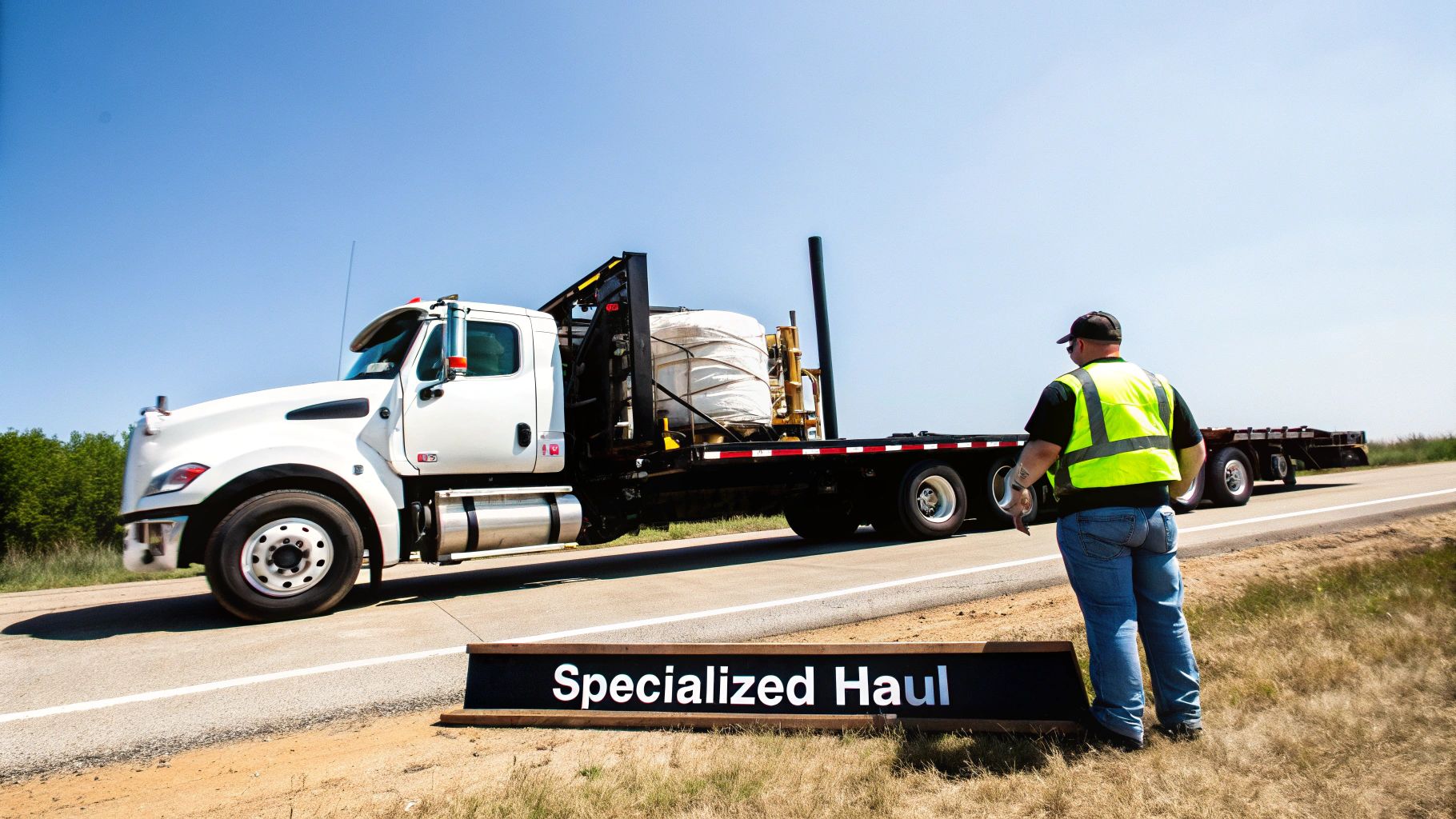
The role of a Specialized Haul Driver goes beyond standard freight transport, involving cargo that requires specific equipment, handling procedures, and advanced driver certifications. These drivers are responsible for safely moving liquids in tankers, securing oversized machinery on flatbeds, or transporting hazardous materials. This niche represents one of the highest paying logistics jobs for company drivers because the increased risk, specialized skill set, and high-value cargo command premium compensation from employers.
Earning Potential and Career Path
Drivers with endorsements for specialized freight see a significant increase in their earning potential. The compensation reflects the advanced training and heightened responsibility required for these demanding loads.
- Hazmat Tanker Drivers: Transporting hazardous materials like chemicals or fuel is a top-tier role, with earnings often between $75,000 and $95,000 annually.
- Oversized/Heavy Haul Operators: Moving large items like wind turbines or construction equipment requires meticulous planning and skill, paying from $75,000 to $90,000.
- Flatbed Specialists: While more common, experienced flatbed drivers transporting specialized equipment can earn $70,000 to $85,000, with pay increasing based on load complexity.
The career path begins as a standard dry van or reefer driver. After 1-2 years of proven, safe driving experience, individuals can pursue specific endorsements and transition into these more lucrative roles within their company or with a specialized carrier.
Steps to Become a Specialized Haul Driver
Becoming a specialized driver is a strategic career move built upon a solid foundation of professional driving. It requires a commitment to continuous learning and maintaining an impeccable safety record.
Key Insight: Endorsements are the fastest way for a company driver to increase their income. Each certification you add to your CDL, such as tanker (N) or hazmat (H), unlocks a new, higher-paying tier of freight opportunities.
First, you must earn your Commercial Driver's License (CDL) Class A. A quality program like the one at Patriot CDL School provides the necessary training to pass the exam and enter the industry. Once you have your CDL, immediately pursue valuable endorsements like the X endorsement (a combination of tanker and hazmat). Maintain a spotless driving record, as any serious incidents can disqualify you from hauling sensitive cargo. Target companies with dedicated specialized fleets and document all your training to build a powerful resume that highlights your elite qualifications.
4. Dispatch Manager / Transportation Manager
The Dispatch Manager or Transportation Manager is the operational nerve center of a trucking company, making this one of the most critical and highest paying logistics jobs. These professionals are responsible for the intricate daily puzzle of coordinating vehicle routes, assigning drivers to loads, and ensuring that every shipment moves efficiently and on schedule. They act as the primary communication link between drivers, customers, and management, handling real-time problem-solving, monitoring compliance, and optimizing the fleet’s performance to meet service level agreements.
Earning Potential and Career Path
The strategic importance of this role is reflected in its strong earning potential, which grows with experience and the scale of the operation managed. Effective dispatching directly impacts a company's profitability.
- Entry-Level Dispatch Coordinator: Individuals starting in this support role can expect to earn between $45,000 and $60,000.
- Experienced Dispatch Manager: With several years of experience and proven fleet management skills, salaries typically range from $65,000 to $90,000.
- Senior Transportation Manager: At large national carriers or complex operations, senior managers can earn upwards of $95,000 to $120,000+.
The career path often begins on the ground floor. Many successful managers start as drivers or warehouse associates before moving into a dispatch coordinator role and eventually being promoted to manager.
Steps to Become a Dispatch Manager
Becoming an effective Dispatch Manager requires a blend of operational knowledge, technical skill, and strong interpersonal abilities. The role is less about driving and more about orchestrating the entire fleet's movements.
Key Insight: Great dispatchers don't just assign loads; they build relationships. Their ability to communicate clearly and respectfully with drivers is the single biggest factor in retaining top talent and ensuring operational excellence.
To enter this field, gaining hands-on experience is invaluable. Starting as a truck driver provides a deep understanding of the challenges drivers face, from hours-of-service regulations to on-the-road delays. This perspective is crucial for effective management. Aspiring managers should master dispatch software platforms and focus on developing exceptional communication and problem-solving skills. Pursuing a certificate or degree in logistics or business management can also accelerate career advancement.
5. Owner-Operator / Independent Truck Driver
The role of an Owner-Operator, or independent truck driver, represents one of the most entrepreneurial and potentially one of the highest paying logistics jobs available. Unlike company drivers, owner-operators own their commercial vehicle and operate as an independent business. They are responsible for every aspect of their operation, from sourcing loads and managing client relationships to handling fuel, maintenance, insurance, and compliance. This path combines the hands-on skill of professional driving with the strategic demands of business ownership, offering unparalleled autonomy and earning potential.
Earning Potential and Career Path
While the responsibility is high, so is the financial ceiling. Gross revenue for successful owner-operators can far exceed that of company drivers, though net income depends on diligent business management and controlling costs.
- Expedited Hauling: Operators in this urgent, time-sensitive niche can earn between $120,000 and $200,000 annually.
- Specialized Loads: Those with endorsements for hazmat or permits for oversized loads often command premium rates, with typical earnings ranging from $100,000 to $180,000.
- Dedicated Lanes: Securing long-term contracts with specific shippers for consistent routes can yield a stable income of $80,000 to $150,000.
The typical career path involves gaining 2-3 years of experience as a company driver to build skills, industry knowledge, and capital before transitioning to ownership.
Steps to Become an Owner-Operator
Transitioning from a driver to a business owner requires a strategic approach. This is not just a job change; it is a career and lifestyle transformation that demands careful planning and execution.
Key Insight: The most successful owner-operators think like CEOs, not just drivers. They master cost-per-mile calculations, build strong relationships with freight brokers, and reinvest in their business wisely.
To start, obtain your Commercial Driver’s License (CDL) Class A. Programs like those offered at Patriot CDL School provide the foundational training needed to enter the industry. Once you have a few years of driving experience, create a detailed business plan. This should include a budget for purchasing a truck, insurance, permits, and an emergency fund covering at least three to six months of operational expenses. Initially, consider leasing onto a major carrier to lower your startup costs and gain experience before purchasing your own truck and authority.
6. Warehouse Manager / Distribution Center Manager
The Warehouse or Distribution Center Manager is the operational cornerstone of the supply chain, responsible for overseeing the entire lifecycle of inventory within a facility. This role involves managing the efficient receipt, storage, order fulfillment, and shipment of goods. These professionals are tasked with optimizing space, managing staff, ensuring inventory accuracy, implementing safety protocols, and meeting critical performance metrics. It's a leadership position that blends on-the-floor operational command with strategic planning, making it one of the most vital and highest paying logistics jobs.

Earning Potential and Career Path
Leadership in warehouse operations is rewarded with strong compensation, which increases with the size and complexity of the facility.
- Large-Scale Retail Distribution: Managers at major hubs for large companies can earn between $75,000 and $115,000 annually, plus bonuses.
- Third-Party Logistics (3PL): Managing operations for a 3PL provider often commands a salary range of $70,000 to $105,000.
- Parcel and Freight Hubs: Operations managers at facilities for major carriers typically earn from $70,000 to $100,000.
The career path usually starts with an entry-level position like a warehouse associate, progressing to a team lead or supervisor, and then advancing into management after demonstrating strong leadership and operational expertise over 5-7 years.
Steps to Become a Warehouse Manager
Becoming a successful warehouse manager requires a combination of hands-on experience and specialized knowledge. This career path is built from the ground up, demanding a deep understanding of every facet of warehouse operations.
Key Insight: Elite warehouse managers are data-driven leaders. They don't just manage people; they master Warehouse Management Systems (WMS), analyze throughput data to eliminate bottlenecks, and implement lean methodologies to drive continuous improvement.
Start by gaining floor-level experience as a warehouse associate or dock worker to understand the core processes. Pursue certifications in forklift operation and workplace safety, such as an OSHA 30 card. As you advance to a supervisor role, focus on developing proficiency with WMS software and seek out opportunities to lead projects related to inventory control or process optimization. Obtaining a certification like the APICS Certified in Logistics, Transportation and Distribution (CLTD) can significantly accelerate your path to a management role.
7. Freight Broker / Transport Broker
A Freight Broker, also known as a Transport Broker, operates as a critical intermediary in the logistics ecosystem. They connect shippers who have goods to move with carriers who have the capacity to haul them. This role is a dynamic blend of sales, negotiation, and logistics coordination, requiring brokers to manage relationships, secure competitive rates, and ensure seamless transportation from origin to destination. They don't own trucks themselves; instead, their value lies in their network, industry knowledge, and ability to create efficient and cost-effective shipping solutions, making it one of the highest paying logistics jobs for those with strong sales acumen.
Earning Potential and Career Path
A freight broker's income is often directly tied to performance, with many roles being commission-based. This structure offers a high ceiling for earnings, driven by the volume and profitability of the loads managed.
- Entry-Level/Trainee Broker: Typically salaried, with earnings from $45,000 to $65,000 while learning the industry at a large brokerage.
- Experienced Broker (Commission-Based): After establishing a book of business, brokers can earn $75,000 to $150,000+ annually, with top performers exceeding $200,000.
- Independent Broker/Agency Owner: Successful independent brokers who specialize in niches like hazmat or oversized loads can see their net income surpass $100,000 to $250,000.
The career path often starts with a trainee or sales coordinator position at an established brokerage. After 2-3 years of building a client base and industry expertise, many transition to independent brokerage.
Steps to Become a Freight Broker
Becoming a successful freight broker is about building a powerful network and mastering the art of negotiation. It’s a career that rewards persistence, communication, and meticulous organization.
Key Insight: Top-earning brokers are masters of relationship management. They don’t just find a truck for a load; they build long-term, trusted partnerships with a core group of both shippers and carriers, becoming an indispensable part of their clients' supply chains.
To begin, seek an entry-level position at a large brokerage to gain invaluable training and access to a wide network. Focus on developing a deep understanding of market rates, lane profitability, and carrier operations. For those aiming for independence, the next steps include creating a business plan, obtaining a freight broker license from the FMCSA, and securing a surety bond. Building a solid reputation and leveraging technology like load boards are crucial for sourcing opportunities and scaling your business.
8. Safety Manager / Compliance Officer (Logistics)
The role of a Safety Manager or Compliance Officer is a critical, non-driving position that forms the backbone of a secure and legally sound logistics operation. These professionals are responsible for ensuring that a company's transportation and warehousing activities adhere to all federal regulations, including those from the Department of Transportation (DOT) and the Occupational Safety and Health Administration (OSHA). They develop and implement safety protocols, manage driver training programs, conduct audits, and handle all regulatory reporting to minimize risk, prevent accidents, and avoid costly penalties. This career is ideal for detail-oriented individuals with a passion for process and a commitment to protecting people and assets.
Earning Potential and Career Path
As regulatory scrutiny increases, the demand for skilled safety professionals has grown, making this one of the highest paying logistics jobs focused on governance and risk. Compensation reflects the immense responsibility of keeping a fleet compliant and a workforce safe.
- Corporate Safety Manager: At large carriers, managers overseeing national safety programs can earn between $90,000 and $130,000.
- Compliance Specialist: Professionals focused specifically on DOT and FMCSA regulations typically earn from $75,000 to $115,000.
- Regional Safety Supervisor: Roles with regional oversight often command salaries in the $70,000 to $105,000 range.
The career path often begins with operational experience, such as a few years as a professional driver or warehouse lead, to understand the real-world challenges. This is followed by a move into a safety coordinator role before advancing to manager or director positions.
Steps to Become a Safety Manager
Transitioning into a safety and compliance role requires a combination of hands-on industry knowledge and specialized credentials. It’s a shift from executing logistics tasks to overseeing the framework that governs them, demanding a strategic and analytical mindset.
Key Insight: Elite safety managers are not just rule enforcers; they are culture builders. They excel at communicating the "why" behind regulations, fostering a proactive safety-first mindset across the entire organization, from the loading dock to the executive suite.
To start, gain foundational experience in the logistics industry. While not always required, having a CDL and driving experience provides invaluable credibility and insight. Concurrently, pursue key certifications like the OSHA 30-hour training and specialized DOT compliance courses. A deep understanding of the Federal Motor Carrier Safety Regulations (FMCSRs) is non-negotiable. For senior roles, earning the Certified Safety Professional (CSP) credential is a significant differentiator that opens doors to top-tier earning potential.
9. Logistics Software Specialist / Implementation Consultant
As the logistics industry becomes increasingly data-driven, the role of a Logistics Software Specialist or Implementation Consultant has emerged as a critical and high-paying career. These professionals are the bridge between complex logistics operations and the technology that powers them. They implement, customize, and maintain essential systems like Transportation Management Systems (TMS) and Warehouse Management Systems (WMS), ensuring technology translates into real-world efficiency, visibility, and cost savings. This role combines deep operational knowledge with technical expertise, making it one of the most in-demand and highest paying logistics jobs for tech-savvy individuals.
Earning Potential and Career Path
Technical expertise in logistics commands a premium salary, with significant growth potential as specialists gain experience with major software platforms and complex integrations.
- Entry-Level/Associate Consultant: Individuals implementing systems for smaller operations can expect to earn between $75,000 and $100,000.
- Mid-Level Specialist (TMS/WMS): Professionals with experience in major platforms typically earn $90,000 to $140,000.
- Senior Consultant/Architect: Top-tier experts leading large-scale enterprise projects can command salaries from $130,000 to $220,000+.
The career path often starts in a hands-on logistics role (like a dispatcher or warehouse associate) to build domain knowledge before moving into a junior IT or support role.
Steps to Become a Logistics Software Specialist
Entering this field requires a blend of operational understanding and technical skill. It’s a career built on translating business needs into software solutions, demanding a strategic and detail-oriented approach.
Key Insight: The most valuable specialists don’t just know the software; they deeply understand the warehouse floor or transportation network they are optimizing. This operational context allows them to configure systems for maximum impact.
First, gain foundational experience in a core logistics area like warehousing or transportation. This provides the practical knowledge necessary to understand system requirements. Concurrently, build technical skills by learning SQL for data analysis, studying major platforms, and pursuing relevant IT certifications like CompTIA A+ or project management credentials (PMP). Combining an APICS certification (like CPIM or CLTD) with your tech skills creates a powerful and highly sought-after professional profile.
10. Regional Truck Driver / Dedicated Route Driver
The Regional or Dedicated Route Driver role offers a compelling middle ground in the trucking industry, blending strong earning potential with a more predictable and balanced lifestyle. Unlike over-the-road (OTR) drivers who may be away for weeks, regional drivers operate within a specific geographic territory, such as the Midwest or Southeast, allowing for weekly or even daily home time. Dedicated drivers take this a step further, servicing a single customer's consistent routes, like shuttling goods between a distribution center and retail stores. This specialization makes it one of the most desirable and highest paying logistics jobs for those seeking stability.
Earning Potential and Career Path
While OTR roles may have a slightly higher top-end salary, regional and dedicated positions offer competitive pay with the significant benefit of a consistent schedule. Earnings are influenced by the carrier, route, and any specialized endorsements.
- Grocery/Retail Dedicated Routes: Drivers for major distributors or retail chains often earn between $70,000 and $90,000 annually due to the consistent, high-demand nature of the freight.
- Major Carrier Regional Fleets: Working for companies on regional routes typically yields an income of $65,000 to $85,000.
- Specialized Regional Hauling: Drivers with hazmat or tanker endorsements on regional routes can command premium pay, often in the $75,000 to $95,000 range.
The career path usually starts with gaining 1-2 years of OTR experience to build a solid driving record and skills before transitioning into these more sought-after regional or dedicated roles.
Steps to Become a Regional/Dedicated Driver
Securing a regional or dedicated driving position requires a strategic approach focused on building a reputation for reliability and safety. The predictable nature of these roles makes them highly competitive.
Key Insight: The best dedicated drivers become indispensable partners to the customer they serve. They master the specific needs of the route, build relationships at pickup and delivery locations, and demonstrate unwavering reliability, making them a valuable asset beyond just driving.
The first step is earning your CDL Class A. An accelerated program, like the training offered at Patriot CDL School, can get you qualified in just a few weeks. After obtaining your license, aim for an initial OTR position to accumulate at least one year of incident-free driving experience. Use this time to get endorsements like hazmat or tanker to broaden your opportunities. Actively monitor job boards for dedicated fleet openings with major carriers or apply directly to companies known for strong regional divisions.
Top 10 Highest-Paying Logistics Jobs Comparison
| Role | 🔄 Implementation Complexity | 💡 Resource Requirements | 📊 Expected Outcomes | ⭐ Ideal Use Cases | ⚡ Key Advantages |
|---|---|---|---|---|---|
| Long-Haul Truck Driver (OTR) | Moderate — CDL A training, ELD compliance, long routes | CDL Class A, DOT medical, long periods away from home | High earnings ($55k–$85k+); steady demand; variable home time | Independent drivers seeking high pay and mobility across states | High earning potential, flexible scheduling, carrier benefits |
| Logistics & Supply Chain Manager | High — requires strategic planning, cross-functional leadership | 3–10+ yrs experience, bachelor’s/MBA helpful, WMS/TMS tools | Substantial compensation ($70k–$140k+); measurable cost & service improvements | Organizations needing network design, inventory optimization, forecasting | Strategic cost savings, leadership impact, career growth |
| Specialized Haul Driver (Tanker/Flatbed/Heavy) | High — extra endorsements, complex load securement | CDL A + X/H/L endorsements, 2–4 weeks additional training, higher insurance | Premium pay ($65k–$95k+); high responsibility and niche demand | Hazardous, oversized, or high-value cargo requiring certified handlers | Higher pay for specialized skills; competitive advantage in niche lanes |
| Dispatch Manager / Transportation Manager | Moderate — real-time coordination, software mastery | 2–5 yrs operations experience, dispatch/TMS platforms, communication skills | Mid-to-high pay ($60k–$100k+); improved routing and utilization | Daily fleet operations needing dynamic routing and driver management | Optimizes utilization and customer service; office-based role |
| Owner-Operator / Independent Truck Driver | Very high — business ownership, financial & admin burden | Significant capital ($50k–$150k+), CDL, insurance, permits, cash reserves | Highly variable/unlimited earnings ($80k–$200k+); high risk & reward | Entrepreneurs wanting full control, equity in equipment, scaling fleets | Complete independence, tax deductibility, potential for high ROI |
| Warehouse Manager / Distribution Center Manager | High — facility operations, staffing, safety oversight | 5–8 yrs warehouse experience, WMS knowledge, staff management | Strong pay ($65k–$120k+); measurable throughput and accuracy gains | Large fulfillment centers, 3PLs, high-volume distribution sites | Direct operational impact, leadership path, tangible KPIs |
| Freight Broker / Transport Broker | Moderate — sales-focused with regulatory steps | Broker license, surety bond ($10k–$25k), carrier & shipper network | Commission-driven earnings ($65k–$150k+); income variability | Matching shippers and carriers, niche lanes, brokerage entrepreneurship | High upside for top performers; flexible/remote sales-based work |
| Safety Manager / Compliance Officer (Logistics) | High — regulatory oversight, audits, training programs | OSHA/FMCSA knowledge, certifications (OSHA 30, CSP), operational background | Premium pay ($70k–$130k+); reduced incidents & regulatory penalties | Companies with fleets/sites requiring strong DOT/OSHA compliance | Lowers risk, enforces safety culture, protects from fines/liability |
| Logistics Software Specialist / Implementation Consultant | High — technical integrations plus domain expertise | TMS/WMS platforms, SQL/IT skills, change management, possible travel | Strong pay ($75k–$140k+); improved automation, reporting, BI | TMS/WMS deployments, system integrations, process automation projects | Drives efficiency, analytics, and scalable system improvements |
| Regional Truck Driver / Dedicated Route Driver | Low–Moderate — CDL A plus preferred experience for some roles | CDL Class A, 1–2 yrs OTR preferred, predictable schedules | Solid earnings ($60k–$85k+); better home time and routine | Drivers prioritizing work-life balance with steady customer lanes | Predictable schedule, improved home time, lower fatigue than OTR |
Taking the Wheel of Your High-Paying Logistics Career
As we've explored, the logistics sector is a sprawling landscape of opportunity, offering a diverse array of high-paying career paths that cater to a wide range of skills, ambitions, and work styles. This is not a one-size-fits-all industry. The journey from warehouse floor to Distribution Center Manager is just as viable and rewarding as the path from a newly licensed driver to a successful Owner-Operator managing a fleet of one. The key takeaway is that strategic planning and skill acquisition are the universal currency for advancement.
The roles we've detailed, from Freight Broker to Safety Manager, all share a common thread: they are critical cogs in the intricate machine that keeps global commerce moving. Whether you are orchestrating the movement of goods from behind a desk or physically transporting them across state lines, you are contributing to a vital economic engine. This exploration of the highest paying logistics jobs reveals that financial success is directly tied to the level of responsibility, specialization, and expertise you bring to your role.
Charting Your Course: Key Takeaways for Success
To turn this information into a tangible career plan, it’s crucial to distill the core principles that separate high-earners from the average. Reflect on these points as you map out your next steps:
- Specialization is Your Superpower: Generalists have a place, but specialists command higher salaries. A standard truck driver earns a good living; a specialized haul driver with tanker, hazmat, and oversized load endorsements enters a different earning bracket entirely. The same principle applies to management and software roles. Becoming the go-to expert in a specific niche, like cold chain logistics or logistics software implementation, makes you an invaluable asset.
- Experience is the Ultimate Accelerator: In logistics, time in the trenches is often more valuable than a degree. An experienced Dispatch Manager who has navigated countless supply chain disruptions is more valuable than a recent graduate with a pristine academic record. Your goal should be to accumulate practical, real-world experience that demonstrates your problem-solving capabilities and resilience.
- Technology is Not the Future, It's the Present: Proficiency with Transportation Management Systems (TMS), Warehouse Management Systems (WMS), and route optimization software is no longer optional. For aspiring managers, specialists, and even brokers, a deep understanding of the technological tools that drive efficiency is mandatory. For drivers, mastering electronic logging devices (ELDs) and communication apps is just the beginning.
- The CDL Class A is Your Golden Ticket: For nearly half of the roles on our list, a Commercial Driver's License isn't just a piece of paper; it's the foundational key that unlocks the door. It is the most direct and fastest entry point into a high-demand, well-compensated career. This license is the bedrock upon which you can build a future as a Specialized Hauler, an Owner-Operator, or even transition into a management role with unmatched operational credibility.
Key Insight: Your career in logistics is not a single destination but a series of interconnected routes. The skills you gain as a driver directly inform your effectiveness as a future dispatcher, safety manager, or even a freight broker. Every mile driven and every problem solved builds the expertise that fuels your ascent.
Ultimately, securing one of the highest paying logistics jobs is about proactive career management. It requires identifying the path that aligns with your personal strengths, whether that's the independence of the open road or the strategic challenge of managing a complex distribution network. Once you've chosen your destination, the next step is to acquire the non-negotiable qualifications. For those drawn to the stability, freedom, and significant earning potential of a professional driving career, that first step is clear, achievable, and more valuable than ever.
Ready to shift your career into high gear? The path to many of the highest paying logistics jobs begins with a CDL Class A, and Patriot CDL provides the accelerated, hands-on training you need to get on the road in just a few weeks. Start your journey with Patriot CDL today and take the first, most important step toward a lucrative and stable future.